


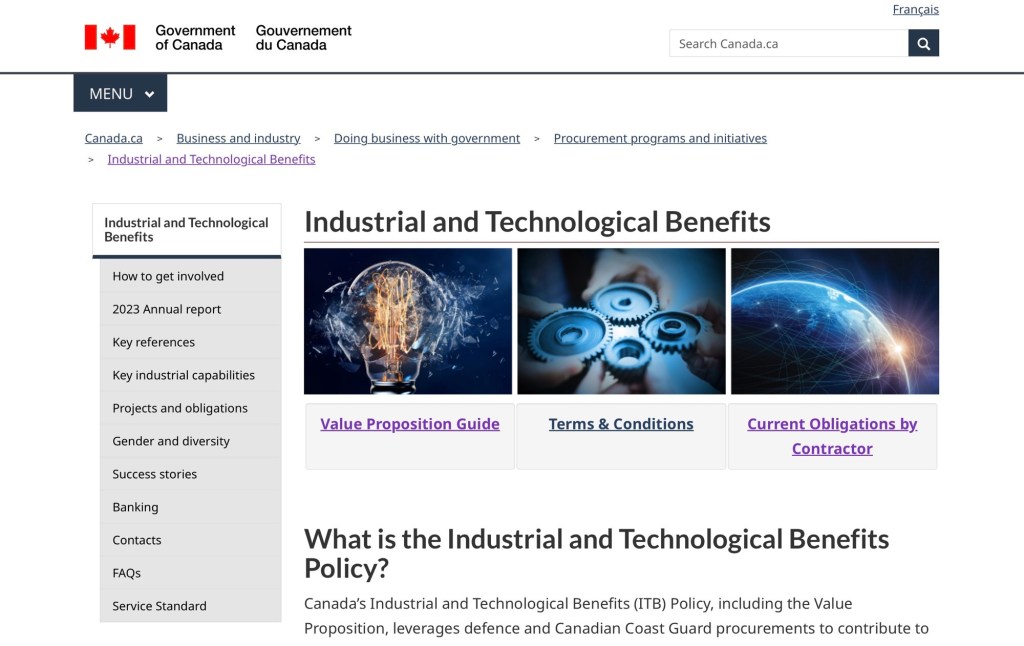
The Industrial and Technological Benefits (ITB) Policy is a powerful tool designed to leverage Canada’s defence and security procurement to drive economic growth, create jobs, and foster innovation across the country. This policy requires companies awarded major defence contracts to undertake business activities in Canada equal to the value of their contracts, ensuring that the nation receives substantial economic benefits from its investments in defence and security.
As the global space economy continues to expand, the ITB Policy presents a unique opportunity for Canadian space businesses to capitalize on this growth and establish themselves as leaders in the field. By participating in the ITB program, these companies can access new markets, forge partnerships with major defence contractors, and secure the funding and resources needed to develop cutting-edge technologies and solutions.
The Objectives of the ITB Policy
The ITB Policy has five primary objectives:
- Support the long-term sustainability and growth of Canada’s defence sector
- Foster the growth of prime contractors and suppliers in Canada, including small and medium-sized enterprises (SMEs) in all regions of the country
- Boost innovation through research and development (R&D) in Canada
- Increase the export potential of Canadian-based firms
- Identify skills development and training opportunities for Canadians
By focusing on these key areas, the ITB Policy aims to create a robust, globally competitive defence and security sector that generates high-quality jobs, drives economic growth, and enhances Canada’s technological capabilities.
Eligibility and Application of the ITB Policy
The ITB Policy applies to defence and Canadian Coast Guard procurements valued at more than $100 million that are exempt from trade agreements due to national security considerations or other exemptions. For defence procurements with contract values between $20 million and $100 million, the applicability of the ITB Policy is determined on a case-by-case basis.
When a procurement falls under the ITB Policy, bidders must submit a Value Proposition as part of their bid. The Value Proposition outlines the economic benefits that will accrue to Canada as a result of the contract, and it is evaluated alongside the technical and cost components of the bid. The winning contractor is then obligated to fulfill the commitments made in their Value Proposition.
Key Industrial Capabilities
To ensure that the ITB Policy supports the development of a strong, innovative, and globally competitive defence and security sector, the Government of Canada has identified 16 Key Industrial Capabilities (KICs). These KICs encompass areas of emerging technology with significant growth potential, established capabilities where Canada is globally competitive, and areas where domestic capacity is essential for national security.
The 16 KICs are:
- Advanced Materials
- Artificial Intelligence
- Cyber Resilience
- Remotely-Piloted Systems and Autonomous Technologies
- Space Systems
- Aerospace Systems and Components
- Armour
- Defence Systems Integration
- Electro-Optical / Infrared (EO/IR) Systems
- Ground Vehicle Support
- In-Service Support
- Marine Ship-Borne Mission and Platform Systems
- Munitions
- Shipbuilding, Design, and Engineering Services
- Sonar and Acoustic Systems
- Training and Simulation
By targeting investments in these key areas, the ITB Policy aims to foster the development of a strong, innovative, and globally competitive Canadian defence and security sector.
Opportunities for Canada’s Space Economy Businesses
The inclusion of Space Systems as a Key Industrial Capability under the ITB Policy presents a significant opportunity for Canadian space businesses. As the global space economy continues to grow, with some estimates projecting it to reach $1 trillion by 2040, Canadian companies are well-positioned to capitalize on this growth and establish themselves as leaders in the field.
Through the ITB Policy, space businesses can access new markets, forge partnerships with major defence contractors, and secure the funding and resources needed to develop cutting-edge technologies and solutions. By participating in the ITB program, these companies can:
- Engage in research and development activities to advance their capabilities and create innovative products and services
- Collaborate with universities, research institutions, and other industry partners to leverage expertise and resources
- Expand their customer base by supplying products and services to major defence contractors and their supply chains
- Access new export opportunities by demonstrating their capabilities and value through ITB investments
- Develop and retain a highly skilled workforce through training and skills development initiatives
The Role of Government and Industry
To fully realize the potential of the ITB Policy for Canada’s space economy, government and industry must work together to create a supportive environment for growth and innovation. The Government of Canada can support the space sector by:
- Continuing to prioritize investments in space through defence and security procurement
- Providing funding and support for R&D activities, particularly in areas aligned with the Key Industrial Capabilities
- Fostering collaboration between industry, academia, and government to leverage expertise and resources
- Promoting Canadian space capabilities and technologies in international markets
- Ensuring that the ITB Policy remains responsive to the evolving needs of the space sector
Industry, for its part, must actively engage with the ITB Policy and seize the opportunities it presents. Space businesses should:
- Familiarize themselves with the ITB Policy and its requirements
- Identify potential opportunities to supply products and services to defence contractors and their supply chains
- Invest in R&D and innovation to develop cutting-edge technologies and solutions
- Collaborate with other industry partners, universities, and research institutions to leverage expertise and resources
- Actively promote their capabilities and value proposition to potential customers and partners
Summary
The Industrial and Technological Benefits Policy is a powerful tool for driving growth and innovation in Canada’s space economy. By leveraging defence and security procurement to generate economic benefits, the ITB Policy creates opportunities for space businesses to access new markets, forge partnerships, and secure the funding and resources needed to develop cutting-edge technologies and solutions.
As the global space economy continues to expand, Canadian companies are well-positioned to capitalize on this growth and establish themselves as leaders in the field. By actively engaging with the ITB Policy and seizing the opportunities it presents, these businesses can contribute to the development of a strong, innovative, and globally competitive Canadian space sector that generates high-quality jobs, drives economic growth, and enhances Canada’s technological capabilities.
To fully realize the potential of the ITB Policy for Canada’s space economy, government and industry must work together to create a supportive environment for growth and innovation. By prioritizing investments in space, fostering collaboration, and promoting Canadian capabilities and technologies, we can ensure that Canada remains at the forefront of the global space economy for years to come.


