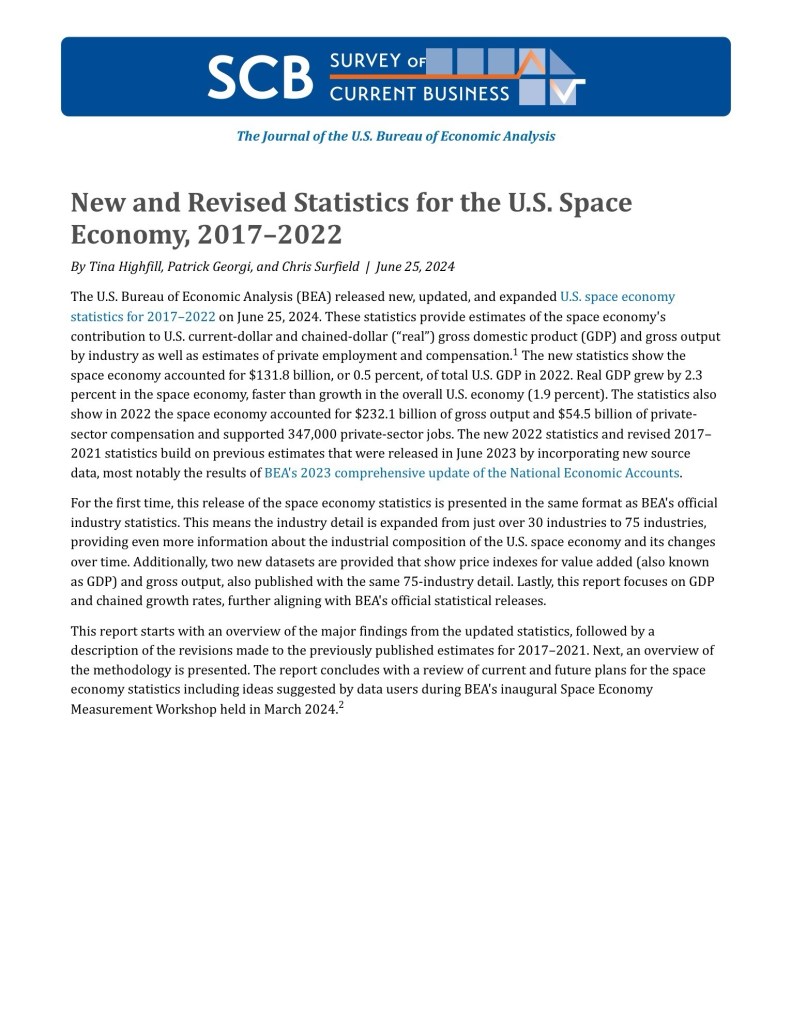
The space economy, which includes a wide range of activities related to the exploration and utilization of space, has been growing rapidly in recent years. As the commercial space sector expands and new technologies emerge, it is becoming increasingly important to accurately measure the economic contributions of space-related industries to the overall U.S. economy.
In response to this need, the Bureau of Economic Analysis (BEA) has been developing new statistics to quantify the space economy. These estimates provide valuable insights into the size, scope, and growth of space-related economic activities, helping policymakers, businesses, and researchers make informed decisions.
Defining the Space Economy
The space economy encompasses a diverse array of industries and activities, from the manufacturing of spacecraft and satellites to the provision of space-based services such as telecommunications, Earth observation, and navigation. It also includes government space programs, such as those conducted by NASA, as well as the growing private space sector.
To effectively measure the space economy, the BEA has developed a comprehensive definition that captures all relevant economic activities. This definition includes:
- The manufacturing, sale, and operation of space vehicles, satellites, and related equipment
- The provision of space-based services, such as telecommunications, Earth observation, and navigation
- The research and development of space technologies
- The construction and operation of space-related infrastructure, such as launch facilities and ground stations
By using this broad definition, the BEA can provide a more complete picture of the economic impact of the space sector.
Measuring the Space Economy
To estimate the size and growth of the space economy, the BEA uses a variety of data sources and methodologies. These include:
- Surveys of businesses engaged in space-related activities
- Government budget data on space programs and contracts
- Trade data on imports and exports of space-related goods and services
- Economic models and statistical techniques to estimate the indirect and induced effects of space activities on the broader economy
By combining these data sources and methods, the BEA can produce detailed estimates of the space economy’s contribution to U.S. gross domestic product (GDP), employment, and other key economic indicators.
The Size and Growth of the Space Economy
According to the BEA’s latest estimates, the U.S. space economy accounted for $196.4 billion of real gross output in 2022, representing 0.6 percent of total U.S. gross output. This includes $125.9 billion in private space activities and $70.5 billion in government space programs.
The space economy has been growing rapidly in recent years, with real gross output increasing by an average of 6.7 percent per year between 2012 and 2022. This growth has been driven largely by the expansion of the private space sector, which has seen an average annual growth rate of 9.5 percent over this period.
In terms of employment, the space economy supported an estimated 354,000 private sector jobs in 2022, up from 283,000 in 2012. These jobs are spread across a wide range of industries, including manufacturing, professional and technical services, and information technology.
The Impact of the Space Economy on Other Industries
In addition to its direct contributions to GDP and employment, the space economy also has significant spillover effects on other industries. Many of the technologies and innovations developed for space applications have found uses in other sectors, driving productivity gains and creating new business opportunities.
For example, advances in satellite imaging and remote sensing have enabled more precise monitoring of crops, forests, and other natural resources, leading to improved agricultural productivity and environmental management. Similarly, GPS technology, originally developed for military and space applications, has become ubiquitous in consumer devices and has transformed industries such as transportation and logistics.
The BEA’s estimates capture some of these indirect impacts by measuring the space economy’s contribution to GDP and employment in downstream industries. However, the full economic benefits of space-related innovations are likely even greater than these numbers suggest, as many of the spillover effects are difficult to quantify.
Challenges and Opportunities for the Space Economy
While the space economy has been growing rapidly, it also faces a number of challenges and uncertainties. These include:
- High costs and technical risks associated with space activities
- Regulatory and policy uncertainties, particularly in areas such as space traffic management and resource utilization
- Increasing competition from other countries, as more nations develop their own space capabilities
- Potential environmental impacts of space activities, such as orbital debris and the effects of rocket launches on the atmosphere
Despite these challenges, the space economy also presents significant opportunities for economic growth and innovation. As the cost of access to space continues to decline and new technologies emerge, there is potential for a wide range of new space-based applications and services, from high-speed internet to space tourism.
To fully realize these opportunities, however, will require continued investment in research and development, as well as a supportive policy environment that encourages private sector innovation while ensuring responsible and sustainable use of space resources.
Summary
The BEA’s new statistics on the space economy provide a valuable tool for understanding the economic impact of this rapidly growing sector. By measuring the direct and indirect contributions of space-related activities to GDP, employment, and other key indicators, these estimates can help inform policy decisions and business strategies related to space.
As the space economy continues to evolve and expand, it will be important to continue refining and updating these measurement frameworks to keep pace with new developments. By doing so, we can ensure that the economic benefits of space are fully realized and that this exciting frontier remains a source of innovation and growth for years to come.