


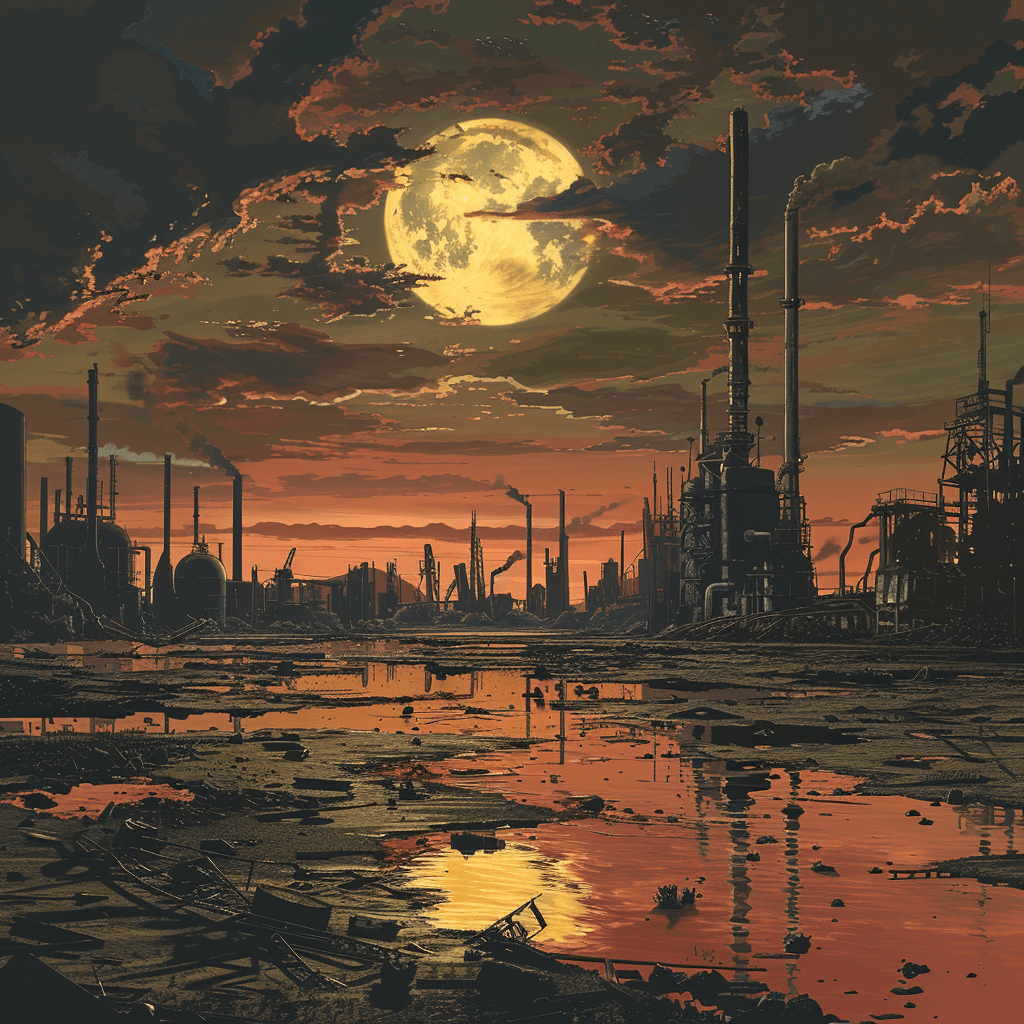
Imagine a world where one side of the Earth always faces the sun, while the other remains in perpetual darkness. This scenario, known as tidal locking, would fundamentally alter our planet’s climate, geology, and potential for life as we know it. While Earth is not tidally locked to the sun, exploring this hypothetical situation provides insights into the complex interplay of factors that shape planetary environments.
Understanding Tidal Locking
Tidal locking occurs when an object’s rotational period matches its orbital period around another body. In this case, if Earth were tidally locked to the sun, it would complete one rotation on its axis in the same time it takes to orbit the sun – approximately 365 days. This phenomenon is not uncommon in our solar system; for example, the Moon is tidally locked to Earth, which is why we always see the same side of the Moon from our planet.
Climate Extremes
The Sunlit Side
The side of Earth perpetually facing the sun would experience extreme heat and constant daylight. Without the cooling effect of night, temperatures on this hemisphere would rise dramatically. The intense solar radiation would likely create a vast, inhospitable desert environment. Water would evaporate rapidly, potentially forming thick cloud cover that could somewhat mitigate the intense heat.
The Dark Side
In stark contrast, the side of Earth facing away from the sun would be plunged into eternal night. Without direct sunlight, this hemisphere would become extremely cold. Temperatures would likely drop well below freezing, potentially causing water and atmospheric gases to freeze and accumulate as ice.
The Twilight Zone
Between these two extremes, a narrow band circling the planet – often referred to as the terminator or twilight zone – would experience more moderate conditions. This region would see the sun perpetually on the horizon, creating a state of constant twilight. It’s in this area that conditions might be most suitable for life as we know it.
Atmospheric Changes
The extreme temperature differences between the sunlit and dark sides of the planet would create strong winds and unusual weather patterns. These winds would play a crucial role in heat distribution, potentially moderating temperatures to some extent.
However, the lack of day-night cycles could significantly alter atmospheric circulation patterns. The current system of trade winds, jet streams, and seasonal variations would be dramatically different. This could lead to unpredictable and potentially severe weather phenomena.
There’s also a possibility that the atmosphere could freeze out on the dark side of the planet. If this occurs, it could lead to a thinner atmosphere overall, potentially compromising Earth’s ability to retain heat and protect against harmful solar radiation.
Oceanic Effects
The distribution of Earth’s oceans would likely change dramatically in a tidally locked scenario. Water might evaporate from the hot side and freeze on the cold side, potentially creating a vast ice cap on the dark hemisphere. This redistribution of water could expose new land masses on the sunlit side while submerging others on the dark side.
Ocean currents, which play a vital role in Earth’s current climate system, would be altered significantly. The lack of rotational forces that currently drive many ocean currents could lead to stagnant waters in some areas, while strong winds might create powerful currents in others.
Geological Impacts
Tidal locking would have profound effects on Earth’s geology. The constant gravitational pull in one direction could lead to increased volcanic activity and more frequent earthquakes, particularly along the terminator line where the stress between the hot and cold sides would be greatest.
The planet’s magnetic field, which is generated by the rotation of Earth’s liquid outer core, could be weakened or altered. This could have serious implications for the planet’s ability to shield itself from solar radiation.
Implications for Life
The extreme conditions on a tidally locked Earth would pose significant challenges for life as we know it. However, this doesn’t necessarily mean that life would be impossible.
Potential Habitable Zones
The twilight zone between the sunlit and dark sides could potentially support life. This region might maintain temperatures suitable for liquid water, a key ingredient for life as we understand it. However, the conditions would be very different from what we experience on Earth today, and any life forms would need to be highly adapted to this unique environment.
Adaptations and Survival Strategies
If life were to exist on a tidally locked Earth, it would likely develop unique adaptations. On the sunlit side, organisms might evolve mechanisms to cope with intense heat and radiation, such as reflective surfaces or the ability to burrow underground during the hottest parts of the day. On the dark side, life might adapt to use chemosynthesis instead of photosynthesis, similar to organisms found near deep-sea hydrothermal vents on Earth today.
In the twilight zone, life might evolve to take advantage of the constant, low-angle sunlight. Plants, for example, might develop structures to capture light from the ever-present sunset/sunrise.
Atmospheric Redistribution of Heat
Recent studies suggest that atmospheric circulation could play a significant role in redistributing heat on a tidally locked planet. This process might help to moderate temperatures, potentially making larger areas of the planet habitable than initially thought.
Models indicate that if Earth had an atmosphere similar to its current one, winds could transport heat from the hot side to the cold side, preventing the atmosphere from completely freezing out on the dark side. This heat distribution could create a more complex and potentially habitable climate system than the simple hot side/cold side dichotomy.
Comparison to Known Exoplanets
While Earth is not tidally locked to the sun, many exoplanets discovered orbiting other stars are thought to be tidally locked. These planets, particularly those orbiting red dwarf stars, provide real-world examples of what a tidally locked Earth might be like.
Observations of these exoplanets have challenged some of our assumptions about tidally locked worlds. For instance, some models suggest that tidally locked planets might be able to maintain liquid water on their surfaces under certain conditions, even with extreme temperature differences between their day and night sides.
Potential for Alternative Energy Sources
In a tidally locked Earth scenario, traditional forms of renewable energy like solar and wind power would face unique challenges and opportunities. The constant sunlight on one side of the planet could make solar power highly efficient, while the strong winds generated by temperature differences could be harnessed for wind energy.
However, the distribution of these energy sources would be highly uneven across the planet’s surface. This could necessitate the development of advanced energy storage and transportation systems to provide power to areas without direct access to these resources.
Impact on Human Civilization
If Earth were to become tidally locked, the consequences for human civilization would be profound. The extreme conditions would likely make large portions of the planet uninhabitable, potentially forcing mass migrations to the more temperate regions.
Agriculture as we know it would be severely disrupted. The lack of day-night cycles and seasons would require a complete reimagining of farming practices. Food production might shift to controlled indoor environments or focus on crops specially adapted to the new conditions.
The changes in climate and geography would also have significant impacts on transportation, trade, and geopolitics. The redistribution of water resources and habitable land could lead to conflicts and a reshaping of national boundaries.
Scientific Opportunities
While a tidally locked Earth would pose numerous challenges, it would also present unique scientific opportunities. The stark contrasts between different regions of the planet would provide natural laboratories for studying extreme environments and their effects on geology, climate, and potentially life.
The permanent dark side could offer ideal conditions for astronomical observations, free from light pollution and atmospheric disturbances caused by the sun. This could potentially accelerate our understanding of the universe.
Summary
The concept of a tidally locked Earth presents a fascinating thought experiment that highlights the delicate balance of factors that make our planet habitable. While such a scenario would create extreme challenges for life as we know it, it also illustrates the potential adaptability of life and the complex interplay between a planet’s rotation, orbit, atmosphere, and geology.
Studying the potential consequences of tidal locking not only helps us understand hypothetical scenarios for Earth but also provides valuable insights into the potential habitability of exoplanets. As we continue to discover and study worlds beyond our solar system, many of which may be tidally locked, the lessons learned from considering a tidally locked Earth will inform our understanding of these distant worlds and the potential for life elsewhere in the universe.


