

As an Amazon Associate we earn from qualifying purchases.

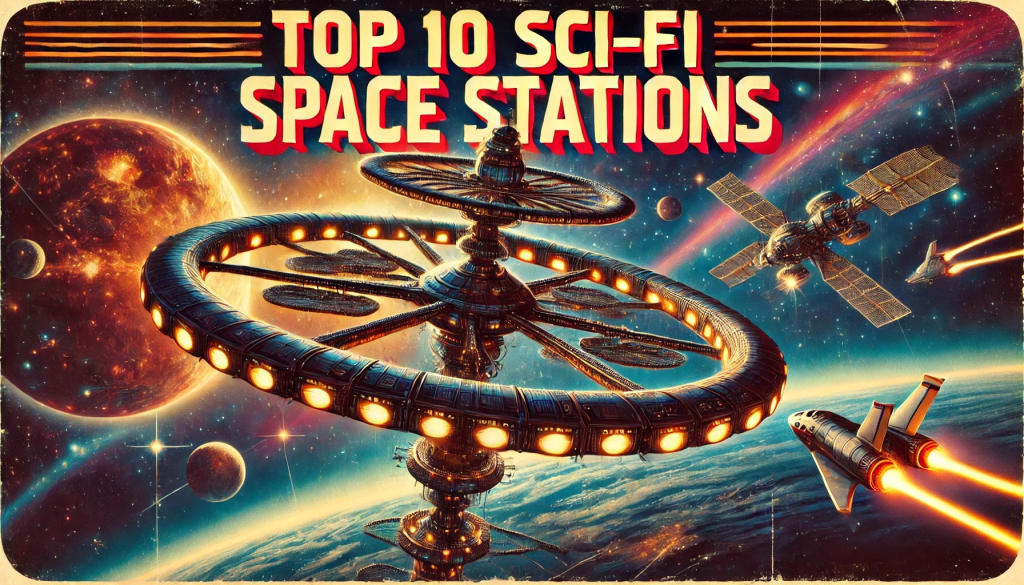
Space stations have captured the imagination of audiences for decades, serving as critical hubs of exploration, governance, and conflict in science fiction. These structures are often depicted as reflections of the societies and civilizations that create them, offering a unique lens into futuristic technology, societal organization, and the challenges of life in space. Below is a comprehensive exploration of ten of the most iconic space stations in science fiction.
1. Babylon 5 (Babylon 5)
Babylon 5, the titular station in J. Michael Straczynski’s series, stands as a beacon of diplomacy and interstellar cooperation. Designed to be a neutral ground for resolving disputes between alien species, Babylon 5 is situated in neutral space and serves as the last of its kind after the failure of previous attempts.
Its design is cylindrical, utilizing centrifugal force to generate artificial gravity. The station houses thousands of inhabitants, including diplomats, military personnel, and civilians. Over the course of the series, Babylon 5 becomes a nexus for galactic politics, war, and personal drama. It explores themes of power, ethics, and the enduring struggle for peace amidst chaos. The show’s intricate storytelling makes Babylon 5 a cornerstone of science fiction.
2. Deep Space Nine (Star Trek: Deep Space Nine)
Deep Space Nine (DS9) is a pivotal setting in the Star Trek universe, diverging from the traditional exploration-centric narrative of other series. Positioned near the planet Bajor and a stable wormhole leading to the Gamma Quadrant, DS9 is a mix of Federation and Cardassian technology.
Originally constructed by the Cardassians as a mining station, Terok Nor, it becomes a Federation-administered outpost following Bajor’s liberation. DS9’s unique stationary setting allows for deep character development and complex storytelling. The station serves as a cultural crossroads, dealing with themes such as occupation, resistance, religion, and diplomacy. Its role in the Dominion War storyline cements its status as a cornerstone of Star Trek lore.
3. Death Star (Star Wars)
The Death Star, introduced in Star Wars: A New Hope, is arguably the most infamous space station in science fiction. This moon-sized weapon, built by the Galactic Empire, houses a planet-destroying superlaser and serves as a symbol of authoritarian control.
The Death Star’s engineering is both awe-inspiring and menacing, with its spherical design housing millions of personnel and extensive infrastructure. Despite its power, its fatal flaw—a vulnerable thermal exhaust port—becomes central to the Rebel Alliance’s victory. The station’s destruction marks a turning point in the original trilogy and showcases the narrative tension between overwhelming power and the resilience of rebellion.
4. The Citadel (Mass Effect)
In the Mass Effect video game series, The Citadel is a marvel of engineering and serves as the political, cultural, and economic hub of the galaxy. This massive space station, shaped like a wheel with sprawling arms, is home to the Citadel Council and represents interspecies cooperation.
The Citadel’s interior is a blend of natural and artificial elements, featuring verdant gardens, rivers, and towering skyscrapers. Its origins are shrouded in mystery, tied to the ancient and enigmatic Protheans. Throughout the series, the Citadel plays a critical role in galactic diplomacy, commerce, and the unfolding conflict with the Reapers. Its sheer scale and intricate design make it a standout setting in science fiction gaming.
5. Elysium (Elysium)
In Neill Blomkamp’s film Elysium, the titular space station serves as a stark contrast to the dystopian conditions of Earth. Built as a Stanford torus, Elysium is a rotating ring structure that provides a luxurious and idyllic existence for Earth’s wealthiest inhabitants.
The station boasts advanced medical technology capable of curing any illness, highlighting the socio-economic divide central to the film’s narrative. Its pristine environment and exclusivity symbolize privilege and inequality, driving the protagonist’s efforts to bridge the gap between Earth’s impoverished population and Elysium’s elite. The film’s portrayal of the station underscores the potential for space stations to serve as metaphors for societal disparities.
6. Rama (Rendezvous with Rama)
In Arthur C. Clarke’s novel Rendezvous with Rama, Rama is an enormous cylindrical spacecraft discovered drifting through the solar system. Though technically a spacecraft, its design and function closely resemble that of a space station.
Rama’s interior is a self-contained ecosystem, with artificial gravity generated by rotation and vast cylindrical seas. The structure’s enigmatic origins and purpose drive the novel’s plot, as scientists and explorers attempt to unravel its mysteries. Rama’s design and functionality represent a pinnacle of alien engineering, and its depiction highlights humanity’s enduring curiosity and the challenges of understanding advanced civilizations.
7. Cloud City (The Empire Strikes Back)
Cloud City, featured in Star Wars: The Empire Strikes Back, is a unique example of a floating city that functions similarly to a space station. Suspended in the atmosphere of the gas giant Bespin, Cloud City serves as a hub for mining tibanna gas, a valuable resource in the Star Wars universe.
Governed by Lando Calrissian, the city is characterized by its art deco-inspired architecture and idyllic setting. However, its serene façade masks political intrigue and betrayal, as it becomes a battleground in the Galactic Civil War. Cloud City’s role in the story highlights the interplay between commerce, governance, and personal loyalty in science fiction narratives.
8. The Ark (The 100)
In the post-apocalyptic television series The 100, The Ark is a massive space station composed of interconnected modules housing the remnants of humanity after Earth becomes uninhabitable. The station is designed to support life indefinitely, with advanced systems for recycling air, water, and resources.
The Ark’s society is marked by strict resource management and harsh laws, reflecting the challenges of survival in a closed environment. When life on the station becomes unsustainable, its inhabitants face the difficult decision to return to Earth, sparking the events of the series. The Ark’s depiction emphasizes the moral and practical dilemmas of living in space.
9. Halo (Halo)
The Halo installations in the Halo video game series are colossal ringworlds created by the Forerunner civilization. These structures function as both habitable environments and weapons, designed to contain and combat the parasitic Flood species.
Each Halo ring features a vast, self-sustaining ecosystem on its inner surface, with artificial gravity provided by rotation. Their dual purpose as living spaces and doomsday devices creates a compelling narrative tension. Exploring the Halos reveals the Forerunners’ technological prowess and the ethical challenges of wielding immense power. The rings’ iconic design and significance to the story make them a cornerstone of the Halo universe.
10. Ringworld (Ringworld)
Larry Niven’s novel Ringworld introduces one of the most ambitious concepts in science fiction: Ringworld, a massive artificial ring encircling a star. Spanning nearly a million miles in diameter, this structure offers an enormous habitable surface area, with artificial gravity generated by its rotation.
Ringworld is a testament to advanced engineering, featuring a complex ecosystem, weather systems, and sunlight provided by orbiting shadow squares. The novel follows a group of explorers attempting to understand the Ringworld’s origins and purpose, uncovering mysteries about its creators and its deteriorating state. Ringworld’s scale and intricacy make it a landmark in science fiction literature, influencing countless works in the genre.
Summary
Space stations in science fiction are more than just physical settings; they are reflections of humanity’s ambitions, fears, and creativity. From the diplomatic corridors of Babylon 5 to the enigmatic wonders of Ringworld, these constructs explore themes of cooperation, conflict, survival, and the unknown. Each station offers a unique narrative and visual experience, cementing its place in the genre’s rich history.
10 Best-Selling Science Fiction Books Worth Reading
Dune
Frank Herbert’s Dune is a classic science fiction novel that follows Paul Atreides after his family takes control of Arrakis, a desert planet whose spice is the most valuable resource in the universe. The story combines political struggle, ecology, religion, and warfare as rival powers contest the planet and Paul is drawn into a conflict that reshapes an interstellar civilization. It remains a foundational space opera known for its worldbuilding and long-running influence on the science fiction genre.
Foundation
Isaac Asimov’s Foundation centers on mathematician Hari Seldon, who uses psychohistory to forecast the collapse of a galactic empire and designs a plan to shorten the coming dark age. The narrative spans generations and focuses on institutions, strategy, and social forces rather than a single hero, making it a defining work of classic science fiction. Its episodic structure highlights how knowledge, politics, and economic pressures shape large-scale history.
Ender’s Game
Orson Scott Card’s Ender’s Game follows Andrew “Ender” Wiggin, a gifted child recruited into a military training program designed to prepare humanity for another alien war. The novel focuses on leadership, psychological pressure, and ethical tradeoffs as Ender is pushed through increasingly high-stakes simulations. Often discussed as military science fiction, it also examines how institutions manage talent, fear, and information under existential threat.
The Hitchhiker’s Guide to the Galaxy
Douglas Adams’s The Hitchhiker’s Guide to the Galaxy begins when Arthur Dent is swept off Earth moments before its destruction and launched into an absurd interstellar journey. Blending comedic science fiction with satire, the book uses space travel and alien societies to lampoon bureaucracy, technology, and human expectations. Beneath the humor, it offers a distinctive take on meaning, randomness, and survival in a vast and indifferent cosmos.
1984
George Orwell’s 1984 portrays a surveillance state where history is rewritten, language is controlled, and personal autonomy is systematically dismantled. The protagonist, Winston Smith, works within the machinery of propaganda while privately resisting its grip, which draws him into escalating danger. Frequently categorized as dystopian fiction with strong science fiction elements, the novel remains a reference point for discussions of authoritarianism, mass monitoring, and engineered reality.
Brave New World
Aldous Huxley’s Brave New World presents a society stabilized through engineered reproduction, social conditioning, and pleasure-based control rather than overt terror. The plot follows characters who begin to question the costs of comfort, predictability, and manufactured happiness, especially when confronted with perspectives that do not fit the system’s design. As a best-known dystopian science fiction book, it raises enduring questions about consumerism, identity, and the boundaries of freedom.
Fahrenheit 451
Ray Bradbury’s Fahrenheit 451 depicts a future where books are outlawed and “firemen” burn them to enforce social conformity. The protagonist, Guy Montag, begins as a loyal enforcer but grows increasingly uneasy as he encounters people who preserve ideas and memory at great personal risk. The novel is often read as dystopian science fiction that addresses censorship, media distraction, and the fragility of informed public life.
The War of the Worlds
H. G. Wells’s The War of the Worlds follows a narrator witnessing an alien invasion of England, as Martian technology overwhelms existing military and social structures. The story emphasizes panic, displacement, and the collapse of assumptions about human dominance, offering an early and influential depiction of extraterrestrial contact as catastrophe. It remains a cornerstone of invasion science fiction and helped set patterns still used in modern alien invasion stories.
Neuromancer
William Gibson’s Neuromancer follows Case, a washed-up hacker hired for a high-risk job that pulls him into corporate intrigue, artificial intelligence, and a sprawling digital underworld. The book helped define cyberpunk, presenting a near-future vision shaped by networks, surveillance, and uneven power between individuals and institutions. Its language and concepts influenced later depictions of cyberspace, hacking culture, and the social impact of advanced computing.
The Martian
Andy Weir’s The Martian focuses on astronaut Mark Watney after a mission accident leaves him stranded on Mars with limited supplies and no immediate rescue plan. The narrative emphasizes problem-solving, engineering improvisation, and the logistical realities of survival in a hostile environment, making it a prominent example of hard science fiction for general readers. Alongside the technical challenges, the story highlights teamwork on Earth as agencies coordinate a difficult recovery effort.
10 Best-Selling Science Fiction Movies to Watch
Interstellar
In a near-future Earth facing ecological collapse, a former pilot is recruited for a high-risk space mission after researchers uncover a potential path to another star system. The story follows a small crew traveling through extreme environments while balancing engineering limits, human endurance, and the emotional cost of leaving family behind. The narrative blends space travel, survival, and speculation about time, gravity, and communication across vast distances in a grounded science fiction film framework.
Blade Runner 2049
Set in a bleak, corporate-dominated future, a replicant “blade runner” working for the police discovers evidence that could destabilize the boundary between humans and engineered life. His investigation turns into a search for hidden history, missing identities, and the ethical consequences of manufactured consciousness. The movie uses a cyberpunk aesthetic to explore artificial intelligence, memory, and state power while building a mystery that connects personal purpose to civilization-scale risk.
Arrival
When multiple alien craft appear around the world, a linguist is brought in to establish communication and interpret an unfamiliar language system. As global pressure escalates, the plot focuses on translating meaning across radically different assumptions about time, intent, and perception. The film treats alien contact as a problem of information, trust, and geopolitical fear rather than a simple battle scenario, making it a standout among best selling science fiction movies centered on first contact.
Inception
A specialist in illicit extraction enters targets’ dreams to steal or implant ideas, using layered environments where time and physics operate differently. The central job requires assembling a team to build a multi-level dream structure that can withstand psychological defenses and internal sabotage. While the movie functions as a heist narrative, it remains firmly within science fiction by treating consciousness as a manipulable system, raising questions about identity, memory integrity, and reality testing.
Edge of Tomorrow
During a war against an alien force, an inexperienced officer becomes trapped in a repeating day that resets after each death. The time loop forces him to learn battlefield tactics through relentless iteration, turning failure into training data. The plot pairs kinetic combat with a structured science fiction premise about causality, adaptation, and the cost of knowledge gained through repetition. It is often discussed as a time-loop benchmark within modern sci-fi movies.
Ex Machina
A young programmer is invited to a secluded research facility to evaluate a humanoid robot designed with advanced machine intelligence. The test becomes a tense psychological study as conversations reveal competing motives among creator, evaluator, and the synthetic subject. The film keeps its focus on language, behavior, and control, using a contained setting to examine artificial intelligence, consent, surveillance, and how people rationalize power when technology can convincingly mirror human emotion.
The Fifth Element
In a flamboyant future shaped by interplanetary travel, a cab driver is pulled into a crisis involving an ancient weapon and a looming cosmic threat. The story mixes action, comedy, and space opera elements while revolving around recovering four elemental artifacts and protecting a mysterious figure tied to humanity’s survival. Its worldbuilding emphasizes megacities, alien diplomacy, and high-tech logistics, making it a durable entry in the canon of popular science fiction film.
Terminator 2: Judgment Day
A boy and his mother are pursued by an advanced liquid-metal assassin, while a reprogrammed cyborg protector attempts to keep them alive. The plot centers on preventing a future dominated by autonomous machines by disrupting the chain of events that leads to mass automation-driven catastrophe. The film combines chase-driven suspense with science fiction themes about AI weaponization, time travel, and moral agency, balancing spectacle with character-driven stakes.
Minority Report
In a future where authorities arrest people before crimes occur, a top police officer becomes a suspect in a predicted murder and goes on the run. The story follows his attempt to challenge the reliability of predictive systems while uncovering institutional incentives to protect the program’s legitimacy. The movie uses near-future technology, biometric surveillance, and data-driven policing as its science fiction core, framing a debate about free will versus statistical determinism.
Total Recall (1990)
A construction worker seeking an artificial vacation memory experiences a mental break that may be either a malfunction or the resurfacing of a suppressed identity. His life quickly becomes a pursuit across Mars involving corporate control, political insurgency, and questions about what is real. The film blends espionage, off-world colonization, and identity instability, using its science fiction premise to keep viewers uncertain about whether events are authentic or engineered perception.


