

As an Amazon Associate we earn from qualifying purchases.

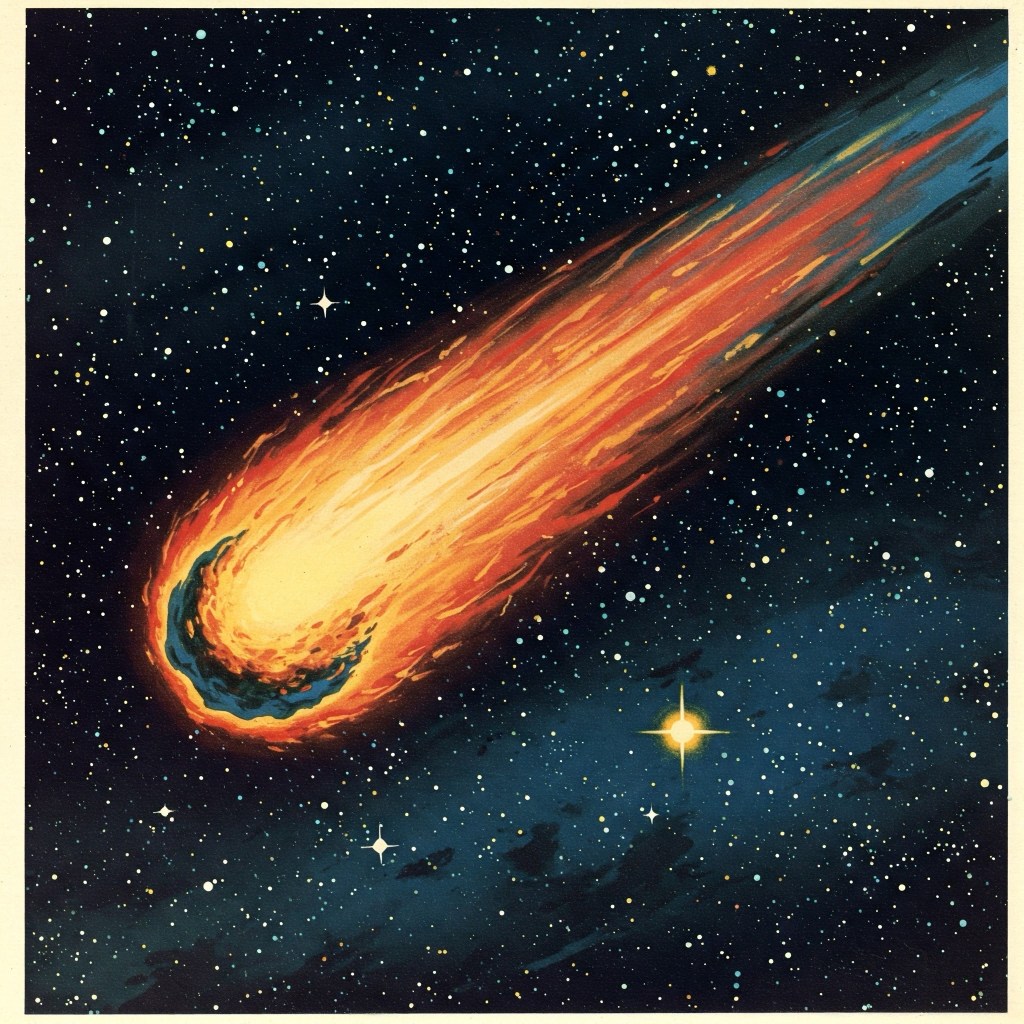
Comets have captivated humanity for centuries, appearing as streaks of light cutting across the night sky. While they are often considered simple cosmic snowballs, these celestial objects possess characteristics that challenge common assumptions. Scientists continue to uncover surprising details about their composition, behaviors, and history. Below are ten intriguing aspects of comets that are not widely known.
Comets Can Have Multiple Tails
Contrary to the traditional depiction of a single luminous tail, comets can develop multiple appendages. Typically, two distinct tails emerge: the dust tail and the ion tail. The dust tail consists of small solid particles pushed away from the comet’s nucleus by solar radiation, forming a bright and often curved extension.
The ion tail, on the other hand, is composed of ionized gas particles influenced by the solar wind. This tail appears bluish and points almost directly away from the Sun due to interaction with charged particles in space. Occasionally, additional structures such as disconnection events can occur within these tails, adding to their complexity.
Cometary Nuclei Are Surprisingly Dark
Despite their glowing appearance when visible from Earth, comets themselves are not inherently bright objects. In reality, their nuclei—composed of rock, dust, and ice—are some of the darkest objects in the solar system. Observations from spacecraft such as the European Space Agency’s Rosetta probe show that cometary surfaces reflect very little light, comparable to the darkness of charcoal.
The darkened surfaces result from organic compounds and space weathering, which alter the structure of the material over time. This low reflectivity challenges initial assumptions that comets would appear bright even when inactive.
Comets Can Break Apart and Reassemble
Unlike asteroids, which are typically solid bodies, comets have weaker structural integrity. This makes them susceptible to fragmentation due to various forces, including gravitational interactions, solar radiation, and internal gas pressure. Some comets have been observed breaking apart into multiple pieces, such as Comet Shoemaker-Levy 9, which fragmented before colliding with Jupiter.
Surprisingly, in certain cases, separated fragments may gently come back together due to weak gravitational attraction. This behavior suggests that some comets may be an accumulation of loosely bound rubble rather than single solid objects.
Some Comets Exhibit Unusual Spin Patterns
Many celestial objects rotate in predictable ways, but some comets display irregular or chaotic spin motions. This occurs because outgassing—where sublimating ice releases gas into space—creates unpredictable thrust forces. As a result, a comet’s nucleus may experience shifts in rotational speed or unexpected turbulence.
Data from Rosetta revealed that Comet 67P/Churyumov–Gerasimenko exhibited rotational variations over time, providing insights into how jet activity influences a comet’s movement. These irregular rotations can also contribute to structural instabilities, leading to breakup events.
Comets May Have Contributed to Earth’s Water
Scientists have long debated the origins of Earth’s water. One prevailing theory suggests that comets played a role in delivering water-rich material during the early history of the planet. Spectroscopic analysis of certain comets has revealed that they contain water ice with isotopic signatures similar to that found on Earth.
However, not all comets match Earth’s water composition. Some contain a higher ratio of heavy hydrogen (deuterium), which differs from the water found in Earth’s oceans. This suggests that if comets contributed to Earth’s water supply, they were likely part of a broader array of sources, including asteroids.
Some Comets Originate from the Oort Cloud
The Oort Cloud is a vast, spherical region believed to exist at the outermost reaches of the solar system. It contains icy bodies that occasionally get nudged into the inner solar system, becoming long-period comets. These objects can take thousands or even millions of years to complete a single orbit around the Sun.
Unlike short-period comets, which originate in the Kuiper Belt, long-period comets often have highly eccentric orbits. Their arrival near the Sun is unpredictable, making them fascinating targets for observation.
Comets Can Develop a “Backward” Tail
Though comet tails are generally expected to extend away from the Sun, some comets appear to have tails pointing in an unusual direction. This phenomenon occurs when a comet moves past perihelion (its closest approach to the Sun), and the relationship between its speed and the solar wind shifts.
The resulting effect can produce a tail that appears to be trailing ahead of the nucleus rather than lagging behind. This optical illusion depends on the perspective of an observer from Earth and the interaction between dust particles and solar radiation.
Some Comets Undergo Surface Erosion
Repeated passages close to the Sun cause significant changes in a comet’s surface over time. The intense heat leads to the sublimation of ices, altering the landscape of the nucleus and creating deep fissures, depressions, and jet-like vents.
Extensive surface changes were documented on Comet 67P/Churyumov–Gerasimenko, where cliffs collapsed, new jets emerged, and portions of the terrain shifted between successive orbits. This process highlights the dynamic nature of cometary bodies.
Comets Can Contain Organic Molecules
Some comets harbor complex organic molecules, including carbon-based compounds essential for life. Data from missions such as Rosetta confirmed the presence of amino acids and other prebiotic ingredients within cometary material.
These discoveries suggest that comets may have seeded early Earth with the building blocks necessary for the development of life. While they are not proof of life itself, they demonstrate that organic chemistry can thrive in the extreme conditions of space.
Some Comets Exhibit Outbursts of Activity
Comets do not always follow predictable brightness patterns. Some undergo sudden outbursts, dramatically increasing their visibility. This phenomenon occurs when internal pressure causes subsurface material to be expelled rapidly into space.
An example is Comet Holmes, which unexpectedly brightened by nearly a million times in 2007, transforming from an obscure object into one of the most prominent features in the sky. The exact triggers behind these explosive events remain an active topic of research.
Today’s 10 Most Popular Science Fiction Books
[amazon bestseller=”science fiction books” items=”10″]


