


Introduction
The act of landing on the Moon remains one of the most formidable engineering challenges ever undertaken. It involves crossing an immense void, navigating a hostile environment of vacuum and extreme temperatures, and executing a descent with razor-thin margins for error. In this complex ballet of physics and technology, the lunar lander is the final, critical performer. It is the physical and symbolic bridge between Earth and the Moon—the one vehicle that must conquer the last, most perilous phase of the journey from orbit to surface.
The story of the lunar lander is a story of our evolving ambition on the Moon. It’s a narrative that traces a path from the first tentative, robotic touches of the Cold War, through the singular triumph of the crewed Apollo missions, to the current, dynamic era of diverse international and commercial efforts. These machines, each a product of its time, reflect not just technological progress but also shifting geopolitical goals and scientific priorities. From simple, rugged spheres to towering, reusable spaceships, their evolution chronicles humanity’s quest to transform the Moon from a distant object of fascination into a destination for exploration, science, and perhaps one day, settlement.
The First Touch: Pioneering the Lunar Surface
The first wave of lunar landings was born from the intense geopolitical rivalry of the Space Race. These early robotic missions were more than just technical demonstrations; they were crucial intelligence-gathering operations designed to answer a fundamental question before sending humans: Was the lunar surface safe for landing? Each success was a national triumph, and each data point was a vital piece of the puzzle for the ultimate goal of putting human boots on the Moon.
The Silent Success of Luna 9
On February 3, 1966, the Soviet Union’s Luna 9 mission accomplished what had never been done before: it performed the first successful soft landing on another celestial body. This monumental achievement came after a string of failures by both superpowers and represented a major victory for the Soviet space program. The lander’s design was both ingenious and robust. As the main spacecraft plummeted towards the Moon, it fired a retrorocket to brake its descent. Just moments before impact, it ejected a 99 kg spherical landing capsule. This sphere was encased in a large airbag that inflated to cushion the blow, allowing the probe to bounce several times across the Oceanus Procellarum (Ocean of Storms) before coming to a rest.
Once settled, four spring-loaded “petals” on the capsule opened, stabilizing the craft and revealing a television camera. Soon after, Luna 9 began transmitting the first-ever panoramic images from the lunar surface, providing humanity with its first ground-level view of an alien world. The stark, rocky landscape it revealed was a moment in exploration. Perhaps more importantly, the mission dispelled a major fear among space planners. A prominent theory at the time suggested the Moon could be covered in a deep layer of fine dust, a treacherous trap that could swallow a landing craft. Luna 9 proved the surface was firm and could support the weight of a lander, clearing a major psychological and engineering hurdle for future missions.
The mission also provided a lesson in public relations. In a move uncharacteristic of the typically secretive Soviet program, the images were transmitted using a standard, unencrypted signal format used by international news agencies to share photographs. Observers at the Jodrell Bank Observatory in the UK quickly intercepted and decoded the signals, publishing the historic photos worldwide before Moscow’s official announcement. This suggests the possibility that the probe’s engineers, wanting to ensure their achievement was seen by their peers globally and without delay, built in a way for the world to witness their success in near real-time, bypassing slower state-controlled channels.
Surveyor’s Cautious Footprint
Just four months later, in June 1966, NASA responded with its own success. The Surveyor 1 spacecraft executed a flawless soft landing, becoming the first American probe to do so on an extraterrestrial body. That it succeeded on its very first attempt was a tremendous boost for a US program still stinging from earlier failures and a powerful validation of its different engineering approach.
The contrast between the two pioneering landers revealed two distinct national philosophies. Where Luna 9 was a rugged, brute-force solution designed to secure a “first,” Surveyor 1 was a more complex and precise machine built for a longer game. Instead of an airbag, Surveyor used a sophisticated closed-loop guidance system with a radar altimeter and throttleable vernier engines. These engines fired to control the descent until the lander was just 3.4 meters above the ground, from which it dropped to the surface. This powered descent was far more controlled and a direct precursor to the technique that would be used by the Apollo Lunar Module.
Surveyor’s primary purpose was to act as a robotic scout for the upcoming Apollo missions. It was not just about landing; it was about gathering a wealth of data. The lander carried over 100 engineering sensors and a high-resolution television camera that returned more than 11,240 images. These pictures gave scientists unprecedented views of the spacecraft’s own footpads pressing into the lunar soil, the texture of the surrounding terrain, and nearby rocks. The mission provided critical data on the soil’s bearing strength, surface temperatures, and radar reflectivity, all of which confirmed that the lunar surface was safe and that the Apollo LM’s design was sound. The Soviet Union was focused on winning individual battles in the Space Race; the United States was executing a methodical reconnaissance campaign to win the war.
One Giant Leap: The Apollo Lunar Module
The culmination of this early work was the Apollo Lunar Module (LM), built by Grumman Aircraft Engineering Corporation. It remains the only vehicle in history to have landed humans on the Moon and returned them safely to orbit. It was a machine of pure function, an angular, insect-like craft with no aerodynamic surfaces, as it was designed to fly only in the vacuum of space. Its sole purpose was to get two astronauts to the surface and back, and it did so with remarkable success.
The LM’s iconic two-stage architecture was a masterpiece of engineering designed to maximize efficiency and reliability.
- The Descent Stage: The lower, four-legged section of the craft served as the workhorse for the landing. It housed a powerful, throttleable descent engine that gave the Apollo commanders the ability to hover and pilot the craft horizontally to find a safe landing spot, a capability that famously saved the Apollo 11 mission. This stage also contained the fuel tanks, landing gear, water, batteries, and the scientific experiments to be deployed on the surface. After touchdown, it became a permanent part of the lunar landscape, serving as a launchpad for the journey home.
- The Ascent Stage: The upper section was the crew’s cabin and flight deck, a cramped but functional space for two astronauts. It had its own, simpler, non-throttleable rocket engine designed for one critical task: to fire once and lift the astronauts off the Moon back into orbit to rendezvous with the orbiting Command Module. When the ascent engine fired, the descent stage was left behind, becoming the first of six man-made monuments on the Moon.
The LM was not a static design. The initial models used on the first landings could support a stay of about two days on the surface. The later “J-series” LMs, which flew on the final three Apollo missions, were significantly upgraded. They carried more consumables, allowing for stays of up to three days, and featured a crucial addition: stowage space for the Lunar Roving Vehicle (LRV). This electric car dramatically expanded the astronauts’ exploration range from a few hundred meters to many kilometers, transforming the missions from simple landing site surveys into regional geological expeditions.
| Feature | Luna 9 (USSR) | Surveyor 1 (USA) |
|---|---|---|
| Mission Goal | Achieve the first-ever soft landing; transmit images from the surface. | Test soft-landing technology for Apollo; analyze lunar surface properties. |
| Landing Date | February 3, 1966 | June 2, 1966 |
| Landed Mass | 99 kg (218 lb) | 294 kg (649 lb) |
| Landing Method | Airbag-cushioned capsule ejected from main craft, bounced to a stop. | Powered descent with throttleable vernier engines and radar altimeter. |
| Key Technology | Airbag impact absorption system. | Closed-loop, radar-guided, powered descent. |
| Scientific Payload | Panoramic television camera, radiation detector. | High-resolution TV camera, over 100 engineering sensors. |
| Mission Significance | First soft landing on another world; proved surface was solid. | First US soft landing; provided critical engineering data for Apollo. |
The Robotic Renaissance: A New Generation Reaches for the Moon
After the Apollo program ended in 1972, lunar surface exploration entered a long hiatus. The 21st century, however, has witnessed a vibrant resurgence, with new national space agencies entering the field. This modern era is characterized not by a singular race, but by a diversification of goals, with different nations carving out unique technological niches and pursuing more targeted scientific objectives.
The Dragon’s Ascent: China’s Chang’e Program
China’s approach to lunar exploration has been a model of deliberate, methodical success. The Chang’e program, named after the Chinese moon goddess, has been executed as a multi-phase campaign, with each mission building systematically on the capabilities of the last. This strategy is less about winning a sprint and more about building a permanent railroad to the Moon, establishing a complete and sustainable set of operational capabilities. The program began with the Chang’e 1 and 2 orbiters, which meticulously mapped the lunar surface to scout for future landing sites.
In December 2013, the Chang’e 3 mission made China only the third nation to successfully soft-land on the Moon. It deployed the Yutu (“Jade Rabbit”) rover, which explored the northern Mare Imbrium region and made scientific discoveries, including identifying a new type of basaltic rock. The program’s most celebrated achievement came in January 2019, when Chang’e 4 performed the first-ever landing on the Moon’s far side. This was a remarkable technical accomplishment, as the far side never faces Earth, requiring China to first place the Queqiao relay satellite in a special halo orbit beyond the Moon to enable communications.
Having mastered landing and roving, China then moved to the next phase: sample return. The Chang’e 5 mission in 2020 and Chang’e 6 in 2024 both successfully landed, collected several kilograms of rock and soil, and returned the samples to Earth for analysis. Chang’e 6’s payload was particularly historic, as it contained the first-ever samples collected from the Moon’s far side.
Triumph of the Tricolour: India’s Chandrayaan Missions
The story of India’s lunar landing program is one of extraordinary resilience. The nation’s first attempt, the Chandrayaan-2 mission in 2019, was a partial success. It successfully placed a state-of-the-art orbiter around the Moon, which continues to send back valuable data today. However, during the final phase of descent, communication with its Vikram lander was lost just 2.1 km above the surface, and the craft crash-landed.
Rather than viewing this as a crippling setback, the Indian Space Research Organisation (ISRO) treated it as a learning experience. Engineers meticulously analyzed the failure and developed the Chandrayaan-3 mission as a direct follow-on, designed specifically to correct the issues from the previous attempt. The new Vikram lander was equipped with stronger landing legs, additional sensors for redundancy, more propellant, and improved software logic. This persistence paid off spectacularly. On August 23, 2023, Chandrayaan-3 executed a perfect soft landing near the Moon’s south pole. The achievement made India the fourth nation to soft-land on the Moon and the very first country to successfully land in the coveted south polar region. The mission deployed its small Pragyan rover, which rolled onto the surface to conduct in-situ chemical analysis of the lunar soil. The choice of a polar landing site was highly strategic, as scientists believe the region’s permanently shadowed craters hold vast deposits of water ice, a critical resource for sustaining a future human presence.
Pinpoint Precision: Japan’s SLIM Lander
In January 2024, Japan’s SLIM (Smart Lander for Investigating Moon) mission introduced a new paradigm in lunar landings. While other missions aimed to land safely within a designated area, SLIM’s primary objective was to demonstrate a “pinpoint” landing—to touch down at a specific, pre-selected spot with unprecedented accuracy.
The mission was a stunning success. SLIM landed just 55 meters from its target point on the treacherous, sloped rim of the small Shioli crater. This was an incredible feat of autonomous navigation, especially when compared to the landing ellipses of earlier missions, which were often several kilometers wide. This accuracy was achieved using a novel, vision-based navigation system. During its final descent, SLIM’s cameras rapidly photographed the lunar surface. Its onboard computer then used technology adapted from facial recognition to instantly match the crater patterns in the images to pre-loaded maps, allowing the spacecraft to know its exact position and guide itself to its target. Although the lander tipped over upon touchdown, its systems remained functional, and it completed its science objectives. The ability to land with surgical precision on hazardous but scientifically rich terrain—such as near cave entrances, on steep crater walls, or next to specific geological formations—effectively unlocks a new frontier of the Moon that was previously inaccessible.
| Feature | Chang’e 4 (China) | Chandrayaan-3 (India) | SLIM (Japan) |
|---|---|---|---|
| Mission Goal | First soft landing on the lunar far side. | First soft landing in the lunar south polar region; demonstrate landing after prior failure. | Demonstrate “pinpoint” high-precision landing technology. |
| Landing Date | January 3, 2019 | August 23, 2023 | January 19, 2024 |
| Landing Site | Von Kármán crater (Far Side) | Near Shiv Shakti Point (South Pole Region) | Shioli Crater Rim |
| Key Technology | Far-side operations via a dedicated relay satellite (Queqiao). | Robust, fault-tolerant landing system developed from lessons learned. | Vision-based navigation for a 100-meter accuracy landing. |
| Rover/Payloads | Yutu-2 Rover with ground-penetrating radar. | Pragyan Rover with spectrometers for in-situ chemical analysis. | Two small, unconventional hopping/crawling rovers (LEV-1, LEV-2). |
| Unique Contribution | Opened the far side of the Moon to surface exploration. | Proved resilience and placed a lander in the resource-rich polar region. | Shifted landing paradigm from “area” to “specific point” targeting. |
The Commercial Space Age: A New Business on the Moon
A fundamental shift is underway in how lunar exploration is conducted, driven largely by a new model of public-private partnership. This approach is changing the economics, pace, and risk tolerance of landing on the Moon, aiming to create a self-sustaining lunar economy.
NASA’s New Playbook: The CLPS Initiative
At the heart of this shift is NASA‘s Commercial Lunar Payload Services (CLPS) program. Instead of designing, building, and operating its own robotic landers—a slow and expensive process—NASA now acts as a customer. It purchases payload delivery services from a growing list of American commercial companies, effectively outsourcing the ride to the Moon. The goal of CLPS is to enable rapid, frequent, and more affordable access to the lunar surface for science instruments and technology demonstrations. These missions are a key preparatory step for the Artemis human landing program, scouting for resources like water ice and testing technologies needed for long-term stays on the Moon.
This new model represents a change in NASA‘s operational philosophy. It moves away from monolithic, “failure is not an option” flagship missions toward a diversified portfolio of smaller, lower-cost missions. By spreading its investments across multiple providers and planning for a cadence of several flights per year, NASA accepts that some missions may fail. This higher tolerance for risk is balanced by the potential for a much greater scientific return, achieved more quickly and at a lower overall cost than a traditional government-led program would allow. It is the application of venture capital principles to planetary exploration.
Early Forays: A Story of Trial and Triumph
The CLPS model was put to a dramatic and very public test in early 2024. The first mission to launch, Astrobotic Technology’s Peregrine lander, suffered a critical propellant leak shortly after separating from its rocket in January. The leak made a lunar landing impossible, and the mission ended with the spacecraft being guided to a controlled reentry over the Pacific Ocean. While a disappointment, the event demonstrated the program’s resilience.
Just a few weeks later, the second CLPS mission, Intuitive Machines’ Odysseus lander, successfully touched down on the Moon in February 2024. It was a landmark achievement: the first successful landing by a private company in history and the first American spacecraft to soft-land on the Moon in over 50 years, since Apollo 17. The landing was not perfect; a navigation sensor issue required a last-minute software patch, and upon touchdown, the lander tipped and came to rest on its side. Despite this, Odysseus remained operational, communicating with Earth and returning data from both its NASA and commercial payloads. This outcome perfectly encapsulated the CLPS philosophy. In this faster, cheaper, higher-risk model, success is no longer a binary concept. A less-than-perfect landing that still returns valuable data is a significant win, and the rapid succession of missions ensures that the failure of one does not derail the entire program.
Return of the Argonauts: The Future of Human Lunar Landings
As robotic and commercial landers pave the way, humanity is preparing to return to the Moon in person. The next generation of crewed landers are being designed on a scale that dwarfs anything from the Apollo era. These are not vehicles for brief visits; they are the foundational elements for establishing a sustained human presence on another world.
Artemis and the Titans: Building the Next Human Landers
NASA’s Artemis program is the ambitious initiative to land the first woman and first person of color on the Moon and establish a long-term scientific base at the lunar south pole. A central pillar of this program is the Human Landing System (HLS), the spacecraft that will ferry astronauts from lunar orbit—either directly from the Orion crew capsule or from a future orbiting outpost called the Gateway—down to the surface and back again.
Learning a key lesson from the Space Shuttle program’s reliance on a single vehicle type, NASA has taken a different approach for the HLS. The agency is funding two different companies, SpaceX and a consortium led by Blue Origin, to develop competing lander designs. This strategy fosters innovation through competition and provides critical redundancy, ensuring that if one system faces delays or technical issues, the other can still carry the program forward.
Starship HLS: A Reusable Giant
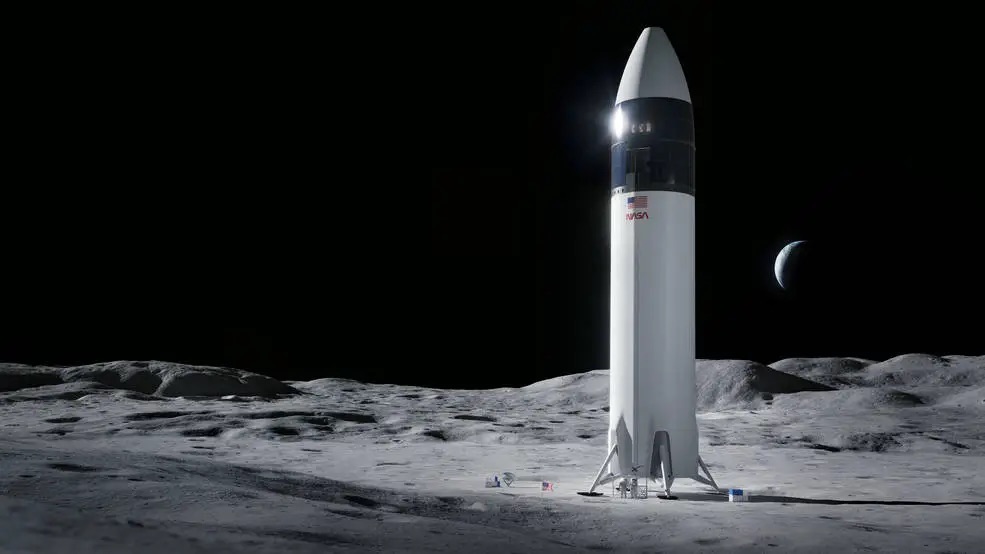
The first HLS selected by NASA is SpaceX‘s Starship HLS, a lunar-optimized variant of its massive, fully reusable Starship rocket. Standing roughly 50 meters (172 feet) tall, it is a radical departure from any lander that has come before. The entire vehicle is designed to land vertically on the Moon and then lift off from the surface to return to orbit, acting as a single stage. Because it will only operate in space, it lacks the heat shield and large fins of the Earth-reentry version of Starship.
Its mission architecture is equally unprecedented. A Starship HLS will first be launched uncrewed into Earth orbit. There, it will be fully refueled by a series of up to a dozen or more “tanker” Starship flights before it fires its engines to travel to lunar orbit. It will then wait for the Artemis crew to arrive aboard a separate Orion spacecraft. Two astronauts will transfer to the Starship for the descent to the surface. With a capacity to deliver over 100 metric tons of cargo in addition to the crew, its capabilities far exceed those of the Apollo LM. To get from the high-perched crew cabin down to the surface, astronauts will use a large elevator system built into the side of the vehicle.
Blue Moon: The National Team’s Approach
The second HLS provider is a “National Team” led by Blue Origin, which includes aerospace titans like Lockheed Martin, Draper, and Boeing. Their Blue Moon lander represents a more modular, though still massive, approach. The system consists of multiple elements, including a reusable crew lander, the Mark 2, and a separate cislunar space tug, built by Lockheed Martin, that will ferry the lander from Earth orbit to lunar orbit.
The Mark 2 lander is designed to carry a crew of four astronauts to the surface and support them for up to 30 days. The team’s plan also includes a smaller, robotic precursor lander called Mark 1. This uncrewed cargo vehicle is intended to deliver up to 3.3 tons of supplies and equipment to the surface and test key technologies, such as its high-efficiency BE-7 liquid oxygen/liquid hydrogen engine, ahead of the first human missions. This incremental strategy is designed to build confidence and systematically de-risk the final, complex human landing system.
| Feature | Apollo Lunar Module | Starship HLS (SpaceX) | Blue Moon (Blue Origin) |
|---|---|---|---|
| Program / Era | Apollo / 1960s-70s | Artemis / 2020s-30s | Artemis / 2020s-30s |
| Crew Capacity | 2 | 2, expanding to 4 | 4 |
| Architecture | Two-stage (disposable descent stage, ascent stage returns to orbit). | Single-stage to/from lunar surface. Requires orbital refueling. | Multi-element system with lander and cislunar space tug. |
| Reusability | None. Single-use. | Fully reusable lander. | Fully reusable lander. |
| Key Innovation | First vehicle to land humans on another world; two-stage design. | Massive scale; full reusability; orbital refueling mission profile. | High-efficiency hydrogen/oxygen engine (BE-7); modular architecture. |
| Mission Profile | Launched with crew on a single Saturn V rocket. | Launched uncrewed; refueled in Earth orbit; meets crew in lunar orbit. | Launched uncrewed; meets crew in lunar orbit via space tug. |
Establishing a Foothold: Visions of a Lunar Future
As multiple nations and companies develop the capability to land on the Moon, the future of lunar exploration is taking shape around two major, parallel international efforts. These grand visions will define humanity’s role on the Moon for decades to come, moving from short-term visits to a permanent presence.
The International Lunar Research Station (ILRS)
A major initiative is the International Lunar Research Station (ILRS), led by China and Russia. This project plans to establish a comprehensive scientific base on the lunar surface and/or in lunar orbit, designed for long-term robotic operation with the prospect of eventually hosting human crews. The ILRS is presented as a facility for multi-purpose research, including lunar geology, astronomy, and technology verification for in-situ resource utilization.
The ILRS is not just a bilateral project; it is actively recruiting its own coalition of international partners, with countries such as Pakistan, South Africa, Egypt, and Venezuela signing on. The project’s roadmap is a long-term, phased plan. The current reconnaissance phase (2021-2025) involves robotic missions to scout locations. This will be followed by a construction phase (2026-2035) to build a basic outpost at the lunar south pole, and finally a utilization phase (from 2036) to expand the station and support crewed missions. The emergence of the ILRS alongside the US-led Artemis program signals a significant shift from the post-Cold War model of space cooperation seen with the International Space Station. The future of lunar activity appears to be bifurcating into two major spheres of influence, each with its own partners and operating frameworks. This could spur development through competition, but also raises questions about resource management and geopolitical coordination on the lunar surface.
An Enduring Presence
The modern lunar landscape is no longer defined by a single type of lander or a single national goal. Instead, it is a vibrant and diverse ecosystem of specialized vehicles, each playing a critical role. There are the small, agile robotic scouts like Japan’s SLIM, which act as pathfinders, testing new technologies and opening up previously unreachable terrain. There are the commercial “delivery trucks” of the CLPS program, which are building a reliable supply chain and creating the foundations of a lunar economy. And there are the massive, reusable human transports of the Artemis program, the vehicles that will finally allow us to build, work, and stay.
Together, these landers form a pyramid of capability, with each layer supporting the one above it. The evolution of the lunar lander—from a 99 kg bouncing sphere to a towering, 50-meter-tall reusable spaceship—is the most tangible measure of our progress. It reflects a half-century of technological advancement and an unwavering human determination to establish an enduring foothold on the Moon, and from there, to look toward the worlds beyond.


