

As an Amazon Associate we earn from qualifying purchases.

- Orbital Launch Capacity
- How Orbital Launch Capacity Is Calculated
- Estimated Launch Capacity Based on Current Infrastructure
- Emerging and Inland Spaceports
- Historical Data on Launches
- Environmental and Regulatory Impacts
- US Launch Service Providers
- Forecast Spaceport Demand 2025 to 2034
- Current Spaceports Capacity versus Demand by 2034
- Summary
- What Questions Does This Article Answer?
- 10 Best-Selling Books About Elon Musk
- Elon Musk
- Elon Musk: Tesla, SpaceX, and the Quest for a Fantastic Future
- Liftoff: Elon Musk and the Desperate Early Days That Launched SpaceX
- Reentry: SpaceX, Elon Musk, and the Reusable Rockets That Launched a Second Space Age
- Power Play: Tesla, Elon Musk, and the Bet of the Century
- Insane Mode: How Elon Musk’s Tesla Sparked an Electric Revolution
- Ludicrous: The Unvarnished Story of Tesla Motors
- SpaceX: Elon Musk and the Final Frontier
- The Elon Musk Method: Business Principles from the World’s Most Powerful Entrepreneur
- Elon Musk: A Mission to Save the World
- 10 Best-Selling SpaceX Books
- Liftoff: Elon Musk and the Desperate Early Days That Launched SpaceX
- Reentry: SpaceX, Elon Musk, and the Reusable Rockets that Launched a Second Space Age
- SpaceX: Making Commercial Spaceflight a Reality
- SpaceX: Starship to Mars – The First 20 Years
- SpaceX’s Dragon: America’s Next Generation Spacecraft
- SpaceX: Elon Musk and the Final Frontier
- SpaceX From The Ground Up: 7th Edition
- Rocket Billionaires: Elon Musk, Jeff Bezos, and the New Space Race
- The Space Barons: Elon Musk, Jeff Bezos, and the Quest to Colonize the Cosmos
- Space Race 2.0: SpaceX, Blue Origin, Virgin Galactic, NASA, and the Privatization of the Final Frontier
Orbital Launch Capacity
Orbital launch capacity refers to the number of rockets a spaceport can send into orbit over a given period, usually a year. US spaceports play a key role in the nation’s space activities, supporting government missions, commercial satellites, and human spaceflight. Major sites include the Cape Canaveral Space Force Station and Kennedy Space Center in Florida, Vandenberg Space Force Base in California, Wallops Flight Facility in Virginia, the Pacific Spaceport Complex – Alaska in Kodiak, and Starbase in Boca Chica, Texas. These locations handle a mix of small, medium, and heavy-lift rockets.
How Orbital Launch Capacity Is Calculated
Spaceport operators determine capacity by looking at several practical factors. They start with the number of launch pads available, as each pad can only support one rocket at a time. Preparation time matters too—teams need days or weeks to assemble vehicles, fuel them, and check systems. Weather plays a part, since high winds or storms can delay operations, especially at coastal sites. Safety rules limit how closely launches can be scheduled to avoid risks to people or property on the ground.
Range infrastructure, like radar and tracking systems, sets limits on simultaneous activities. For example, if a site has multiple pads but shared control centers, that reduces overall throughput. Capacity often gets expressed as the maximum launches per year, assuming average conditions. It’s like figuring out how many planes an airport can handle, based on runways, gates, and air traffic control. Recent improvements, such as reusable rockets, have boosted numbers by shortening turnaround times.
Another key metric is payload mass to orbit, which measures the total kilograms delivered annually to low Earth orbit (LEO) or geostationary orbit (GEO). This complements launch counts by accounting for vehicle capabilities— a heavy-lift rocket like Starship can deliver far more mass than a small one like Electron. The formula for total mass capacity is: Total Mass Capacity = Sum (Launches × Average Payload per Vehicle). For instance, at Cape Canaveral, with a mix of Falcon 9 (up to 22,800 kg to LEO) and Vulcan Centaur (27,200 kg), estimates for 2025 suggest 500,000-1,000,000 kg annually, driven by SpaceX’s dominance in mass delivery (84% globally in early 2025).
Estimated Launch Capacity Based on Current Infrastructure
Each spaceport’s capacity stems from its existing pads, support buildings, and range equipment. Operators assess this by tallying active pads, estimating turnaround times per vehicle type, and factoring in shared resources like tracking radars or fuel storage. Turnaround time includes assembly, testing, fueling, and post-launch cleanup. Weather windows and safety buffers add variability, so estimates assume 80-90% uptime annually. The general formula for annual capacity is: Capacity = (Number of Pads × 365) / Average Turnaround Time × (1 – Downtime Fraction). Below, details for each site outline the key elements and resulting capacity.
Cape Canaveral and Kennedy Space Center
This combined range features around seven active or planned orbital pads: SLC-40 and LC-39A for SpaceX vehicles, SLC-41 and SLC-37 for United Launch Alliance, LC-39B for NASA’s Space Launch System, smaller sites like LC-13, and SLC-20 leased by Firefly Aerospace for future operations. Infrastructure includes multiple control centers, fuel depots, and radar arrays supporting high traffic. SpaceX is building Starship launch and catch infrastructure at LC-39A, with completion expected in late 2025. To calculate capacity, consider each pad’s potential: reusable rockets like Falcon 9 allow 5-7 day turnarounds, enabling 50-70 launches per pad yearly, while heavier systems need 30-60 days, limiting them to 6-12. Shared range operations cap the total at about 150, accounting for weather delays (10-20% downtime) and maintenance. Current estimates place capacity at 120-150 launches per year, with potential for 200 as upgrades continue.
| Parameter | Value |
|---|---|
| Number of Active Pads | 6 |
| Average Turnaround Time (Days) | 10 |
| Downtime Fraction | 0.15 |
| Additional Limits | Shared range operations |
Vandenberg Space Force Base
The base hosts five main pads: SLC-4E for SpaceX Falcon, SLC-6 upgrading for additional Falcon operations, SLC-3E for United Launch Alliance Vulcan, SLC-2W for small rockets including Firefly Aerospace Alpha, and SLC-8 for emerging providers. Support includes dedicated radar, telemetry stations, and fuel facilities tailored for polar orbits. Capacity calculation weighs pad-specific rates: SLC-4E handles 40-50 launches with quick reusability, while others manage 10-20 due to longer prep. Range-wide limits from shared tracking and safety protocols reduce overlap, with 10-15% downtime for fog or winds. Overall, this yields 80-100 launches annually, expanding to 120 with SLC-6 fully online.
| Parameter | Value |
|---|---|
| Number of Active Pads | 5 |
| Average Turnaround Time (Days) | 15 |
| Downtime Fraction | 0.125 |
| Additional Limits | Shared tracking protocols |
Wallops Flight Facility
Wallops operates three active pads: Pad 0A for medium rockets like the Medium Launch Vehicle, Pad 0B for small vehicles, LC-2 for Rocket Lab Electron launches, and Launch Complex 3 under development for Rocket Lab Neutron, with Pad 0D under construction. Infrastructure features a payload processing facility, control center, and UAS airfield, focused on smaller missions. Pad 0A is being configured to support Firefly Aerospace Alpha launches as early as 2025, alongside the Medium Launch Vehicle. To estimate, note small rockets turn around in 7-14 days (25-50 per pad), but liquid fuel limits (only six allowed yearly) and shared range constrain totals. Downtime hits 20% from Atlantic weather. Current capacity sits at 18-30 launches, rising to 50 once expansions finish.
| Parameter | Value |
|---|---|
| Number of Active Pads | 3 |
| Average Turnaround Time (Days) | 20 |
| Downtime Fraction | 0.20 |
| Additional Limits | Liquid fuel restrictions |
Pacific Spaceport Complex – Alaska
The complex includes Pads 1 and 2 for small rockets, Pad 3B (formerly Astra), and Pad 3C for new users, plus a rocket assembly building and control center. Its remote setup suits polar orbits, with fuel storage and instrumentation fields. Capacity derives from pad throughput: small vehicles allow 10-20 per pad with 2-4 week cycles, but logistics and weather (15-25% downtime) limit site-wide totals. Licensed for up to 25, the estimate is 20-30 launches yearly as demand grows.
| Parameter | Value |
|---|---|
| Number of Active Pads | 4 |
| Average Turnaround Time (Days) | 21 |
| Downtime Fraction | 0.20 |
| Additional Limits | Logistics constraints |
Starbase Boca Chica
Starbase has Orbital Launch Pad A operational and Pad B nearing completion, with assembly factories, control centers, and methane farms for Starship. Focused on heavy-lift reusability, pads support integrated testing. Calculation accounts for 30-60 day turnarounds initially, dropping to weeks with maturity, enabling 12-25 per pad. Regulatory caps at 25 launches and 50 landings, plus Gulf weather (10-15% downtime), set current capacity at 25 annually, scaling with experience.
| Parameter | Value |
|---|---|
| Number of Active Pads | 2 |
| Average Turnaround Time (Days) | 45 |
| Downtime Fraction | 0.125 |
| Additional Limits | Regulatory caps |
Emerging and Inland Spaceports
While coastal spaceports dominate current operations, emerging and inland sites offer potential for diversification and resilience. These facilities, often starting with suborbital tests, aim to support orbital launches as demand surges. Spaceport America in New Mexico stands out as the world’s first purpose-built commercial spaceport. Established in 2006, it has hosted over 300 suborbital flights, including Virgin Galactic’s crewed missions. In 2025, updates to its master plan include infrastructure for orbital capabilities, such as new fuel storage and assembly buildings. The site benefits from vast overland trajectories, reducing risks to populated areas, and supports small to medium vehicles with quick turnaround.
Other inland efforts include the Mid-Atlantic Regional Spaceport at Wallops (already covered but expanding), and proposals in Colorado and Michigan. For instance, Michigan’s Spaceport initiative, backed by FAA grants in 2025, focuses on polar orbits from the Upper Peninsula, leveraging Great Lakes access for safety. These sites address coastal bottlenecks—FAA forecasts predict demand exceeding 300 launches annually by 2030, straining Florida and California. Inland locations mitigate weather vulnerabilities (e.g., hurricanes) and enhance national security by dispersing assets.
Capacity for these sites remains modest, with Spaceport America estimating 10-20 orbital launches yearly by 2028, assuming regulatory approval for inclined orbits. Challenges include environmental reviews and infrastructure costs, but benefits like lower congestion and strategic redundancy make them vital. As opinion pieces argue, unlocking inland orbital launch is essential for a resilient US future, reducing dependence on vulnerable coasts. Partnerships with providers like Firefly Aerospace could accelerate adoption, positioning inland spaceports as key players in the next decade.
Historical Data on Launches
Over the past decade, US spaceports have seen steady growth in orbital launches, driven by commercial demand for satellite constellations. The data below shows annual counts for successful and unsuccessful orbital launches at each major site from 2015 to 2024, with partial figures for 2025 up to August 11. These figures come from public Siri Siri Siri Sirirecords and reflect missions that attempted to reach orbit, with success defined as achieving the intended orbit. By mid-2025, the US has achieved over 110 launches, a record pace led by SpaceX, with projections for 200+ by year-end.
Cape Canaveral and Kennedy Space Center
This Florida hub has led in activity, thanks to its equatorial location favoring geostationary orbits. Launches ramped up with SpaceX‘s Falcon 9 and United Launch Alliance‘s vehicles. In 2025, over 60 successful launches YTD, including New Glenn’s debut.
| Year | Successful | Unsuccessful |
|---|---|---|
| 2015 | 17 | 1 |
| 2016 | 19 | 1 |
| 2017 | 18 | 0 |
| 2018 | 16 | 0 |
| 2019 | 13 | 1 |
| 2020 | 26 | 0 |
| 2021 | 31 | 0 |
| 2022 | 57 | 2 |
| 2023 | 72 | 1 |
| 2024 | 93 | 0 |
| 2025 (partial) | 62 | 1 |
Vandenberg Space Force Base
Focused on polar orbits for Earth observation satellites, Vandenberg’s launches grew with national security needs and commercial payloads. 2025 YTD: 30 successful, including Firefly Alpha.
| Year | Successful | Unsuccessful |
|---|---|---|
| 2015 | 5 | 0 |
| 2016 | 8 | 0 |
| 2017 | 6 | 0 |
| 2018 | 3 | 0 |
| 2019 | 8 | 0 |
| 2020 | 3 | 0 |
| 2021 | 4 | 1 |
| 2022 | 9 | 1 |
| 2023 | 26 | 1 |
| 2024 | 51 | 1 |
| 2025 (partial) | 30 | 0 |
Wallops Flight Facility
This site specializes in smaller rockets for science missions, with fewer but consistent launches. 2025 YTD: 3 successful, with Neutron prep.
| Year | Successful | Unsuccessful |
|---|---|---|
| 2015 | 0 | 0 |
| 2016 | 1 | 0 |
| 2017 | 1 | 0 |
| 2018 | 1 | 0 |
| 2019 | 1 | 0 |
| 2020 | 1 | 0 |
| 2021 | 1 | 0 |
| 2022 | 0 | 0 |
| 2023 | 1 | 0 |
| 2024 | 2 | 0 |
| 2025 (partial) | 3 | 0 |
Pacific Spaceport Complex – Alaska
Kodiak has supported occasional small-lift missions, with activity picking up in recent years before tapering off. 2025 YTD: 1 successful.
| Year | Successful | Unsuccessful |
|---|---|---|
| 2015 | 0 | 0 |
| 2016 | 0 | 0 |
| 2017 | 0 | 0 |
| 2018 | 0 | 2 |
| 2019 | 0 | 0 |
| 2020 | 0 | 2 |
| 2021 | 1 | 1 |
| 2022 | 1 | 0 |
| 2023 | 0 | 1 |
| 2024 | 0 | 0 |
| 2025 (partial) | 0 | 0 |
Starbase Boca Chica
Development focused on Starship, with initial test flights starting in 2023. 2025 YTD: 3 failed orbital attempts.
| Year | Successful | Unsuccessful |
|---|---|---|
| 2015 | 0 | 0 |
| 2016 | 0 | 0 |
| 2017 | 0 | 0 |
| 2018 | 0 | 0 |
| 2019 | 0 | 0 |
| 2020 | 0 | 0 |
| 2021 | 0 | 0 |
| 2022 | 0 | 0 |
| 2023 | 0 | 2 |
| 2024 | 3 | 1 |
| 2025 (partial) | 0 | 3 |
Environmental and Regulatory Impacts
As launch frequency increases, environmental and regulatory factors increasingly influence capacity. The FAA requires Environmental Impact Statements (EIS) for major expansions, assessing impacts on air quality, noise, wildlife, and ecosystems. For example, the draft EIS for SpaceX’s Starship at Cape Canaveral, published August 1, 2025, analyzes infrastructure like new towers and their effects on Merritt Island National Wildlife Refuge. Concerns include noise disrupting endangered species like manatees and sea turtles, and light pollution affecting migration patterns.
Rocket emissions contribute to atmospheric changes, with methane from Starship or kerosene from Falcon adding to greenhouse gases. A 2025 study estimates global launches could increase stratospheric ozone depletion by 1-2% if unchecked. Reusability helps mitigate, as fewer vehicles mean less debris, but orbital congestion from Starlink satellites raises collision risks. Regulatory delays, like FAA’s expanded hazard areas for Starship Flight 9 in May 2025, cap cadence at sites like Boca Chica. Public input, including protests for full EIS on Starship, underscores tensions between innovation and sustainability.
Mitigation includes wildlife monitoring, emission offsets, and reusable tech. For New Glenn, Blue Origin’s 2025 launches incorporated eco-friendly designs, but ongoing reviews for Vulcan at Vandenberg highlight water usage concerns. These factors can reduce effective capacity by 10-20% through delays or limits, emphasizing the need for balanced growth.
US Launch Service Providers
The US hosts several companies that provide orbital launch services or develop capabilities for them. These entities range from established defense contractors to innovative startups, each contributing to the expanding space economy. Below is a description of key providers, their company status, and their orbital launch vehicles.
SpaceX, a private company founded in 2002, pioneered reusable rocket technology and dominates commercial launches. It operates the Falcon family and develops Starship for heavier payloads and deep space missions.
United Launch Alliance, a joint venture between Boeing and Lockheed Martin formed in 2006, focuses on reliable launches for government customers. It transitions from legacy vehicles to the Vulcan Centaur.
Rocket Lab, a public company listed on NASDAQ since 2021, specializes in small satellite deployments. Founded in 2006, it runs the Electron and develops Neutron for larger loads.
Northrop Grumman, a public aerospace and defense firm, offers the Minotaur variants for small government missions and develops Medium Launch Vehicle (Antares 330) in partnership with Firefly.
Blue Origin, a private company founded in 2000 by Jeff Bezos, builds engines and vehicles. It operates New Glenn for orbital flights.
Firefly Aerospace, a public firm established in 2014, targets responsive small-lift services with the Alpha rocket and develops Eclipse for medium payloads. It operates from Vandenberg and plans sites at Cape Canaveral and Wallops, with an international partnership at Esrange Space Centre in Sweden for launches starting in 2026.
Relativity Space, a private company founded in 2015, uses 3D printing for manufacturing. It develops Terran R after retiring Terran 1.
Stoke Space, a private startup founded in 2019, works on fully reusable rockets with the Nova vehicle. In 2025, it secured DoD contracts for certification, expanding national security options.
| Launch Service Provider | Launch Vehicle | Status | Current Spaceport Launching From | Announced Plans for Future Spaceport |
|---|---|---|---|---|
| SpaceX | Falcon 9 | operational | Cape Canaveral Space Force Station, Kennedy Space Center, Vandenberg Space Force Base | None |
| SpaceX | Falcon Heavy | operational | Kennedy Space Center | None |
| SpaceX | Starship | under development | Starbase Boca Chica | Kennedy Space Center |
| United Launch Alliance | Atlas V | operational | Cape Canaveral Space Force Station, Vandenberg Space Force Base | None |
| United Launch Alliance | Vulcan Centaur | operational | Cape Canaveral Space Force Station | Vandenberg Space Force Base |
| Rocket Lab | Electron | operational | Wallops Flight Facility | None |
| Rocket Lab | Neutron | under development | None | Wallops Flight Facility |
| Northrop Grumman | Medium Launch Vehicle | under development | None | Wallops Flight Facility |
| Northrop Grumman | Minotaur | operational | Wallops Flight Facility, Vandenberg Space Force Base | None |
| Blue Origin | New Glenn | operational | Cape Canaveral Space Force Station | None |
| Firefly Aerospace | Alpha | operational | Vandenberg Space Force Base | Cape Canaveral Space Force Station, Wallops Flight Facility |
| Firefly Aerospace | Eclipse | under development | None | Vandenberg Space Force Base, Cape Canaveral Space Force Station, Wallops Flight Facility |
| Relativity Space | Terran R | under development | None | Cape Canaveral Space Force Station, Vandenberg Space Force Base |
| Stoke Space | Nova | under development | None | Vandenberg Space Force Base |
Forecast Spaceport Demand 2025 to 2034
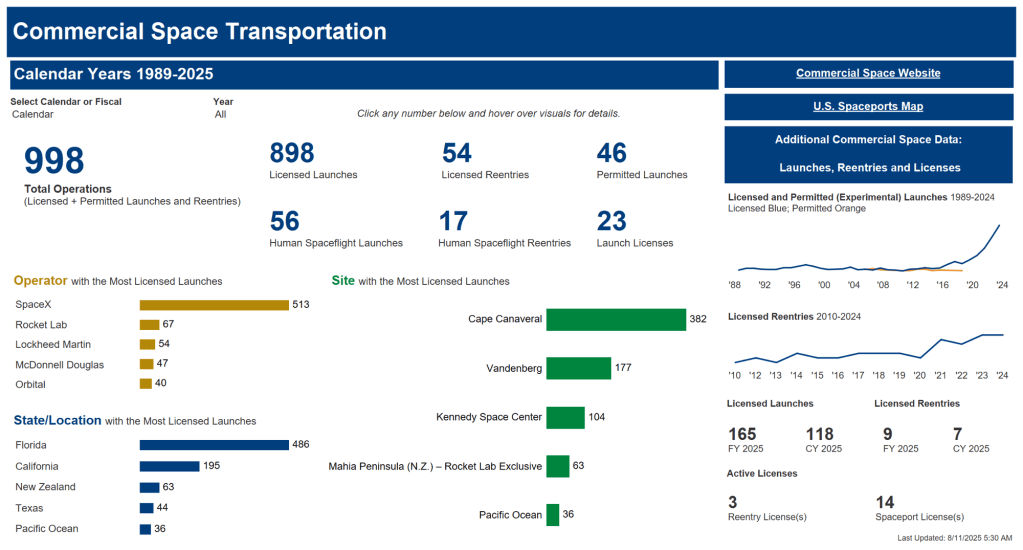
Looking ahead to 2025 through 2034, experts expect explosive growth in US launches, potentially reaching hundreds annually nationwide. Estimates draw from government forecasts and company plans, with totals rising from about 180 in 2025 to over 500 in 2034 in optimistic scenarios. Breakdowns by spaceport, provider, and vehicle reflect current contracts and development trends.
Cape Canaveral and Kennedy Space Center
Projections show this site handling the bulk of activity, with SpaceX dominating via Falcon 9 for Starlink deployments. United Launch Alliance will shift to Vulcan Centaur, and Blue Origin enters with New Glenn.
- SpaceX (Falcon 9): 80-120 launches per year, totaling around 1,000 over the decade.
- United Launch Alliance (Vulcan Centaur): 10-20 per year, totaling 150.
- Blue Origin (New Glenn): 5-15 per year starting 2025, totaling 100.
- Others (e.g., Firefly Aerospace Alpha and Eclipse): 5-10 per year, totaling 70.
Annual average: 100-150 launches.
Vandenberg Space Force Base
Emphasis on polar orbits will drive growth, with SpaceX leading and new entrants like Firefly Aerospace adding volume.
- SpaceX (Falcon 9): 40-60 per year, totaling 500.
- United Launch Alliance (Vulcan Centaur): 5-10 per year, totaling 70.
- Firefly Aerospace (Alpha): 5-10 per year, totaling 60.
- Relativity Space (Terran R): 5-10 per year starting late decade, totaling 40.
- Stoke Space (Nova): 2-5 per year, totaling 30.
Annual average: 60-90 launches.
Wallops Flight Facility
Smaller scale persists, but new vehicles like Firefly Alpha and Rocket Lab Electron boost numbers, with Neutron launches starting in late 2025.
- Northrop Grumman (Medium Launch Vehicle): 1-2 per year, totaling 15.
- Firefly Aerospace (Alpha): 2-4 per year, totaling 30.
- Rocket Lab (Electron): 1-3 per year, totaling 20.
- Rocket Lab (Neutron): 5-10 per year starting 2025, totaling 60.
Annual average: 5-10 launches.
Pacific Spaceport Complex – Alaska
Revival through small-lift providers, with potential for 10-20 annual by 2034 if new companies succeed.
- Various small providers: 1-5 per year, totaling 30.
Annual average: 2-8 launches.
Starbase Boca Chica
SpaceX‘s Starship could transform capacity, aiming for rapid reusability and high cadence.
- SpaceX (Starship): 10-50 per year ramping up, totaling 300-500.
Annual average: 30-50 launches.
Global Comparison
US spaceports lead globally, with 110 launches in 2025 YTD, representing over 60% of worldwide activity. China follows with 42, Russia 9, India 3, and Europe 3. China’s Wenchang and Jiuquan sites emphasize heavy-lift for lunar missions, while Europe’s Kourou focuses on Ariane 6. US dominance stems from commercial innovation, but China’s rapid growth (up 20% YoY) poses competition in mass to orbit—Starship deployed 1,500 tons in 2024. Europe’s delays with Ariane highlight US reusability advantages, but global congestion raises debris concerns. By 2034, US could handle 500 launches if inland sites mature, maintaining edge over China’s projected 200.
Current Spaceports Capacity versus Demand by 2034
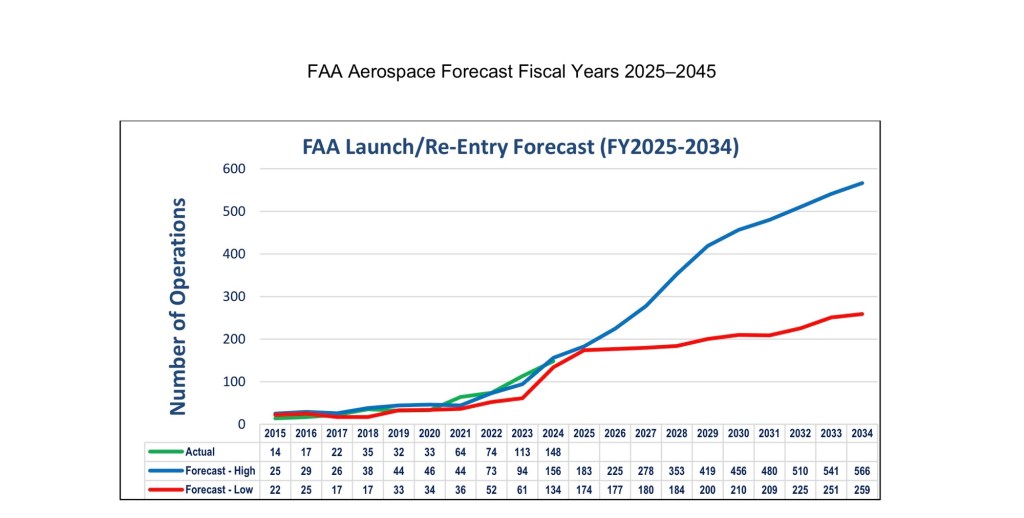
Projections indicate significant growth in launch demand by 2034, driven by satellite constellations, reusability advancements, and new providers. Current capacities may require expansions to meet this demand, based on FAA forecasts showing up to 566 operations (includes Commercial launches and reentry operations, but does not include Federal launches and reentry operations) nationwide in FY2034 under high scenarios.


| Spaceport | Current Estimated Capacity (Launches/Year) | Estimated Demand by 2034 (Launches/Year) |
|---|---|---|
| Cape Canaveral and Kennedy Space Center | 120-150 | 200-250 |
| Vandenberg Space Force Base | 80-100 | 150-200 |
| Wallops Flight Facility | 18-30 | 20-30 |
| Pacific Spaceport Complex – Alaska | 20-30 | 10-20 |
| Starbase Boca Chica | 25 | 100-150 |
Summary
US spaceports have evolved from modest operations to high-volume hubs, with capacity shaped by infrastructure and demand. Historical trends show acceleration, especially at Cape Canaveral and Vandenberg, with occasional unsuccessful attempts highlighting the challenges of spaceflight. Future growth depends on reusable technology and satellite markets, promising a vibrant era for space access.
10 Best-Selling Books About Elon Musk
Elon Musk
Walter Isaacson’s biography follows Elon Musk’s life from his upbringing in South Africa through the building of PayPal, SpaceX, Tesla, and other ventures. The book focuses on decision-making under pressure, engineering-driven management, risk tolerance, and the interpersonal dynamics that shaped Musk’s companies and public persona, drawing a continuous timeline from early influences to recent business and product cycles.
Elon Musk: Tesla, SpaceX, and the Quest for a Fantastic Future
Ashlee Vance presents a narrative biography that links Musk’s personal history to the founding and scaling of Tesla and SpaceX. The book emphasizes product ambition, factory and launch-site realities, leadership style, and the operational constraints behind headline achievements. It also covers setbacks, funding pressures, and the management choices that made Musk both influential in technology and controversial in public life.
Liftoff: Elon Musk and the Desperate Early Days That Launched SpaceX
Eric Berger reconstructs SpaceX’s earliest phase, when technical failures, schedule slips, and financing risk threatened the company’s survival. The book centers on Musk’s role as founder and chief decision-maker while highlighting engineers, mission teams, and launch operations. Readers get a detailed account of how early launch campaigns, investor expectations, and engineering tradeoffs shaped SpaceX’s culture and trajectory.
Reentry: SpaceX, Elon Musk, and the Reusable Rockets That Launched a Second Space Age
Also by Eric Berger, this book explains how SpaceX pushed reusable rocketry from uncertain experiments into repeatable operations. It tracks the technical, financial, and organizational choices behind landing attempts, iterative design changes, and reliability improvements. Musk is presented as a central driver of deadlines and risk posture, while the narrative stays grounded in how teams translated high-level direction into hardware and flight outcomes.
Power Play: Tesla, Elon Musk, and the Bet of the Century
Tim Higgins examines Tesla’s transformation from a niche automaker into a mass-production contender, with Musk as the primary strategist and public face. The book covers internal conflict, production bottlenecks, financing stress, executive turnover, and the consequences of making manufacturing speed a defining business strategy. It reads as a business history of Tesla that ties corporate governance and product decisions directly to Musk’s leadership approach.
Insane Mode: How Elon Musk’s Tesla Sparked an Electric Revolution
Hamish McKenzie tells Tesla’s story through the lens of product launches, market skepticism, and the organizational strain of rapid scaling. Musk appears as both brand amplifier and operational catalyst, while the narrative highlights the role of teams and supply chains in making electric vehicles mainstream. The book is written for nontechnical readers who want context on EV adoption, Tesla’s business model, and Musk’s influence on expectations in the auto industry.
Ludicrous: The Unvarnished Story of Tesla Motors
Edward Niedermeyer offers an investigative look at Tesla’s early and mid-stage growth, emphasizing the tension between engineering reality, marketing narratives, and investor expectations. Musk’s leadership is examined alongside product delays, quality concerns, and strategic messaging, with attention to how a high-profile CEO can shape both market perception and internal priorities. The result is a critical business narrative focused on what it took to keep Tesla expanding.
SpaceX: Elon Musk and the Final Frontier
Brad Bergan presents an accessible overview of SpaceX’s development and its place in the modern space industry, with Musk as the central figure connecting financing, engineering goals, and public messaging. The book describes major programs, launch milestones, and the economic logic of lowering launch costs. It also situates Musk’s influence within the broader ecosystem of government contracts, commercial customers, and competitive pressure.
The Elon Musk Method: Business Principles from the World’s Most Powerful Entrepreneur
Randy Kirk frames Musk as a case study in execution, product focus, and decision-making speed, translating observed patterns into general business lessons. The book discusses leadership behaviors, hiring expectations, prioritization, and the use of aggressive timelines, while keeping the focus on how Musk’s style affects organizational output. It is positioned for readers interested in entrepreneurship and management practices associated with Musk-led companies.
Elon Musk: A Mission to Save the World
Anna Crowley Redding provides a biography-style account that emphasizes Musk’s formative experiences and the stated motivations behind Tesla and SpaceX. The book presents his career as a sequence of high-stakes projects, explaining how big technical goals connect to business choices and public visibility. It is written in clear language for general readers who want a straightforward narrative of Musk’s life, work, and the controversies that follow disruptive companies.
10 Best-Selling SpaceX Books
Liftoff: Elon Musk and the Desperate Early Days That Launched SpaceX
This narrative-driven SpaceX history focuses on the company’s earliest, most uncertain years, following the engineering, leadership, and operational decisions behind the first Falcon 1 attempts. It emphasizes how tight budgets, launch failures, and rapid iteration shaped SpaceX’s culture and set the foundation for later achievements in commercial spaceflight and reusable rockets.
Reentry: SpaceX, Elon Musk, and the Reusable Rockets that Launched a Second Space Age
Centered on the push to land and reuse orbital-class boosters, this book explains how SpaceX turned Falcon 9 reusability from a risky concept into a repeatable operational system. It connects engineering tradeoffs, test failures, launch cadence, and business pressure into a clear account of how reuse affected pricing, reliability, and the modern launch market.
SpaceX: Making Commercial Spaceflight a Reality
Written in an accessible explanatory style, this overview links SpaceX’s design philosophy to outcomes such as simpler manufacturing, vertically integrated production, and faster development cycles. It also frames how NASA partnerships and fixed-price contracting helped reshape the U.S. launch industry, with SpaceX as a central example of commercial spaceflight becoming routine.
SpaceX: Starship to Mars – The First 20 Years
This SpaceX book places Starship in the broader arc of the company’s first two decades, tying early Falcon programs to the scale of fully reusable systems. It explains why Starship’s architecture differs from Falcon 9, what has to change to support high flight rates, and how long-duration goals like Mars transport drive requirements for heat shields, engines, and rapid turnaround.
SpaceX’s Dragon: America’s Next Generation Spacecraft
Focusing on the Dragon spacecraft family, this account explains capsule design choices, cargo and crew mission needs, and how spacecraft operations differ from rocket operations. It provides a readable path through docking, life-support constraints, recovery logistics, and reliability considerations that matter when transporting people and supplies to orbit through NASA-linked programs.
SpaceX: Elon Musk and the Final Frontier
This photo-rich SpaceX history uses visuals and concise text to trace milestones from early launches to newer systems, making it suitable for readers who want context without technical density. It highlights facilities, vehicles, and mission highlights while explaining how Falcon 9, Dragon, and Starship fit into SpaceX’s long-term strategy in the private space industry.
SpaceX From The Ground Up: 7th Edition
Designed as a structured guide, this book summarizes SpaceX vehicles, launch sites, and mission progression in a reference-friendly format. It is especially useful for readers who want a clear overview of Falcon 9, Falcon Heavy, Dragon variants, and Starship development context, with an emphasis on how launch services and cadence influence SpaceX’s market position.
Rocket Billionaires: Elon Musk, Jeff Bezos, and the New Space Race
This industry narrative explains how SpaceX emerged alongside other private space efforts, showing how capital, contracts, and competitive pressure influenced design and launch decisions. SpaceX appears as a recurring anchor point as the book covers the shift from government-dominated space activity to a market where reusable rockets and rapid development cycles reshape expectations.
The Space Barons: Elon Musk, Jeff Bezos, and the Quest to Colonize the Cosmos
This book compares leadership styles and program choices across major private space players, with SpaceX as a principal thread in the story. It connects SpaceX’s execution pace to broader outcomes such as launch market disruption, NASA partnership models, and the changing economics of access to orbit, offering a balanced, journalistic view for nontechnical readers.
Space Race 2.0: SpaceX, Blue Origin, Virgin Galactic, NASA, and the Privatization of the Final Frontier
This wide-angle look at privatized space activity places SpaceX within an ecosystem of competitors, partners, and regulators. It clarifies how NASA procurement, launch infrastructure, and commercial passenger and cargo missions intersect, while showing how SpaceX’s approach to reuse and production scale helped define expectations for the modern commercial spaceflight era.
What Questions Does This Article Answer?
- How is orbital launch capacity calculated at spaceports?
- What factors influence the number of launches a spaceport can handle annually?
- Which US spaceports are major sites for orbital launches and what types of rockets do they handle?
- How do weather conditions affect launch schedules at spaceports?
- What are the estimated launch capacities for major US spaceports like Cape Canaveral and Vandenberg Space Force Base?
- How do reusable rockets impact the launch capacity of spaceports?
- What is the payload mass to orbit, and how is it calculated?
- How do spaceport infrastructure and shared resources like radars influence launch capacity?
- What environmental and regulatory challenges do spaceports face as launch frequency increases?
- What are the projected future demands and capacities for US spaceports from 2025 to 2034?


