


The Florida SpaceReport serves as a valuable chronicle of the global space sector, synthesizing thousands of developments into digestible news briefs. An analysis of weekly newsletter issues covering reporting from February 2025 through December 2025 revealed a total of 2,909 unique articles. These articles collectively referenced 695 distinct sources, demonstrating a wide-ranging and diverse foundation of reporting.
Understanding which sources are most frequently used and how they’re distributed across articles helps illuminate the information architecture supporting public and industry awareness of space affairs. This analysis presents key patterns in source usage and highlights the leading outlets shaping the space narrative.
The Most Frequently Cited Sources
A handful of outlets appear repeatedly across articles, signaling their consistent role in space news reporting. The top sources used were:
- Space News: 558 mentions
- Space Daily: 264 mentions
- Space.com: 108 mentions
- NASA: 78 mentions
- Space Review: 59 mentions
These five sources accounted for over a third of all attributions, with Space News emerging as the dominant provider of original reporting and industry updates.
Distribution Across Source Types
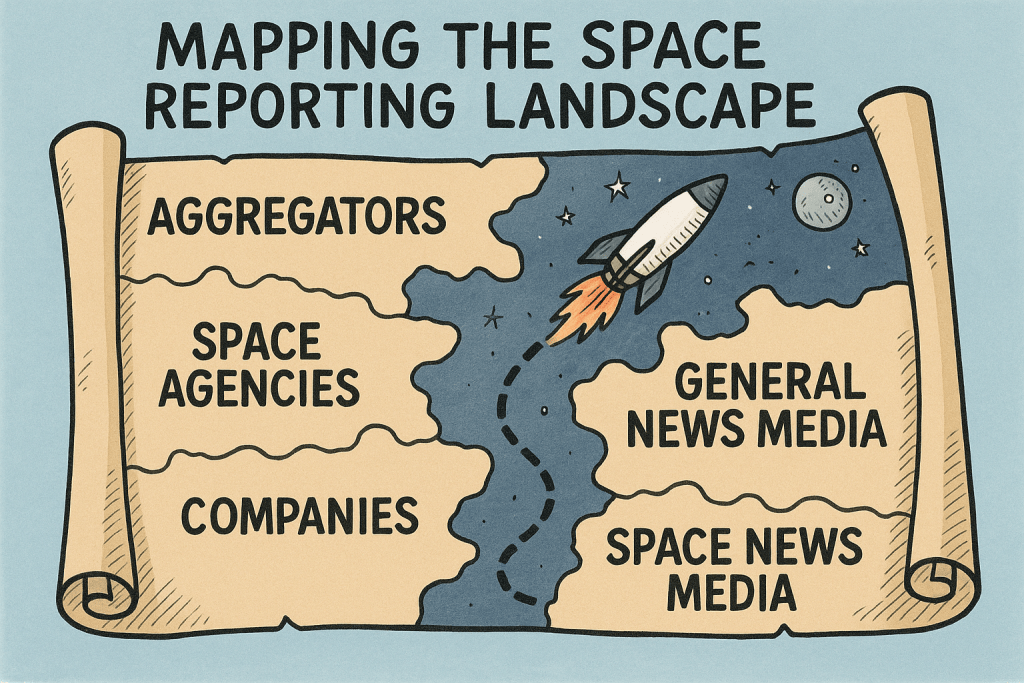
The sources used in the newsletter span a spectrum of categories, including:
- Authoritative Space News Outlets
Sites like Space News, Space Daily, and Space.com provided detailed coverage of industry developments, technology demonstrations, policy shifts, and launch operations. - Space Agencies and Government Institutions
Official websites such as NASA, ESA, JAXA, and ISRO were cited when referencing mission outcomes, funding decisions, or executive-level announcements. - Satellite-Focused Reporting
Publications like Via Satellite and Space Intel Report contributed content relating to satellite markets, communication technologies, and commercial constellations. - Launch Schedule Sources
Launch tracking relied on data from outlets like Next Spaceflight, RocketLaunch.live, and Spaceflight Now, all of which publish up-to-date calendars of upcoming space missions. - Aggregators and Syndicated Content Sites
High-volume republishing outlets, such as Space Daily, combine syndicated articles from agencies, wire services, and smaller news providers. Their high citation count reflects this aggregation strategy. - General-Purpose News Outlets with Space Sections
Although not space-exclusive, major platforms like BBC, Reuters, and The Guardian were frequently cited when breaking stories intersected with global politics, economics, or public interest.
Source Redundancy and Aggregation Effects
One feature of the dataset is a visible pattern of source redundancy due to content aggregation. For example, Space Daily often republishes articles from NASA, JAXA, and ESA, resulting in multiple mentions of the aggregator rather than the originating agency.
This affects source counting by inflating the presence of secondary sites while obscuring the actual origin of primary content. While Space News and Space Review tend to publish original analysis and reporting, many aggregators function as amplifiers rather than creators of content.
Breadth of Sources
With 695 unique sources represented, the Florida SpaceReport draws from a broad landscape of organizations, websites, and media platforms. This diversity suggests a deliberate effort to include international voices and local developments alongside well-established media channels.
Lesser-known or regional sources—such as national agency press portals or foreign-language translations—contributed to coverage of non-U.S. events. Examples include:
The Role of Official Agency Press Pages
Press release sections from national space agencies often served as primary sources for updates on launches, partnerships, and internal restructuring. These include:
These sources tend to offer factual updates without commentary, providing clean and authoritative information useful for newsletter synthesis.
Underrepresented but Emerging Sources
A number of sources appeared only occasionally in the data but could become more prominent due to increasing regional launch activity or commercial development. These include:
Similarly, private firms like Blue Origin, Rocket Lab, and Firefly Aerospace may see increased citations as their public communications grow.
Importance of Launch Tracking Sources
Launch tracking websites played an important role in verifying dates and outcomes of missions. These sources publish pre-launch schedules, real-time updates, and post-launch summaries, which are indispensable for weekly newsletters. The most commonly used among them were:
These sites compile information from spaceports, space agencies, and live telemetry streams, filling gaps not always covered in traditional media.
Summary
The analysis of the Florida SpaceReport reveals a structured and consistent reliance on a core group of authoritative space-focused websites, balanced by a wider array of international agencies, aggregators, and general news outlets. Space News and Space Daily are the dominant sources, accounting for a significant share of citations, while press portals from agencies like NASA and ESA provide first-hand mission data. As the global space sector expands, the diversity and depth of source usage in publications like this newsletter will continue to shape public understanding of space developments.
Appendix: Top 50 Source References
| Source | Total Uses |
|---|---|
| Space News | 558 |
| Space Daily | 264 |
| Space.com | 108 |
| NASA | 78 |
| Space Review | 59 |
| Phys.org | 42 |
| Bloomberg | 37 |
| Breaking Defense | 36 |
| Ars Technica | 35 |
| Reuters | 33 |
| Florida Today | 30 |
| Teslarati | 28 |
| Parabolic Arc | 26 |
| Defense News | 24 |
| Space Intel Report | 21 |
| Aviation Week | 20 |
| CNBC | 19 |
| Defense One | 17 |
| SpaceWatch.Global | 16 |
| Wall Street Journal | 15 |
| CNET | 14 |
| Defense News | 14 |
| Spaceflight Now | 13 |
| U.S. Department of Defense | 13 |
| The Verge | 12 |
| U.S. Space Force | 11 |
| Eutelsat | 11 |
| Air & Space Forces Magazine | 10 |
| SpaceRef | 10 |
| ESA | 10 |
| Sky News | 10 |
| The Independent | 9 |
| Satellite Today | 9 |
| Planet | 8 |
| Space Newsfeed | 8 |
| Rocket Lab | 8 |
| Arianespace | 8 |
| Lockheed Martin | 7 |
| The Space Report | 7 |
| ABC News Australia | 7 |
| MSN | 7 |
| Yahoo News | 6 |
| Space Capstone | 6 |
| Space Launch Report | 6 |
| CNN | 6 |
| Business Insider | 6 |
| NOAA | 6 |
| Space Policy Online | 6 |
| GlobalSecurity.org | 6 |
| SpaceWatch.Global | 6 |
| Airbus | 6 |


