


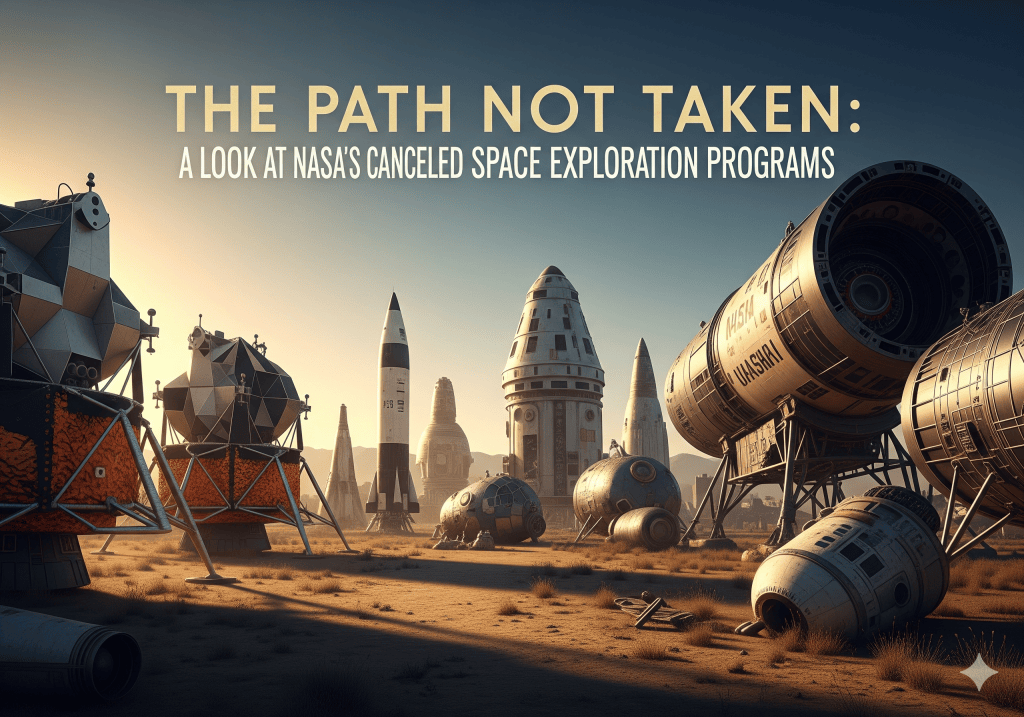
The story of space exploration is often told through its triumphs—the towering Saturn V rocket, the first footprints on the Moon, the rovers trekking across Mars. But for every mission that reaches the launch pad, many more never make it past the drawing board. The history of NASA is also a history of ambitious programs that were conceived, developed, and ultimately canceled. These projects, often victims of shifting political winds, budgetary constraints, or technological hurdles, represent alternate futures for space exploration that were never realized. Understanding these paths not taken provides a deeper appreciation for the complex challenges of venturing beyond Earth.
The Post-Apollo Vision: Ambition Meets Reality
The success of the Apollo program in the 1960s created a sense of boundless possibility at NASA. With the Moon conquered, the agency’s engineers and planners looked toward the next logical steps: establishing a permanent human presence in space and mounting a crewed mission to Mars. This post-Apollo vision was grand, but it collided with a changing national mood and tightening federal budgets.
The Apollo Applications Program
Even as the Apollo program was racing to meet President Kennedy’s deadline, NASA was considering how to use its powerful hardware for missions beyond simple lunar landings. The Apollo Applications Program (AAP) was created to repurpose Apollo technology for long-duration spaceflight, advanced orbital science, and further exploration of the Moon.
One of the most significant concepts within AAP was a crewed orbital workshop made from a converted S-IVB rocket stage. This idea would eventually, in a scaled-down form, become Skylab, America’s first space station. The original AAP plans were far more extensive. They included:
- Multiple Skylab stations with expanded capabilities.
- A lunar base using modified Apollo Lunar Modules.
- Flybys of Venus and Mars using a stack of Apollo spacecraft and additional rocket stages.
As congressional funding dwindled after the Moon landing, most of these ambitious proposals were shelved. The agency focused its limited resources on saving the single Skylab station, which was successfully launched and occupied in 1973. The cancellation of the broader Apollo Applications Program marked the end of NASA’s initial push to capitalize on its lunar success.
The Space Task Group and America’s Next Decade in Space
In 1969, President Nixon convened a Space Task Group to recommend a direction for the US space program after Apollo. The group presented several ambitious options, all centered on developing a reusable Space Shuttle, a permanent space station, and ultimately, a crewed mission to Mars by the 1980s.
The most ambitious plan envisioned a fully reusable shuttle, a 50-person Earth-orbiting station, a lunar orbiting base, and a Mars expedition. The Nixon administration, facing the high costs of the Vietnam War and domestic social programs, rejected this expansive vision. The only element approved for development was a scaled-back, partially reusable Space Shuttle. The dream of a near-term Mars mission died, setting a pattern where the Red Planet would remain a distant goal for decades to come.
The Rise and Fall of the Space Shuttle’s Successors
The Space Shuttle was sold to Congress as a cost-effective, reliable truck for space operations. its operational costs and turnaround times were much higher than originally promised. Almost from the moment it began flying, NASA started looking at concepts for a next-generation space transportation system.
The National Aerospace Plane
In the 1980s, the National Aerospace Plane (NASP), also known as the X-30, emerged as a daring project. It was conceived as a single-stage-to-orbit spacecraft that would take off from a runway like a conventional aircraft, fly directly into orbit using advanced air-breathing engines called scramjets, and then land back on a runway. The promise was airline-like operations for space access.
The technological challenges were immense. The project required breakthroughs in materials science to handle extreme heat, as well as the development of working scramjet engines. After nearly a decade of research and billions of dollars spent, the National Aerospace Plane was canceled in the early 1990s. The required technology was simply too far beyond the state of the art at the time. While it never flew, the research conducted for NASP contributed to later hypersonic flight programs.
The X-33 VentureStar
Learning from the Shuttle’s high costs, NASA launched the X-program in the 1990s to demonstrate technologies for a fully reusable launch vehicle. The flagship project was the X-33 VentureStar, a subscale prototype for a single-stage-to-orbit spacecraft. Unlike the Shuttle, it had no external fuel tanks or solid rocket boosters to discard. It was designed to take off vertically, land horizontally, and be quickly turned around for its next flight.
Lockheed Martin developed a revolutionary “linear aerospike” engine and a lightweight composite liquid hydrogen fuel tank. during a test in 1999, the composite tank failed. Fixing the problem would have required a massive redesign and significant additional funding. Faced with technical setbacks and cost overruns, NASA canceled the X-33 program in 2001. The failure of the VentureStar concept left the US without a clear path to replacing the aging Space Shuttle for another decade.
Canceled Missions to the Moon and Mars
While transportation systems were being reimagined, specific robotic and human missions to other worlds were also being planned and abandoned, often multiple times.
The Voyager Mars Program
Not to be confused with the famous outer planets Voyager probes, the Voyager Mars program was a 1960s concept for a series of large, sophisticated orbiters and landers. These spacecraft were designed to search for life on Mars using advanced biology experiments. The projects were so complex and expensive that they were eventually canceled in favor of a cheaper, more focused alternative. That alternative became the highly successful Viking program, which did land on Mars in 1976. The original Voyager Mars plan was a casualty of its own ambition and cost.
The Jupiter Icy Moons Orbiter
In the early 2000s, NASA’s Prometheus program aimed to develop nuclear-powered spacecraft for deep space exploration. Its flagship mission was the Jupiter Icy Moons Orbiter (JIMO). This enormous spacecraft would have used a nuclear fission reactor to power ion thrusters, allowing it to enter orbit around Jupiter’s moons Europa, Ganymede, and Callisto and conduct detailed studies of their suspected subsurface oceans.
The technical and financial scope of JIMO was enormous. Developing a space-rated nuclear reactor and the associated power systems presented huge challenges. As projected costs soared into the tens of billions, the mission was canceled in 2005. While JIMO never flew, its legacy influenced later, more modest missions to the outer solar system, like Europa Clipper.
The Constellation Program
Following the Space Shuttle Columbia disaster in 2003, the administration of President George W. Bush unveiled the Vision for Space Exploration. This policy directed NASA to complete the International Space Station, retire the Space Shuttle, and develop new spacecraft to return humans to the Moon by 2020 as a stepping stone to Mars. This new lunar program was named Constellation.
The Constellation architecture included:
- The Ares I rocket, designed to launch the crew capsule.
- The Ares V, a massive cargo launch vehicle.
- The Orion crew spacecraft.
- The Altair lunar lander.
Billions of dollars were spent on developing these systems. the program suffered from technical issues, including a problematic design for the Ares I rocket, and chronic underfunding. In 2009, an independent review panel concluded that the Constellation program was on an unsustainable trajectory. In 2010, the Obama administration canceled it, arguing it was over budget, behind schedule, and lacking in innovation.
Not all was lost. The Orion crew vehicle was saved and reassigned to a new program, and the lessons learned from the Ares rockets directly informed the design of the next-generation Space Launch System. But the vision of returning to the Moon by 2020 vanished.
The following table outlines the key human lunar exploration programs that were proposed after Apollo, showing their evolution and eventual fate.
| Program Name | Era | Proposed Architecture | Primary Reason for Cancellation | Legacy & Surviving Elements |
|---|---|---|---|---|
| Apollo Applications Program (AAP) | 1960s-1970s | Extended Apollo hardware for space stations and lunar missions | Budget cuts post-Apollo 11 | Concept led to Skylab space station |
| Space Task Group Vision | 1969 | Space Shuttle, Space Station, Mars Mission | Deemed too expensive by Nixon administration | Only the Space Shuttle was approved and developed |
| Constellation Program | 2005-2010 | Ares I & V rockets, Orion capsule, Altair lander | Underfunded, technical issues, shifting priorities | Orion spacecraft continued development; led to SLS rocket design |
The Asteroid Ambition That Faded
In 2010, with the Constellation program canceled, the Obama administration set a new course for NASA’s human spaceflight. The new plan called for developing a new heavy-lift rocket (which became the Space Launch System or SLS) and the Orion spacecraft, with the goal of sending astronauts to a near-Earth asteroid by 2025, and on to Mars by the 2030s.
The Asteroid Redirect Mission
To facilitate the asteroid goal, NASA conceived the Asteroid Redirect Mission (ARM). This complex mission had two parts. First, an robotic spacecraft would visit a large near-Earth asteroid, pluck a multi-ton boulder from its surface, and redirect that boulder into a stable orbit around the Moon. Second, astronauts aboard an Orion spacecraft would rendezvous with the captured boulder to study it and conduct spacewalks.
Proponents argued ARM would advance technologies for future Mars missions and planetary defense. the mission faced widespread criticism from scientists and lawmakers who saw it as an expensive detour from the ultimate goals of returning to the Moon or going to Mars. The incoming Trump administration canceled ARM in 2017, redirecting NASA’s focus back to the Moon under what would become the Artemis program.
The Legacy of What Might Have Been
The graveyard of canceled NASA programs is not just a collection of failures; it’s an integral part of the innovation process. These projects often pushed the boundaries of technology and forced engineers to solve problems that would benefit future missions.
For instance, the linear aerospike engine developed for the X-33 continues to be studied for potential future spacecraft. The nuclear propulsion research from Project Prometheus is being revisited for future Mars missions. The Constellation program, while canceled, provided the foundational work and valuable lessons that directly enabled the development of the Space Launch System and the completion of the Orion spacecraft.
These abandoned programs also highlight the perennial tension at NASA between ambition and pragmatism. The agency’s direction is inextricably linked to the priorities of successive presidential administrations and the willingness of Congress to provide long-term funding. A mission that seems certain under one president can be abruptly canceled by the next, leading to a phenomenon known as “programmatic discontinuity” that has plagued the US space program for decades.
The following table compares the scale and goals of several major canceled Mars mission concepts, demonstrating the repeating cycle of ambition and revision.
| Mission Concept | Era | Type | Key Objective | Outcome |
|---|---|---|---|---|
| Voyager Mars | 1960s | Orbiter/Lander | Search for life with advanced biology labs | Canceled for being too big/expensive; replaced by Viking |
| Space Task Group Plan | 1969 | Human Mission | Crewed flyby or landing by the 1980s | Rejected by President Nixon as too costly |
| JIMO | 2000s | Orbiter (Jupiter system) | Nuclear-powered study of icy moons | Canceled due to extreme cost and technical complexity |
Summary
The narrative of space exploration is as much about the missions that never flew as it is about those that did. From the extended Apollo ambitions and the futuristic space planes to the canceled journeys to Mars and asteroids, these programs form a parallel history of NASA. They represent moments of tremendous optimism and technological aspiration that were ultimately constrained by earthly realities of budgets and politics. While these projects were often terminated, the ideas and engineering behind them rarely vanished completely. Instead, they seeped into the DNA of the space program, informing and influencing the missions that would eventually succeed. They serve as a reminder that progress is rarely a straight line, but a winding path built on both triumph and perseverance through setback.


