


The new race to the Moon is not a solitary sprint; it’s a complex, multi-lane marathon crowded with a new generation of aerospace contenders. At the center of this effort is NASA‘s Artemis program, an international and commercial collaboration to establish a long-term human presence on the lunar surface. While one company, SpaceX, captured the world’s attention by winning the first contract to land astronauts, the story is far from over. Another aerospace giant, Blue Origin, founded by Jeff Bezos, has been on a parallel, and often tumultuous, journey.
After a high-profile loss, a federal lawsuit, and a major strategic rethink, Blue Origin is now firmly back in the game. The company is deep in the development of its “Blue Moon” human landing system, backed by a multi-billion dollar NASA contract and moving aggressively into a “hardware-rich” phase of development. This is the story of Blue Origin’s lunar ambitions: a narrative of its initial failure, its strategic rebound, the complex architecture of its new lander, and the recent updates that show its progress toward landing the next Americans on the Moon.
The First Bid: The Rise and Fall of the “National Team”
To understand where Blue Origin is today, one must first understand the public and bruising battle it lost. In 2019, NASA put out a call for its Human Landing System (HLS) program. The directive was clear: the agency wanted commercially-developed landers, capable of ferrying astronauts from lunar orbit down to the surface, beginning with the Artemis III mission. NASA’s plan was to foster competition, and it was widely expected to select at least two different companies to ensure redundancy and spur innovation, a model that had worked well for its Commercial Crew program.
Blue Origin, seeing this as its moment to establish itself as a prime contractor on par with aerospace legends, assembled a “National Team.” This was a consortium of industry titans, with each member responsible for a different piece of the lander.
- Blue Origin served as the prime contractor. It would provide the Descent Element, the large component responsible for the powered descent and landing. This was based on the “Blue Moon” cargo lander concept the company had unveiled earlier.
- Lockheed Martin, with its deep human spaceflight experience, was tasked with building the Ascent Element. This was the capsule where the crew would ride, which would fire its own engines to lift off from the lunar surface and return to orbit. It was set to leverage technology from NASA‘s Orion spacecraft.
- Northrop Grumman was responsible for the Transfer Element. This “space tug” would be based on its proven Cygnus cargo vehicle and would be responsible for moving the lander from a higher Earth orbit to the Moon.
- Draper, the non-profit research and development company famous for developing the guidance computer for the Apollo program, would handle the lander’s guidance, navigation, and control (GNC) systems.
The proposed “Integrated Lander Vehicle” (ILV) was a three-stage, non-reusable lander. It was a traditional “battleship” design, impressive in its scope and backed by a powerful collection of industry players. It was also expensive. The National Team’s bid came in at $5.99 billion. They were competing against a lower-cost proposal from Dynetics and a radically different, audacious bid from SpaceX.
In April 2021, NASA made its decision. Citing a significant budget shortfall from the U.S. Congress, the agency announced it was moving forward with only one company: SpaceX. NASA awarded a $2.94 billion contract to SpaceX to develop its Starship HLS, a fully reusable, single-stage vehicle that promised massive payload capacity at a fraction of the cost.
The decision was a stunning blow to Blue Origin and the rest of the aerospace establishment. The National Team had been seen by many as the “safe bet,” a combination of new and legacy space. The loss was not just a programmatic setback; it was a public rejection of their entire approach.
Blue Origin did not accept the decision quietly. The company, along with Dynetics, immediately filed a protest with the Government Accountability Office (GAO). Blue Origin argued that NASA‘s evaluation was flawed and that the agency had improperly changed the rules by selecting only one provider when its original solicitation had implied two. The GAO reviewed the protest and, in July 2021, denied it, stating that NASA‘s decision was reasonable and within its discretion.
Still, Blue Origin persisted. In August 2021, the company escalated its fight by filing a lawsuit against NASA in the U.S. Court of Federal Claims. This move forced a temporary halt to all of NASA‘s HLS work with SpaceX, further delaying the Artemis program. The legal battle was acrimonious and played out in the public sphere, with Blue Origin facing criticism that it was trying to win a contract through litigation rather than engineering. In November 2021, the court ruled against Blue Origin, dismissing its case. The company’s first lunar campaign had ended in unambiguous failure.
The Second Chance: Sustaining Lunar Development
While Blue Origin’s legal challenge failed, its core argument – that NASA needed a second, dissimilar lander for competition and redundancy – was one that NASA itself, and many in Congress, already believed. Relying on a single provider for such a complex and vital program was an acknowledged risk. SpaceX‘s Starship is a revolutionary vehicle, but its development path is complex, requiring numerous in-orbit refueling launches for every lunar mission.
Sensing the political and programmatic winds, NASA had already begun work on a follow-on program. This new opportunity was called the Sustaining Lunar Development (SLD) contract, also known as “Appendix P.” This wasn’t for the first landing (Artemis III) or the second (Artemis IV, for which SpaceX was also contracted). This was for subsequent missions, starting with Artemis V, and it was designed to procure a sustainable lunar service, not just a single lander.
This was Blue Origin’s second chance. The company returned with a new proposal and a reconfigured team. The “National Team” moniker was still there, but its membership had changed, reflecting a new, streamlined approach.
This new team included:
- Blue Origin as the prime contractor, responsible for the lander itself.
- Lockheed Martin returning, but in a new, critical role: developing a “Cislunar Transporter,” a reusable in-space tug and refueler.
- Draper returning to provide the proven GNC systems.
- Boeing joining to contribute its expertise in docking systems, essential for mating with the Lunar Gatewayand the transporter.
- Astrobotic Technology and Honeybee Robotics (a subsidiary of Astro-Med) joining to provide cargo accommodation and payload delivery systems.
Notably absent was Northrop Grumman. The new architecture was fundamentally different from the previous three-stage expendable lander. This time, Blue Origin proposed a more integrated, two-element system designed from the ground up for reusability.
In May 2023, NASA announced its decision. Blue Origin had won. The $3.4 billion contract was a massive victory, a vindication of the company’s persistence. It officially designated Blue Origin as the second provider to build a human lunar lander, tasking them with developing, testing, and flying an uncrewed demo mission before landing astronauts on the Artemis V mission, currently slated for the end of the decade. Blue Origin was, finally, officially on its way to the Moon.
A New Architecture: The Blue Moon Mark 2 and Cislunar Transporter
The winning lander design is a significant evolution from the original “Integrated Lander Vehicle.” The system, broadly known as the “Blue Moon HLS,” consists of two primary components: the Blue Moon Mark 2 (MK2) lander and the Cislunar Transporter. The entire architecture is built around reusability and high-efficiency propellants.
The Blue Moon Mark 2 Lander
The Blue Moon MK2 is the vehicle that will actually carry astronauts. It’s a single-stage, fully reusable lander. This means the same vehicle that descends to the lunar surface is the one that ascends back to orbit, a very different approach from the two-stage Apollo Lunar Module.
It’s a large vehicle, standing over 16 meters (52 feet) tall, and is designed to fit inside the 7-meter payload fairing of Blue Origin’s own New Glenn heavy-lift rocket. It’s designed to carry a crew of four astronauts for surface stays of up to 30 days, a massive increase over the few days of the Apollo missions. In a cargo-only configuration, it can deliver 20 metric tons to the lunar surface in its reusable mode or 30 metric tons in an expendable, one-way trip.
One of the lander’s defining features is its propellant: liquid oxygen (LOX) and liquid hydrogen (LH2). This is the highest-performing chemical propellant combination available, offering tremendous efficiency. It’s also incredibly difficult to work with. Liquid hydrogen is cryogenic, needing to be stored at a frigid -253 degrees Celsius (-424 degrees Fahrenheit). Even with the best insulation, it has a strong tendency to “boil off,” turning from a liquid to a gas and escaping the tank.
This boil-off problem is the central challenge that Blue Origin’s architecture is designed to solve. Storing these propellants for weeks or months in the harsh thermal environment of space is essential for a reusable, refuelable system. Blue Origin is developing advanced “Zero Boil-Off” (ZBO) technology, essentially a high-tech refrigeration system (or cryocooler) powered by solar panels, to actively re-chill the propellants and keep them liquid. This technology is a cornerstone of their entire lunar plan.
The Cislunar Transporter
Because the MK2 lander is so large and is optimized for operations in lunar orbit and on the surface, it needs help getting there. That’s the job of the Cislunar Transporter, being developed by Lockheed Martin.
The Transporter is a reusable in-space tug. It’s also powered by LOX/LH2. The mission profile for Artemis V is a complex orbital ballet that relies on multiple New Glenn launches:
- Launch 1: A New Glenn rocket launches the Cislunar Transporter into Earth orbit.
- Launch 2: Another New Glenn rocket launches the Blue Moon MK2 lander, which is “unfueled” or only partially fueled.
- Rendezvous & Transit: The Transporter meets and docks with the MK2 lander in Earth orbit. The Transporter then fires its engines, pushing the combined stack on a path to the Moon.
- Lunar Orbit: The stack arrives in a Near-Rectilinear Halo Orbit (NRHO), the unique orbit that NASA has chosen for the Lunar Gateway space station.
- Refueling: This is where the architecture’s complexity and elegance become clear. The Transporter’s primary job is to serve as a mobile gas station. It’s not yet publicly clear whether the Transporter brings all the fuel from Earth or if it is refueled itself in orbit by subsequent launches (similar to SpaceX‘s Starship plan). What is clear is that its function is to dock with the Blue Moon MK2 lander in NRHO and fill its tanks with the LOX and LH2 needed for the lunar descent and ascent.
- Crew Arrival: With the Blue Moon lander fully fueled and waiting, the Artemis V astronauts arrive in the NRHO aboard their Orion spacecraft, launched from Earth by the Space Launch System (SLS) rocket. They will dock with the Lunar Gateway.
- Landing: The astronauts transfer from the Gateway to the Blue Moon lander. The lander then undocks, descends to the lunar surface, and conducts its 30-day mission.
- Return: The single-stage lander fires its engines, lifts off from the Moon, and returns to the Gateway in NRHO. The crew transfers back to their Orion capsule for the journey home.
Both the MK2 lander and the Cislunar Transporter are left in orbit, ready to be refueled and reused for future missions, fulfilling NASA‘s “sustaining” requirement.
The Engine: The BE-7 and its Hydrogen Challenge
The single most important piece of technology in Blue Origin’s entire lunar plan is its engine: the BE-7. This engine is the lynchpin for both the MK2 lander and the Cislunar Transporter. It’s a high-performance engine, purpose-built for deep space and landing, that generates 10,000 pounds of thrust.
The BE-7 has been in development for several years, long before the SLD contract was awarded. Blue Origin has been conducting an extensive test campaign, accumulating thousands of seconds of hot-fire test time at its facilities and in partnership with NASA. A key part of this testing involves firing the engine in vacuum chambers that simulate the airless environment of space, a necessary step to “qualify” it for flight.
NASA‘s Marshall Space Flight Center and Glenn Research Center have been collaborating with Blue Origin, lending expertise and test facilities. This includes testing at NASA‘s Armstrong Test Facility, home to one of the few vacuum chambers in the world capable of test-firing an engine of this scale in space-like conditions.
The engine’s “dual-expander cycle” is known for its efficiency, but the real story remains the LOX/LH2 propellant. By mastering the storage of liquid hydrogen, Blue Origin isn’t just solving a problem for its lander; it’s developing a capability that could unlock the wider solar system. Hydrogen is the most abundant element, and water ice – which can be split into hydrogen and oxygen – is plentiful in the shadowed craters of the Moon.
The company’s Zero Boil-Off (ZBO) technology has reportedly been demonstrated in labs at the 20 Kelvin (-253 C) temperature required for liquid hydrogen. Proving this technology works in space, on a large scale, is one of the most significant development hurdles the company must clear to make its architecture viable.
Recent Updates: A “Hardware-Rich” Path Forward
After the legal battle in 2021, Blue Origin faced a narrative that it was a company of “lobbyists, not engineers.” Since winning the SLD contract, the company has been on a campaign to reverse that perception, embracing a “hardware-rich” development philosophy that emphasizes showing, not just telling.
Mockups and Astronaut Testing
In 2024 and 2025, Blue Origin has unveiled a series of full-scale engineering mockups of the MK2 lander’s crew cabin. These are not just static displays; they are functional test beds. NASA astronauts, wearing pressurized spacesuit mockups, have been participating in “human-in-the-loop” testing.
These tests are designed to answer practical questions about living and working in the lander. Astronauts evaluate the layout of control panels, the usability of switches while wearing bulky gloves, the visibility from the windows, and the ease of moving cargo and equipment in and out of the lander. This iterative feedback is essential for refining the final design to make it as safe and efficient for the crew as possible.
The New Glenn Rocket
The entire Blue Moon plan is wholly dependent on Blue Origin’s heavy-lift rocket, New Glenn. This massive, reusable rocket – powered by seven of the company’s BE-4 engines – has been in development for nearly a decade. For years, its progress appeared slow, but 2025 has been a breakout year.
Following a successful orbital debut in early 2025, New Glenn is solidifying its status as an operational vehicle. The company has conducted full-duration static fire tests of the first stage, igniting all seven BE-4 engines simultaneously on the pad. This progress is perhaps the most significant recent update, as it proves the launch vehicle required for the lunar architecture is real and rapidly approaching flight maturity. Without New Glenn, the lander has no way to get to orbit.
The Mark 1 Pathfinder
Before flying the massive, crew-rated MK2 lander, Blue Origin is building a smaller, robotic pathfinder: the Blue Moon Mark 1 (MK1) lander. This lander is self-funded and serves as a important testbed for the company’s core technologies. The MK1 can deliver about 3 metric tons of cargo to the lunar surface.
Its primary purpose is risk reduction. The first MK1 mission (designated MK1-SN001) will be the first in-space flight test of the BE-7 engine, the precision landing (GNC) systems, and the cryogenic fluid management systems. A successful MK1 landing would be a monumental achievement, demonstrating that Blue Origin’s foundational technologies work in the real world.
Recent reports indicate that this first MK1 lander is scheduled to fly on the third mission of the New Glenn rocket. Blue Origin is also under a NASA Commercial Lunar Payload Services (CLPS) contract to study how a future MK1 lander could be used to deliver the agency’s VIPER water-hunting rover to the lunar south pole.
The Artemis III Question

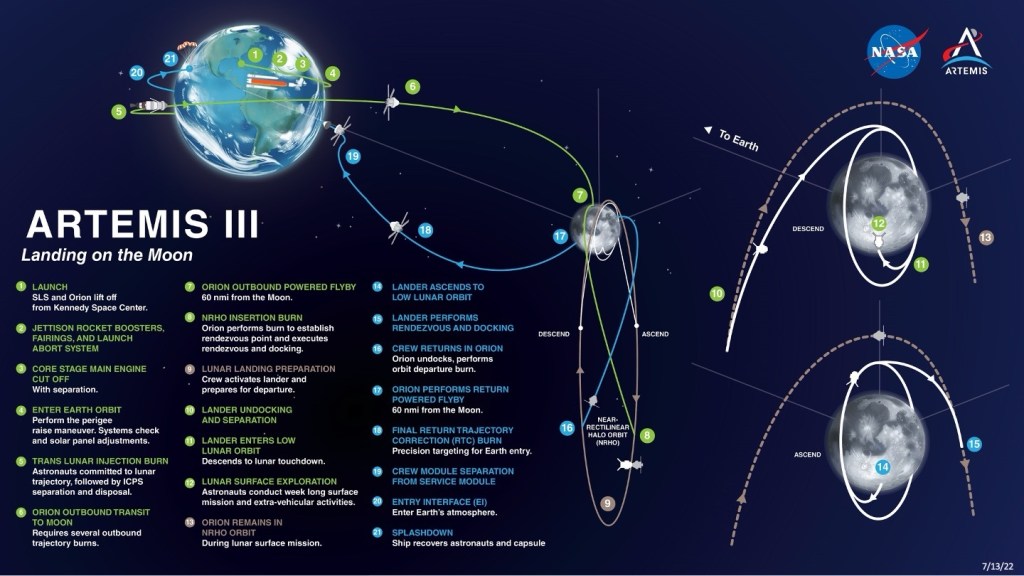
A very recent and intriguing development has emerged from the growing uncertainty around the Artemis III mission. With SpaceX‘s Starship facing a demanding test and development schedule, some former NASA officials have publicly suggested that NASA should reopen the Artemis III landing contract to competition.
In late October 2025, a Blue Origin executive confirmed that the company is “working towards presenting an alternative for an Artemis 3 Moon landing.” This suggests the company believes it may be able to develop a simplified, perhaps crew-adapted, version of its cargo MK1 lander on a much faster timeline than its full MK2 system. This is an aggressive and opportunistic move, signaling that Blue Origin is not content to wait until Artemis V and is ready to step in if the primary Artemis III plan falters.
Summary
Blue Origin’s path to the Moon has been anything but simple. It began with the assembly of a powerful “National Team” that was dealt a stunning and public defeat. That loss led to a period of intense legal and public conflict that ultimately ended in failure. Yet, from that setback, the company regrouped, re-engineered, and re-bid.
Today, Blue Origin stands as one of only two companies in the world contracted to build a human lunar lander for NASA. Its $3.4 billion SLD contract has put it on a firm trajectory to land astronauts on the Moon by the end of the decade. The company’s “hardware-rich” progress – from engine tests and rocket launches to astronaut-tested mockups – is rapidly changing its public narrative.
With the foundational New Glenn rocket now flying and the vital MK1 pathfinder mission on the manifest, Blue Origin is methodically executing a long-term plan. The company’s lunar architecture, built on the challenging but powerful combination of liquid hydrogen and reusability, is not just a plan to visit the Moon. It’s a strategy to become a permanent provider of transportation in the cislunar economy, a goal that is now, after a long and difficult road, within its reach.


