


Key Takeaways
- False UAP narratives may mask covert military tech.
- Deception erodes trust in government institutions.
- Fabricated threats divert funds from real science.
Introduction to the Hypothesis of Fabrication
The discourse surrounding Unidentified Anomalous Phenomena (UAP) has shifted dramatically in recent years, moving from the fringes of conspiracy theory to the halls of legislative bodies. While much of the conversation focuses on the potential for extraterrestrial visitation or non-human intelligence, a counter-narrative exists that demands rigorous examination. This hypothesis suggests that the surge in UAP reports, whistleblower claims, and government disclosures may not reflect a sudden influx of alien visitors, but rather a calculated, human-engineered deception.
The concept of a “False UAP Narrative” posits that various actors, ranging from intelligence agencies to private individuals, have strong motivations to manufacture or amplify stories about anomalous aerial events. The implications of such a deception are vast, affecting everything from national security protocols to the psychological well-being of the general public. By analyzing the motivations behind these potential fabrications and the consequences that follow, observers can gain a more nuanced understanding of the complex information landscape characterizing the modern era.
This analysis explores the mechanisms of this hypothetical deception. It examines why a government might hide advanced technology behind the guise of alien craft, how geopolitical adversaries utilize confusion as a weapon, and why individuals seek fame through sensationalism. Furthermore, it scrutinizes the damaging ripple effects of these falsehoods, including the erosion of public trust, the waste of resources, and the stigmatization of scientific inquiry.
The Strategic Logic of Fabrication
Deception is a time-honored tactic in statecraft and warfare. The ability to control the narrative, to dictate what the adversary and the public believe is true, offers a distinct strategic advantage. In the context of UAP, the ambiguity of the subject matter provides a perfect canvas for disinformation. Unlike conventional military movements or economic indicators, which are measurable and verifiable, UAP are by definition unidentified. This lack of concrete data allows narratives to be constructed with little resistance.
If one assumes that the UAP narrative is a fabrication, the immediate question is “cui bono” – who benefits? The answer is multifaceted. The beneficiaries of such a narrative are not limited to a single shadowy cabal but may include distinct groups with overlapping interests. The military establishment may benefit from the cover provided for black projects. Intelligence agencies may benefit from the confusion sown among foreign powers. Private contractors may benefit from increased funding to investigate these “threats.”
Understanding this strategic logic requires looking past the surface-level claims of lights in the sky and examining the bureaucratic and geopolitical machinery operating beneath. It involves analyzing the utility of the unknown. When a phenomenon is labeled as “anomalous,” it bypasses standard scrutiny. It enters a realm of speculation where standard rules of accountability often fail to apply. This specific operational environment creates fertile ground for the growth of a false narrative.
Protecting National Security Secrets
One of the most compelling motivations for maintaining a false UAP narrative centers on the protection of classified military capabilities. The history of aerospace development is replete with examples where the sightings of experimental aircraft were conveniently misidentified by the public as extraterrestrial craft. The Central Intelligence Agency has historically acknowledged that a significant portion of UFO sightings in the 1950s and 1960s were actually flights of the U-2 and SR-71 Blackbird spy planes.
The Shield of Classification
In the modern context, the stakes are arguably higher. Nations are currently racing to develop hypersonic missiles, next-generation drone swarms, and directed-energy weapons. These technologies represent the cutting edge of military advantage. If a general citizen or a foreign adversary spots a triangular craft moving at impossible speeds, it is far more advantageous for the testing nation if the observer believes they have seen an alien spaceship rather than a top-secret TR-3B or a stealth drone.
The false narrative acts as a shield. It distracts attention from the human origin of the technology. If the public narrative focuses on “non-human intelligence,” legitimate journalists and foreign spies may look in the wrong direction. They waste time looking for biological evidence or interstellar signals, while the actual hardware – the advanced propulsion systems and radar-evading materials – remains secure within Special Access Programs (SAPs). This misdirection is a classic counter-intelligence strategy, effectively hiding the needle by building a haystack of alien lore around it.
The Utility of the UFO Stigma
Furthermore, the historical stigma associated with UFOs serves as a secondary layer of security. For decades, pilots and radar operators were discouraged from reporting odd sightings for fear of ridicule. This culture of silence, arguably encouraged by intelligence services, ensured that test flights of secret aircraft went unreported in official channels. Even in the current era of “destigmatization,” the association of an object with “aliens” often relegates the report to the tabloid press rather than serious defense analysis journals.
By maintaining a low-level background noise of UAP interest, defense agencies can test advanced platforms in plain sight. If a test goes wrong and a craft crashes or is seen performing maneuvers that defy known physics, the “UFO” explanation is a ready-made cover story that dismisses the event as unexplained rather than a breach of operational security. This allows for the continuation of covert operations without the need to explain the technological leaps being made behind closed doors.
Geopolitical Manipulation and Adversarial Confusion

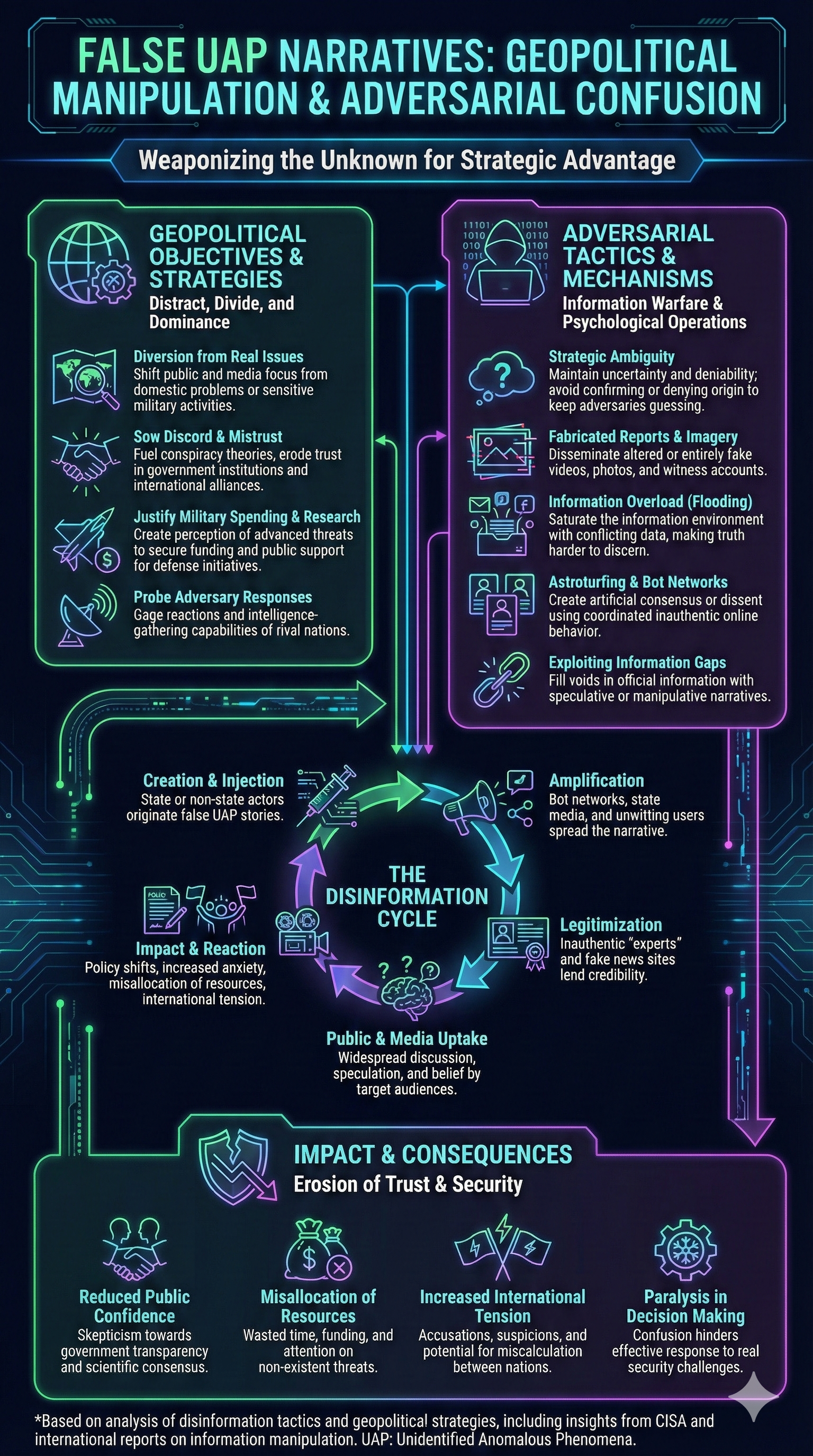
Beyond domestic security, the UAP narrative serves a potent function on the international stage. In an era of great power competition, primarily involving the United States, China, and Russia, perception is a key domain of conflict. The projection of power is not just about what weapons a nation possesses, but what its adversaries believe it possesses.
The Fog of War in Peacetime
A false UAP narrative can be weaponized to sow confusion among foreign adversaries. If the United States, for example, signals that it is encountering craft with capabilities far beyond known physics, rival nations must scramble to interpret this data. Is the US feigning ignorance to hide its own breakthrough technology? Or is the US vulnerable to a third, unknown party? This uncertainty forces adversaries to expend resources investigating non-existent threats or second-guessing their own intelligence assessments.
This tactic falls under the umbrella of reflexive control – conveying information to an opponent that leads them to make a decision predetermined by the instigator. By polluting the intelligence stream with reports of “transmedium” craft, a nation can mask its actual strategic gaps or capabilities. It creates a “fog of war” during peacetime, making it difficult for rival intelligence agencies to distinguish between military developments, sensor glitches, and psychological operations.
Deterrence Through Ambiguity
There is also a component of deterrence through ambiguity. If a nation is suspected of possessing “alien” technology or having recovered exotic materials, it artificially inflates its perceived military strength. A rival might hesitate to engage in aggression if they fear the opposing side has access to reverse-engineered weaponry of unknown power. Even if the claims are entirely fabricated, the mere possibility introduces a variable into the risk calculus of war planners.
This form of geopolitical manipulation requires a delicate balance. The narrative must be convincing enough to cause concern but not so alarmist that it triggers a preemptive strike or a global panic. The controlled release of “unidentified” videos and the carefully worded testimonies of officials can maintain this equilibrium, keeping adversaries in a constant state of analytical paralysis regarding the true capabilities of their opponent.
Psychological Warfare and Information Control
The manipulation of public perception is not limited to foreign adversaries; it is frequently directed inward. Psychological warfare operations (PSYOPs) are designed to influence the emotions, motives, and objective reasoning of target audiences. In the context of a false UAP narrative, the domestic population becomes the test subject for sophisticated disinformation campaigns.
Testing Public Reaction
One hypothetical motivation for these narratives is the testing of public reaction to fabricated threats. Governments and social engineers may wish to gauge how the populace responds to the sudden introduction of an “other” or a superior power. How quickly does panic spread? Who do citizens turn to for authority? How resilient are social institutions in the face of an ontology-shattering revelation?
By introducing a controlled narrative about UAP, authorities can model societal responses to various crisis scenarios without the danger of a real crisis. The data gathered from social media sentiment, public polling, and media coverage provides valuable insights into mass psychology. This information can be used to refine future communication strategies for unrelated emergencies, such as pandemics, economic collapses, or conventional wars.
The Mechanics of Mass Distraction
Historically, “bread and circuses” have been used to distract the populace from pressing political or economic issues. The spectacle of the unknown is a powerful diversion. When the news cycle is dominated by discussions of alien bodies or interstellar motherships, complex domestic issues such as inflation, corruption, or legislative failures often receive less scrutiny.
This distraction technique does not necessarily require a grand conspiracy; it often relies on the opportunistic amplification of sensational stories. If a government is facing a scandal, a conveniently timed hearing on UAP or the release of a grainy video can shift the collective focus of the nation. The mystery of the UAP phenomenon engages the imagination in a way that dry policy debates cannot, making it an ideal tool for managing public attention and directing the national conversation away from inconvenient truths.
Individual Agendas and the Quest for Notoriety
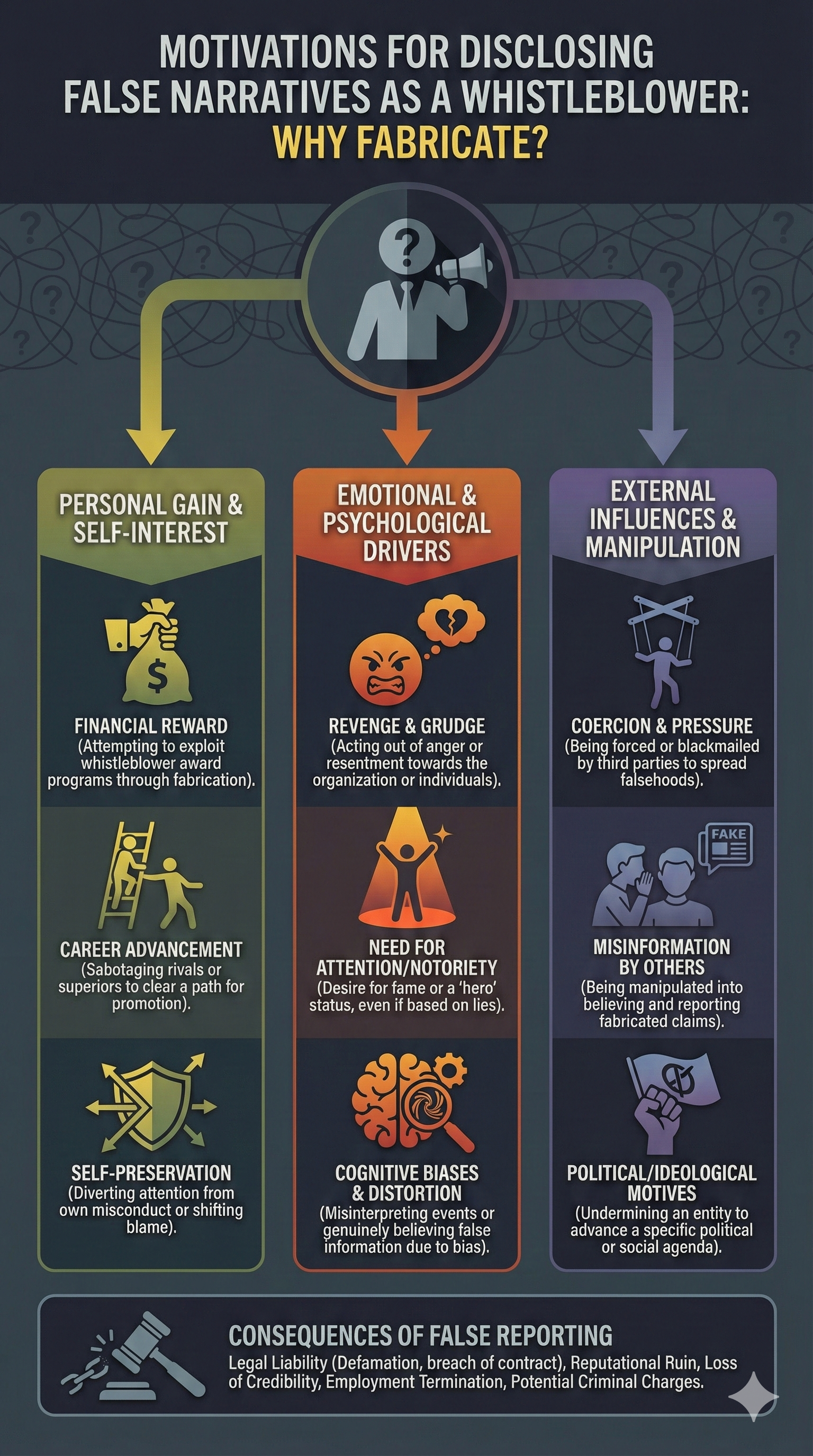
Not all motivations for a false UAP narrative stem from institutional or state actors. The field of Ufology has long been plagued by individuals driven by personal ambition, financial gain, and a desire for notoriety. In the age of social media and the creator economy, the incentives for fabricating or exaggerating UAP claims are higher than ever.
The Economics of Attention
There is a lucrative market for mystery. Books, documentaries, lecture circuits, and podcasts dedicated to UAP generate millions of dollars in revenue. For a person seeking financial independence or fame, positioning oneself as a “whistleblower” or an “insider” with special knowledge is a viable career path. This financial motivation inevitably leads to the embellishment of stories. A mundane sighting of a drone becomes a close encounter with a galactic federation when there is a book deal on the line.
The media ecosystem rewards engagement, and sensational claims drive clicks and views. This creates a feedback loop where content creators are incentivized to produce increasingly extreme narratives to maintain their audience. The truth becomes secondary to the performance. In this environment, a false narrative can arise organically from the collective exaggeration of multiple individuals, each seeking to outdo the other in terms of revelations and shock value.
Validation Seeking Behavior
Beyond money, there is a deep psychological drive for validation. Individuals who feel marginalized or unimportant in their daily lives may find a sense of purpose and status within the UAP community. By claiming to have been chosen for contact or to possess secret knowledge, they elevate their social standing among their peers. This “messianic complex” can drive individuals to fabricate evidence or weave complex lies that they eventually come to believe themselves.
This individual-level deception complicates the landscape for researchers. It becomes difficult to separate , good-faith errors in identification from calculated hoaxes designed to feed the ego of the hoaxer. These personal fabrications muddy the waters, making it easier for state actors to hide their own deceptions amidst the noise of charlatans and storytellers.
Institutional Self-Preservation and Budgetary Politics
Bureaucracies are living organisms with a primary directive: survival and expansion. The defense and intelligence communities are no exception. A false UAP narrative can serve as a powerful tool for institutional self-preservation, particularly when it comes to justifying budgets and avoiding oversight.
The Military-Industrial Complex Factors
The Department of Defense and its associated contractors rely on the existence of threats to justify their funding. As the Global War on Terror wound down, a “threat vacuum” emerged. While near-peer competition with major powers fills some of that void, the “unknown” represents a limitless potential threat. If UAP are framed as advanced technology that can violate sovereign airspace with impunity, it necessitates the development of new sensors, new interceptors, and new command and control systems.
This dynamic creates a symbiotic relationship between the false narrative and the defense budget. By categorizing UAP as a “flight safety hazard” or a “potential national security threat,” agencies can secure billions in funding for research and development. This money flows to defense contractors who build the radar systems and satellites designed to track these elusive objects. The narrative of an invincible, unknown intruder is the perfect justification for a blank check.
Justifying the Unjustifiable
Furthermore, the UAP narrative can be used to retroactively justify spending on failed or illicit programs. If a black budget project produces a platform that fails to meet conventional military needs but exhibits strange flight characteristics, re-branding it as part of a UAP investigation or a counter-UAP measure can shield the program from cancellation.
Additionally, framing unauthorized surveillance or data collection as necessary for “tracking anomalies” allows agencies to bypass privacy concerns. The pursuit of the unknown provides a moral and security imperative that often overrides standard checks and balances. In this scenario, the “threat” is manufactured or exaggerated to ensure the continuity of funding streams and the expansion of bureaucratic power.
| Motivation Category | Primary Objective | Key Beneficiary |
|---|---|---|
| National Security | Masking advanced technology tests and classified capabilities. | Military, Intelligence Agencies |
| Geopolitical | Creating confusion and strategic ambiguity for adversaries. | State Defense Depts, Strategists |
| Psychological | Testing public resilience and creating mass distraction. | Social Engineers, Political Leadership |
| Individual | Gaining fame, money, or social validation. | Authors, Influencers, Hoaxers |
| Institutional | Justifying budget increases and avoiding oversight. | Defense Contractors, Bureaucracies |
The Ripple Effect of Deception
The motivations for creating a false UAP narrative are compelling to those who implement them, but the consequences of such deception are significant and damaging to the fabric of society. Deception is rarely a contained event; it creates a ripple effect that spreads outward, destabilizing institutions and distorting reality for the general public. When truth is sacrificed for strategic advantage or personal gain, the collateral damage is often borne by the citizenry.
The Erosion of Public Trust
The most immediate and lasting consequence of a false UAP narrative is the erosion of public trust. Trust is the currency of a functioning democracy. Citizens must believe that their government, their media, and their scientific institutions are generally truthful. When it is revealed – or even suspected – that these entities have been actively promoting a fabrication, the social contract is fractured.
Skepticism of Institutions
If the government is found to have manipulated UAP narratives to hide technology or distract the public, it validates the most cynical views of state power. It confirms the belief that the government views the population not as constituents to be served, but as subjects to be managed. This skepticism inevitably bleeds into other areas. If the government lied about UAP, why should they be trusted on matters of public health, economic data, or foreign policy?
This loss of faith creates a vacuum of authority. When official sources are discredited, citizens turn to alternative information ecosystems, which are often filled with even more radical misinformation. The delegitimization of mainstream media and government spokespeople makes it nearly impossible to marshal public consensus on crises, as a significant portion of the population will reflexively reject any official narrative.
The Boy Who Cried Wolf Effect
Furthermore, the continuous teasing of “disclosure” that never arrives creates a fatigue known as the “Boy Who Cried Wolf” effect. If officials constantly hint at monumental revelations about non-human intelligence, only to deliver ambiguous reports or mundane explanations later, the public becomes desensitized.
This desensitization is dangerous. In the event of a anomaly – be it a true extraterrestrial contact or a breakthrough foreign adversary drone – the warning may be ignored. The public, conditioned to view UAP news as distraction or grift, may fail to react to a legitimate security threat, assuming it is just another chapter in the ongoing theater of deception.
Misallocation of Financial and Intellectual Resources
The pursuit of a false narrative is not just psychologically damaging; it is expensive. The misallocation of resources occurs on both a macro and micro level, diverting capital and brainpower away from tangible problems toward the investigation of phantoms.
Opportunity Costs in Defense
When the Department of Defense allocates millions to offices specifically tasked with investigating “anomalous” reports that are known by insiders to be sensor artifacts or secret tests, it represents a massive opportunity cost. That funding could have been applied to veteran healthcare, infrastructure maintenance, or conventional readiness.
The legislative time spent in hearings, the bureaucratic hours spent drafting reports, and the intelligence assets tasked with analyzing these false leads represent a drain on the national apparatus. If the threat is fabricated, every dollar spent fighting it is a dollar wasted. This fiscal irresponsibility is compounded by the fact that it is often justified by classified briefings, preventing taxpayers from knowing how their money is actually being squandered.
Diverting Scientific Talent
Perhaps more tragic is the diversion of intellectual capital. Bright young scientists, engineers, and data analysts may be drawn into the field of UAP research by the allure of the false narrative. They dedicate their careers to analyzing data that is either fabricated or intentionally contextualized to be unsolvable.
This brain drain removes talented individuals from fields where they could make concrete contributions, such as climate science, medical research, or renewable energy. The scientific method relies on the analysis of real data; when that data is corrupted by disinformation, the scientific process effectively spins its wheels, generating hypotheses about phenomena that do not exist in the way they are presented.
Stigmatization of Legitimate Scientific Inquiry
Paradoxically, while a false narrative encourages some to waste time, it discourages others from conducting legitimate research. The association of atmospheric science and aerospace safety with “little green men” and government cover-ups creates a toxic environment for serious academic inquiry.
The Chilling Effect on Academia
Universities and grant-making institutions are risk-averse. They are hesitant to fund research that is adjacent to topics perceived as “fringe” or “conspiratorial.” If the UAP narrative is viewed as a domain of hoaxes and psychological operations, legitimate scientists who wish to study unexplained atmospheric phenomena face significant headwinds. They risk their tenure and their professional reputation by engaging with the subject.
This stigmatization means that anomalies – rare weather events, new forms of lightning, or legitimate sensor errors – go unstudied. The “giggle factor” prevents data from being taken seriously. Consequently, the scientific community cedes the territory to amateur investigators and grifters, ensuring that the rigorous analysis needed to actually understand the aerial environment is never applied.
Ridicule as a Control Mechanism
The false narrative often utilizes ridicule as a deliberate control mechanism. By mixing questions with absurd claims (e.g., mixing pilot reports with stories of alien hybrids), the entire subject becomes radioactive. This technique, often attributed to counter-intelligence strategies, ensures that anyone asking difficult questions about unidentified craft is lumped in with the most extreme elements of the subculture.
This discourages whistleblowers from coming forward with information about actual corruption or illegal programs, as they fear being branded as “UFO nuts.” It effectively silences dissent and inquiry, allowing the perpetrators of the deception to operate without fear of serious journalistic or academic investigation.
Social Unrest and Heightened Anxiety
Narratives shape our reality, and frightening narratives create a frightened population. The suggestion that the skies are filled with technologically superior craft that the government cannot control fosters a sense of helplessness and anxiety.
The Proliferation of Conspiracy Theories
A false UAP narrative acts as a gateway drug for conspiracy theories. Once an individual accepts that the government is hiding the biggest truth in human history (alien contact), it requires a very small leap of logic to believe they are lying about everything else. This mindset creates social friction and division.
Families and communities can be torn apart by these diverging realities. The “disclosure” movement often adopts a quasi-religious fervor, where believers view skeptics as sheep and the government as demonic. This polarization contributes to the general temperature of social unrest, creating a populace that is angry, suspicious, and prone to radicalization.
Ontological Shock and Fear
Even without the conspiracy angle, the core message of the UAP narrative – that we are not alone and not in charge – induces “ontological shock.” This is the trauma resulting from the collapse of one’s worldview. While this might be a necessary growing pain in the event of real contact, inducing it artificially through a false narrative is a form of psychological abuse on a societal scale.
It generates low-level anxiety about invasion, abduction, or technological obsolescence. For vulnerable individuals, this can manifest as psychological distress. The promotion of fear-based narratives (“they are a threat to national security”) amplifies this anxiety, keeping the population in a state of heightened alert against an enemy that may not exist.
Undermining Genuine National Security
The final and perhaps most ironic consequence of the false UAP narrative is that it ultimately undermines the very national security it purports to protect. By filling the information space with noise, the signal is lost.
Ignoring Real Threats
When defense systems are calibrated to look for “anomalous” signatures based on science fiction parameters, they may miss the conventional but deadly threats posed by human adversaries. A slow-moving commercial drone or a high-altitude balloon might be ignored because analysts are looking for warp drives. The obsession with the extraordinary creates blind spots for the ordinary.
Adversaries, aware of this fixation, can exploit it. They can design drones that mimic the reported behavior of UAP, knowing that US defenses might hesitate to engage or misidentify the threat. The camouflage of the “alien” narrative becomes a vulnerability that savvy opponents can leverage to penetrate airspace undetected.
The Blowback of Falsehoods
Furthermore, when the deception is eventually exposed – as most secrets are – the blowback is severe. The revelation that national security apparatuses spent decades gaslighting the public destroys the credibility required to lead during a real crisis. A security state that is viewed as a manufacturer of hoaxes cannot effectively rally the nation when a real war begins. The tools of deception, once used, blunt the tools of truth, leaving the nation weaker, more divided, and less prepared for the reality of the geopolitical landscape.
Summary
The hypothesis of a false UAP narrative offers a objectiveing lens through which to view the modern phenomenon of unidentified aerial sightings. It suggests that what is often interpreted as evidence of extraterrestrial contact may instead be the result of a complex interplay of human motivations. From the protection of classified military technology and the execution of geopolitical strategy to the pursuit of individual fame and institutional budget expansion, the drivers for deception are powerful and pervasive.
However, the cost of this deception is high. The fabrication of threats and the manipulation of truth degrade the essential trust between a government and its people. It squanders finite resources on chasing ghosts, stigmatizes legitimate scientific discovery, and fractures society through the proliferation of conspiracy and fear. While the short-term strategic gains of a false narrative may seem attractive to planners and opportunists, the long-term damage to the credibility of institutions and the psychological health of the public suggests that the price of this deception is far too high.
Appendix: Top 10 Questions Answered in This Article
1. What is the primary motivation for the military to support a false UAP narrative?
The military may use UAP narratives to mask the testing of classified technologies such as hypersonic missiles or stealth drones. By attributing sightings of these advanced platforms to “aliens,” they protect sensitive operational security from foreign adversaries and public scrutiny.
2. How does a false UAP narrative aid in geopolitical manipulation?
It creates strategic ambiguity and confusion among rival nations. By suggesting the possession of “non-human” technology or creating a “fog of war” regarding aerial capabilities, a nation can deter adversaries who may fear engaging with a potentially superior, albeit fabricated, force.
3. In what way does the UAP narrative serve as a psychological operation?
The narrative can be used to test public reaction to existential threats or to create mass distraction from domestic political issues. It allows social engineers to gauge societal resilience and manipulate the focus of the national conversation.
4. Why would individuals fabricate UAP stories?
Individuals are often driven by the “economics of attention,” seeking financial gain through book deals and media appearances. Additionally, many seek psychological validation and social status within the UAP community by positioning themselves as possessors of secret knowledge.
5. How do government institutions use UAP to increase their budgets?
By framing UAP as a potential “national security threat” or flight safety hazard, agencies can justify requests for increased funding. This creates a perpetual need for expensive sensor systems and bureaucratic offices to track an undefined enemy.
6. What is the “Erosion of Public Trust” in this context?
This refers to the loss of faith in government and media when the public suspects they are being lied to or manipulated. It damages the social contract, making citizens skeptical of official narratives on all topics, not just UAP.
7. How does the false narrative affect scientific research?
It stigmatizes legitimate inquiry into atmospheric anomalies. Scientists avoid the subject for fear of ridicule or professional damage, resulting in a “chilling effect” where phenomena go unstudied and the field is left to amateurs.
8. What is the “Boy Who Cried Wolf” effect regarding UAP?
Continuous promises of disclosure that result in no evidence cause public desensitization. This apathy is dangerous because it means the public may eventually ignore a warning of a real threat, assuming it is just another deception.
9. How does the UAP narrative lead to misallocation of resources?
Billions of dollars and significant intellectual talent are diverted toward investigating fabricated threats. This represents a massive opportunity cost, as these resources could be applied to solving tangible problems like healthcare, infrastructure, or conventional defense.
10. Can a false UAP narrative actually hurt national security?
Yes, by creating blind spots. If defense systems and analysts are calibrated to look for science-fiction scenarios, they may miss conventional threats like drones or balloons. Additionally, the loss of credibility makes it harder for the state to lead during actual crises.
Appendix: Top 10 Frequently Searched Questions Answered in This Article
1. Why does the government hide UFO information?
The government often hides information not because of aliens, but to protect classified military projects and sensor capabilities. Admitting to what is seen would often reveal the resolution of spy satellites or the existence of secret aircraft prototypes.
2. Is the UFO phenomenon a distraction?
Many analysts argue that high-profile UFO news cycles are used as “bread and circuses” to distract the public from pressing economic or political scandals. It serves as a sensational diversion that consumes media oxygen and public attention.
3. Do defense contractors profit from UFOs?
Yes, the narrative of an unknown aerial threat justifies government contracts for advanced radar, satellite tracking, and data analysis systems. Companies within the military-industrial complex benefit financially from the need to “investigate” the phenomenon.
4. What is the difference between UAP research and the false narrative?
Genuine research relies on open data, peer review, and the scientific method to understand atmospheric anomalies. The false narrative relies on secrecy, unverified whistleblower testimony, and sensationalism to promote a specific, often fear-based, story.
5. How do fake UFO stories spread?
They spread through a feedback loop of social media algorithms, sensationalist journalism, and validation-seeking individuals. This ecosystem rewards extreme claims with views and revenue, encouraging the amplification of fabrications.
6. What are the dangers of believing in UFO conspiracies?
Belief in these conspiracies can lead to social isolation, radicalization, and a deep distrust of democratic institutions. It can also induce unnecessary anxiety and fear regarding non-existent existential threats.
7. Can foreign countries use UFOs against us?
Adversaries can use the concept of UFOs to confuse US intelligence or mask their own drone incursions. If US operators hesitate to fire on a “UFO,” a foreign drone can operate with impunity inside restricted airspace.
8. Why are scientists afraid to study UFOs?
Scientists fear the “giggle factor” and the potential loss of professional credibility. The topic is heavily stigmatized and associated with pseudoscience, making it difficult to secure funding or publish in reputable journals.
9. Is Project Blue Beam real?
While often discussed in conspiracy circles as a plan to fake an alien invasion, the concept aligns with the real military strategy of using psychological warfare to test public reaction and manipulate adversary perceptions, though likely not to the extreme extent of the conspiracy theory.
10. What happens if the UFO threat is a lie?
If the threat is proven to be a fabrication, it would lead to a historical collapse in public trust in the military and intelligence communities. It would also reveal the waste of billions of tax dollars on chasing phantoms.
KEYWORDS: False UAP Narrative, National Security Deception, Government Disinformation, Psychological Warfare UFO, Military Industrial Complex UAP, Geopolitical Ambiguity, Social Engineering, UFO Stigmatization, Special Access Programs, Blue Beam Theory, Misallocation of Defense Spending, Adversarial Confusion, Institutional Self-Preservation, UAP Whistleblower Skepticism, Aerospace Disinformation.


