


- Key Takeaways
- The Myth vs. Reality
- The Foundations of the Myth in Radio History
- Cold War Tensions and the Polar Orbit Scare
- The Gordon Cooper Sighting Claims
- Duncan Lunan and the 13,000-Year Timeline
- STS-88 and the Photographic Evidence
- Analyzing the Debris Imagery
- The Role of the Internet and Confirmation Bias
- Comparison of Claims and Explanations
- Space Debris and the Reality of Low Earth Orbit
- Summary
- Appendix: Top 10 Questions Answered in This Article
- Appendix: Top 10 Frequently Searched Questions Answered in This Article
Key Takeaways
- Myth combines unrelated events into one narrative
- STS-88 debris is the confirmed source of famous photos
- Pareidolia drives the persistent belief in the object
The Myth vs. Reality
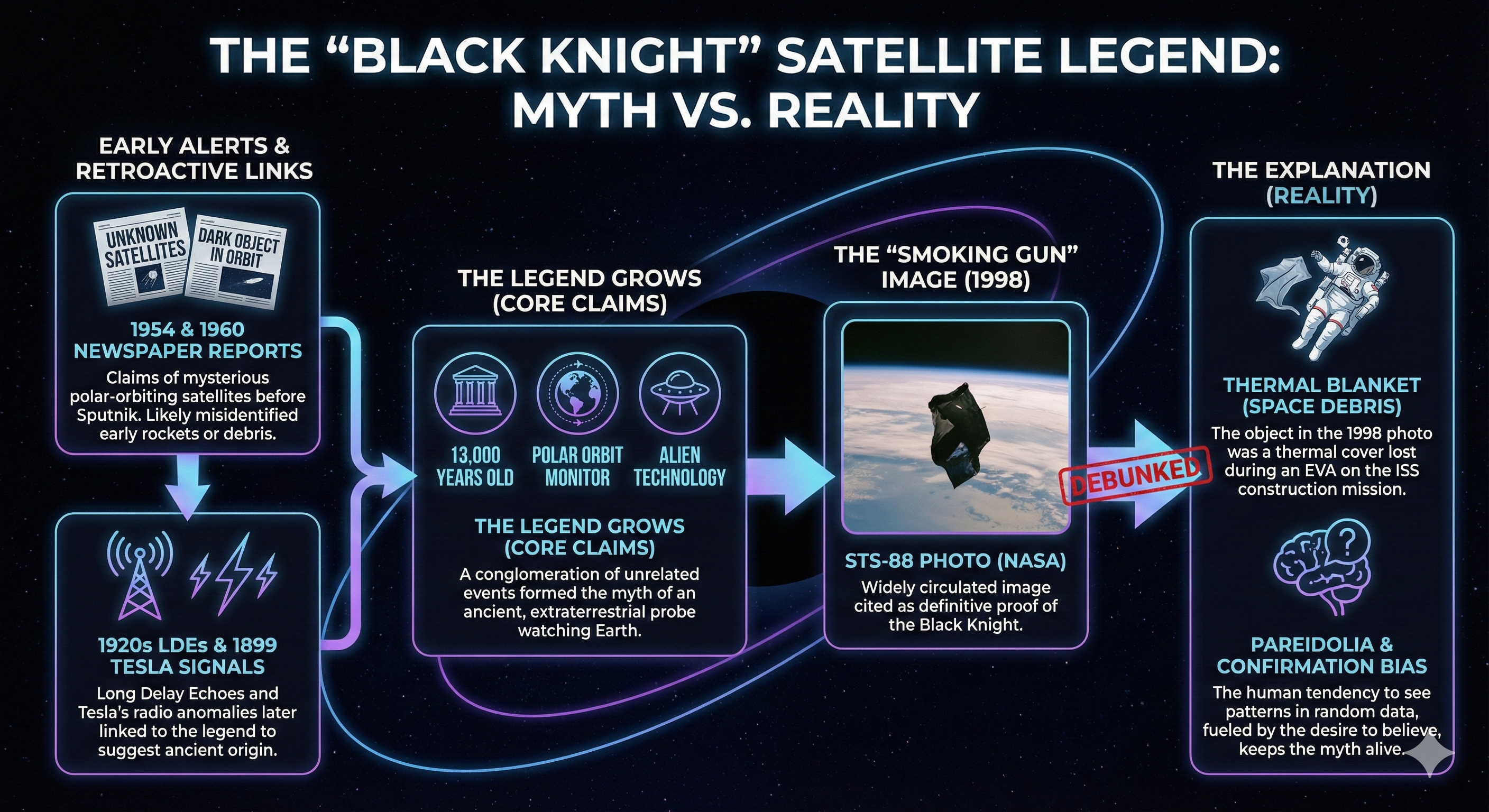
The exploration of low Earth orbit has generated millions of photographs, vast catalogs of tracked objects, and a handful of persistent mysteries that capture the public imagination. Among these, the legend of the Black Knight satellite stands out as a unique convergence of historical radio anomalies, Cold War paranoia, and misinterpreted space photography. The narrative suggests that an extraterrestrial probe has orbited Earth for 13,000 years, monitoring human development from a polar trajectory. This story relies on a conglomeration of distinct historical events – radio experiments from the late 19th century, unidentified radar echoes from the 1920s, and newspaper reports from the 1950s – retroactively stitched together to support a singular conclusion.
However, the most compelling visual evidence cited by proponents of the theory emerged in 1998 during the assembly of the International Space Station . Photographs taken during the STS-88 mission show a dark, irregular object floating against the backdrop of Earth. While these images are frequently presented as definitive proof of alien technology, the operational records from NASA provide a documented explanation involving lost thermal protection equipment. Understanding the Black Knight legend requires dissecting these various components, separating the verifiable history of spaceflight from the folklore that has grown around it.
The Foundations of the Myth in Radio History
The narrative of the Black Knight often begins long before the advent of spaceflight, rooting itself in the early history of radio astronomy and wireless transmission. Proponents of the legend frequently cite the experiments of Nikola Tesla as the first instance of human contact with the object. In 1899, Tesla established a laboratory in Colorado Springs to investigate high-voltage, high-frequency electricity and wireless telegraphy. During his time there, he intercepted rhythmic radio signals that he believed originated from beyond Earth.
Tesla observed that the signals occurred periodically and demonstrated a clear numerical order. At the time, the concept of naturally occurring cosmic radio sources, such as pulsars, was unknown to science. Consequently, Tesla hypothesized that these impulses might be attempted communications from Mars or another intelligent civilization. In the context of the Black Knight myth, these signals are retroactively interpreted as the satellite’s automated transmissions. However, modern analysis of Tesla’s notes suggests he likely intercepted signals from terrestrial electrical storms or arguably radio noise from Jupiter, which was not identified until decades later.
The legend gains further complexity with the phenomenon of Long Delay Echoes (LDEs). In the late 1920s, radio operators, including Jørgen Hals and physicist Carl Størmer , observed radio signals returning to the transmitter after a significant delay, ranging from several seconds to over a minute. Standard radio propagation theory could not easily explain these delays, as radio waves travel at the speed of light and should circle the globe in a fraction of a second. While ionospheric conditions and magnetospheric ducts are now the standard scientific explanations for LDEs, the mystery surrounding them in the early 20th century allowed for speculative interpretations. In the 1970s, the Black Knight narrative absorbed these events, suggesting the echoes were re-transmissions from an alien probe acting as a repeater in Earth’s orbit.
Cold War Tensions and the Polar Orbit Scare
The timeline of the Black Knight legend moves from radio anomalies to physical detection during the intense geopolitical atmosphere of the 1950s. Following the launch of Sputnik 1 by the Soviet Union in 1957, the United States military and intelligence communities were on high alert for additional Soviet space assets. In the years preceding and immediately following Sputnik, several newspaper reports emerged claiming that unidentified satellites had been detected in orbit.
One specific claim from 1954 involved newspapers reporting that the United States Air Force had detected two satellites orbiting Earth. This was significant because no nation possessed the capability to launch satellites at that time. The reports were later clarified as misinterpretations of astronomical data or equipment calibration issues, but the initial headlines provided fertile ground for conspiracy theories.
In 1960, the legend solidified further with reports of a “dark object” in a polar orbit. A polar orbit passes over the Earth’s north and south poles, allowing a satellite to view every part of the globe as the Earth rotates beneath it. This is a strategic orbit for reconnaissance satellites. At the time, neither the United States nor the Soviet Union was believed to have established a stable polar orbit satellite. The United States Navy detection system, designed to track non-cooperative targets, picked up an object that did not match known flight paths.
Subsequent investigation revealed that this object was likely the casing from the Discoverer 8 launch. The Discoverer program, a cover for the Corona reconnaissance satellite project, experienced numerous technical failures. On typical launches, the casing would separate and fall away, but in this instance, debris remained in orbit. Despite the mundane identification of the object as lost hardware, the initial reports of a “mystery satellite” shadowing Earth persist in the folklore as evidence of the Black Knight’s presence.
The Gordon Cooper Sighting Claims
Another pillar of the Black Knight legend involves Gordon Cooper , one of the original Mercury Seven astronauts. The story circulating within UFO communities alleges that during the Mercury-Atlas 9 mission in 1963, Cooper reported seeing a greenish object approaching his capsule. The legend further claims that the Muchea Tracking Station in Australia picked up the object on radar, corroborating the visual sighting.
Transcripts of the mission and post-flight reports do not support this account. Cooper did report various visual phenomena, which were standard for early astronauts adjusting to the visual environment of space, but the specific narrative of a tracked, unidentified craft approaching the Mercury capsule appears to be a fabrication added later by myth-makers. Cooper himself was a vocal proponent of the existence of extraterrestrial visitors later in his life, but his official mission logs do not contain the specific Black Knight encounter often attributed to him. The conflation of his personal beliefs with his official mission record serves to lend an air of authority to the legend.
Duncan Lunan and the 13,000-Year Timeline
The specific claim that the Black Knight is 13,000 years old and originates from the Epsilon Boötis star system stems from the work of Scottish science writer Duncan Lunan . In 1973, Lunan analyzed the Long Delay Echoes recorded in the 1920s. He theorized that the varying delay times of the echoes effectively formed a star map.
By plotting the delay sequences as data points, Lunan created a graph that he believed resembled the constellation Boötes. He noted that the position of the star Epsilon Boötis in his chart was slightly off from its current location but matched where the star would have been approximately 13,000 years ago. This led to the hypothesis that the probe had arrived or began transmitting during that epoch.
Lunan published these findings in Spaceflight magazine, and the story was quickly sensationalized by the press. However, Lunan later recanted the theory, stating that his methodology was flawed and that he had been looking for patterns in data that likely contained random errors. He explicitly rejected the connection between his star map hypothesis and the “Black Knight” satellite, noting that the term “Black Knight” was not even in use regarding the object at the time of his paper. Despite his retraction, the “13,000-year-old map” remains a central, unshakable component of the modern myth.
STS-88 and the Photographic Evidence
The visual component of the Black Knight legend relies almost exclusively on a series of high-resolution photographs taken in December 1998. These images were captured during STS-88 , the first Space Shuttle mission to the International Space Station . The mission’s primary objective was to mate the American Unity node with the Russian Zarya module. This was a complex construction task requiring precise maneuvering and multiple Extravehicular Activities (EVAs), or spacewalks.
During one of the EVAs, astronauts Jerry L. Ross and James H. Newman were working on the exterior of the station to attach thermal cables and install handrails. The environment during an EVA is challenging; astronauts wear bulky pressurized gloves that reduce tactile feedback and dexterity. While securing a thermal cover on a trunnion pin (a mounting point used to secure the module in the shuttle’s cargo bay), a mishap occurred.
The specific item was a thermal blanket, essentially a cover made of insulating material designed to protect the metal pin from the extreme temperature fluctuations of space. The blanket was not tethered correctly, and it drifted away from the work site. The laws of orbital mechanics dictate that an object released from a spacecraft will drift relative to the craft, often appearing to hover or slowly recede depending on the velocity vector.
Commander Robert D. Cabana and the crew aboard the Space Shuttle Endeavour watched the object drift away. They documented the lost item with photography, capturing a series of images as the blanket tumbled in the vacuum. These images, cataloged by NASA (specifically frames like STS088-724-66), show a black, irregularly shaped object. Because the blanket is flexible and silver on one side and black on the other, its tumbling motion created weird, angular shapes that looked solid and metallic in static photos.
Analyzing the Debris Imagery
To the untrained eye, the object in the STS-88 photos appears structured. It seems to have a body, appendages, or perhaps a cockpit. This interpretation is a classic example of pareidolia , the psychological phenomenon where the human brain perceives familiar patterns – such as faces or vehicles – in random stimuli. The “Black Knight” in these photos is an amorphous thermal cover, distorted by shadows and the lack of atmospheric scattering, which creates high-contrast lighting conditions in space.
The object was tracked by United States Space Surveillance Network as space debris. It was cataloged as item 25570, designated as international designator 1998-067C. The tracking data followed the object’s orbital decay. Unlike a spacecraft with propulsion capabilities or a massive ancient probe, the object’s orbit degraded due to atmospheric drag. It re-entered the Earth’s atmosphere and burned up shortly after the mission, completely destroying it.
The persistence of these images as proof of an alien satellite demonstrates a disconnection between technical documentation and public perception. The mission transcripts record the loss of the item. The photographic catalog identifies the object as debris. The radar tracking data confirms its decay and reentry. Yet, the visual ambiguity of the crumpled blanket allows the “Black Knight” label to stick.
The Role of the Internet and Confirmation Bias
The Black Knight legend exploded in popularity with the rise of the internet. In the digital age, the disparate elements – Tesla, the 1950s newspapers, and the 1998 photos – were curated into copypasta and viral videos. This curation process relies heavily on confirmation bias, where contradictory evidence is ignored in favor of details that support the exciting narrative.
For instance, the fact that the “polar orbit” satellite of 1960 was identified as a Discoverer casing is rarely mentioned in the retelling. The fact that Duncan Lunan retracted his star map theory is omitted. The transcript of Jerry Ross losing the thermal blanket is ignored. Instead, the narrative focuses on the mystery, presenting the questions without the answers.
The legend has also permeated pop culture. It was featured in a promotional campaign by PepsiCo for a short film, further cementing the name “Black Knight” in the public consciousness. This commercialization blurs the line between fiction and reality, making it difficult for casual observers to distinguish between a marketing stunt, a conspiracy theory, and historical fact.
Comparison of Claims and Explanations
To provide a clear distinction between the mythological aspects of the Black Knight and the verifiable historical events, the following table organizes the primary claims against the scientific reality.
| Claim component | Mythological interpretation | Historical/Scientific reality |
|---|---|---|
| 1899 Radio Signals | Nikola Tesla communicated with the Black Knight satellite. | Tesla likely intercepted signals from pulsars, Jupiter’s magnetosphere, or terrestrial storms. |
| 1920s Long Delay Echoes | Alien probe acting as a radio repeater. | Natural radio propagation phenomena involving the ionosphere and magnetosphere. |
| 1954 Satellite Reports | Two alien satellites detected before Sputnik. | Misinterpretation of astronomical data and equipment errors; no physical objects were found. |
| 1960 Polar Orbit Object | Anomalous dark object shadowing the Earth. | identified as a casing from the Discoverer VIII reconnaissance satellite launch. |
| 13,000 Year Origin | Decoded star map shows the satellite’s origin and age. | Based on a retracted theory by Duncan Lunan regarding radio echoes; unrelated to the satellite. |
| STS-88 Photos (The “Knight”) | High-resolution image of an alien spacecraft. | A thermal blanket (trunnion pin cover) lost during a spacewalk by Jerry Ross. |
| Current Status | Still in orbit, monitoring Earth. | The debris (thermal blanket) burned up in the atmosphere shortly after the 1998 mission. |
Space Debris and the Reality of Low Earth Orbit
The misidentification of the Black Knight highlights the very real issue of space debris. Low Earth Orbit (LEO) is crowded with defunct satellites, spent rocket stages, and fragments from collisions. Agencies like the European Space Agency and NASA track thousands of these objects to prevent collisions with active spacecraft.
In this context, an unknown object of significant size, such as the alleged Black Knight, would be impossible to hide. It would be visible to radar networks, amateur astronomers, and commercial satellite operators. The absence of any tracking data for a stable, massive, polar-orbiting object that is not a known government asset is a strong refutation of the legend. The objects that are tracked are cataloged, and their origins are generally known.
The STS-88 thermal blanket fits perfectly into the category of “mission-related debris.” These constitute items released intentionally or accidentally during operations. Other examples include a spatula lost during a shuttle mission and a tool bag lost during an ISS spacewalk. These objects are tracked until they re-enter. The “Black Knight” blanket was simply one of the most photogenic pieces of space trash ever documented.
Summary
The Black Knight satellite legend is a fascinating case study in modern folklore. It demonstrates how humans seek patterns and meaning in random data, stitching together unrelated historical anomalies to create a cohesive and compelling story. From the radio experiments of the Victorian era to the high-definition photography of the Space Shuttle program, each piece of evidence cited by the legend has a specific, verifiable explanation rooted in human activity or natural phenomena.
The famous “smoking gun” images from 1998 are conclusively identified as a thermal blanket lost during the construction of the International Space Station. The 13,000-year-old origin story is based on a debunked interpretation of radio echoes. The early satellite detections were artifacts of the Cold War space race. While the idea of an ancient alien sentinel watching over Earth appeals to our sense of wonder, the reality is that the Black Knight is a reflection of our own history in space exploration – our experiments, our fears, and our discarded hardware.
Appendix: Top 10 Questions Answered in This Article
What is the Black Knight satellite legend?
The legend suggests that an extraterrestrial spacecraft has been orbiting Earth for approximately 13,000 years. It claims the object monitors humanity and has been signaling Earth since the days of Nikola Tesla.
What is the object shown in the famous Black Knight photos?
The object in the widely circulated photos is a thermal blanket tracking cover. It was lost during an Extravehicular Activity (EVA) on the STS-88 Space Shuttle mission in 1998.
Did Nikola Tesla discover the Black Knight satellite?
No, Tesla intercepted rhythmic radio signals in 1899 that he thought were extraterrestrial communications. Modern science attributes these to pulsars or background radio noise, not an artificial satellite.
Is the Black Knight satellite still in orbit?
No. The object photographed in 1998, which is the primary visual evidence for the legend, was space debris that burned up in Earth’s atmosphere shortly after it was lost.
What is the origin of the 13,000-year-old claim?
This date comes from a 1973 theory by Duncan Lunan, who interpreted 1920s radio echoes as a star map pointing to Epsilon Boötis 13,000 years ago. Lunan later retracted this theory.
Did Gordon Cooper see the Black Knight?
There is no official record of Gordon Cooper encountering an alien satellite during his Mercury mission. The story of his sighting is widely considered a fabrication added to the myth later.
Why does the object look like a spaceship in photos?
The irregular shape is due to the crumpling of the flexible thermal blanket. Shadows and high-contrast lighting in space create an optical illusion known as pareidolia, making the debris look structured.
Was there a mystery satellite detected in 1960?
Yes, the US Navy detected a dark object in a polar orbit in 1960. However, it was identified as a casing from the Discoverer VIII satellite launch, not an alien craft.
What are Long Delay Echoes (LDEs)?
LDEs are radio signals that return to the sender after a significant delay. While the myth attributes them to an alien repeater, they are natural phenomena caused by the ionosphere and magnetosphere.
Why is the Black Knight called a “polar orbit” satellite?
A polar orbit covers the entire Earth as the planet rotates. The myth uses this detail to suggest the object is a surveillance probe, though the 1960 object detected in this orbit was US hardware.
Appendix: Top 10 Frequently Searched Questions Answered in This Article
Is the Black Knight satellite real?
The “Black Knight” as an alien probe is a myth. However, the physical object seen in the famous photos was real; it was a piece of thermal insulation lost by astronauts.
What does the Black Knight satellite look like?
In the STS-88 photos, it appears as a black, angular, irregular shape. This appearance is caused by the silver and black thermal material twisting in the vacuum of space.
who took the photos of the Black Knight satellite?
The crew of the Space Shuttle Endeavour took the photos during mission STS-88 in December 1998. They were documenting the loss of a thermal cover during a spacewalk.
How big is the Black Knight satellite?
The object photographed was a thermal blanket, which is relatively small, roughly the size of a large rug or a small piece of furniture, not a massive spacecraft.
Why did NASA cover up the Black Knight?
NASA did not cover it up; they publicly cataloged the object as space debris (item 25570). The photos are publicly available in the NASA archives, which contradicts the idea of a cover-up.
What is the connection between Tesla and the Black Knight?
The connection is retrospective. Tesla heard unexplained radio signals in 1899, and modern conspiracy theorists later claimed, without evidence, that these were transmissions from the Black Knight.
Can I see the Black Knight satellite with a telescope?
No. The specific debris identified as the Black Knight burned up in the atmosphere in the late 1990s. It is no longer in orbit.
What happened to the Black Knight satellite?
The thermal blanket identified as the Black Knight experienced orbital decay due to atmospheric drag. It re-entered Earth’s atmosphere and disintegrated.
Is the Black Knight mentioned in ancient history?
No. The legend is a modern invention that attempts to link ancient astronomical alignments or star maps to 20th-century space events, but there are no historical texts referencing this satellite.
What is the scientific explanation for the Black Knight?
The scientific explanation is a combination of misidentified space hardware (Discoverer VIII, STS-88 thermal blanket) and natural radio phenomena (pulsars, LDEs) conflated into a single story.


