


Key Takeaways
- Aliens mirror evolving societal norms.
- Sci-fi explores the outsider archetype.
- Comedy humanizes complex cosmic concepts.
Introduction
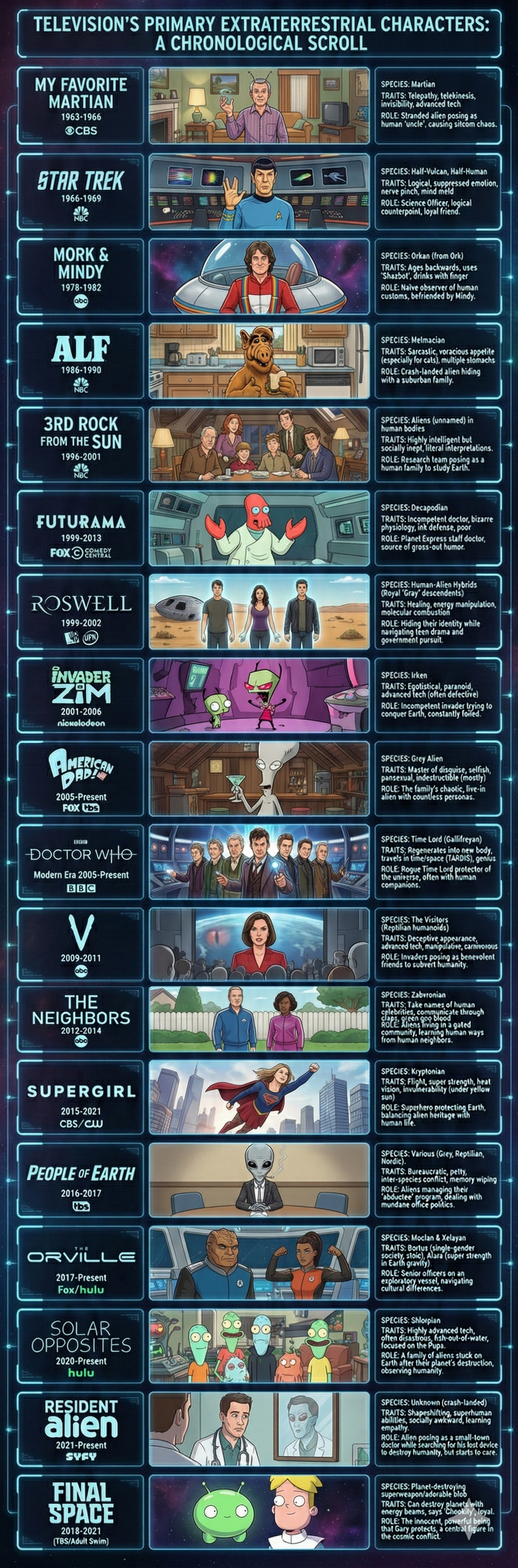
Television has long utilized the concept of the extraterrestrial visitor to explore the human condition. By placing a non-human character in a mundane or high-stakes Earthly setting, creators strip away the familiar social contracts that govern daily life, allowing audiences to view their own behaviors through an alien lens. This narrative device has evolved significantly from the sitcoms of the 1960s to the complex, genre-bending series of the modern era. The progression of these characters reveals shifts in cultural attitudes toward technology, immigration, and the definition of humanity itself.
The Early Sitcom Era and the Friendly Invader
The 1960s marked a period where science fiction began to permeate mainstream domestic television. While cinema often portrayed aliens as terrifying invaders representing Cold War anxieties, television frequently took a softer approach. The “fish out of water” trope allowed writers to use extraterrestrial characters as a vehicle for observational comedy.
My Favorite Martian and the Domesticated Alien
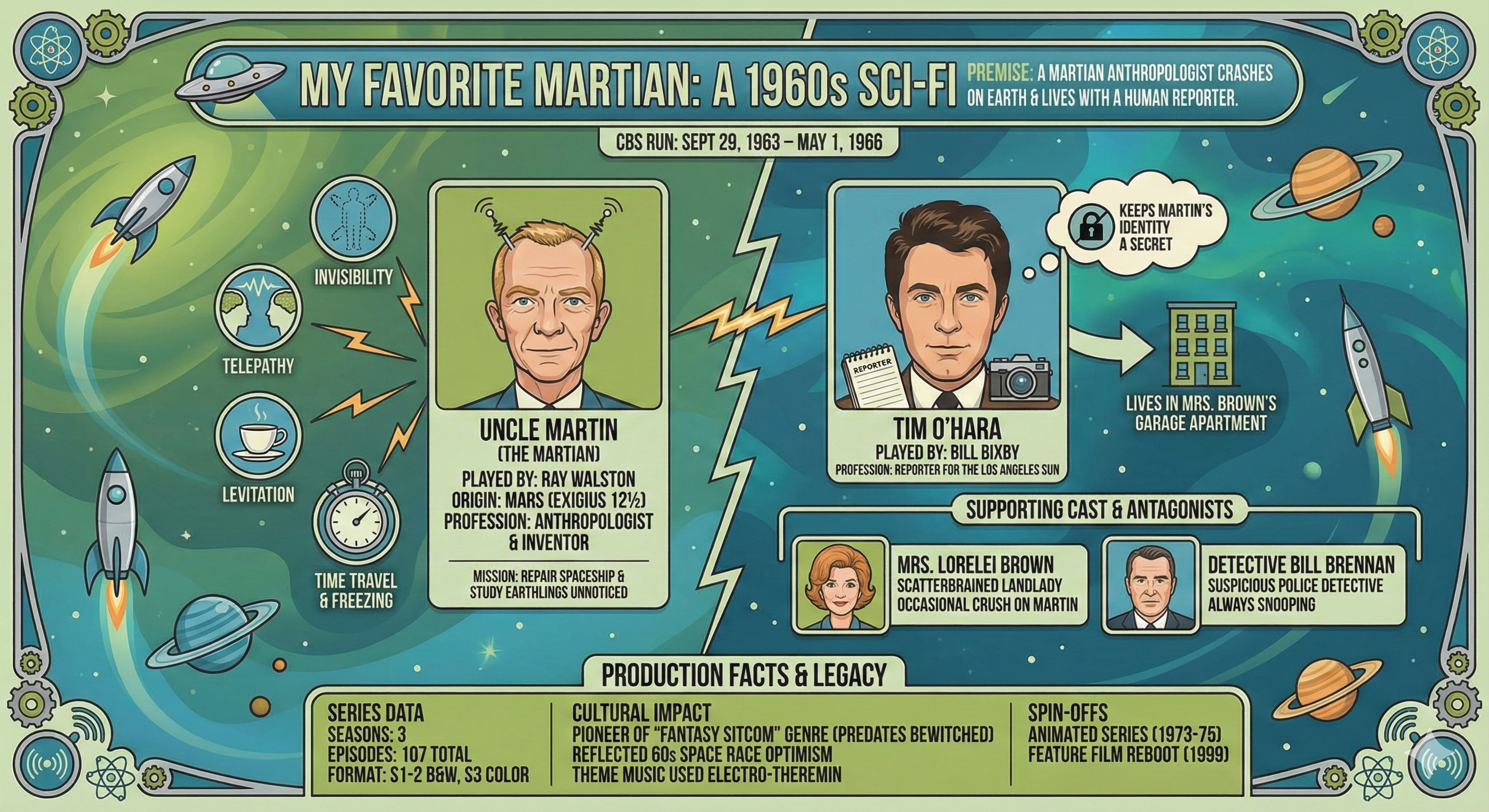
Debuting in 1963 on CBS, My Favorite Martian established the template for the hidden alien sitcom. The character of Uncle Martin, a Martian anthropologist stranded on Earth, brought advanced technology and telepathic abilities to a suburban setting. Unlike the monstrous invaders of 1950s B-movies, Uncle Martin was sophisticated and intellectual, often viewing human customs with bemused superiority. His presence introduced the concept that aliens could be benevolent, albeit condescending, observers of human folly. The show utilized special effects such as invisibility and levitation, which were novel for television comedies of that time, to create situational humor derived from the need to conceal his true identity.

Star Trek and the Logic of Spock
While My Favorite Martian played for laughs, Star Trek introduced a character who would become the archetype for the intellectual alien: Spock. As a half-human, half-Vulcan Science Officer, Spock represented the struggle between emotion and logic. His character did not hide his alien nature but rather integrated it into the crew’s dynamic. Spock served as a logical counterpoint to the passionate human captain, creating a dynamic that allowed the show to debate philosophical and ethical questions. The character’s suppressed emotion and adherence to logic were not presented as villainous but as a valid, alternative way of existence. This representation shifted the narrative from aliens as threats to aliens as complex beings capable of deep loyalty and friendship.
The Expansion of the Alien Sitcom in the 1970s and 80s
As societal norms loosened in the 1970s and 80s, the portrayal of aliens became more eccentric. The focus shifted from concealing the alien’s identity to exploring the chaotic interactions between the alien and their human hosts.
Mork & Mindy and the Naive Observer
Mork & Mindy capitalized on the manic energy of its lead actor to portray an alien from the planet Ork. Mork was a naive observer, essentially a child in an adult’s body, attempting to understand human customs. His reports to his leader, Orson, at the end of each episode served as a moral summary, deconstructing complex human behaviors like love, greed, and war into simple, often poignant observations. Mork’s character inverted the “superior alien” trope; instead of looking down on humans, he often found beauty in emotions that humans took for granted. The show emphasized the absurdity of social rituals by having an outsider perform them incorrectly.
ALF and the Sarcastic Houseguest
In the late 1980s, ALF introduced a darker, more cynical edge to the alien sitcom. Gordon Shumway, known as ALF (Alien Life Form), was a refugee from the destroyed planet Melmac. Unlike the polite Uncle Martin or the innocent Mork, ALF was abrasive, sarcastic, and possessed a voracious appetite – specifically for cats. This character represented a shift toward the anti-hero. He was not on Earth to learn or to help; he was simply stuck. The show explored the tension of harboring a fugitive, as the family had to hide him from the Alien Task Force. The use of a puppet allowed for physical comedy and a unique visual distinction that separated ALF from human-looking aliens of the past.
The Ensemble Approaches of the 1990s
The 1990s saw a diversification in how aliens were presented, moving beyond the solitary visitor to groups of aliens attempting to integrate or cope with life on Earth.
3rd Rock from the Sun and the Research Team
3rd Rock from the Sun took the concept of the observer to its logical extreme by featuring a team of four aliens posing as a human family. The High Commander, security officer, information officer, and transmitter assumed the roles of father, sister, brother, and teenage son, respectively. This structure allowed the show to tackle gender roles, generational divides, and social hierarchy simultaneously. The aliens were highly intelligent but socially inept, approaching human life as a rigorous scientific experiment. Their literal interpretations of idioms and social cues highlighted the often arbitrary nature of human interaction. The show was notable for suggesting that the human body itself – with its hormones and sensations – was the most confusing aspect of the mission.
Futurama and the Workplace Alien
Animation allows for more diverse character designs, and Futurama utilized this to create Dr. Zoidberg, a Decapodian resembling a lobster. Zoidberg subverted the “scary alien” trope by being pathetic, incompetent, and perpetually impoverished. Despite his bizarre physiology and ink defense mechanisms, he was a mundane part of the Planet Express crew. He represented the immigrant experience gone wrong – someone who tries desperately to fit in and succeed but is continually marginalized and misunderstood. The humor derived not from his alienness being a secret, but from it being completely ignored or reviled by his peers.
Roswell and the Teen Metaphor
Moving away from comedy, Roswell utilized the alien identity as a metaphor for adolescent alienation. The show featured three human-alien hybrids who were survivors of the 1947 crash. Hiding in plain sight as high school students, they dealt with the fear of exposure, the search for their origins, and the development of frightening powers. The series tapped into the universal feeling of being different that characterizes the teenage experience. The stakes were life and death, involving government cover-ups and intergalactic politics, grounding the fantastical elements in emotional reality.
The Millennium: Satire and Subversion
The early 2000s introduced aliens that were openly hostile or chaotic, reflecting a more cynical worldview.
Invader Zim and the Incompetent Conqueror
Invader Zim featured an Irken invader sent to Earth not to conquer it, but effectively to get him out of the way of his own leaders. Zim was egotistical, paranoid, and largely incompetent, thwarted constantly by a human child. The show used grotesque imagery and dark humor to satirize consumption culture and the education system. Zim viewed humanity with utter contempt, yet his failures humanized him in a twisted way. The series broke new ground in animation style and tone, presenting a gritty, dirty version of Earth that seemed just as alien as Zim himself.
American Dad! and the Hedonistic Alien
Roger the Alien from American Dad! represents the alien as the id. Living in the attic of a CIA agent, Roger is a master of disguise who adopts countless personas to interact with the outside world. He is selfish, pansexual, substance-abusing, and emotionally volatile. Roger deconstructs the idea of the “wise visitor.” He has been on Earth for decades and has absorbed its worst qualities rather than its best. His personas often serve as satirical critiques of various human stereotypes, from corrupt politicians to abusive authority figures.
Doctor Who and the Lonely God
The 2005 revival of Doctor Who reintroduced The Doctor to a modern audience. As a Time Lord, The Doctor is the protector of the universe, traveling in the TARDIS. The modern iteration focused heavily on the loneliness of an immortal being who outlives everyone they love. The Doctor is a charming eccentric but carries the weight of the Time War and the genocide of his own people. This iteration explores the burden of immense power and the necessity of companionship to maintain moral grounding. The Doctor needs human companions not for protection, but to remind him of the value of small, ephemeral lives.
Modern Complexities and Genre Blending
In the last decade, television has blended genres, mixing high-concept sci-fi with workplace comedy, domestic drama, and superhero action.
V and the Deceptive Invasion
The 2009 reboot of V updated the 1983 miniseries for a post-9/11 world. The Visitors, led by the charismatic Anna, arrive offering universal healthcare and clean energy. Beneath their beautiful human exteriors lie reptilian predators. The show explored themes of media manipulation, the cult of personality, and the trade-off between security and freedom. It questioned the price of utopia and the dangers of blind trust in benevolent-seeming authorities.
The Neighbors and Gated Communities
The Neighbors placed aliens in a very specific Earth setting: a gated community in New Jersey. The Zabvronians assumed the names of sports celebrities and communicated through synchronized clapping. The show used the insular nature of suburban gated communities as a parallel to the isolation of an alien species. It focused on the aliens learning parenting and marriage dynamics from a regular human family, reinforcing the idea that human social structures are bizarre even to those who travel the stars.
Supergirl and the Refugee Experience
Supergirl brought the Kryptonian mythology to the forefront. Kara Zor-El, unlike her cousin Superman, arrived on Earth as a teenager with memories of her lost world. Her narrative is explicitly tied to the refugee experience. She navigates the dual identity of being a superhero and a reporter while dealing with xenophobia and anti-alien sentiment. The show tackles political issues surrounding immigration and rights for non-citizens, using the alien population of National City as a direct allegory for marginalized groups in the real world.
People of Earth and Bureaucracy
People of Earth focused on a support group for alien abductees, or “experiencers.” The show introduced a hierarchy of alien races – Greys, Reptilians, and Nordics – managing their “subjects” with the mundane inefficiency of a mid-level corporation. Jeff the Grey, an alien handler, deals with inter-species conflict and office politics on his ship. This approach demystified the abduction phenomenon, turning terrifying cosmic events into administrative errors and workplace grievances.
The Orville and Cultural Relativism
The Orville began as a parody of space operas but evolved into a sincere exploration of sci-fi tropes. Characters like Bortus (a Moclan) and Alara (a Xelayan) serve as officers on an exploratory vessel. Bortus comes from a single-gender society, and his storylines often involve complex social issues regarding gender identity and tradition. The show uses these alien cultures to engage in cultural relativism, forcing human characters – and the audience – to question whether their moral values are universal or merely a product of Earth’s specific history.
Solar Opposites and the unconventional Family
Solar Opposites features a family of aliens stuck on Earth after their planet’s destruction. Korvo, the mission leader, hates Earth, while his partner Terry loves its junk culture. The show is violent and frantic, focusing on the sci-fi concepts of the “Pupa,” a living supercomputer destined to terraform Earth. It contrasts the high-stakes mission of the aliens with their petty, domestic squabbles. The “Wall” subplot, involving humans shrunk and kept in a terrarium, explores the development of civilization and religion in a microcosm, contrasting with the aliens’ disregard for human life.
Resident Alien and the Search for Humanity
Resident Alien features Harry Vanderspeigle, a crash-landed alien who takes the form of a small-town doctor. His mission is to destroy humanity, but he becomes distracted by the complexities of human emotion and small-town murder mysteries. The show relies on the tension between his murderous logic and his growing empathy. It is a character study of a being learning to feel, often confusing indigestion with sadness or hunger with love. Harry’s awkwardness is not just for laughs; it highlights the isolation of being the only one of your kind.
Final Space and Cosmic Stakes
Final Space introduces Mooncake, a planet-destroying superweapon that looks like an adorable green blob. The relationship between the protagonist Gary and Mooncake forms the emotional core of the series. Despite Mooncake’s destructive potential, he is innocent and loyal. The show balances slapstick humor with tragic space opera elements, exploring themes of loss and destiny. Mooncake represents the duality of power and innocence, a common theme in modern animation.
| Show Title | Primary Alien Character(s) | Species/Origin | Disguise/Integration Method | Primary Narrative Role |
|---|---|---|---|---|
| My Favorite Martian | Uncle Martin | Martian | Passes as human uncle; uses invisibility | Benevolent but superior observer causing sitcom chaos. |
| Star Trek | Spock | Half-Vulcan/Half-Human | No disguise; Science Officer | Logical counterpoint to human emotion; loyal friend. |
| Mork & Mindy | Mork | Orkan (Planet Ork) | Passes as human; wears colorful clothing | Naive observer of customs; befriended by human. |
| ALF | ALF (Gordon Shumway) | Melmacian | Hides in house; no physical disguise | Sarcastic houseguest; cultural critic. |
| 3rd Rock from the Sun | The Solomon Family | Unnamed Species | Human bodies (biological suits) | Research team posing as a family to study Earth. |
| Futurama | Dr. Zoidberg | Decapodian | No disguise; Planet Express staff | Incompetent doctor; source of gross-out humor. |
| Roswell | Max, Isabel, Michael | Human-Alien Hybrids | Pass as human teenagers | Hiding identity while navigating teen drama. |
| Invader Zim | Zim | Irken | Wears bad contact lenses and wig | Incompetent invader trying to conquer Earth. |
| American Dad! | Roger | Grey Alien | Master of disguise (costumes/personas) | Chaotic, hedonistic family member. |
| Doctor Who | The Doctor | Time Lord (Gallifrey) | Looks human; regenerates | Protector of the universe; lonely traveler. |
| V (2009) | Anna | The Visitors | Synthetic human skin over reptilian body | Invaders posing as benevolent friends. |
| The Neighbors | The Zabvronians | Zabvronian | Human bodies; green blood | Aliens in a gated community learning human ways. |
| Supergirl | Kara Zor-El | Kryptonian | Looks human; uses glasses as disguise | Superhero protecting Earth; balancing heritage. |
| People of Earth | Jeff | Grey | No disguise (seen on ship) | Bureaucratic middle-manager of abductions. |
| The Orville | Bortus, Alara | Moclan, Xelayan | No disguise; Ship officers | Senior officers navigating cultural differences. |
| Solar Opposites | Korvo, Terry | Shlorpian | No disguise; live in suburbs | Family stuck on Earth; observing humanity. |
| Resident Alien | Harry Vanderspeigle | Unknown (Shapeshifter) | Genetically transforms into human | Alien posing as doctor; learns empathy. |
| Final Space | Mooncake | Planet-destroying weapon | No disguise | Innocent pet/weapon; central to cosmic conflict. |
Summary
The evolution of extraterrestrial characters on television demonstrates a clear trajectory from simple comedic devices to complex psychological portraits. Early portrayals in My Favorite Martian and Mork & Mindy utilized aliens as tools for safe social commentary, highlighting the quirks of human behavior through a lens of innocence or superiority. As the genre matured, shows like Star Trek and Doctor Who used aliens to explore deeper philosophical questions regarding logic, mortality, and morality. The modern era has fractured these tropes, offering viewers everything from the gritty, bureaucratic realism of People of Earth to the dark, character-driven comedy of Resident Alien. Regardless of the tone, these characters remain essential to the television landscape because they allow creators to isolate and examine the specific traits that define humanity. By looking at the stars, television writers continue to find new ways to talk about life on Earth.
Appendix: Top 10 Questions Answered in This Article
How did early sitcoms like My Favorite Martian portray aliens?
Early sitcoms portrayed aliens as benevolent, often superior observers who had to hide their identity. They served as a vehicle for observational comedy, pointing out the absurdities of human customs while living in a typical suburban setting.
What is the significance of Spock in the history of TV aliens?
Spock established the archetype of the logical, intellectual alien who struggles with human emotion. He provided a counterbalance to human passion, allowing Star Trek to explore ethical and philosophical debates through the conflict between logic and feeling.
How did Mork & Mindy change the depiction of aliens?
Mork & Mindy introduced the “naive observer” trope, where the alien is childlike and innocent rather than superior. Mork’s misunderstandings of social norms highlighted the arbitrary nature of human rituals and focused on the beauty of human emotion.
What role did ALF play in the evolution of alien characters?
ALF introduced a cynical, sarcastic, and self-interested alien character, shifting away from the polite visitor trope. As a puppet, he offered a distinct visual style and explored the tension of a family harboring a fugitive who was often a nuisance.
How did 3rd Rock from the Sun approach the concept of aliens on Earth?
The show featured a team of aliens posing as a family to conduct scientific research on human society. It used their literal interpretations of language and social cues to satirize gender roles, generational gaps, and the confusion of inhabiting a biological human body.
What metaphor does the show Roswell use for its alien characters?
Roswell used the secret identity of its alien characters as a metaphor for the teenage experience of feeling like an outsider. The fear of exposure and the struggle to understand one’s origins mirrored the anxieties of adolescence and growing up.
How does Roger from American Dad! differ from traditional aliens?
Roger is depicted as a hedonistic, selfish, and emotionally volatile character who has absorbed the worst traits of humanity. He uses disguises not just to hide, but to actively participate in and manipulate human society for his own entertainment.
What themes does the modern Doctor Who explore through its protagonist?
The modern Doctor Who explores the themes of loneliness and the burden of immortality. The Doctor is portrayed as a “lonely god” who requires human companions to maintain a moral grounding and to appreciate the fleeting nature of mortal life.
How does The Orville use alien cultures in its storytelling?
The Orville uses its alien crew members to engage in cultural relativism and social commentary. By presenting alien societies with vastly different norms regarding gender and tradition, the show forces the audience to question the universality of human moral values.
What is the premise of Resident Alien?
Resident Alien follows an alien who crash-lands and takes the form of a small-town doctor with the initial mission to destroy humanity. The series focuses on his gradual development of empathy and human emotion, which complicates his original destructive directive.
Appendix: Top 10 Frequently Searched Questions Answered in This Article
What was the first major sitcom to feature an alien protagonist?
My Favorite Martian, which debuted in 1963, is considered one of the first major sitcoms to feature an alien protagonist living among humans. It established many of the tropes used in later series.
Who played the alien in Mork & Mindy?
The alien character Mork was played by Robin Williams. His high-energy performance and improvisation skills were central to the show’s success and the character’s popularity.
Is The Doctor in Doctor Who an alien?
Yes, The Doctor is a Time Lord from the planet Gallifrey. Although they appear human, they possess two hearts and the ability to regenerate into a new body when mortally wounded.
What species is ALF?
ALF is a Melmacian from the planet Melmac. His real name is Gordon Shumway, and he arrived on Earth after his home planet was destroyed.
Why does Spock have pointed ears?
Spock has pointed ears because he is half-Vulcan. In the Star Trek universe, this physical trait is characteristic of the Vulcan species, along with their green blood and upswept eyebrows.
What is the plot of 3rd Rock from the Sun?
The plot involves four extraterrestrials who land on Earth and pose as a human family to observe and study human behavior. They report their findings back to their home leader, the Big Giant Head.
Are the aliens in V friendly?
In the series V, the aliens, known as Visitors, initially present themselves as friendly and benevolent, offering technology and aid. However, this is a deception to hide their true reptilian nature and their sinister agenda to exploit humanity.
What kind of alien is Zoidberg in Futurama?
Dr. Zoidberg is a Decapodian from the planet Decapod 10. He resembles a humanoid lobster or crustacean and serves as the staff doctor for Planet Express, despite his poor understanding of human anatomy.
Does Supergirl have the same powers as Superman?
Yes, as a Kryptonian living under a yellow sun, Supergirl possesses the same set of powers as Superman. These include flight, super strength, heat vision, x-ray vision, and invulnerability.
What happens to the aliens in Solar Opposites?
The aliens in Solar Opposites are stranded on Earth after their home planet, Shlorp, was destroyed by an asteroid. They are waiting for their supercomputer, the Pupa, to mature and terraform Earth into a new home for their species.


