


Key Takeaways
- FOIA grants public access to agency records
- National security laws limit UAP disclosure
- Exemptions protect methods and sources
Introduction to the Right to Know
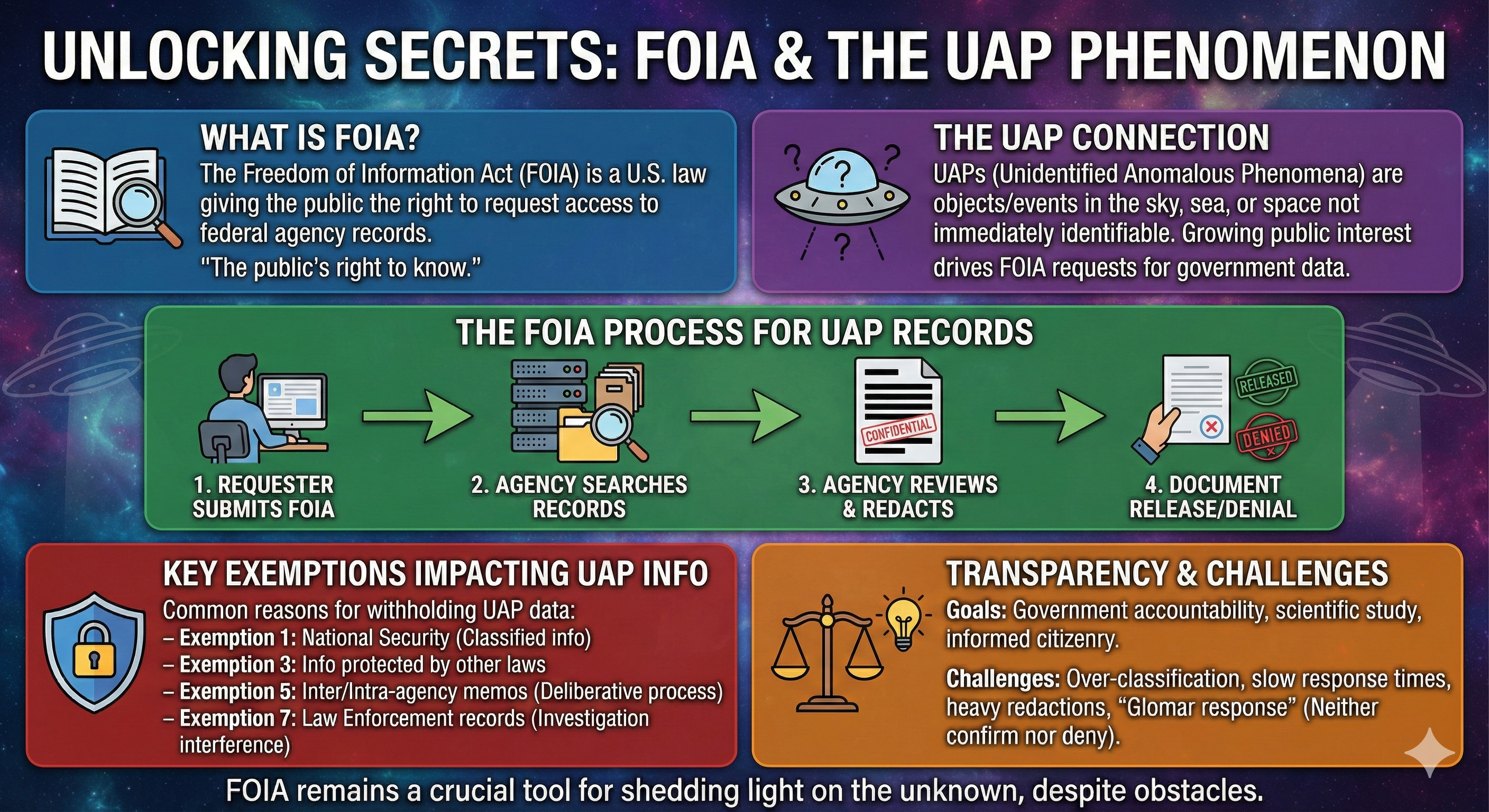
The concept of open government serves as a foundational pillar of democratic societies. In the United States, this principle finds its legal embodiment in the Freedom of Information Act (United States). Enacted in 1966, this statute provides any person the right to request access to records from any federal agency. It is often described as the law that keeps citizens in the know about their government. While the act covers a vast array of topics ranging from environmental data to consumer safety, a specific subset of inquiries has persistently captured public imagination and strained the mechanisms of the law: requests concerning the Unidentified anomalous phenomenon.
Public interest in objects or events in the sky, sea, or space that are not immediately identifiable has grown substantially. These phenomena, formerly known as UFOs, present a unique challenge to the transparency mandates of the information act. Government agencies tasked with national defense and intelligence gathering operate under strict protocols of secrecy. The intersection of a citizen’s right to know and the state’s obligation to protect sensitive information creates a complex legal and bureaucratic landscape. This article examines the intricate relationship between information requests and the government’s handling of anomalous phenomena records.
The Legal Architecture of Transparency
The Freedom of Information Act (United States) generally provides that any person has a right, enforceable in court, to obtain access to federal agency records, except to the extent that such records (or portions of them) are protected from public disclosure by one of nine exemptions or by one of three special law enforcement record exclusions.
The Presumption of Openness
Under current legal standards, agencies operate under a presumption of openness. This means that an agency should disclose information unless it falls squarely within a statutory exemption. The burden of proof lies with the government to justify why a record or a portion of a record cannot be released. This shift places the requester in a position of initial strength, forcing the agency to articulate specific harms that would result from disclosure.
However, the definition of a “record” is strict. It encompasses information that is created or obtained by an agency and is under agency control at the time of the request. For researchers studying anomalous phenomena, this distinction is significant. If a contractor holds the data and the agency does not have a contractual right to access it for its own purposes, that data may sit outside the reach of the law.
The Request Mechanism
The process begins when a requester submits a formal inquiry to the specific agency believed to hold the records. There is no central clearinghouse for all government documents. A researcher seeking information on a naval encounter must file with the United States Navy, while a request regarding satellite data might go to the National Reconnaissance Office.
The request must reasonably describe the records sought. This requirement often proves difficult in the context of anomalous phenomena. If a request is too broad, such as “all files on flying saucers,” an agency may reject it for failing to provide enough detail to locate the documents with a reasonable amount of effort. Successful requesters often cite specific dates, locations, or project names to trigger a valid search.
| Step | Action Taken | Typical Timeframe | Outcome |
|---|---|---|---|
| Submission | Requester sends a detailed letter or digital form to the agency’s FOIA office. | Immediate receipt | Request number assigned |
| Search | Agency staff queries databases and contacts relevant departments for records. | Weeks to Years | Documents located or “No Records Found” |
| Review | Specialists analyze documents for sensitive information requiring redaction. | Months to Years | Determination of exemptions |
| Response | Agency releases documents, denies the request, or issues a Glomar response. | Variable | Release, denial, or litigation |
The Unidentified Anomalous Phenomena Connection
The subject of Unidentified anomalous phenomenon presents specific difficulties for the information release process. Unlike requests for policy memos or budget expenditures, records regarding anomalous phenomena often originate from sensor systems designed for combat or intelligence gathering.
The Shift from UFO to UAP
The terminology shift from Unidentified Flying Object (UFO) to Unidentified Anomalous Phenomena (UAP) reflects a change in government attitude. The term UAP encompasses airborne objects, transmedium objects (those that move between water and air), and submerged objects. This broader definition expands the scope of potential records. It implicates not just the Air Force, but also the Navy and organizations monitoring the oceans.
Why the Government Collects This Data
The government’s primary interest in these phenomena is not necessarily the search for extraterrestrial life, but rather aviation safety and national security. An unidentified object in restricted airspace poses a collision risk. Furthermore, if the object represents advanced technology from a foreign adversary, it constitutes a defense failure. Consequently, the records generated during these encounters are often classified at high levels immediately upon creation. This immediate classification creates a hurdle for subsequent public access requests.
The Agency Search and Review Process
Once a request is logged, the agency enters the search phase. This is an internal administrative procedure where Freedom of Information Act officers task subject matter experts to look for responsive records.
The Search Burden
Courts require agencies to conduct a search that is “reasonably calculated to uncover all relevant documents.” This does not mean the agency must search every filing cabinet or hard drive. They must search the locations where such records are likely to be found. In the realm of anomalous phenomena, this can be problematic. If a file was moved to a “special access program” or misfiled decades ago, a standard search may not locate it. The agency then responds with “no records found,” which does not necessarily mean the records do not exist, only that the search parameters did not yield them.
Processing and Queues
Agencies process requests in a multi-track system. Simple requests go into a fast track; complex requests involving voluminous records or multiple offices go into a slower track. Requests involving anomalous phenomena almost always default to the complex track. The need to consult with other agencies, known as “consultations” or “referrals,” adds significant time. For example, if the Department of State finds a document that originated with the Central Intelligence Agency, they must send it to the CIA for review before releasing it.
Key Exemptions Impacting UAP Information
The Freedom of Information Act contains nine specific exemptions that allow agencies to withhold information. In the context of unidentified anomalous phenomena, four exemptions appear with high frequency. These legal shields are often the source of frustration for researchers and the general public.
Exemption 1: National Security
This exemption protects information that is properly classified under an Executive Order in the interest of national defense or foreign policy. Executive Order 13526 currently governs national security information. If a record reveals intelligence sources, methods, or military plans, it is exempt.
For anomalous phenomena videos, this exemption is frequently cited to protect the capabilities of the sensor platforms. The government may argue that releasing high-resolution video would reveal the resolution limits, range, or tracking abilities of a classified radar or camera system. Even if the object in the video is unknown, the method of capturing the image is a state secret.
Exemption 3: Statutory Protections
Exemption 3 applies to information specifically exempted from disclosure by another statute. A common statute cited in this field is the National Security Act of 1947, which requires the Director of National Intelligence to protect intelligence sources and methods from unauthorized disclosure. Another is the Atomic Energy Act, which protects “Restricted Data” regarding nuclear technology. If an anomalous incident occurred near a nuclear facility, this exemption might be applied to withhold details about the facility’s operations.
Exemption 5: The Deliberative Process
This exemption protects “inter-agency or intra-agency memorandums or letters.” It covers the “deliberative process privilege,” which is designed to encourage open and frank discussion among government officials. It protects draft documents, recommendations, and opinions generated before a final decision is made.
In the study of anomalous phenomena, Exemption 5 is often used to withhold internal emails or briefing slides where officials speculate about the nature of an object. The government argues that releasing these candid discussions would confuse the public and inhibit officials from speaking freely in the future.
Exemption 7: Law Enforcement Records
Exemption 7 covers records or information compiled for law enforcement purposes. Within this category, Exemption 7(E) is particularly relevant. It protects techniques and procedures for law enforcement investigations or prosecutions if disclosure could reasonably be expected to risk circumvention of the law.
The Federal Bureau of Investigation frequently utilizes this exemption. If the Bureau investigates a sighting to determine if it involves a violation of federal law (such as unauthorized flight in restricted airspace), the investigative file is treated as a law enforcement record.
| Exemption Code | Legal Basis | Application to UAP Records |
|---|---|---|
| (b)(1) | National Security | Protects classified sensor data, radar telemetry, and military capabilities. |
| (b)(3) | Other Statutes | Protects intelligence sources (CIA Act) and nuclear data (Atomic Energy Act). |
| (b)(5) | Deliberative Process | Withholds internal emails, draft reports, and speculative discussions. |
| (b)(7) | Law Enforcement | Protects investigative files and techniques used to track unauthorized airspace incursions. |
The Glomar Response
In some instances, an agency will refuse to confirm or deny the existence of records. This is known as a “Glomar response.” The term originates from a 1970s case involving the Hughes Glomar Explorer, a ship built by the Central Intelligence Agency to salvage a sunken Soviet submarine. When journalists requested records about the ship, the agency stated it could “neither confirm nor deny” the existence of the records because the mere existence of the program was a classified fact.
In the context of unidentified phenomena, agencies use the Glomar response when acknowledging the existence of records would itself reveal a sensitive fact. For example, if a person asks for “records of UAP intercept attempts by the specific classified satellite X,” the agency may issue a Glomar response. Confirming they have records would confirm the satellite has intercept capabilities; denying they have records would reveal it does not. Both admissions provide intelligence to adversaries.
Transparency Goals and Institutional Challenges
The tension between the desire for transparency and the necessity of secrecy defines the current landscape of information release. The goal of the Freedom of Information Act (United States) is to create an informed citizenry that can hold its governors accountable. In the specific domain of anomalous phenomena, advocates argue that scientific study and flight safety require greater data release.
Over-Classification
A significant challenge identified by legislators and transparency advocates is over-classification. This occurs when officials classify information at a higher level than necessary or classify information that should be unclassified, often out of an abundance of caution or to avoid bureaucratic embarrassment. In the UAP field, this tendency is exacerbated by the stigma historically attached to the subject. Officials may classify reports to avoid media scrutiny or ridicule.
Redactions
When documents are released, they are often heavily redacted. Black bars obscure names, technical details, and location data. While necessary to protect privacy and security, heavy redaction can render a document virtually useless for analysis. A report describing a pilot’s visual observation loses scientific value if the altitude, speed, location, and date are redacted under Exemption 1.
Resource Constraints
Government FOIA offices are chronically underfunded and understaffed. The backlog of requests across the federal government numbers in the hundreds of thousands. A request for complex records regarding anomalous phenomena competes with requests from journalists, corporations, and other citizens. This resource bottleneck leads to delay. It is not uncommon for a complex request to take several years to reach the front of the queue.
The Role of Appeal and Litigation
When a request is denied, or if the redactions are deemed excessive, the requester has the right to file an administrative appeal. A higher authority within the agency reviews the initial decision. If the appeal is denied, the requester can file a lawsuit in federal court.
Litigation is a primary driver of transparency in this field. Judges examine the agency’s justifications for withholding records. In some cases, judges perform “in camera” reviews, looking at the unredacted documents privately to determine if the exemptions were applied correctly. Many significant releases of documents related to anomalous phenomena have occurred only after legal action forced the government’s hand.
Recent Legislative Developments
The landscape of disclosure is evolving due to legislative pressure. The United States Congress has shown increased interest in the subject, mandating reports and establishing offices like the All-domain Anomaly Resolution Office (AARO). The National Defense Authorization Acts (NDAA) of recent years have included provisions requiring the Department of Defense to establish procedures for reporting and analyzing these events.
These legislative mandates interact with the information act by creating new records and, potentially, new pathways for release. However, the legislation also contains provisions regarding the protection of sources and methods, ensuring that the tension between secrecy and transparency persists.
The Scientific Imperative
Beyond government accountability, a major driver for information requests is scientific inquiry. Scientists require data to test hypotheses. The vast sensor networks of the military collect data that is unmatched by civilian instruments. Accessing this data, even in a redacted form, allows the scientific community to analyze the kinematics and observational signatures of these phenomena. The National Aeronautics and Space Administration has commissioned independent study teams to examine how civilian data can be used to understand these events, acknowledging that classified data is often of limited use for open scientific collaboration due to the restrictions on its release.
Summary
The Freedom of Information Act (United States) remains the primary tool for the public to access government records regarding unidentified anomalous phenomena. While the law provides a clear pathway for requests, the nature of the subject matter – often intertwined with advanced military technology and intelligence operations – invokes powerful exemptions. The process is a balance between the democratic necessity of an informed public and the state’s responsibility to maintain national security. Despite challenges such as delays, over-classification, and heavy redactions, the systematic use of this law continues to bring new information into the public domain, slowly clarifying the government’s historical and contemporary engagement with the unknown.
Appendix: Top 10 Questions Answered in This Article
What is the Freedom of Information Act?
The Freedom of Information Act is a U.S. law enacted in 1966 that gives the public the right to request access to records from any federal agency. It is designed to ensure government transparency and accountability.
What is the definition of UAP?
UAP stands for Unidentified Anomalous Phenomena. The term encompasses objects or events in the sky, sea, or space that are not immediately identifiable and cannot be explained by known aircraft or natural phenomena.
Why does the government redact UAP information?
The government redacts information primarily to protect national security, intelligence sources, and methods. Releasing full data could reveal the capabilities of sensitive military sensors or radar systems.
What is a “Glomar response”?
A Glomar response is when an agency refuses to confirm or deny the existence of requested records. This is used when the mere admission that records exist would reveal a classified fact or compromise national security.
What is Exemption 1 in the context of FOIA?
Exemption 1 protects information that is classified under an Executive Order for national defense or foreign policy reasons. It is frequently cited to withhold technical details of military encounters with anomalous phenomena.
What is the “presumption of openness”?
This is the legal standard that agencies should disclose information unless it falls within a specific statutory exemption. The burden of proof is on the government to justify why a record must be withheld.
How does Exemption 5 impact UAP requests?
Exemption 5 protects inter-agency or intra-agency memorandums that are part of the deliberative process. It allows the government to withhold internal emails, drafts, and speculative discussions among officials regarding anomalous events.
Why are law enforcement records exempt?
Under Exemption 7, records compiled for law enforcement purposes are exempt if their release would interfere with investigations or reveal sensitive techniques. This often applies to FBI files or investigations into airspace violations.
What creates the backlog in FOIA requests?
Backlogs are caused by a combination of limited resources, understaffing in agency FOIA offices, and the increasing complexity and volume of requests. Complex consultations with other agencies also delay the review process.
Can a denied FOIA request be challenged?
Yes, a requester can file an administrative appeal within the agency. If that appeal is denied, the requester has the right to file a lawsuit in federal court to have a judge review the agency’s decision.
Appendix: Top 10 Frequently Searched Questions Answered in This Article
How do I file a FOIA request for UFOs?
You must submit a written request directly to the federal agency you believe holds the records, such as the Navy or Air Force. You must reasonably describe the records sought, including dates and locations if possible.
How long does a FOIA request take?
The time varies significantly, ranging from a few weeks for simple requests to several years for complex inquiries. Requests involving classified information or inter-agency consultations almost always take longer.
What is the difference between a UFO and a UAP?
UFO stands for Unidentified Flying Object, while UAP stands for Unidentified Anomalous Phenomena. UAP is the modern term used by the government to include objects in the air, water (transmedium), and space.
Is all government UFO data classified?
Not all data is classified; some records are unclassified but may still be withheld under other exemptions. However, the most detailed sensor data is often classified to protect the technology used to capture it.
What constitutes a “record” under FOIA?
A record is any information created or obtained by an agency that is under the agency’s control at the time of the request. This includes physical documents, emails, videos, and database entries.
Why did my FOIA request say “no records found”?
This response means the agency’s search, based on the description you provided, did not locate responsive documents. It does not definitively prove that no records exist, only that the specific search parameters failed to find them.
What are the costs associated with a FOIA request?
Agencies may charge fees for search time and duplication of records. However, fees are often waived for educational researchers, news media, or if the disclosure is in the public interest.
Does FOIA apply to private companies?
No, the act applies only to federal agencies. It does not cover Congress, the courts, or private corporations, even if those corporations are defense contractors holding data.
What is the role of AARO?
The All-domain Anomaly Resolution Office (AARO) is a Department of Defense office tasked with synchronizing efforts to detect and attribute anomalous objects. It generates new records and reports regarding these phenomena.
Can I get unredacted documents?
It is very difficult to obtain fully unredacted documents if they contain sensitive information. However, successful litigation or a mandatory declassification review can sometimes result in fewer redactions.


