


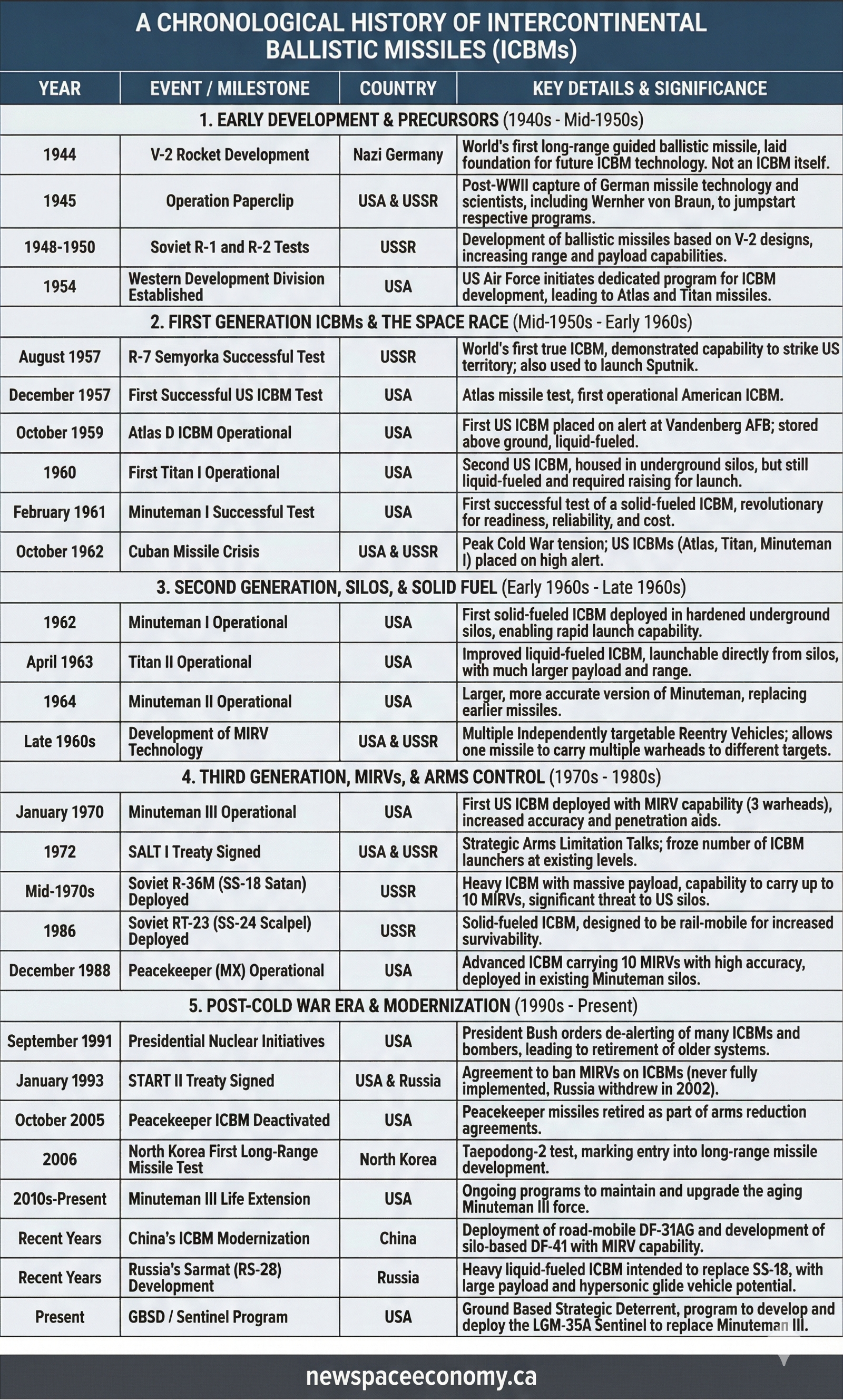
Key Takeaways
- ICBMs revolutionized global defense strategies.
- Solid fuel enhanced launch readiness significantly.
- Modern systems prioritize speed and mobility.
Introduction to Long Range Deterrence
The development of the Intercontinental Ballistic Missile (ICBM) represents a defining shift in military strategy and geopolitical power dynamics. These weapons are capable of delivering nuclear payloads across distances greater than 5,500 kilometers (3,400 miles). They serve as the land-based leg of the nuclear triad, operating alongside strategic bombers and submarine-launched ballistic missiles (SLBMs). The history of the ICBM is a narrative of technological escalation, where advancements in propulsion, guidance, and reentry physics have continuously altered the balance of power between major nations. This article examines the trajectory of these systems from their earliest theoretical foundations to the hypersonic vehicles of the modern era.
Precursors and the Dawn of Rocketry
The conceptual framework for long-range ballistic missiles emerged during the chaotic final years of the Second World War. While rocketry had existed for centuries, the application of precision guidance and liquid-fuel propulsion to military bombardment began in earnest with German engineering. The V-2 rocket, developed under the technical direction of Wernher von Braun, demonstrated the viability of a ballistic trajectory for delivering explosives.
Although the V-2 lacked the range to be an intercontinental weapon, it established the fundamental architecture used in later designs. It utilized a liquid propellant mixture of ethanol and liquid oxygen, fed into a combustion chamber by turbopumps. Following the war, the United States and the Soviet Union engaged in a strategic competition to acquire this technology and the personnel behind it. Operation Paperclip facilitated the transfer of German scientists to the United States, while the Soviet Union conducted similar recovery efforts. These programs laid the groundwork for the two superpowers to begin their own independent research into extending the range of ballistic missiles.
The Race Begins and the First Generation
The geopolitical tension of the 1950s accelerated the demand for a weapon system capable of striking an adversary’s homeland without relying on slow-moving bomber aircraft. The Soviet Union achieved the first major breakthrough under the guidance of Sergei Korolev. The R-7 Semyorka was the world’s first true ICBM. It was a massive vehicle that utilized a cluster of engines to generate sufficient thrust to lift a heavy nuclear warhead.
The R-7 is perhaps best known for launching Sputnik, but its primary design purpose was delivering a thermonuclear device to American soil. Despite this achievement, the R-7 had significant operational limitations. It used cryogenic fuels that boiled off at room temperature, meaning the missile could not be stored in a launch-ready state. Fueling the rocket took hours, which made it vulnerable to a preemptive strike.
The United States responded with the Atlas program. The Atlas D became the first operational American ICBM in 1958. It employed a unique “balloon tank” structure where the pressure of the fuel itself maintained the structural integrity of the airframe. Like the R-7, the Atlas relied on liquid oxygen and kerosene, necessitating long preparation times. These early systems were typically stored in unprotected above-ground complexes or “coffin” shelters that offered minimal protection against blast effects. The strategic utility of these first-generation missiles was limited by their low readiness and vulnerability, but they proved that intercontinental strike was technically feasible.
The Shift to Hardened Silos and Solid Fuel
As the 1960s approached, military planners recognized that the vulnerability of liquid-fueled rockets was a major liability. If a missile took hours to fuel, an enemy could destroy it on the ground before it could launch. This realization drove the development of two distinct technologies: storable liquid fuels and solid propellants.
The United States Air Force introduced the Titan I and subsequently the Titan II. The Titan II utilized hypergolic propellants – hydrazine and nitrogen tetroxide – which ignite spontaneously upon contact. These fuels could be stored inside the missile for long periods, allowing for a near-instantaneous launch. The Titan II was also housed in hardened underground silos, designed to withstand significant overpressure from nearby nuclear detonations. This shift to silo-based basing modes fundamentally changed nuclear targeting. An adversary now had to dedicate significant firepower to dig out these hardened targets.
Simultaneously, the development of the LGM-30 Minuteman I marked a revolutionary step forward. The Minuteman was the first operationally deployed solid-fueled ICBM. Solid fuel consists of a rubber-like compound containing both fuel and oxidizer. It is stable, requires no maintenance, and allows the missile to be launched in under a minute. The deployment of hundreds of Minuteman missiles in the Great Plains of the United States created a “sponge” effect, forcing the Soviet Union to target vast, sparsely populated areas rather than concentrating solely on cities.
The Soviet Union also advanced its capabilities during this period with the R-16 and later the R-36. These missiles emphasized heavy throw weight, allowing them to carry massive warheads. The Soviet design philosophy focused on creating rockets large enough to overcome American defenses through sheer yield and later, numbers. The Cuban Missile Crisis in 1962 highlighted the strategic importance of these systems. While the crisis was precipitated by medium-range ballistic missiles, the backdrop was the growing ICBM gap that the Soviet Union was desperate to close.
Guidance Systems and Accuracy
The ability to fly thousands of miles is useless without the ability to hit a specific target. Early ICBMs had large Circular Error Probable (CEP) figures, often measured in miles. This necessitated warheads with massive yields to ensure target destruction. As guidance technology improved, accuracy increased, allowing for smaller warheads and more precise targeting of hardened military sites.
Inertial Guidance Systems became the standard for ICBM navigation. These systems use gyroscopes and accelerometers to track the missile’s position and velocity relative to its launch point. They function independently of external signals, making them immune to jamming. Charles Stark Draper Laboratory was instrumental in refining these technologies for American missiles. Later iterations incorporated stellar guidance, where the missile would take a fix on the stars during the midcourse phase to correct any drift in the inertial platform.
The improvement in accuracy shifted nuclear doctrine. With precise missiles, it became possible to execute “counterforce” strikes targeting the enemy’s nuclear forces, rather than just “countervalue” strikes against cities and industrial centers. This capability raised fears of a first-strike scenario, where one side might believe it could wipe out the other’s retaliatory capacity in a surprise attack.
The MIRV Era and Strategic Complexity
By the 1970s, the arms race entered a new phase with the introduction of Multiple Independently Targetable Reentry Vehicles (MIRVs). Previously, one missile carried one warhead. With MIRV technology, a single missile could carry a “bus” or post-boost vehicle that would maneuver in space, releasing multiple warheads onto distinct trajectories to hit different targets.
The United States deployed the Minuteman III, the first MIRV-capable ICBM, in 1970. The Soviet Union followed suit with the SS-18 Satan (R-36M). The SS-18 was a massive liquid-fueled missile capable of carrying 10 heavy warheads. The introduction of MIRVs destabilized the strategic balance. A single Soviet SS-18 could theoretically destroy 10 American Minuteman silos. This favorable exchange ratio incentivized striking first in a crisis, as waiting to absorb an attack would mean losing one’s own missiles.
The LGM-118 Peacekeeper, deployed by the United States in the 1980s, was the American answer to the heavy Soviet ICBMs. It was highly accurate and carried 10 warheads. The deployment of these high-capability systems led to intense debates regarding strategic stability and fueled the desire for arms control treaties.
Treaties and the End of the Cold War
Recognizing the dangers of unbridled escalation, the superpowers engaged in a series of negotiations. The Strategic Arms Limitation Talks (SALT) and the Anti-Ballistic Missile (ABM) Treaty attempted to cap the number of launchers and limit defensive systems that might undermine the logic of Mutual Assured Destruction.
The end of the Cold War in 1991 brought about the START I treaty, which mandated significant reductions in strategic arsenals. The United Nations and various oversight bodies monitored the dismantling of delivery vehicles. The Peacekeeper was retired, and the Minuteman III was “de-MIRVed” to carry a single warhead, reducing the incentive for an enemy to strike it. The Soviet Union’s dissolution left a massive arsenal inherited by the Russian Federation, which also underwent reductions but maintained a strong focus on modernization.
Post-Cold War Modernization and New Threats
In the current geopolitical landscape, the ICBM remains a central pillar of national defense for major powers. The focus has shifted from sheer numbers to survivability and penetrating defenses. The United States has initiated the Sentinel program, formerly known as the Ground Based Strategic Deterrent (GBSD), to replace the aging Minuteman III infrastructure by the late 2020s. This program focuses on modular architecture and lower maintenance costs.
Russia has continued to develop heavy ICBMs. The RS-28 Sarmat is designed to replace the SS-18. It is a heavy liquid-fueled missile with enough range to attack the United States via the South Pole, bypassing traditional radar networks. Russia has also pioneered the Avangard hypersonic glide vehicle, which sits atop an ICBM but glides through the atmosphere at Mach 20, maneuvering to avoid missile defense systems.
China has significantly expanded its ICBM capabilities. The People’s Liberation Army Rocket Force has deployed the DF-41, a road-mobile solid-fueled missile capable of carrying MIRVs. China has also constructed new silo fields in its western deserts, signaling a shift away from a purely minimal deterrent posture. North Korea has also entered the ICBM arena with the Hwasong series, demonstrating the ability to reach the continental United States, complicating the security calculus in the Pacific.
The Physics of Reentry
A specific challenge for ICBM design is the reentry phase. Warheads reenter the atmosphere at speeds exceeding Mach 23. The friction with the air generates plasma and immense heat that would destroy an unprotected object. Engineers developed ablative heat shields, often made of carbon-phenolic composites. These materials are designed to burn away slowly, carrying the heat away from the warhead.
The shape of the reentry vehicle is also heavily engineered. Blunt bodies were used initially to create a shockwave that kept hot plasma away from the surface, but modern warheads use sharper, slender cones to maintain velocity and accuracy while managing thermal loads through advanced materials. This technology remains one of the most closely guarded secrets in national defense programs.
Mobile Launchers and Survivability
To counter the threat of accurate silo-busting missiles, nations have turned to mobile launchers. Transporter Erector Launchers (TELs) are large, heavy-duty vehicles that can move missiles across road or off-road networks. The Soviet SS-25 and modern Russian Yars missiles use this basing mode. The advantage is that a moving target is extremely difficult to track and destroy.
Rail-mobile ICBMs were also developed, most notably the Soviet SS-24 Scalpel. These trains looked like standard freight trains but carried nuclear missiles. They could utilize the vast rail network to hide in plain sight. While the United States considered rail-mobile basing for the Peacekeeper, the end of the Cold War curtailed the project. Russia has periodically discussed reviving the “Barguzin” combat railway missile complex.
Summary
The history of the Intercontinental Ballistic Missile is a chronology of scientific ingenuity applied to the grim necessity of deterrence. From the rudimentary V-2 to the sophisticated, multiple-warhead systems of today, ICBMs have shaped the modern world. They forced superpowers to negotiate, altered the landscape of international relations, and drove advancements in aerospace engineering. As nations continue to modernize their arsenals with hypersonic technologies and mobile platforms, the ICBM remains a potent symbol of the high stakes involved in global security. The technology has evolved, but the fundamental strategic purpose remains unchanged: to deter aggression through the promise of inevitable retaliation.
| Missile System | Country of Origin | Propulsion Type | Basing Mode | Notable Feature |
|---|---|---|---|---|
| V-2 (A4) | Germany | Liquid (Ethanol/LOX) | Mobile/Fixed Pad | First long-range ballistic missile precursor |
| R-7 Semyorka | Soviet Union | Liquid (Kerosene/LOX) | Open Pad | First true ICBM; launched Sputnik |
| Atlas D | United States | Liquid (Kerosene/LOX) | Above-ground/Coffin | Balloon tank structure; first US ICBM |
| Titan II | United States | Liquid (Hypergolic) | Hardened Silo | Storable fuel allow rapid launch |
| Minuteman I | United States | Solid Fuel | Hardened Silo | First solid-fuel ICBM; mass deployment |
| R-36M (SS-18) | Soviet Union | Liquid (Storable) | Hardened Silo | Heavy throw weight; 10 MIRVs |
| LGM-118 Peacekeeper | United States | Solid Fuel | Hardened Silo | High accuracy; 10 MIRVs; Cold Launch |
| RT-2PM2 Topol-M | Russia | Solid Fuel | Silo / Road Mobile | Modern maneuverable reentry vehicle |
| DF-41 | China | Solid Fuel | Road Mobile | Long range; MIRV capable |
| LGM-35 Sentinel | United States | Solid Fuel | Hardened Silo | In development; modular architecture |
Appendix: Top 10 Questions Answered in This Article
What was the first operational ICBM?
The Soviet R-7 Semyorka was the world’s first intercontinental ballistic missile. It was successfully tested in 1957 and famously launched the Sputnik satellite. However, its use of cryogenic fuel made it difficult to keep operationally ready for military use.
Why did the US move from liquid to solid fuel for missiles?
Liquid fuels like those used in the Atlas rocket required hours to load, leaving the missile vulnerable to attack. Solid fuels, introduced with the Minuteman I, allowed missiles to be stored in a ready-to-fire state for years and launched in under a minute.
What is a MIRV?
MIRV stands for Multiple Independently Targetable Reentry Vehicle. This technology allows a single missile to carry multiple warheads that can be released at different points to hit separate targets. This greatly increased the destructive potential of individual missiles.
What was the “Missile Gap”?
The “Missile Gap” was a perceived disparity in the number and power of ICBMs between the US and the Soviet Union during the late 1950s and early 1960s. While fears suggested the Soviets were far ahead, intelligence later showed the gap was not as severe as initially thought.
How do ICBMs navigate to their targets?
ICBMs primarily use inertial guidance systems containing gyroscopes and accelerometers. These internal computers calculate position and velocity without needing external signals. some modern systems also use stellar guidance to correct their path by observing stars.
What is the purpose of a missile silo?
Missile silos are hardened underground structures designed to protect ICBMs from enemy attacks, including nearby nuclear blasts. They allow the missile to be stored safely and launched vertically directly from the ground.
What is the Sentinel program?
The Sentinel program, formerly the Ground Based Strategic Deterrent (GBSD), is the current United States Air Force initiative to replace the aging Minuteman III missiles. It focuses on modernizing the land-based leg of the US nuclear triad with new missiles and infrastructure.
How fast does an ICBM warhead travel during reentry?
During the reentry phase, an ICBM warhead travels at hypersonic speeds, typically exceeding Mach 23 or roughly 7 kilometers per second. This immense speed generates extreme heat and makes interception by defensive systems very difficult.
What is the difference between counterforce and countervalue targeting?
Counterforce targeting focuses on destroying an enemy’s military forces, such as missile silos and bomber bases, to limit their ability to fight. Countervalue targeting focuses on destroying cities, industrial centers, and populations to inflict maximum cost and deter aggression.
What are hypersonic glide vehicles?
Hypersonic glide vehicles, like the Russian Avangard, are payloads launched by rockets that glide through the atmosphere at hypersonic speeds. Unlike traditional ballistic warheads, they can maneuver in flight to avoid missile defense systems.
Appendix: Top 10 Frequently Searched Questions Answered in This Article
How long does it take an ICBM to reach its target?
An ICBM typically takes about 30 minutes to travel between continents, such as from Russia to the United States. The exact time depends on the specific trajectory and the distance between the launch site and the target.
Can ICBMs be shot down?
Intercepting an ICBM is extremely difficult due to its high speed and small size, often described as hitting a bullet with a bullet. While systems like the Ground-based Midcourse Defense exist, they are not guaranteed to stop a large-scale attack.
Which countries have ICBMs today?
The United States, Russia, China, and North Korea are known to possess operational land-based ICBMs. India has developed the Agni-V which has intercontinental range, and France relies on submarine-launched ballistic missiles rather than land-based ICBMs.
What is the range of a standard ICBM?
By definition, an ICBM must have a minimum range of 5,500 kilometers (about 3,400 miles). However, many modern ICBMs have ranges exceeding 10,000 to 12,000 kilometers, allowing them to strike almost anywhere on Earth.
What is the nuclear triad?
The nuclear triad refers to the three methods of delivering nuclear weapons: land-based ICBMs, strategic bombers, and submarine-launched ballistic missiles (SLBMs). This diversity ensures that if one leg is destroyed, the others can still retaliate.
What is the most powerful ICBM ever built?
The Soviet R-36M (NATO reporting name SS-18 Satan) is generally considered the heaviest and most powerful ICBM ever deployed. It could carry a massive payload, including up to 10 high-yield warheads or a single massive warhead.
Why are some ICBMs mobile?
Mobile ICBMs, carried on large trucks or trains, are harder for an enemy to locate and destroy compared to fixed silos. This mobility increases the survivability of the nuclear force, ensuring a second-strike capability.
What does the term “launch on warning” mean?
Launch on warning is a strategy where retaliatory missiles are launched as soon as early warning sensors detect an incoming enemy attack. This ensures the missiles are airborne before the enemy warheads can destroy them in their silos.
How much does an ICBM cost?
The cost varies significantly by program, but modern ICBM development costs billions of dollars. For example, the US Sentinel program is estimated to cost nearly $100 billion over its lifetime for development, procurement, and maintenance.
What is the difference between a ballistic missile and a cruise missile?
A ballistic missile is powered by a rocket for the initial phase and then falls towards its target under gravity in a high arc. A cruise missile is powered by a jet engine for the entire flight, flies at lower altitudes, and maneuvers like an airplane.


