


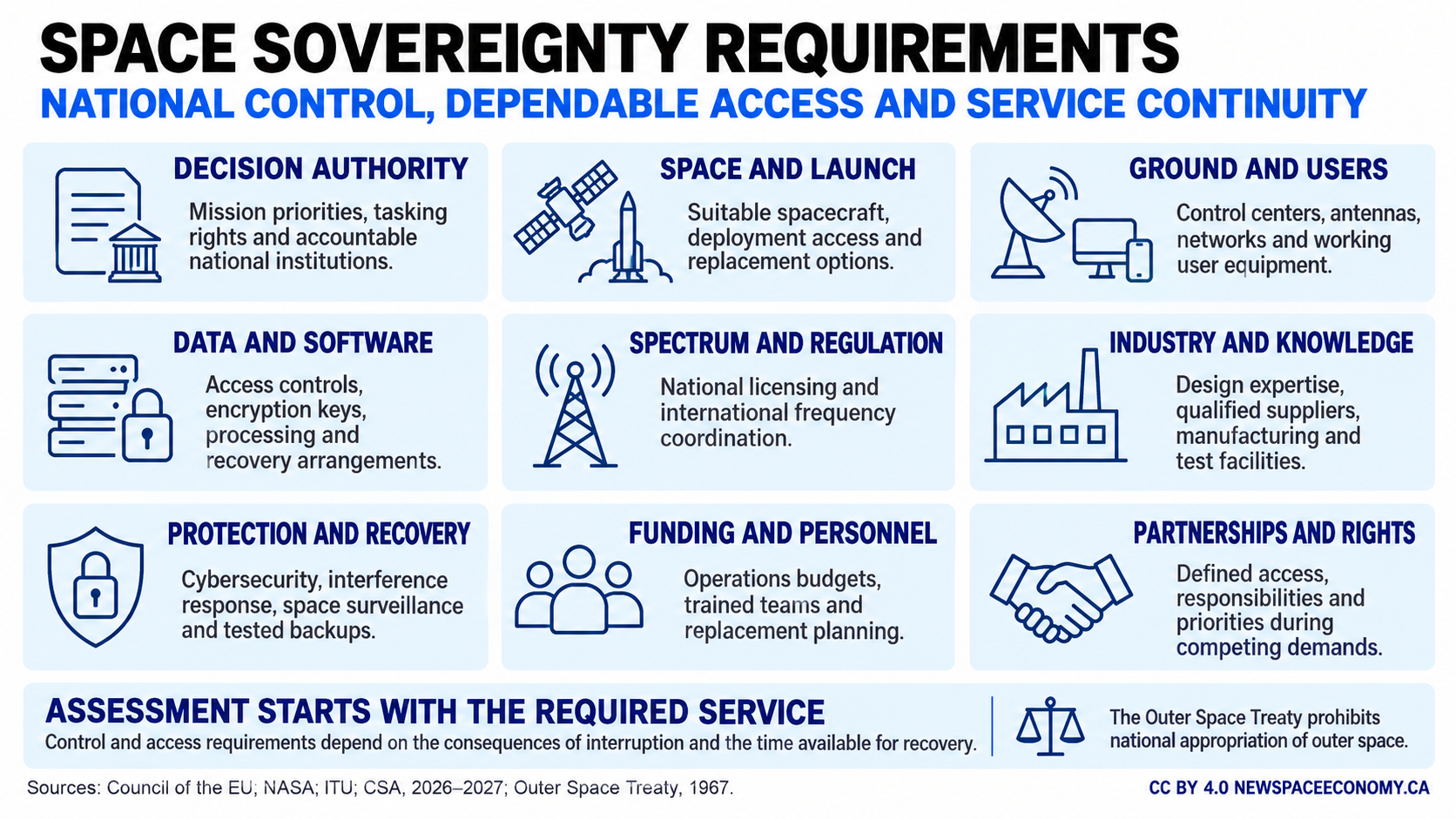
The European Union connects its space capabilities with freedom of action and independent decision-making in security and defense. That connection provides a practical starting point for space sovereignty: national authorities need dependable access to the space services required to carry out their responsibilities. Possessing satellites contributes to that objective, but an assessment must also examine who controls missions, handles information, supplies equipment, and restores services after disruption.
Space sovereignty consequently involves several distinct questions. A government may control the use of a satellite without manufacturing it domestically. A domestic manufacturer may produce spacecraft that depend on foreign software or components. An international partnership may provide capabilities that no participating country could afford independently. These arrangements require separate assessments of authority, technical capacity, and the consequences of losing access.
The term also requires a legal distinction. The Outer Space Treaty prohibits national appropriation of outer space, including the Moon and other celestial bodies, through claims of sovereignty or other means. Its Article VIII provides for a registering state to retain jurisdiction and control over its space object and associated personnel. National control over activities and assets does not establish territorial ownership of an orbital region or lunar site.
A sovereignty assessment begins with the service that national authorities need. Secure government communications, environmental observations, military surveillance, weather information, and positioning can have different requirements. Some users need immediate access during emergencies. Others can tolerate delayed delivery or obtain equivalent information from another provider. Defining the required coverage, accuracy, confidentiality, and continuity establishes what capability must be protected before ownership decisions are made.
Decision-making authority is another element. Authorities need to understand who can approve satellite maneuvers, schedule observations, allocate communications capacity, and change operating priorities. Commercial providers and partner governments may retain some of these powers. The practical question concerns whether national requirements can still be met when several customers request scarce capacity or when a partner changes its priorities.
The spacecraft is only one part of the service. Antennas, ground stations, control centers, telecommunications connections, processing systems, and user equipment must operate together. NASA’s systems engineering guidance treats personnel, facilities, procedures, hardware, and software as elements of a functioning system. A national capability assessment that counts satellites but omits these supporting elements can overlook dependencies that interrupt the final service.
Data control deserves its own assessment. Earth observation involves decisions about collection requests, raw measurements, analytical products, storage, and distribution. Communications systems also generate operational information about traffic and network management. Sensitive information may require controls over administrator access, encryption keys, processing locations, and recovery arrangements. Physical storage within national borders does not alone establish control if an external organization retains essential access or support functions.
Access to radio spectrum creates an institutional requirement. The International Telecommunication Union provides the international framework for spectrum and associated satellite-orbit resources. National administrations license satellite systems and participate in coordination and notification processes. Engineering capability must be accompanied by the regulatory expertise needed to establish and maintain compliant communications arrangements. These processes coordinate use; they do not confer territorial sovereignty over space.
Launch access affects deployment and replacement. Governments can own spacecraft yet depend on external providers to place them in the required orbit. Assessments need to distinguish having a domestic launch site, having a domestic launch vehicle, and having dependable access to suitable launches. Vehicle compatibility, payload integration, launch schedules, and available capacity determine whether a replacement satellite can become operational within the required period.
The industrial base supports continued capability. Relevant organizations include manufacturers, software developers, specialist suppliers, research institutions, and test facilities. Their contribution extends beyond building an initial satellite. Technical knowledge, production records, qualified processes, and personnel are needed to resolve failures and develop replacements. Related coverage of industrial policy explains how procurement decisions connect mission requirements with domestic production capacity.
Protection and recovery are separate from routine operation. Operators need to address unauthorized access, radio interference, equipment failures, and physical damage to ground facilities. Space surveillance can support awareness of objects and potential collision risks. Recovery planning must identify which services can continue at reduced performance and which require another satellite, ground station, network, or provider. No single protective measure resolves all of these conditions.
Financing and workforce availability determine whether the capability can be sustained. Acquisition funding does not automatically pay for operations, software support, staff training, replacement equipment, or future launches. National authorities also need the expertise to evaluate contractors and verify delivery. Dependence can remain substantial if the purchaser lacks the technical competence to assess whether a system meets its stated requirements.
Different countries select different priorities. The Canadian Space Agency’s 2026–2027 operating context identifies four space capabilities designated under Canada’s Defence Industrial Strategy: space-based intelligence, surveillance and reconnaissance; space domain awareness; satellite communications; and space launch. This is a stated investment focus, rather than evidence that every associated capability has already been delivered. It illustrates the need to distinguish policy objectives from operational results.
International cooperation can address some requirements without eliminating national choices. Shared programs can distribute costs, provide access to specialist knowledge, and support larger infrastructure. Their governance must still establish access rights, responsibilities, and procedures for competing demands. Sovereignty at the level of a multinational program also differs from unilateral control by an individual member.
Governance also needs clear responsibility for approving risks. Civil agencies, defense organizations, regulators, and commercial operators can have different obligations. Recording who accepts a dependency and who funds its mitigation prevents a capability from being assumed available without an accountable organization maintaining it.
A complete assessment connects these elements to a defined national function and a defined period of disruption. The necessary degree of domestic production or direct ownership depends on the consequences of denial and the availability of substitutes. Space sovereignty becomes a measurable policy objective when authorities can explain what remains under national control, what depends on others, and how essential services would be maintained or restored.
Useful Books Available on Amazon


