


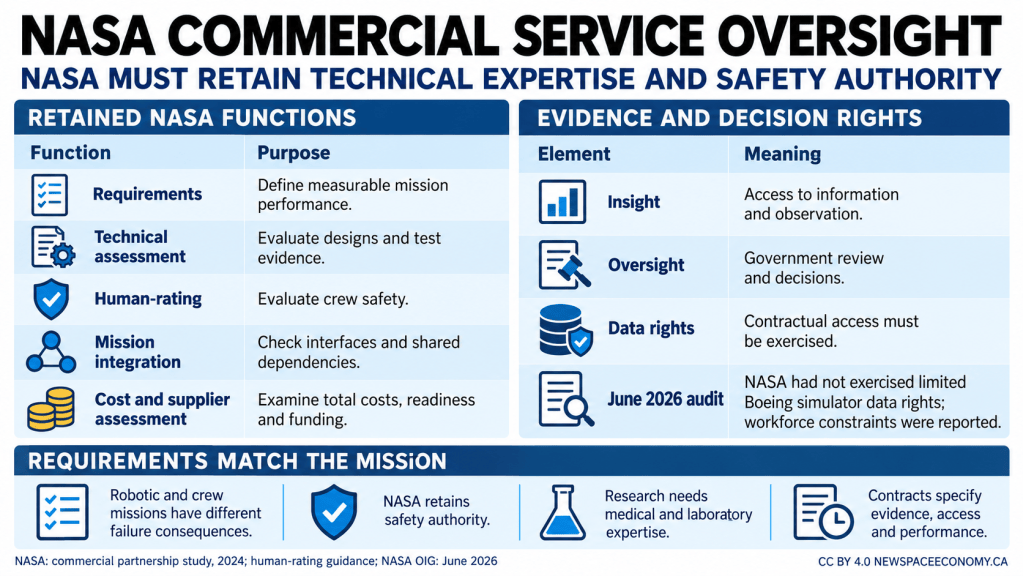
NASA’s purchase of commercial services changes who owns and operates space systems without removing the agency’s need to evaluate them. Astronaut transportation, research access, lunar delivery, and communications each require NASA to define acceptable performance and assess the evidence supplied by providers. The agency’s commercial oversight capability becomes part of the service’s value because it determines whether the government can make informed decisions about use, safety, and cost.
NASA’s commercial partnership management report examines experience from Commercial Crew and Human Landing System development. It distinguishes technical insight, which involves observing and understanding contractor activities, from oversight that includes government decisions and direction. Commercial procurement can give companies more design freedom, but NASA still needs enough knowledge and authority to accept the resulting services.
Requirements expertise is the first retained capability. NASA must translate a scientific or operational objective into a purchase that a company can price and deliver. A requirement for carrying astronauts includes more than seat capacity. Research access includes more than an empty laboratory compartment. Communications involves more than a headline data rate. Requirements need to identify the actual mission conditions and the evidence necessary to establish satisfactory performance.
Excessively detailed requirements can limit a provider’s design choices, but requirements that omit necessary functions can produce an unusable service. The appropriate level depends on the mission. NASA can specify an operational outcome and allow the supplier to choose the engineering method, provided that the outcome is measurable and its safety implications are understood. This is a purchasing judgment that requires technical knowledge, rather than a reason to remove engineers from acquisition planning.
Safety expertise remains particularly important for human spaceflight. NASA’s human-rating guidance describes evaluation of the complete system, accommodation of human interaction, and safe recovery from hazardous situations. A provider’s successful uncrewed flight does not establish every condition needed to transport astronauts. Engineers and operational specialists must evaluate testing, hazards, interfaces, and the assumptions supporting certification. Commercial ownership does not itself answer those technical questions.
Human health knowledge is also necessary. The NASA Spaceflight Human-System Standard addresses requirements intended to reduce health and performance risks in vehicles, habitats, and related equipment. Its applicability to contractors depends on the relevant agreements and contracts. NASA needs specialists who can decide which provisions apply to a mission and evaluate how providers satisfy them, rather than relying on an unsupported claim that a facility is suitable for people.
Access to evidence determines whether oversight can work. Contracts and agreements must provide information appropriate to NASA’s responsibilities, and agency personnel must examine that information. An inspection right has little practical value if it is never exercised. Equally, an engineer cannot evaluate a disputed result if the underlying data or test conditions are unavailable. Negotiating access and using it are different responsibilities that must both be fulfilled.
The June 2026 commercial crew findings provide a documented example. NASA’s Inspector General found that the agency did not exercise its limited contractual rights to Boeing flight simulator training data and consequently did not fully analyze simulation failures. The report also identified workforce constraints that could hinder oversight and technical resolution. These findings concern the adequacy of NASA’s implementation, rather than establishing that commercial ownership inherently prevents effective scrutiny.
Independent assessment requires the ability to question a supplier’s assumptions. Technical teams need to understand how test results relate to actual mission conditions and whether the evidence supports the proposed schedule. Financial and acquisition teams need to assess whether payment milestones correspond to meaningful progress. New Space Economy’s analysis of commercial crew audit findings connects these issues to transportation availability and contract management.
NASA must also retain mission integration expertise. A company may satisfy the requirements for its own service yet depend on another provider’s launch, docking arrangement, communications, or equipment. The complete mission can fail at an interface between otherwise functioning systems. Government specialists need to identify those dependencies, assign responsibility, and verify that the providers’ operating assumptions are compatible. Purchasing separate services does not automatically produce a working integrated mission.
Cost analysis remains necessary under fixed-price contracts. The negotiated price covers specified work under agreed conditions; changes in scope and additional purchases can create further expense. Evaluating value requires comparable definitions of development funding, recurring service charges, agency support, and contingency costs. A lower quoted price does not establish lower total public expenditure if the comparison excludes costs included in another program’s accounting.
Supplier assessment is another retained function. NASA needs to evaluate actual available capabilities, financial pressures, and dependencies shared among providers. A second company is not an operational alternative if its system remains uncertified or uses the same constrained infrastructure. The Inspector General’s September 2026 transportation review illustrates how spacecraft diversity and launch independence can differ. Contingency planning must address the service available when needed, rather than the number of suppliers under contract.
Knowledge sharing can support commercial development without transferring government ownership. NASA has shared medical operations expertise with prospective station providers, including practices for selection, training, and in-flight support. This illustrates a continuing role for accumulated public expertise. Losing that expertise would affect both NASA’s ability to assess services and its ability to help companies avoid repeating established operational problems.
The intensity of oversight should match the consequences of failure and the maturity of the capability. A robotic technology experiment can accept a different risk level from a spacecraft carrying astronauts. NASA’s CLPS management audit showed that expanding requirements and inconsistent implementation can undermine a service program’s intended cost and schedule approach. Effective oversight requires explicit risk decisions, rather than adding controls without considering their purpose.
NASA’s retained expertise should allow the agency to define purchases, verify performance, integrate missions, and respond when suppliers cannot deliver. Companies can own the systems and make many engineering decisions within that arrangement. The government still needs personnel, evidence, and decision rights sufficient to determine whether the purchased service meets its responsibilities. Reducing hardware ownership succeeds only if NASA preserves the capability to judge the services replacing it.
Useful Books Available on Amazon


