


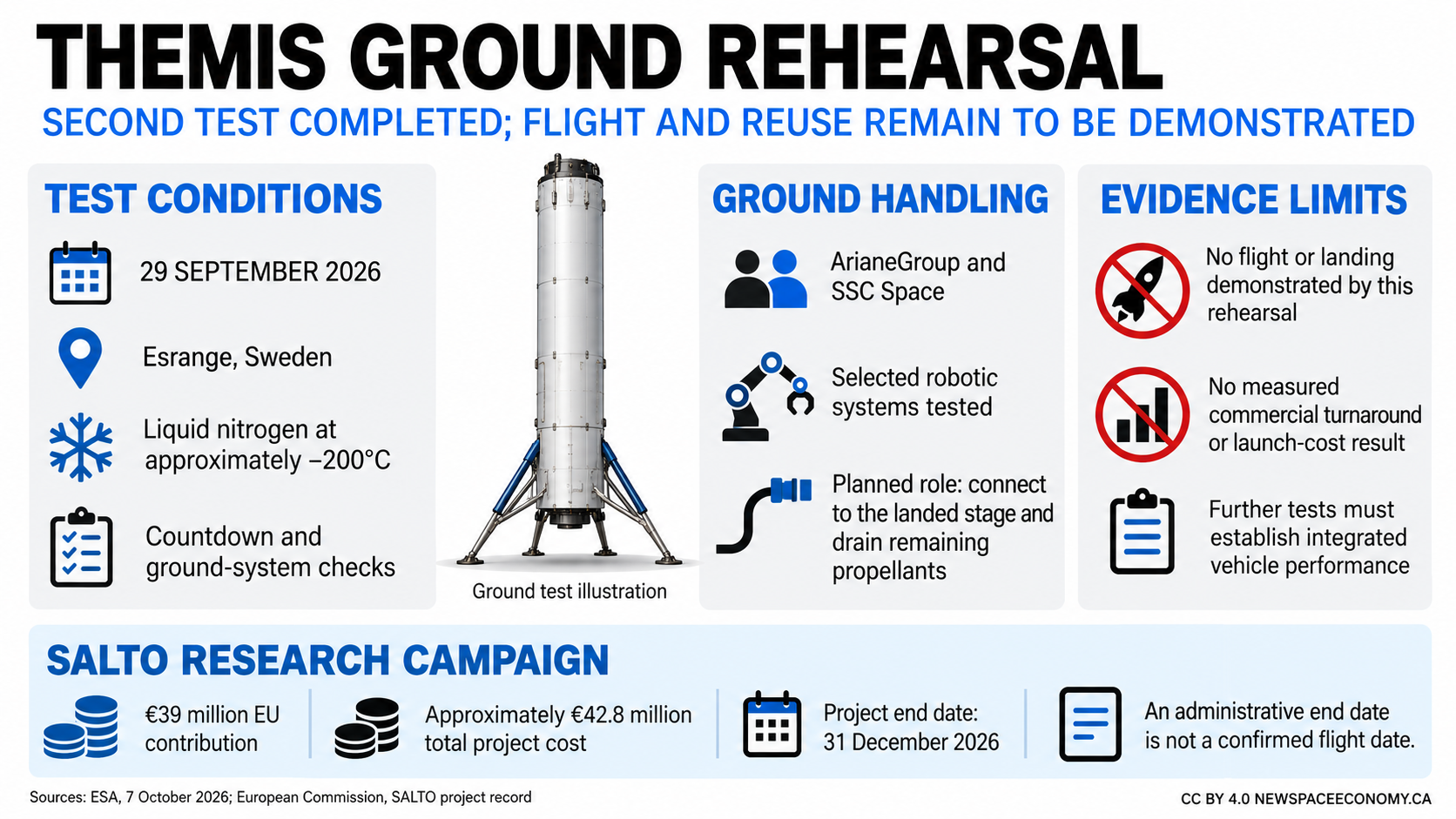
The European Space Agency announced on October 7, 2026, that its Themis reusable rocket demonstrator had completed a second ground rehearsal at Esrange Space Center in Sweden. The test took place on September 29. ArianeGroup and SSC Space practiced operations with the vehicle filled with liquid nitrogen, including checks of equipment intended to support automated handling after landing.
Themis is testing technologies for a rocket stage that can launch, return, and fly again. The September exercise supplied evidence about ground operations under very cold conditions. It did not demonstrate a flight, landing, or commercial turnaround. That distinction matters because the economic case for reuse depends on the work required between missions as well as the survival of the hardware.
During the second rehearsal, the nitrogen reached approximately −200°C. Using nitrogen allowed operators to reproduce relevant temperature and pressure conditions without loading the methane and oxygen intended for flight. ESA also reported testing some elements of robotic ground operations. The planned equipment would locate the landed stage, connect to it, and drain remaining fuel and oxidizer with personnel at a safe distance.
A wet dress rehearsal is a practice run of ground procedures with liquid loaded into the vehicle. It gives engineers an opportunity to check the interaction between tanks, plumbing, control systems, and launch-site equipment before attempting more demanding operations. The choice of test fluid also defines the limits of the result: a nitrogen rehearsal cannot establish how an engine burns its actual propellants or how a vehicle behaves in flight.
The September test followed an initial rehearsal on July 23, 2026. ESA’s account of that earlier exercise described countdown and post-flight procedures intended to identify remaining anomalies. It also identified preparation of the cryogenic engine for ignition as an operation that would benefit from the data. Repeating a rehearsal can help establish whether procedures and interfaces behave consistently, although the published accounts do not provide a detailed comparison of the two tests.
The vehicle brings several engineering problems together. ESA’s Themis description identifies landing legs, aerodynamic stabilizers, lightweight tanks, onboard electronics, power distribution, and flight-control algorithms among the technologies involved. Each contributes to a stage that must function during ascent and return. Testing those elements as an integrated vehicle addresses questions that cannot be resolved through engine development alone, particularly how commands, structures, and supporting equipment interact.
Prometheus, the engine intended to power Themis, uses liquid oxygen and methane. ESA describes an electronic regulation system that can adjust thrust and the fuel-to-oxidizer ratio. Thrust is the force produced by the engine; reducing it allows a descending vehicle to manage its speed as it approaches the ground. Restart capability and controlled thrust are engineering requirements for the planned recovery sequence, rather than evidence that the complete stage has already performed it.
Engine testing has supplied a separate set of results. In July 2025, ESA reported that a Prometheus campaign at ArianeGroup’s Vernon facility in France had concluded the previous month. That campaign included four consecutive ignitions on June 20 and work on different thrust profiles. These results concern engine operation on a test stand. They do not replace the need to demonstrate flight control, landing, and subsequent reuse of an integrated stage.
Ground handling deserves attention because a recovered vehicle still requires preparation before another mission. ESA’s planned robotic connections address the period immediately after touchdown, when propellants may remain onboard. Keeping personnel away during draining can reduce their direct involvement in hazardous operations. The operational benefit will depend on whether the equipment connects reliably, completes the required tasks, and supports inspection and maintenance without creating additional delays.
The relevant commercial comparison is the total work needed to deliver another launch. Reusing hardware can avoid manufacturing a replacement stage, but recovery equipment, inspections, repairs, transport, and ground staffing also consume resources. New Space Economy’s examination of Europe’s reusable-rocket economics describes this distinction between recovering hardware and operating it economically. A demonstration program can establish technical feasibility before there is enough operating experience to support a credible cost comparison.
The European Union’s SALTO project supports the flight campaign. The European Commission’s project record lists €39 million in EU contributions and approximately €42.8 million in total project costs. Its stated work includes two low-altitude test campaigns and demonstration of flight, recovery, and repeat flight. These are funded research objectives. The amounts describe the SALTO project rather than the complete historical cost of every technology used by Themis.
The same record lists December 31, 2026, as the project end date. That date is an administrative milestone, not a published commitment that the first flight will occur on a particular day. A schedule assessment should distinguish the funding period from the sequence of tests needed to establish readiness. ESA’s October announcement documents the completed rehearsal but does not announce a firm first-flight date.
For future operators, useful evidence would include the condition of the recovered stage, the work needed to prepare it again, and the consistency of successive operations. A single successful landing would answer whether the vehicle could complete that maneuver under the tested conditions. It would leave open questions about repeated use, maintenance workload, component replacement, and the operating costs of a sustained service. Those questions require measurements across more than one isolated event.
Themis can contribute to European launch development by making these operations observable and testable before they are incorporated into a commercial service. The September rehearsal narrows uncertainty about selected ground procedures, but the public evidence remains limited to the activities reported. The next assessment should connect each demonstrated capability to the work still required for flight, recovery, and another launch, with cost claims based on measured operations rather than the fact that a stage was designed for reuse.
Useful Books Available on Amazon


