


Key Takeaways
- NASA’s 2026 ISAM report catalogs operational examples, demonstrations, and developing capabilities.
- Servicing, assembly, and manufacturing impose different design, interface, and logistics requirements.
- A capability inventory supports planning but does not establish commercial demand or service availability.
What the 2026 ISAM Report Documents
NASA’s technical reports server records October 8, 2026, as the publication date of the agency’s 2026 ISAM report. The document surveys in-space servicing, assembly, and manufacturing (ISAM), including missions, technologies, developers, and testing facilities. Its practical purpose is to help mission designers identify capabilities that could be incorporated into future spacecraft and exploration systems.
The publication describes a field with established operational examples and substantial unfinished development. Spacecraft maintenance, robotic docking, structural construction, and materials processing have different technical requirements and histories. Grouping them under ISAM makes their relationships easier to examine, but does not establish that every listed activity has reached the same readiness level or offers a purchasable service.
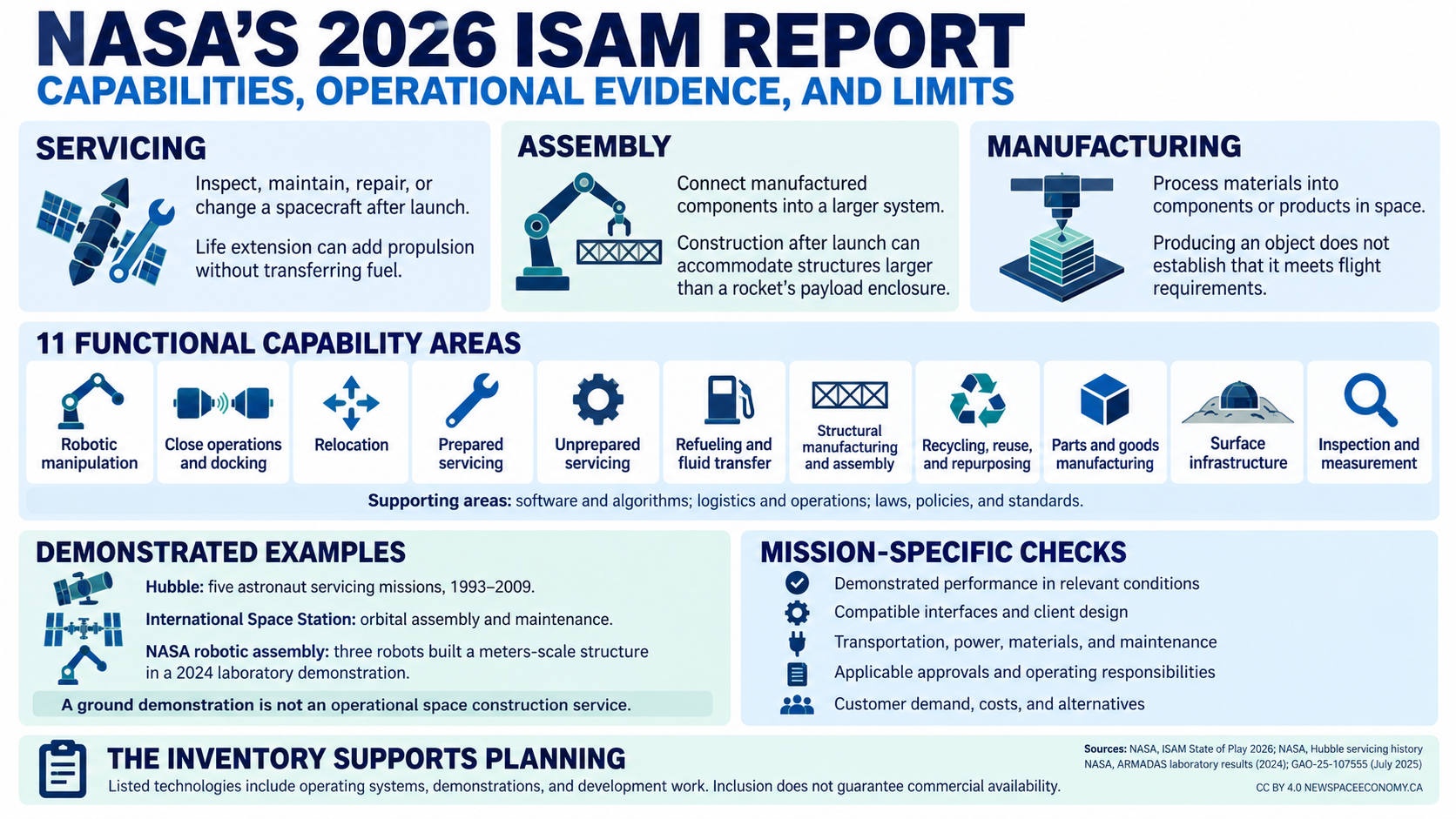
Servicing means inspecting, maintaining, repairing, or otherwise changing a spacecraft after launch. Assembly connects previously manufactured components into a larger system. Manufacturing transforms materials into components or products in space. These activities can support one another, but they answer different operational needs. A vehicle that supplies propulsion to another satellite does not necessarily repair its instruments or manufacture replacement hardware.
NASA organizes the survey into 11 functional capability areas and three supporting areas covering software and algorithms, logistics and operations, and laws, policies, and standards. The functional areas include robotic manipulation, close spacecraft operations and docking, relocation, prepared and unprepared servicing, fluid transfer, structural construction, material reuse, parts production, surface infrastructure, and inspection. This organization directs attention to the specific operation a mission requires.
The complete report also identifies organizations and facilities associated with this work. These entries can help a project locate relevant expertise or test equipment. They do not constitute procurement commitments, guarantees of facility access, or independent assessments of every supplier’s commercial performance. The authors describe the survey as an account of the field to the best of their ability, rather than an exhaustive inventory.
For decision-makers, the document is most useful as a starting point for more detailed investigation. A promising entry still requires checks on demonstrated performance, operating environment, interfaces, available funding, and mission suitability. The report’s breadth identifies possible combinations of capabilities; the engineering and economic case must be established for each proposed combination.
Servicing Experience Establishes Specific Operational Precedents
The Hubble Space Telescope and International Space Station provide established examples of hardware being changed after launch. NASA’s Hubble servicing chronology records five servicing missions between 1993 and 2009. Astronauts corrected optical performance, replaced instruments and other equipment, and restored functions that would otherwise have remained unavailable.
Hubble demonstrates that servicing can preserve an asset and change its capabilities. It also shows why the supporting architecture matters. The missions required trained astronauts, spacecraft transportation, specialized tools, procedures, and accessible hardware. Their scientific results do not establish that an autonomous vehicle could perform equivalent tasks on an arbitrary telescope or that the same approach would be economical for a smaller satellite.
The space station demonstrates another combination: assembly of a large orbital system followed by maintenance and continuing logistics. NASA’s ISAM survey treats the station as both an operational example and a platform for technology demonstrations. Its history supports the feasibility of building and sustaining complex hardware in space. It does not remove the distinction between operations involving astronauts and operations performed by independent robotic spacecraft.
Commercial life extension supplies a different precedent. The report identifies Northrop Grumman’s Mission Extension Vehicles as examples of servicing. Their central function is to attach to a client and provide propulsion and attitude control, meaning control of the spacecraft’s orientation. This can address a satellite’s limited ability to maintain its assigned position without replacing the satellite’s communications payload.
That distinction prevents several forms of overstatement. Providing maneuvering capability is not equivalent to transferring propellant into the client’s tanks. Attaching to a satellite is not evidence that its electronics can be repaired. A successful life-extension mission demonstrates a defined service for a defined spacecraft configuration, rather than a general ability to restore every failing satellite.
New Space Economy’s coverage of commercial satellite life extension explains the business context around these operations. An operator must compare the value of additional service with servicing costs and the option of replacement. That comparison depends on the condition and usefulness of the client, not simply on whether docking is possible.
These precedents give ISAM development a factual basis. They also establish the need for precise descriptions of what was accomplished, which supporting systems were required, and which capabilities remain unproven in the proposed setting. Operational heritage is valuable evidence when its scope matches the new mission.
Prepared Spacecraft Change the Servicing Task
NASA separates prepared servicing from unprepared servicing because the client spacecraft’s design changes the work required. A prepared spacecraft incorporates features intended for later interaction. These can include accessible attachment points, replaceable modules, and connections for power, data, heat transfer, or fluids. The servicing vehicle and client can be designed around known interfaces.
An interface is the connection through which two systems interact. A mechanical interface must support attachment and loads. An electrical interface must accommodate the intended power connection. A fluid interface must permit the correct material to pass under appropriate conditions. Sharing a docking geometry alone does not establish compatibility across all these functions.
Preparation can make a future operation more predictable because designers can identify access routes, connection requirements, and expected handling procedures before launch. It may also impose additional mass, packaging, testing, or development requirements on the original spacecraft. A serviceable design should be evaluated against the mission’s expected needs rather than treated as a universally preferable specification.
An unprepared spacecraft was not designed for the proposed intervention. A servicer may need to approach an existing feature, remove a cover, manipulate equipment originally intended for ground use, or attach through a mission-specific mechanism. NASA includes this category because valuable hardware already in space may remain useful after its original support systems become limiting.
The report’s distinction concerns design preparation, not the client’s willingness to cooperate. A spacecraft can be operated by a consenting owner and still lack serviceable interfaces. A non-cooperative object presents another issue: it may not provide reliable communications, maintain a requested orientation, or support coordinated approach procedures. These conditions affect planning even before tools contact the object.
Inspection helps establish whether the proposed work is appropriate. Images and measurements can reveal configuration, condition, and accessible surfaces. Operators still need information about the client’s design, materials, and internal systems when that information affects the task. An external image cannot establish every internal failure or confirm that an old component will tolerate a new load.
For spacecraft buyers, the implication is that servicing decisions begin before a servicing contract exists. Procurement specifications can preserve the option of later refueling or module replacement. Whether those features justify their cost depends on the anticipated service, its timing, and the probability that a suitable provider will be available.
Prepared and unprepared servicing should consequently be compared as different engineering cases. Their potential customers, tools, verification requirements, and failure consequences may differ even when both services aim to extend operational life.
Assembly and Manufacturing Address Different Constraints
Assembly can change how a large space system is packaged for launch. Instead of launching the complete structure as one integrated object, a mission can transport components and connect them at their destination. This approach can accommodate structures whose completed geometry would not fit within a rocket’s payload enclosure, commonly called its fairing.
The remaining requirements are substantial. Components must be delivered to the correct location, handled without damage, joined securely, and inspected after installation. The completed system must achieve its required alignment, stiffness, thermal behavior, and operating performance. Separating construction from launch does not eliminate these requirements; it changes when and where they must be satisfied.
NASA’s robotic assembly research provides a concrete example of development toward this approach. In a laboratory demonstration described in 2024, three robots autonomously assembled a meters-scale structure from modular building blocks. The Automated Reconfigurable Mission Adaptive Digital Assembly Systems project combines hardware with software that assigns and coordinates construction tasks.
The demonstration establishes a result under laboratory conditions. It does not establish completion of a comparable structure in orbit or on the Moon. The distinction is relevant because a construction system must work with the loads, environmental exposure, communications, and recovery options associated with its destination. A successful ground experiment supports further development without proving the complete operational application.
Manufacturing adds another set of requirements because the material itself must be processed. Printing a spare part, producing a structural element, and making a material for return to Earth involve different production methods and acceptance criteria. NASA’s classification includes parts and goods manufacturing as well as structural manufacturing and assembly, allowing these purposes to be considered separately.
Producing an object does not establish that it can safely replace a flight component. The finished part must meet its required geometry and material properties, and its production process must provide adequate evidence of quality. Any mission that depends on local production also requires feedstock, power, equipment maintenance, and procedures for failed production runs.
Manufacturing for use in space should also be distinguished from manufacturing products for sale on Earth. The former may seek to reduce dependence on stored spares or enable construction after arrival. The latter must support a product valuable enough to justify space operations and return transportation. Neither business case follows automatically from demonstrating a fabrication process.
The report supports several possible architecture choices rather than one universal manufacturing model. Each choice must connect a production or assembly method to a specified operational requirement.
Refueling Depends on an Integrated Logistics System
Refueling addresses a resource that spacecraft consume during operations. A satellite with useful instruments can become constrained by the propellant available for positioning or maneuvering. Supplying additional propellant could extend selected operations, provided that the spacecraft can accept the delivery and its remaining hardware supports continued use.
NASA distinguishes refueling and fluid transfer as a functional capability rather than treating it as another name for life extension. Its survey describes experience with storable fluids and continuing work on cryogenic systems. Cryogenic fluids require very low temperatures. Their storage and transfer introduce thermal requirements that differ from those of propellants designed for less demanding storage conditions.
A proposed refueling service combines several operations. The supplier must obtain the propellant, transport it to an appropriate location, approach the client, establish compatible connections, and transfer the intended quantity. The client’s tanks, valves, plumbing, and operating procedures must support the transfer. A refueling interface is one component of that system.
The amount delivered is also not the complete performance measure. A mission must establish how much useful propellant reaches the client, what losses occur, how the operation affects the client’s thermal and pressure conditions, and whether the connection can be safely disconnected. Results from one fluid, tank configuration, or transfer method should not be generalized without supporting evidence.
Logistics determines whether a technically possible delivery is useful. A servicing spacecraft needs time and resources to reach its customer. Customers in different orbits may require different transportation arrangements. A depot or delivery vehicle must have a replenishment plan if the intended service extends beyond its initial inventory. These requirements connect servicing with launch, transportation, storage, and scheduling.
New Space Economy’s discussion of space supply and value chains provides useful context for this distinction. Supplying equipment or materials is different from delivering an operational service with measurable value to a customer. An inventory of refueling components identifies potential suppliers, but does not establish that the complete delivery system exists for every proposed user.
The customer’s demand is mission-specific. An operator may value additional maneuvers, longer service, or reduced dependence on a fixed initial propellant supply. Another may prefer to launch sufficient propellant at the outset or replace the spacecraft. Comparing those alternatives requires mission costs and performance assumptions that a capability catalog does not supply.
Lunar Infrastructure Requires Surface-Specific Evidence
NASA’s definition of ISAM extends beyond spacecraft in Earth orbit. Surface infrastructure is one of the report’s functional areas, covering excavation, construction, installation, and the handling of materials on planetary surfaces. The category includes horizontal infrastructure such as roads and landing pads, alongside structures supporting power or habitation.
This scope matters because construction at a destination requires more than a robot that can connect components. Equipment must be delivered, unloaded, moved to the work area, and supported through the intended task. The completed structure must serve a defined operational purpose. Material handling and site preparation can become prerequisites for the construction operation itself.
The use of local surface material adds another distinction. Regolith is the loose material covering much of the Moon’s surface. Processing it into a construction material involves understanding its properties and controlling the production method. A system intended to use regolith must also obtain and transport suitable material, rather than assume a uniform supply at every location.
These tasks should be evaluated against conditions at the planned worksite. Surface systems face environmental and operational requirements different from orbital systems or ground laboratories. The availability of power, mobility, communications, equipment maintenance, and replacement parts affects whether a construction process can continue beyond a short demonstration.
New Space Economy’s discussion of Moon and Mars technologies connects construction with supporting capabilities such as autonomy, resource processing, and logistics. That relationship is useful for interpreting NASA’s inventory. A construction technology can be technically promising but remain dependent on infrastructure that another program must supply.
The same reasoning applies to reuse and recycling. Reusing a component means employing it again without necessarily transforming its material. Recycling processes material into a form suitable for another use. Repurposing assigns an object or component a different function. NASA groups these activities together but does not make them operationally interchangeable.
A proposal to reduce resupply by recycling must account for collection, separation, processing, storage, and product quality. The material available after a mission activity may not match the material required for a subsequent one. Avoiding a new delivery can be valuable, but processing equipment and operations also have costs and resource needs.
The report identifies a field of possible supporting technologies rather than a completed lunar construction industry. A practical assessment must connect each capability to a site, a task, a support system, and evidence that it can meet the intended operating requirements.
Inspection, Software, and Standards Connect the Hardware
NASA includes inspection and metrology among the 11 functional areas. Inspection observes condition or configuration. Metrology concerns measurement, including size, shape, position, and related properties. These functions can support an approach, identify a repair task, and assess whether an assembly operation produced the required result.
Their value extends beyond collecting images. A servicing decision depends on interpreting observations against the mission’s requirements. A visible attachment point may be accessible but unsuitable for the intended load. A completed structure may appear assembled but require measurements to establish alignment. The relevant evidence depends on the operation being considered.
Software and algorithms support this work across multiple categories. Close spacecraft operations require estimates of relative position and motion. Robotic manipulation requires coordinated movement and control. Assembly requires planning the sequence of tasks and managing the interaction between tools, components, and supporting systems.
Autonomy means that equipment can perform some tasks without continuous human direction. It does not remove the need for defined limits, fault handling, or operational responsibility. A system may automate navigation or placement but still depend on human approval for another action. Describing the specific automated function is more informative than labeling an entire mission autonomous.
New Space Economy’s assessment of advanced space technology evidence makes a related distinction between an experimental achievement and repeatable operational performance. For ISAM, integration means that sensing, control, mechanical interaction, and recovery procedures must work together under the intended conditions.
Testing facilities help developers examine parts of that interaction. NASA’s catalog identifies facilities and their capabilities, which can support planning for ground experiments. A facility listing should still be followed by confirmation of its test conditions, equipment limits, access arrangements, and suitability for the proposed hardware. Ground testing can reduce uncertainty without reproducing every aspect of space operations.
Standards address another integration requirement: agreement about how systems interact. Shared specifications can help designers build compatible hardware and communicate performance requirements. They do not guarantee that every product follows the specification, establish permission to approach another operator’s spacecraft, or replace mission-specific safety assessment.
NASA treats laws, policies, and standards as a supporting capability area because engineering and operational rules are connected. A proposed service must identify the applicable requirements and responsible parties. The existence of a technical standard or policy strategy is different from a contract, a license, or an approved operational plan.
Commercial Demand Must Be Evaluated Separately
The number of technologies or developers in a survey is not a measurement of paying demand. A supplier may have a working component but no complete service. A proposed customer may have a technical need but no budget, compatible spacecraft, or procurement decision. Distinguishing these conditions prevents an inventory from being misread as a market forecast.
The U.S. Government Accountability Office’s July 2025 technology assessment examined this adoption problem. It found that potential providers hesitated to commit before a customer base existed, and potential users hesitated before services were available. It also identified fragmented priorities, limited testing opportunities, and emerging rules and standards as barriers.
Those findings describe the assessment’s period, not a complete measurement of conditions in October 2026. They remain useful for interpreting the new NASA inventory because they identify questions a capability listing cannot answer. Whether a specific barrier has been resolved requires subsequent evidence from the relevant program, operator, or service provider.
New Space Economy’s servicing and inspection market analysis provides related context on customers and operational trust. The commercial question is whether a defined service provides sufficient value to justify its price and risks. That value may involve additional operating revenue, a required maneuver, improved knowledge of spacecraft condition, or another mission-specific outcome.
Customers also face competing options. Servicing an old satellite may preserve functioning equipment, but replacement can offer updated performance. Designing a new satellite for future intervention can preserve flexibility, but adds requirements before any service is purchased. A useful comparison includes both the initial spacecraft decision and the later intervention.
Government programs can influence demand through research, demonstrations, and purchasing requirements. However, a research award is not evidence of an established commercial customer base. A demonstration contract can pay for development without showing that unrelated customers will buy the resulting service at a sustainable price.
The 2025 assessment presented five policy options, explicitly distinguishing them from recommendations. Its considerations included evaluating serviceability, supporting development and testing, clarifying regulations and standards, improving coordination, or maintaining existing efforts. These are choices for policymakers to assess, not enacted requirements established by the report.
NASA’s inventory and the adoption assessment consequently serve different purposes. One identifies capabilities and participants; the other examines obstacles to use. A defensible investment or procurement decision needs both technical evidence and a defined customer requirement, followed by information about costs, availability, compatibility, and performance.
Summary
NASA’s 2026 ISAM report documents capabilities that could change how selected space systems are maintained, constructed, and supplied. Established examples demonstrate that post-launch intervention can produce useful results. They also show that those results depend on a specific combination of client design, transportation, tools, procedures, and operational support.
The report’s classification helps separate those requirements. Prepared servicing differs from work on legacy hardware. Assembly differs from processing material into a product. Refueling differs from attaching an external propulsion system. Lunar construction adds requirements for site preparation, material handling, and continuing support.
The practical use of the publication is to identify candidates for further evaluation. Mission planners and customers still need to establish which functions have been demonstrated in relevant conditions, how the complete system will operate, and whether the service is preferable to available alternatives. A capability inventory supports those decisions without making them on behalf of operators.
Appendix: Useful Books Available on Amazon
Appendix: Top Questions Answered in This Article
What Is the Purpose of NASA’s 2026 ISAM Report?
The report surveys missions, technologies, developers, and facilities associated with in-space servicing, assembly, and manufacturing. It is intended to help mission designers and technologists identify relevant capabilities. Its entries support further investigation, rather than guarantee commercial availability, operating performance, facility access, or compatibility with a particular mission.
Does Inclusion Mean a Technology Is Operational?
Inclusion does not establish operational readiness. The report covers established examples alongside demonstrations and technologies under development. A proposed user must examine what the particular system has accomplished, where it was tested, and whether the evidence matches the intended operating environment. A laboratory result is different from a repeatable flight service.
How Do Servicing, Assembly, and Manufacturing Differ?
Servicing changes or supports a spacecraft after launch through activities such as inspection, repair, or life extension. Assembly connects previously manufactured components into a larger system. Manufacturing processes materials into components or products in space. A mission may combine these activities, but success in one does not demonstrate all three.
What Does Hubble Demonstrate About Servicing?
Five astronaut servicing missions between 1993 and 2009 repaired and upgraded Hubble’s equipment. They demonstrate that intervention after launch can preserve useful hardware and improve performance. Those missions depended on transportation, trained crews, tools, and procedures. Their results do not prove that equivalent autonomous servicing would suit every telescope.
Is Satellite Life Extension the Same as Refueling?
Life extension describes an outcome rather than one specific mechanism. A vehicle can attach to a satellite and supply propulsion without transferring propellant into the satellite’s tanks. Refueling transfers fluid into a compatible receiving system. These approaches require different hardware and should be evaluated against the client’s condition and operational needs.
Why Do Prepared Interfaces Matter?
Prepared interfaces give a servicer known attachment points or connections for functions such as power, data, or fluid transfer. They can make an operation more predictable. Their value depends on the proposed service and its availability. The original spacecraft also bears the design, integration, and testing requirements associated with including those interfaces.
Can Robotic Assembly Eliminate Launch Constraints?
Assembly can permit a completed structure to exceed the dimensions accommodated by a rocket’s payload enclosure. Its components and construction equipment still need transportation. The mission must also establish secure connections, acceptable alignment, and operating performance. Assembly changes the construction sequence rather than removing the engineering requirements of the finished system.
Does the Report Establish a Lunar Construction Industry?
The report identifies surface infrastructure capabilities and development activities, including construction and material handling. That inventory does not establish a complete commercial industry. A lunar project would need suitable equipment, a defined site, supporting logistics, power, and evidence that the construction method can achieve its required performance under the intended conditions.
What Limits the Commercial Interpretation of the Inventory?
Technology listings do not measure paying demand or establish service prices. Customers must compare servicing with alternatives such as replacement or carrying additional resources at launch. The July 2025 Government Accountability Office assessment identified adoption barriers, including fragmented demand and limited testing opportunities. Later progress must be assessed through evidence specific to each activity.
Are the Government Accountability Office’s Policy Options Requirements?
The July 2025 assessment explicitly presented policy options rather than recommendations. Options concerning serviceability, testing, standards, and coordination identify choices policymakers could examine. Their inclusion does not make them enacted requirements. A proposed mission must separately identify the laws, approvals, contracts, and operating rules that actually apply to its activities.
Appendix: Glossary of Key Terms
In-Space Servicing, Assembly, and Manufacturing
A group of capabilities for changing spacecraft after launch, connecting components into larger systems, and processing materials into usable products in space. The category includes activities in orbit and on planetary surfaces, with different levels of demonstrated performance.
Servicing
An intervention that inspects, maintains, repairs, upgrades, or otherwise supports a spacecraft after launch. The work can involve astronauts or robotic systems. The term describes a category of operations and does not imply that every client can receive every service.
Assembly
The connection of previously manufactured components to create a larger structure or system. In space, assembly requires transportation, handling, joining, and verification. It differs from manufacturing because the principal task is connecting components rather than transforming their raw material.
Manufacturing
The processing of materials into components or products. Space applications can include producing parts for local use or goods intended for return to Earth. Each application requires evidence that the production process and finished product meet the intended requirements.
Attitude Control
Control of a spacecraft’s orientation rather than its location alone. Orientation can affect where antennas, instruments, propulsion equipment, and power-generating surfaces point. A servicing system may provide this function to a client without replacing the client’s payload or transferring propellant.
Interface
A defined connection through which systems attach or exchange resources and information. Spacecraft interfaces can serve mechanical, electrical, data, thermal, or fluid functions. Compatibility in one function does not establish compatibility in all others, so the intended operation requires specific checks.
Cryogenic Fluid
A fluid maintained at very low temperature. Storage and transfer require attention to thermal conditions as well as the relevant tanks, valves, and connections. Performance demonstrated with one fluid or configuration cannot automatically establish performance for another application.
Regolith
The loose material covering a planetary surface, including much of the Moon’s surface. Proposed construction processes may use it as feedstock. Its suitability depends on material properties, collection and processing methods, and the requirements of the intended product.
Autonomy
The ability of a system to perform specified tasks without continuous human direction. Its scope can range from a limited control function to coordinated operations. Autonomous behavior still requires defined operating limits, fault handling, and evidence appropriate to its application.
Metrology
The measurement of physical properties such as dimensions, shape, position, or alignment. In ISAM operations, measurements can help characterize a client or verify an assembled structure. Measurement quality must be sufficient for the decision or engineering requirement it supports.


