


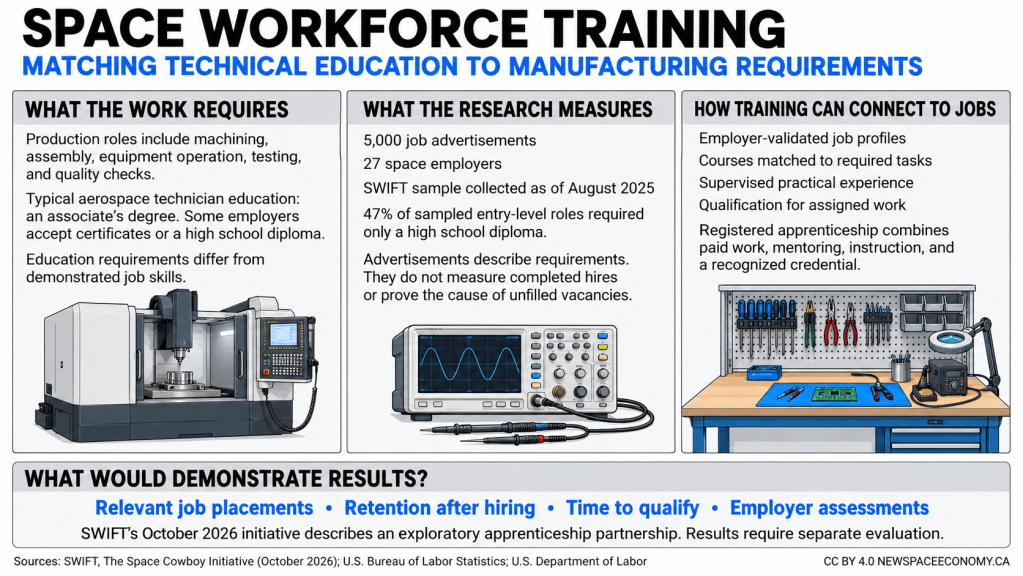
The Space Workforce Incubator for Texas (SWIFT) describes a specific problem for space workforce training in its October 2026 publication, The Space Cowboy Initiative: employers need people who can manufacture, assemble, test, and operate hardware, and educational qualifications alone do not establish readiness for those tasks. The organization proposes closer connections between employers and training institutions, using job requirements to identify the practical skills that courses should teach.
The initiative provides primary-source detail behind the Texas workforce issue examined in Andrea Leinfelder’s October 11 Houston Chronicle feature. Its relevance extends beyond recruitment. A manufacturer cannot increase output solely by purchasing equipment or hiring additional designers if production and testing positions remain unfilled. The evidence supports examining particular occupations and qualifications rather than treating the space workforce as a single category.
SWIFT’s report draws on an analysis of 5,000 active job advertisements from 27 space employers, collected as of August 2025. It says 47% of the entry-level roles examined required only a high school diploma, and one-third of postings specified or preferred a technical certificate or industry standard. These are findings about advertised requirements in a defined sample. They are not a count of completed hires, an estimate of every space occupation, or evidence that employers require no additional preparation.
The distinction between education and demonstrated skill is central. The U.S. Bureau of Labor Statistics describes aerospace engineering and operations technicians as workers who install, operate, and maintain equipment used to develop, test, produce, and sustain aircraft and spacecraft. Typical entry education is an associate’s degree, although some employers consider certificates or a high school diploma. Duties include calibrating equipment, recording measurements, installing instruments, and checking production quality.
Those responsibilities explain why additional engineering graduates cannot automatically resolve a technician shortage. Design, fabrication, assembly, and testing involve related but different competencies. New Space Economy’s account of jobs in the space economy distinguishes these functions from software, satellite operations, data analysis, and business roles. A useful workforce assessment identifies the task preventing delivery, then determines whether the missing capacity involves training, recruitment, supervision, or retention.
SWIFT’s proposed method begins with detailed job profiles that employers validate. Schools can compare those profiles with existing courses and identify missing practical instruction. The report also describes hardware projects in which students build, weld, wire, and test equipment. Such projects can provide evidence of applied skills, but participation alone does not establish that a graduate meets every employer’s production requirements.
The organization says it is exploring a partnership with a national registered apprenticeship sponsor. That wording matters: an exploratory partnership is not the same as an established apprenticeship with documented completion and hiring results. SWIFT’s publication combines analysis with advocacy for its own programs. Its claims about the initiative’s effectiveness require separate assessment from its descriptions of activities already underway.
Registered apprenticeship offers a defined model for connecting instruction with employment. The U.S. Department of Labor describes programs combining paid work, structured mentoring, related classroom instruction, progressive wage increases, and a nationally recognized credential. For space manufacturers, that structure could connect general technical education with supervised experience on actual processes. It also requires employers to supply suitable work and experienced mentors; a classroom provider cannot deliver the entire program independently.
A separate RAND study identifies related constraints in the U.S. defense space industrial base. Published August 31, 2026, Breaking Glass, Missing Hands examines workforce readiness to restore military space capabilities after a conflict. Its authors distinguish engineers, technicians and assemblers, and specialists in fields such as electro-optical systems and radiation hardening. The last category concerns equipment designed to operate despite radiation exposure.
RAND also warns that interrupted production can erode specialized knowledge as experienced employees leave for other industries. The implication for procurement is that training and retention depend partly on continuing work, not simply on occasional recruitment campaigns. However, a study of military rebuilding requirements does not measure labor shortages throughout commercial space. Its findings identify a related risk, rather than a universal shortage rate.
Eligibility can create another difference between available workers and candidates who can fill a particular position. The Bureau of Labor Statistics notes that some defense-related technician jobs require security clearances and that certain clearances may require U.S. citizenship. Those conditions should not be generalized to every space job. Training providers need accurate requirements for the actual employers and positions their programs serve.
The Texas approach also raises a measurement issue. Job advertisements describe employer preferences, but an advertisement does not prove that a vacancy remained unfilled because qualified applicants were unavailable. Compensation, location, schedules, and recruitment practices may also affect hiring. Evaluating a skills shortage requires information about applications, hiring decisions, time to fill positions, and the reasons employers reject candidates, alongside the requirements listed in advertisements.
Program evaluation needs similarly specific results. Enrollment measures participation; course completion measures educational progress. Neither establishes whether a manufacturer gained additional qualified staff. Relevant evidence would include placement into related jobs, retention after hiring, the time required to qualify for assigned tasks, and employer assessments of performance. Comparisons also need to distinguish new entrants from experienced workers completing a short additional qualification.
For other countries, the transferable element is the process of matching training to verified occupational requirements. Texas job-posting percentages cannot establish the size or composition of another country’s labor shortage. Local employers, vocational institutions, qualification systems, and defense restrictions differ. Applying the approach elsewhere would require local evidence and employer validation rather than importing U.S. percentages as planning assumptions.
The available sources support a focused conclusion: increasing space manufacturing capacity requires coordinated preparation for specific production and testing jobs. SWIFT provides a proposed method for connecting institutions to employer needs; federal occupational guidance explains the work; RAND identifies consequences when specialized capacity is lost. Whether a particular training initiative resolves those constraints remains a question for hiring, qualification, and retention data, rather than enrollment totals or employment forecasts alone.