

As an Amazon Associate we earn from qualifying purchases.

- Key Takeaways
- NASA Opens a Commercial Space Stations Competition
- How the Contract Structure Allocates Work
- Research Access Defines the Service
- Safety Depends on Integrated Systems
- Different Station Designs Create Different Dependencies
- The ISS Transition Requires More Than Launches
- Paying Customers Must Support Recurring Operations
- Financing and Suppliers Face Connected Risks
- What Would Demonstrate a Successful Transition
- Summary
- Appendix: Useful Books Available on Amazon
- Appendix: Top Questions Answered in This Article
- Appendix: Glossary of Key Terms
Key Takeaways
- NASA’s new competition seeks orbital destinations and transportation for human spaceflight.
- Contract selection, safety certification, and operational readiness are separate milestones.
- Station economics depend on dependable services, realistic financing, and repeat customer demand.
NASA Opens a Commercial Space Stations Competition
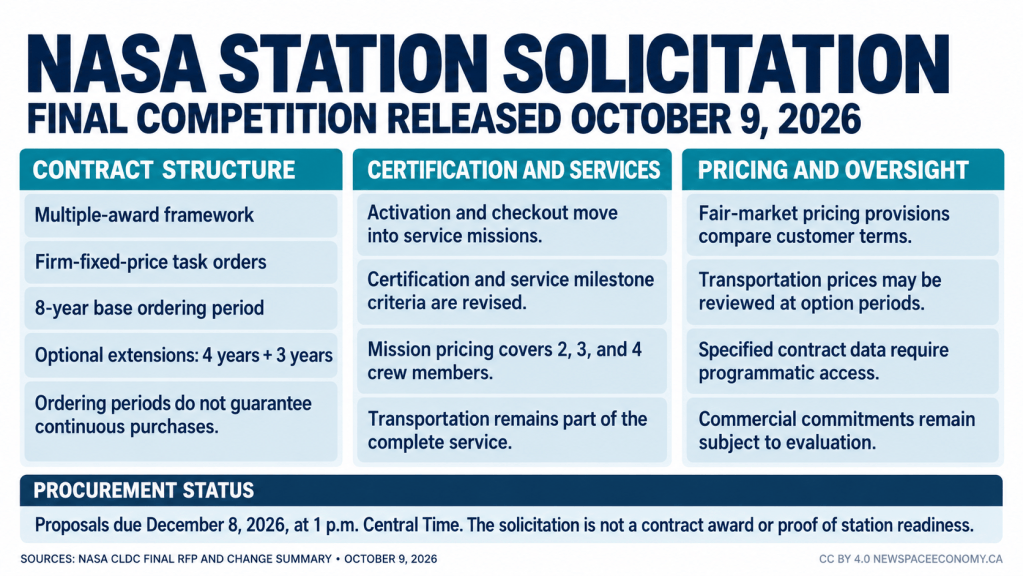
On October 9, 2026, NASA released its final request for proposals for commercial space stations that could support human spaceflight after the International Space Station (ISS) retires. The agency’s announcement of the competition sets a December 8, 2026, proposal deadline and identifies spring 2027 as the expected period for contract awards. Those awards would begin another stage of development, rather than establish that a replacement station is ready for astronauts.
The solicitation seeks companies capable of designing, building, testing, certifying, and operating destinations, including end-to-end transportation services. That scope connects the orbital facility to the systems needed to reach it, conduct a mission, and return safely. NASA’s stated objective remains sustained access to low Earth orbit for research, technology development, crew training, and preparation for exploration beyond Earth.
Low Earth orbit is the region relatively close to Earth where the ISS operates. A station there can host people and equipment for extended periods, unlike a spacecraft mission that offers only a brief research visit. NASA’s commercial approach would change who provides this infrastructure and how the agency acquires access to it.
The final competition follows NASA’s July 6 draft solicitation, which invited industry feedback on a procurement approach covering development, certification, and services. The draft described industry confidence in attracting investment and finding customers. Such statements document industry’s position; they do not independently establish future revenue or delivery performance.
The immediate change is a more concrete route from planning to contracting. Companies must turn proposed destinations into offers that NASA can evaluate, with responsibility for technical delivery and an accompanying commercial case. For the public, the important distinction is between opening a competition and successfully completing the transition that competition is intended to support.
How the Contract Structure Allocates Work
NASA plans firm-fixed-price, multiple-award, indefinite-delivery/indefinite-quantity contracts. The July acquisition update described selecting two or more contractors for early development, followed by competition for later work covering final design, testing, evaluation, certification, and services from one or more contractors. This structure allows competition to continue after the initial selection.
A firm-fixed-price contract generally places responsibility for performance costs and the resulting profit or loss on the contractor. The price is not adjusted simply because the contractor’s own costs turn out differently from its estimate. That distinction affects how a company budgets development work, negotiates with suppliers, and assesses the reserve funding it may need.
Fixed pricing does not establish that development will be inexpensive or that a provider cannot encounter financial trouble. It sets a commercial allocation of cost responsibility. An ambitious design can still require expensive testing, redesign, or replacement hardware, making the realism of the original estimate important to both NASA and the contractor.
The other part of the structure concerns ordering. Under the Federal Acquisition Regulation, an indefinite-quantity contract establishes limits and a minimum obligation, with individual requirements ordered separately. A task order specifies particular work within the contract’s scope. Selection for the underlying contract should not be interpreted as an unlimited commitment to purchase every service a provider might offer.
The economic implication is that contract access and realized revenue are different. A provider needs to understand the work actually ordered, its delivery obligations, and the resources required to perform it. A large potential contractual opportunity cannot automatically be treated as cash available to finance an entire station.
Competition also creates a tradeoff. Keeping more than one design in development can preserve alternatives, but providers must finance work without assuming that each will receive all later orders. The resulting business plans need to account for selection risk as well as engineering risk.
This arrangement fits the broader shift toward buying space services. NASA can purchase defined capabilities from a private operator, and the operator can seek additional customers. Whether that model produces lasting savings depends on performance, prices, and sustained demand, rather than the contract label alone.
Research Access Defines the Service
NASA’s need for an orbital destination begins with the work performed there. Its low Earth orbit microgravity strategy identifies scientific research, technology development, and preparation for deeper-space exploration as important purposes of continued human activity near Earth. A successor’s usefulness depends on its research capability, rather than simply its habitable volume.
Microgravity describes the near-weightless conditions experienced by objects and people falling together in orbit. Gravity remains present, but the orbital environment changes how fluids, materials, and living systems behave. Researchers can investigate processes that are difficult to separate from gravity-driven effects in a laboratory on Earth.
The ISS provides an established setting for these activities. NASA’s 2024 strategy announcement emphasized long-duration human research, exploration-system testing, operational skills, and international cooperation. These objectives show why a short visit and an extended research campaign are not interchangeable.
An orbital research service also includes work before and after flight. Experiment hardware must meet safety and interface requirements, survive transportation, operate under the available environmental conditions, and produce usable results. Depending on the investigation, researchers may need crew assistance, remote control, data delivery, or physical samples returned to Earth.
NASA’s payload development best practices recommend experienced implementation partners and attention to storage conditions, launch and landing stresses, and mission integration. These considerations matter to commercial stations because customers purchase an experimental outcome, not merely a place to install equipment.
Useful comparisons between destinations would consequently examine the complete research process. A station with adequate power but insufficient crew time might constrain a labor-intensive investigation. Another facility could suit automated experiments but lack the return service needed for sensitive samples. Those are service-design considerations, rather than evidence that any particular proposed station has such shortcomings.
The relationship between facilities and end users is part of the wider space economy. Transportation, laboratory services, data handling, and research support contribute to the value of the platform. A commercial destination becomes useful when these capabilities can be assembled into a dependable service that customers can plan and purchase.
Safety Depends on Integrated Systems
An occupied station must keep its inhabitants alive and enable them to work safely. Pressure containment, breathable air, water, temperature control, electrical power, communications, and emergency procedures form an interconnected operating system. Passing a test of one component does not establish that the complete destination is ready for an extended crewed mission.
NASA’s historical reporting on Orbital Reef life-support tests provides a specific example. In March 2024, the agency described milestones involving air contaminant removal, water treatment, urine-water recovery, and water storage. These were development achievements for individual functions, rather than certification of an operational station.
Recycling air and water can reduce the supplies that must be launched from Earth. The accompanying engineering task is to maintain dependable performance in a closed environment. Systems must be designed around the people using them, their maintenance activities, and the consequences of equipment problems.
NASA’s human systems integration guidance extends that discussion beyond basic survival. It covers human factors, operations, training, maintainability, habitability, and the environment. In April 2024, NASA shared lessons with commercial developers about incorporating human abilities and limitations throughout design and operation.
That approach makes everyday usability relevant to safety. Equipment access, understandable controls, workable procedures, and a suitable acoustic environment affect how reliably crews perform tasks. NASA’s discussion of spacecraft noise illustrates that pumps, fans, valves, and other machinery must be considered as part of the inhabited environment.
Commercial ownership does not remove these engineering obligations. Customers may have different mission objectives and levels of experience, but the physical constraints of an occupied spacecraft remain. A provider must connect hardware design to training, ground support, and the procedures used during normal operations and emergencies.
Certification provides a separate decision about whether the destination meets the requirements for NASA’s intended use. Development progress supplies evidence for that decision; it cannot substitute for the decision itself. This distinction is important when interpreting announcements about component tests or completed design reviews. Such milestones can reduce uncertainty, but their meaning depends on what was tested and what work remains.
Different Station Designs Create Different Dependencies
Commercial station development has included more than one architectural approach. NASA’s program background describes work involving ISS-attached modules and independent destinations. These approaches create different assembly, transportation, and operational dependencies, even when their eventual purpose is to sell orbital services.
Axiom Space illustrates the attached-module route. In December 2024, NASA reported a revised assembly sequence intended to reduce dependence on the ISS and permit an earlier transition to free flight. The revised plan placed the Payload, Power, and Thermal Module first, with additional elements added afterward.
The significance of that historical change is architectural. A station initially supported by another facility must eventually obtain the functions needed to operate independently. The sequence in which power, thermal control, habitats, and other elements become available affects when that independence is possible. An assembly plan is also a plan for transferring operational responsibility.
Starlab offers a different example. NASA’s July 2025 progress report described a planned habitat and service module launched together on one flight. The report also covered preliminary design and safety reviews, procurement planning, and work on a full-scale mockup for testing human interaction with the interior.
A single-launch approach places substantial importance on the launch carrying the main facility. A staged approach distributes deployment across multiple events and introduces assembly dependencies. Neither description alone establishes which design will prove safer, cheaper, or better suited to NASA’s eventual service needs.
These examples explain development choices without establishing the October competition’s results. Earlier NASA support, a completed milestone, or a publicly announced station concept does not identify a winning proposal. The final solicitation is a procurement action with its own evaluation and selection process.
For customers, the relevant comparison is the capability available when their mission begins. The complete proposed station may contain functions added over time. A credible service offer needs a clear relationship between the configuration available for a particular mission and the work promised to the customer.
The ISS Transition Requires More Than Launches
The planned end of ISS operations in 2030 creates a scheduling constraint, but replacing access to the station requires more than launching a new orbital structure. NASA needs a usable destination, transportation, accepted safety evidence, and the ability to conduct the intended missions. Those activities must align closely enough to support continuity.
A June 17, 2026, assessment by the U.S. Government Accountability Office (GAO) identified the possibility of a gap in human presence or capability in low Earth orbit. It recommended assessing the likelihood and duration of a gap and documenting the factors used to decide whether to retire the ISS as planned or extend operations.
The report described acquisition circumstances as of May 2026. The July draft and October final solicitation subsequently clarified the commercial contracting approach. Its earlier description should not be treated as the governing procurement plan, although its warning about aligning replacement readiness with retirement remains relevant.
Retirement itself involves engineering and procurement. In June 2024, NASA selected SpaceX to develop a U.S. Deorbit Vehicle for the ISS. The agency said it would take ownership after development and operate the vehicle during its mission. That historical arrangement demonstrates that a commercially developed spacecraft can serve a government-operated disposal task.
A replacement station and the ISS retirement system perform different functions. Readiness of one does not establish readiness of the other. Scheduling the transition requires attention to both, including the practical commitments needed to sustain missions before the changeover.
International participation adds another dimension. The ISS has depended on contributions from multiple space agencies and their hardware. Continued cooperation on a commercial platform requires arrangements for the missions, facilities, and services involved. Existing ISS participation cannot automatically be assumed to transfer under identical terms.
The practical implication is that continuity should be evaluated as a complete capability. An orbital facility without dependable transportation cannot provide routine crew access. A transport vehicle without a suitable destination cannot supply the laboratory service NASA seeks. An occupied station without the necessary research support would preserve human presence but might fail to preserve the specific scientific work motivating that presence.
Paying Customers Must Support Recurring Operations
NASA intends to be a customer of commercial destinations alongside other users. That ambition raises a demand question: which organizations will purchase services repeatedly at prices that support station operations? A list of possible applications cannot answer it without evidence about customers, mission frequency, and payment.
New Space Economy’s coverage of emerging station markets identifies potential services including laboratory access, astronaut missions, technology demonstrations, manufacturing support, and education. These categories have different requirements and funding sources. They should not be combined into a single assumed revenue stream.
Government agencies may purchase research or astronaut missions to meet public objectives. Commercial researchers need an outcome that justifies their expenditure. Private participants may purchase a mission experience. Each group presents a different sales process, and each consumes station resources in a different way.
NASA’s private astronaut mission program offers historical evidence of activity beyond its own crew rotations. Axiom Mission 1 reached the ISS in April 2022, followed by further missions. NASA describes these flights as a way to develop operational experience and understand demand and costs for commercial destinations.
Those missions demonstrate that integrated astronaut visits can be organized. They do not establish that the same customer base would cover the recurring costs of an independently operated station. A service performed using ISS infrastructure and a service delivered on a new private platform have different cost arrangements.
Manufacturing is another proposed demand source. NASA’s In Space Production Applications program supports progression from proof of concept toward production quality and scalability. Its discussion of candidate applications includes advanced materials and biotechnology. These are areas for development, not confirmation that large manufacturing revenues already support commercial stations.
The business test is whether customers continue purchasing after an initial demonstration. A research sponsor may fund an experiment without committing to repeated production. A manufacturer needs evidence that an orbital process can deliver a useful product at an acceptable total cost. Credible demand planning should distinguish exploratory funding, contracted missions, and expectations about later commercial activity.
Financing and Suppliers Face Connected Risks
A commercial destination requires expenditure before it can earn routine service revenue. Design, hardware procurement, testing, launch preparation, and operational staffing precede many customer missions. The resulting financing problem concerns both the total funding required and the timing of cash becoming available.
NASA’s July announcement reported that industry expected an agency award to help attract additional investment. That expectation identifies a plausible relationship between government procurement and private financing. It remains different from evidence that every selected company will obtain the capital needed to complete its proposed destination.
An anchor customer is an early purchaser important enough to support a provider’s initial commercial position. NASA can perform that role, but an investor still needs to examine the actual work ordered, the delivery conditions, and revenue from other customers. An underlying contract and a repeatable business are related achievements with different evidence requirements.
The supporting supply chain extends beyond station modules. Developers need equipment, software, testing services, launch, transportation, mission control, and research integration. New Space Economy’s discussion of the in-space economy explains the dependence of orbital services on logistics, crew access, and sample return.
That dependence creates connected risks. If transportation is delayed, customer activity may also be delayed. If hardware requires redesign, purchasing schedules and financing needs may change. These are business implications of the linked service model, rather than predictions about any particular competitor.
Insurance and allocation of liability also require attention. New Space Economy’s discussion of a commercial station policy framework summarizes a 2023 paper addressing regulation, insurance, and indemnification. Its proposals are policy recommendations, not evidence that the recommended arrangements became law.
For suppliers, a customer’s proposed station capacity is less informative than funded orders and achievable delivery requirements. A development company can announce an extensive future configuration without immediately procuring every element. Suppliers must distinguish a prospective market from work that has been ordered and financed.
Financial resilience belongs in the same assessment as technical progress. A capable engineering team requires sufficient resources to finish development, resolve problems, and maintain operations. Private ownership changes commercial incentives, but it does not eliminate the need to sustain a demanding human spaceflight service through setbacks.
What Would Demonstrate a Successful Transition
The first evidence of progress will come from the procurement itself: submitted proposals, announced selections, and clearly defined work. Later evidence must show that the selected capabilities can perform their intended functions. These stages answer different questions and should be reported separately.
A design review can establish progress toward a mature engineering definition. Ground testing can demonstrate behavior under selected conditions. Flight testing can reveal how hardware performs in orbit. Certification addresses NASA’s requirements for use. Routine missions then show whether the provider can deliver the purchased service repeatedly.
No single milestone covers all those questions. A successful launch establishes that hardware reached its destination; it does not independently demonstrate long-term habitability or research delivery. Similarly, a completed astronaut visit is useful evidence of operation, but the commercial case also depends on the frequency and economics of subsequent activity.
A meaningful assessment would compare performance with explicit obligations. Relevant considerations include the delivered station configuration, the availability of transport, the research functions supported, and the cost of purchasing missions. Commercial sustainability additionally requires attention to revenue beyond development funding and to the costs of maintaining the service.
Public reporting should preserve distinctions between demonstrated achievements and proposed expansion. Future modules, additional laboratory facilities, or increased mission frequency can remain legitimate plans. They become delivered capabilities only after the corresponding work is completed and the service can actually be offered under its required conditions.
The same discipline applies to savings. NASA’s commercial strategy seeks lower-cost access and greater ability to direct resources toward exploration. The appropriate test compares the purchased capability and its total cost with the relevant alternatives. A smaller station or shorter mission might cost less but provide a different service, making a simple headline comparison misleading.
The October solicitation creates a concrete next step toward this assessment. Its wider significance will be determined by the capabilities that follow: safe destinations, dependable transportation, useful research, and customer purchases sufficient to sustain operations. Procurement can support that development, but the transition’s results must ultimately be measured through service delivery.
Summary
NASA’s commercial station competition advances a plan to buy orbital capabilities from private providers after the ISS retires. The immediate milestone is a solicitation, followed by proposal evaluation and expected contract awards. Operational readiness remains a separate outcome requiring completed development, safety acceptance, transportation, and functioning mission support.
The approach combines public demand with private development and an expectation of additional customers. Its economic performance will depend on the work NASA orders, the cost of providing that work, and the ability of operators to sell other services. Research visits, manufacturing trials, and private astronaut missions provide different forms of evidence and should retain those distinctions.
The transition also requires coordinated decisions about the ISS, replacement destinations, logistics, and international participation. A successful result would preserve useful access to low Earth orbit through a service that meets NASA’s needs and can be maintained over time. The commercial model provides a method for pursuing that result; engineering performance and recurring operations will determine whether it delivers.
Appendix: Useful Books Available on Amazon
Appendix: Top Questions Answered in This Article
What Did NASA Announce on October 9, 2026?
NASA announced the release of a final request for proposals for commercial space stations. Proposals are due December 8, 2026, and contract awards are expected in spring 2027. The announcement opens a procurement competition; it does not establish that a replacement station has been selected, certified, or made operational.
Why Does NASA Need Commercial Space Stations?
NASA needs continued access to an occupied orbital destination for research, technology development, crew preparation, and exploration-related work. Its commercial approach seeks to purchase these capabilities from private providers. The objective is to sustain useful activity after the ISS retires, with NASA buying services alongside other customers.
Will Every Initially Selected Company Operate a Station for NASA?
The acquisition approach does not establish that every initial contractor will receive all later work. NASA describes early development involving multiple contractors and further competition for later activities. A company’s initial selection must be distinguished from a subsequent order, completed certification, and the delivery of operational services.
What Does Firm-Fixed-Price Mean?
A firm-fixed-price arrangement sets a price that is not adjusted simply because the contractor’s performance costs differ from its estimate. The contractor bears responsibility for those costs and the resulting profit or loss. This can encourage cost control, but it does not eliminate development difficulties or the need for realistic financing.
What Is an Indefinite-Delivery/Indefinite-Quantity Contract?
This contract type establishes a framework for ordering work within defined limits rather than specifying every future purchase at the outset. It includes a minimum obligation, with additional requirements ordered separately. For a provider, the potential scope of the contract must be distinguished from the particular services and revenue associated with actual orders.
Does a Successful Launch Establish Station Readiness?
A successful launch shows that hardware reached orbit, but a crewed station also needs functioning support systems, appropriate safety evidence, and mission operations. NASA must determine whether the destination meets requirements for its intended use. Research capability and dependable transportation also affect whether the station can deliver the service being purchased.
How Do Commercial Station Designs Differ?
Development approaches have included modules initially attached to the ISS and destinations intended for independent deployment. These choices create different dependencies involving assembly, launch, and the availability of essential systems. Historical plans for Axiom Station and Starlab illustrate architectural differences without establishing which proposal will win NASA’s new competition.
Can Manufacturing Support Station Revenues?
Manufacturing is a potential source of demand, particularly where microgravity can improve a useful process or product. NASA supports development work in advanced materials and biotechnology, among other applications. A successful experiment still needs to progress toward repeatable production, acceptable total costs, and paying customers before it establishes a lasting revenue stream.
What Could Cause a Gap After ISS Retirement?
A gap could occur if replacement capabilities are not ready when ISS operations end. Readiness involves the destination, transportation, safety acceptance, and the ability to conduct missions. GAO recommended evaluating gap risk and documenting the factors used in retirement decisions; the existence of a procurement competition alone does not resolve that risk.
How Should Commercial Success Be Evaluated?
Commercial success requires dependable delivery and revenues sufficient to support the service over time. Evidence includes actual customer purchases, repeat missions, usable research outcomes, and the costs of maintaining operations. Development funding and proposed expansion can help build a business, but neither independently demonstrates sustained demand or profitable routine operation.
Appendix: Glossary of Key Terms
Low Earth Orbit
Earth-centered orbits relatively close to the planet, generally extending to an altitude of about 2,000 kilometers. This region supports the ISS and many satellites. It offers comparatively accessible transportation and communication, although spacecraft there still need specialized systems and careful mission planning.
Firm-Fixed-Price Contract
A contract with a price that is not adjusted on the basis of the contractor’s own cost experience. The contractor assumes responsibility for performance costs and the resulting profit or loss. The arrangement does not guarantee that technical work will proceed without setbacks.
Indefinite-Delivery/Indefinite-Quantity Contract
A contracting framework for purchasing supplies or services within specified limits during a defined period. It includes a stated minimum obligation, with individual requirements ordered separately. Its potential scope does not mean the government has committed to purchase every permitted service.
Certification
A formal determination that a system meets requirements for a specified use. For NASA’s commercial station missions, development and testing provide evidence supporting that determination. Certification should be distinguished from a successful component test, a launch, or a provider’s announcement of progress.
Task Order
An order for particular services issued under an existing contract. It identifies work to be performed within the underlying contract’s scope and conditions. Task orders connect a broader purchasing framework to defined activities, rather than leaving all future work unspecified.
Microgravity
The near-weightless condition experienced when people and equipment fall together in orbit. Earth’s gravity remains present. The environment reduces many gravity-driven effects seen in terrestrial laboratories, allowing researchers to study changes in fluids, materials, biological processes, and human physiology.
Life Support
The systems and operating activities needed to sustain people inside a spacecraft. They include maintaining breathable air, managing water, controlling the inhabited environment, and monitoring relevant conditions. Their performance depends on integration with power, maintenance, crew procedures, and other station functions.
Anchor Customer
An early purchaser whose demand is important to establishing a provider’s service or commercial position. NASA can serve this role for orbital destinations. Having an anchor customer does not independently establish that other markets will develop or that the provider’s operations will be profitable.


