


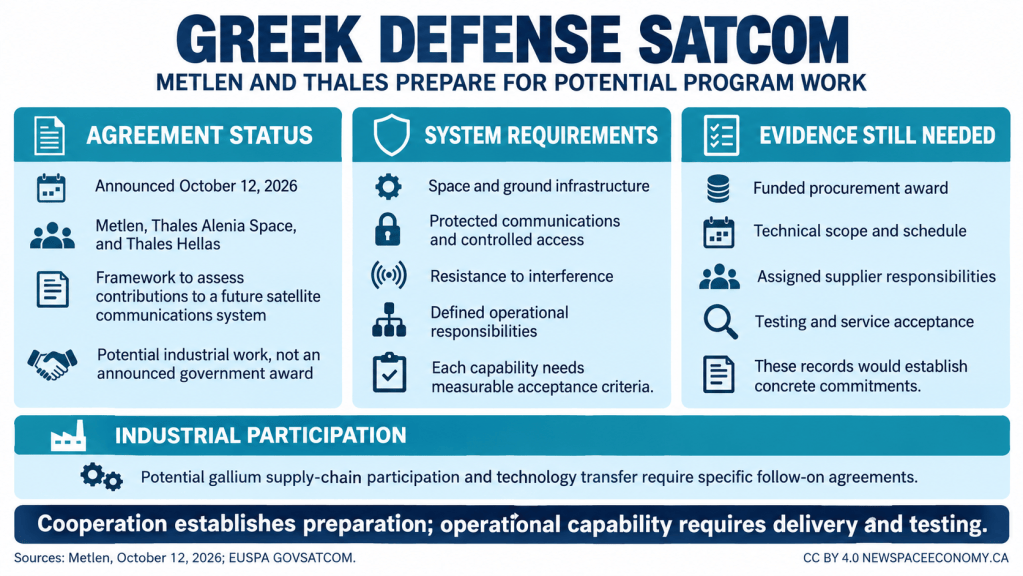
Metlen, Thales Alenia Space, and Thales Hellas announced a collaboration agreement on October 12, 2026, to prepare for potential opportunities in Greece’s future defense telecommunications space program. The company announcement establishes a framework for examining how the partners’ capabilities could contribute to a future system. It does not announce a Greek government procurement award or an operational satellite communications network.
That distinction defines the agreement’s immediate significance. The companies have organized prospective cooperation around a possible national requirement. Delivering secure communications would require subsequent decisions about the service, technical architecture, funding, procurement, and operation. The announcement identifies industrial participants and areas for assessment, but it leaves the eventual system’s scope and delivery arrangements unresolved.
The stated framework includes Metlen’s M Technologies activities, Thales Alenia Space’s satellite and ground infrastructure expertise, and potential technology transfer and skills development in Greece. It also considers possible use of Metlen’s gallium production capabilities in supply chains for future Thales Alenia Space satellites. These are proposed contributions and opportunities. The release does not disclose a contract value, satellite quantity, orbital configuration, or launch schedule.
An end-to-end satellite communications system includes more than spacecraft. Its ground infrastructure connects users to the space segment, manages traffic, and supports satellite operation. New Space Economy’s overview of satellite ground equipment describes antennas, transmitters, receivers, tracking and control facilities, and network management functions. A national capability must account for these connected elements because useful communication depends on the complete path between users.
This has practical implications for interpreting industrial participation. Manufacturing a component, supplying material, integrating ground equipment, and controlling an operational network are different roles. Each could contribute to a program, but none alone establishes national control over the resulting service. The relevant procurement documents would need to identify which functions Greece retains, which suppliers perform them, and how those arrangements continue throughout the system’s operating life.
The European Union Agency for the Space Programme provides a useful public definition of government communications requirements through GOVSATCOM. Its stated use cases include crisis management, surveillance, and protection of key infrastructure. The program pools capacity from governmental and commercial satellite providers for authorized governmental users. This illustrates that a government communications capability can involve access arrangements and shared resources as well as dedicated hardware.
EUSPA also identifies guaranteed access, resistance to interference, protection against interception and intrusion, cybersecurity, and reduced dependence on third parties as relevant requirements. These categories explain why describing a proposed system as secure is insufficient without defining its intended protections. The GOVSATCOM framework provides context; it does not establish that the newly announced industrial agreement forms part of that program or has received its approval.
Jamming and interception present different problems. Jamming interferes with a radio link’s ability to carry useful information. Interception concerns access to information carried by the link. Protection against one threat cannot simply be assumed to address the other. A design assessment needs to consider the communication channel, protection of the information, access controls, and the systems used to manage service.
A satellite communications security survey by Pietro Tedeschi, Savio Sciancalepore, and Roberto Di Pietro separates physical-layer protections from cryptographic approaches. Its discussion includes anti-jamming measures, anti-spoofing strategies, and confidentiality. This distinction supports a more precise reading of supplier claims: resistance to specified interference conditions and protection of message content are capabilities that require defined designs and evaluation, rather than conclusions established by a partnership announcement.
These distinctions also affect acceptance testing: a customer would need measurable criteria for each promised protection, together with the conditions under which it must work.
Ground operations also affect security and continuity. Satellite control, user authentication, network administration, and maintenance create operational responsibilities alongside the radio equipment. From a procurement perspective, the question is how these responsibilities will be allocated and supported. An arrangement that depends on external expertise may still serve national objectives, but the permitted dependencies and access conditions would need to be explicit.
The gallium element adds a separate industrial dimension. In an October 5 announcement, Metlen described commercial interest in its planned European production. This places the satellite collaboration within a broader effort to develop material supply relationships. It does not establish that a specific satellite manufacturer has qualified a particular material, ordered a defined quantity, or committed to deliveries under the October 12 agreement.
Material production and acceptance into a space supply chain are distinct commercial questions. A potential supplier relationship would need to specify the product, customer requirements, delivery responsibilities, and applicable acceptance procedures. Without those details, it would be premature to assign satellite revenue to the gallium proposal. The relevant evidence would be a subsequent supply agreement or another disclosure identifying a concrete commitment.
Technology transfer requires similarly specific treatment. Training personnel, granting access to design information, licensing production, and assigning integration work can produce different levels of domestic capability. The value to Greek industry would depend on which activities are actually contracted and retained. The announcement’s general objective does not disclose the duration of training, ownership of resulting knowledge, or allocation of future maintenance work.
A further distinction concerns the evidence needed at successive stages. A signed cooperation framework confirms that companies intend to assess opportunities together. A funded development contract would establish a different commitment, and an accepted operational service would require further evidence of delivered performance. Treating those stages separately allows progress to be evaluated without assuming that commercial preparation has already produced a national communications capability.
The practical next evidence would be a defined requirement, a funded award, allocated industrial responsibilities, and criteria for accepting the service. Those records would make it possible to assess whether the proposed cooperation produces the control, security, and domestic participation sought by Greece. Until then, the agreement establishes an industrial framework for potential work, with the system’s operational and financial commitments still to be determined.
Useful Books Available on Amazon


