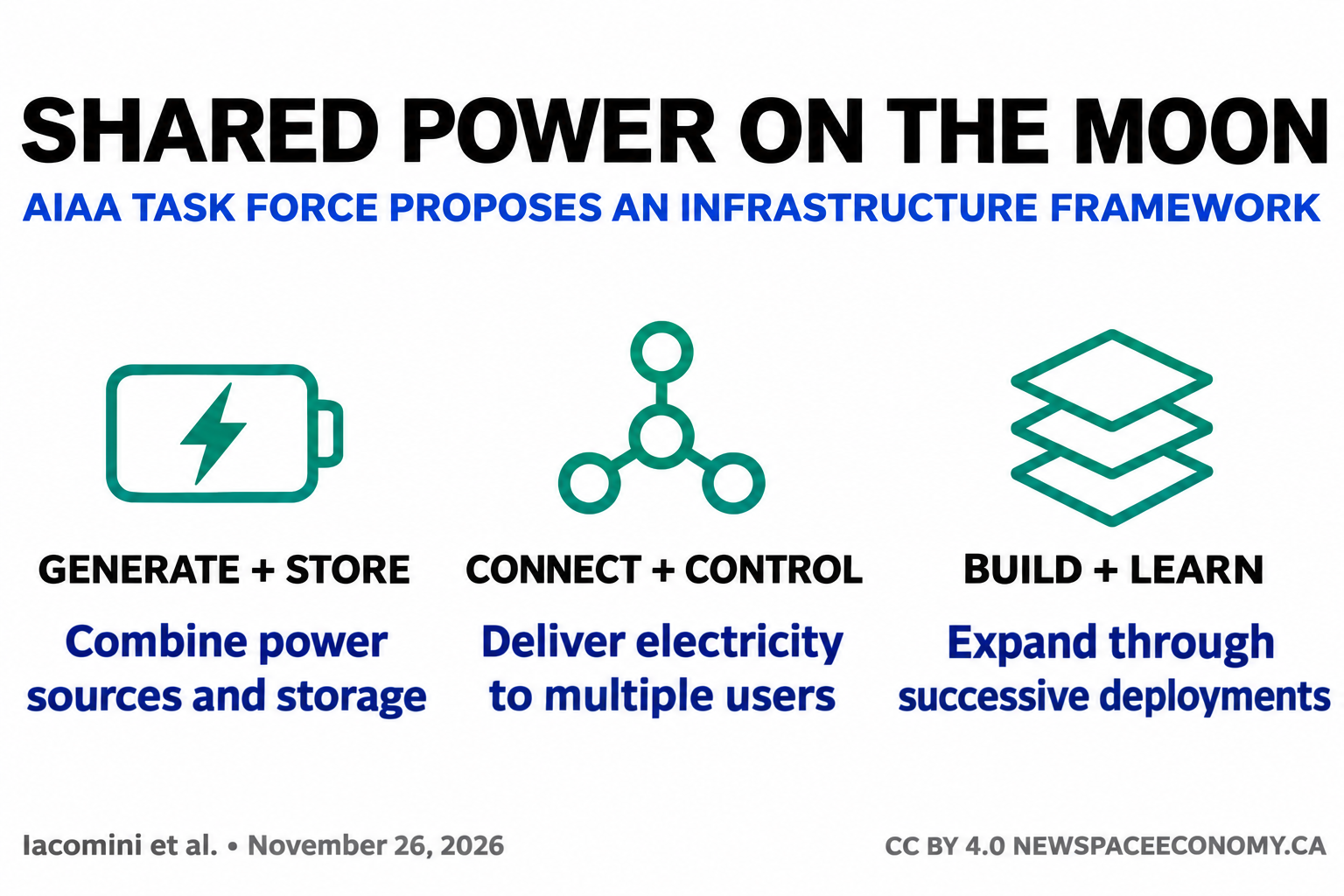
An American Institute of Aeronautics and Astronautics task force proposed a shared lunar surface power system in a paper published November 26, 2026. Led by Christie S. Iacomini, the authors describe an approach in which early demonstrations become reusable infrastructure serving later missions.
The Space and Planetary Resources paper treats electricity generation, storage, distribution, and control as one system. Its proposed commercial approach combines defined customer demand with compatible interfaces and coordinated delivery of power equipment, communications, and surface mobility.
The authors identify transmission, grid control, conversion between electrical interfaces, and survival over long operating periods as central parts of the architecture. They propose combining generation technologies and using operating experience from early deployments to guide subsequent expansion. Their paper presents a development framework for a future network.
Connecting Generation to Surface Users
A power source and a power network perform different functions. A generator produces electricity. Distribution equipment delivers it to a load, such as a heater, radio, or processing machine. Storage bridges periods when consumption exceeds available generation. Control equipment balances those changing demands and manages electrical faults.
NASA engineer Jeffrey Csank described an integrated approach in a 2023 lunar power presentation. That concept combines solar arrays and fission power with batteries and regenerative fuel cells. It applies features of terrestrial microgrids, which can operate locally or exchange power with other parts of a network.
Local operation keeps generation close to the equipment consuming electricity and reduces transmission losses. A connection between separate installations allows power sharing. The same architecture can accommodate additional equipment over time rather than requiring every installation to remain an isolated electrical system.
Power equipment also has a physical location. Cables connect particular points, and solar arrays receive sunlight according to the surrounding terrain. New Space Economy’s examination of lunar lighting and thermal conditions explains how low solar angles and local shadows connect the electrical design with the temperature of surface hardware.
Electrical consumption includes keeping equipment within its operating temperature range. A machine can stop its main task and still consume energy for heaters, communications, or control electronics. The amount of energy stored for a dark period is related to both its duration and the equipment operating during it.
A Nuclear Power Procurement Provides Current Context
NASA announced on November 23 that it was seeking partners for Lunar Reactor-1. The planned fission system would generate 20 kilowatts of electricity for surface users. NASA’s stated target is a launch-ready system by 2030, followed by at least five years of lunar operation.
Fission supplies heat through the splitting of atomic nuclei, allowing electricity production without sunlight. NASA identifies habitats, communications systems, rovers, and scientific instruments as potential users of the planned reactor’s output. That operating characteristic is relevant during lunar darkness and at sites with limited illumination.
The procurement and the task force paper address different parts of the same physical system. NASA’s announcement specifies a planned source of electrical generation. A shared network connects sources and storage with the equipment consuming that electricity. In NASA’s announced reactor program, the immediate activity is the design and testing effort to produce the launch-ready system.