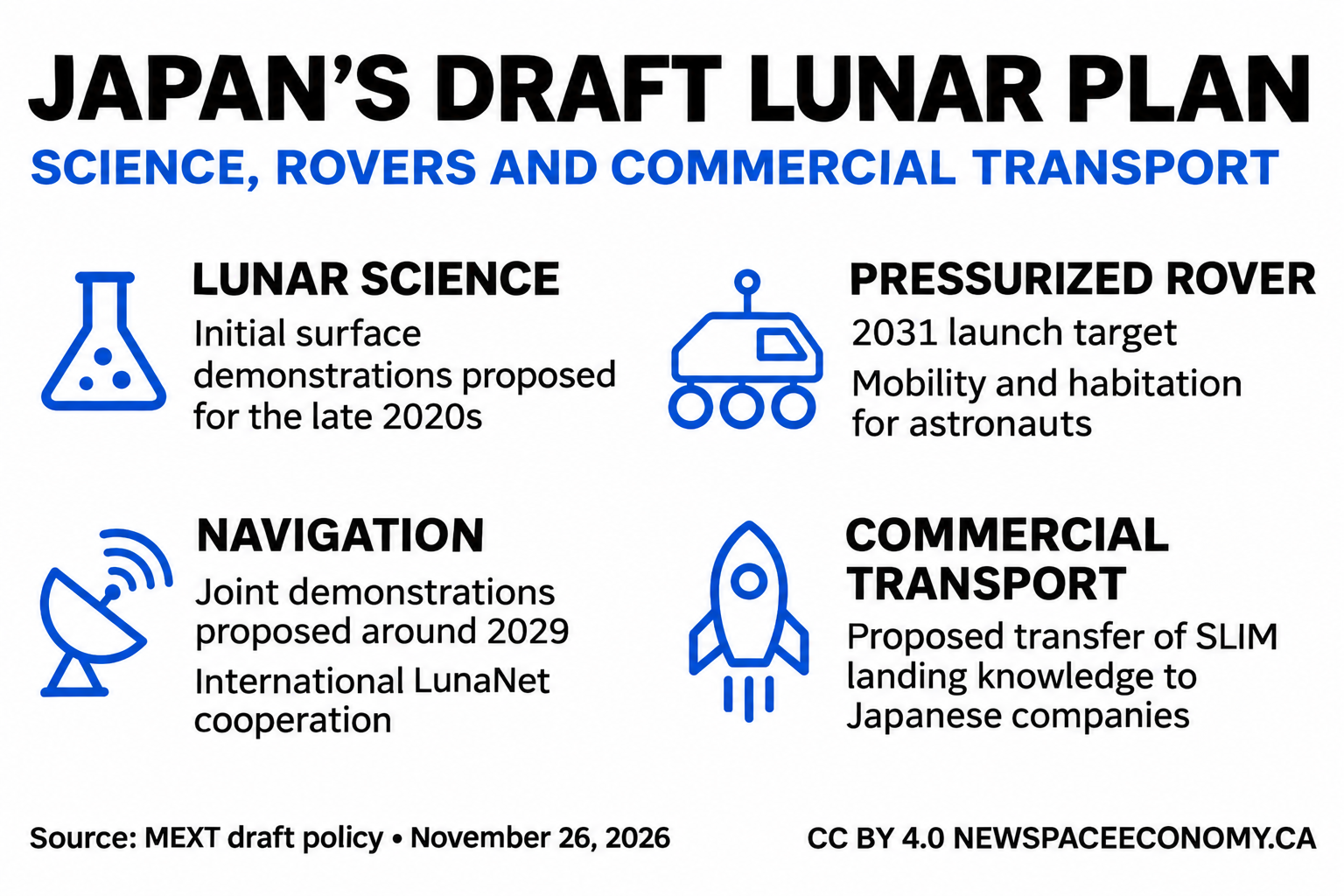
Japan’s science ministry presented a draft lunar exploration policy on November 26, 2026, linking scientific missions and crewed exploration with the development of commercial transportation and navigation services. The proposal sets out near-term work on lunar surface science, a pressurized rover and technologies that Japanese companies could supply to international missions.
The Ministry of Education, Culture, Sports, Science and Technology, known as MEXT, circulated the draft at its Space Development and Utilization Subcommittee. Its proposed approach connects government research with industrial participation through technology transfer, service procurement and demonstrations on the Moon.
The draft identifies three scientific activities: astronomical observations from the lunar surface, the selection and analysis of lunar samples, and a network of instruments that measure moonquakes. The instruments would address different questions about the universe and the Moon’s composition and interior. Their deployment would proceed in stages, beginning with equipment development and demonstrations before expanding to larger observing systems.
Initial surface demonstrations are proposed for the late 2020s. That timing is tied to the planned arrival of Japan’s pressurized rover, which has a 2031 launch target. A vehicle capable of traveling substantial distances could help astronauts collect samples and place instruments at multiple locations.
The rover combines transportation with a habitable interior. The draft says its development entered basic design in November 2025. Under the April 2024 agreement between Japan and the United States, Japan provides the rover and the United States provides two opportunities for Japanese astronauts to land on the Moon.
Developing that vehicle involves equipment for driving across lunar terrain, storing energy through extended darkness and generating power with deployable solar panels. The proposal identifies potential applications for some of those technologies on Earth, including automated driving and regenerative fuel cells. These are intended applications of the development work.
Navigation is another proposed area for Japanese industrial participation. The draft describes cooperation with the United States and Europe through LunaNet, the effort to establish compatible communications and navigation services around the Moon. Shared specifications would allow equipment and services supplied by different organizations to work together.
The document discusses joint navigation demonstrations around 2029 and an international concept for eight satellites in two orbital planes by the middle of the 2030s. Japanese companies could participate through satellite development or operating services. The eight-satellite concept belongs to the international infrastructure discussion.
That work connects with the separate coordination of radio frequencies used by lunar missions. New Space Economy’s coverage of lunar communications coordination explains the international regulatory work associated with those networks.
For lunar transportation, the draft proposes transferring knowledge from JAXA’s Smart Lander for Investigating Moon, or SLIM, to Japanese industry. SLIM demonstrated precise landing in January 2024 and continued operating after multiple lunar nights. The policy connects accurate landing with reaching scientifically useful terrain and surviving darkness with extending surface operations.
The proposed commercial approach includes studying government purchases of transportation services and continuing delivery opportunities, including the launch vehicles needed to reach the Moon. It also places lunar transport within preparations for more distant exploration. These passages describe procurement policy under consideration.
The draft addresses changes to NASA’s Gateway plans by proposing that Japanese environmental-control and life-support expertise remain available for lunar surface activities and human spaceflight in low Earth orbit. Its near-term science sequence calls for instrument demonstrations in the late 2020s, followed by activities that could use the rover’s planned mobility and habitation capabilities.