


Merck has sent crystal-growth experiments to the International Space Station since 2014, using successive investigations to study pharmaceutical formulation and manufacturing processes. That history provides a documented example of microgravity research becoming a repeated activity within a drug company’s research program. The product of an orbital experiment can be information used in laboratories and production processes on Earth.
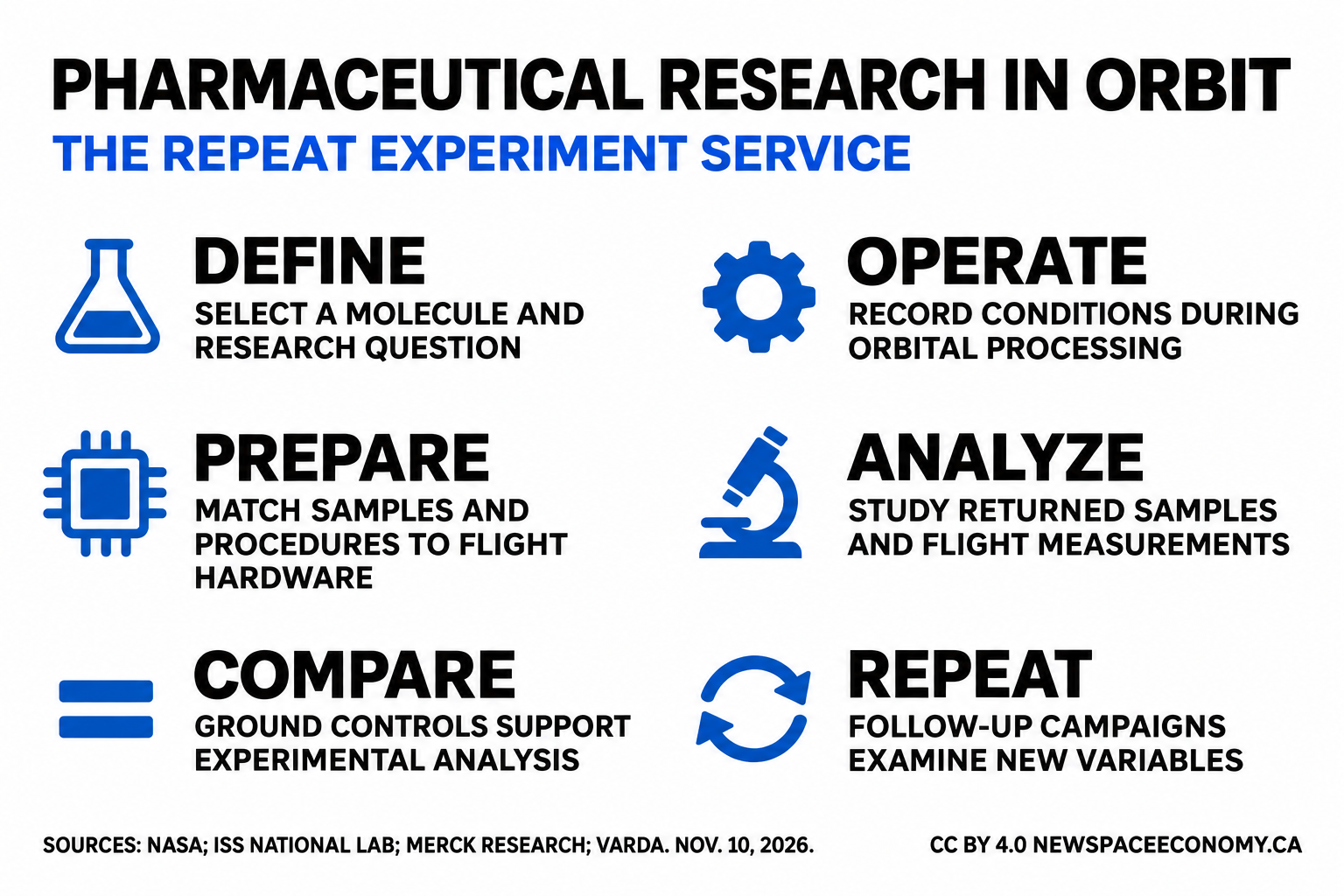
The commercial service supporting that work includes experiment design, flight hardware, mission integration, operations, and analysis of returned samples. Pharmaceutical researchers define the scientific question. Space research providers organize the equipment and flight activity that produce the measurements. Repeated business arises when successive experiments address different stages or variables in the same development program.
Crystals Can Answer Different Pharmaceutical Questions
Protein crystals have several uses in pharmaceutical research. A sufficiently ordered crystal can support structural analysis, allowing researchers to examine a molecule’s three-dimensional arrangement. Crystalline suspensions serve another purpose: they contain many particles whose size and other properties affect how a formulation behaves. The desired experimental result depends on which of these questions the research addresses.
NASA’s account of protein crystallization investigations describes both structural studies and formulation work. Its discussion of the PCG-5 investigation explains that researchers sought a more uniform crystalline suspension of pembrolizumab. A follow-up experiment, PCG 20, examined additional variables and methods in 2022.
A structural experiment and a suspension experiment consequently purchase different scientific outputs. The first can generate crystals suitable for determining molecular structure. The second can generate a distribution of particles for measuring formulation properties. A flight provider serves the pharmaceutical customer by matching hardware and procedures to the particular output requested.
What Microgravity Changes in an Experiment
A spacecraft and its contents remain in continuous free fall as they orbit Earth. This produces the microgravity environment experienced inside the station. Gravity-driven settling and buoyancy-driven fluid motion are greatly reduced. Molecules still move and interact, and experimental temperature and composition still influence what forms in a sample.
For crystallization, those conditions alter how material reaches a growing crystal and how particles move within the liquid. Researchers can compare flight samples with ground controls prepared under corresponding conditions. The comparison isolates information about the process and can identify variables useful in subsequent laboratory work. The experimental value lies in the measured behavior of the selected material.
Merck researchers reported their pembrolizumab crystallization experiments in npj Microgravity in 2019. Their results connected particle uniformity with sedimentation and temperature gradients. The investigators then used ground experiments to examine ways of controlling the process. The orbital work supplied information that could be applied to terrestrial crystallization methods.
This creates a business in research services even when the eventual manufacturing process operates on Earth. The customer purchases access to an experimental condition, receives samples and measurements, and incorporates the findings into its own development program. The value delivered is knowledge about the material and its processing behavior.
A Research Program Produces Successive Assignments
The ISS National Laboratory’s project portfolio records several Merck investigations, including work on crystalline suspensions and later studies of monoclonal antibody production and purification. Monoclonal antibodies are laboratory-produced proteins. Their formulation and processing characteristics provide several distinct experimental questions for a development team.
One flight can examine a selected formulation, and another can change the processing conditions or investigate an additional molecule. The provider can reuse its experience with the customer’s sample handling and measurement needs. The new experiment remains scientifically distinct, even when it uses familiar hardware and an established integration process.
NASA’s January 2026 account describes the Merck work as providing early insights into particle structure and size for formulation development. It also connects the research with improved ground-based production of uniform crystalline suspensions. The practical connection is between an orbital observation and the customer’s continuing development activity.
The research deliverable can include physical samples, images, temperature records, and a documented processing history. Those elements allow the pharmaceutical team to relate the observed material to the conditions under which it formed. A repeat service uses the same basic chain to generate another comparison or investigate another variable.
Bristol Myers Squibb Uses Commercial Laboratory Equipment
Bristol Myers Squibb has also conducted successive crystallization investigations on the station. A 2023 investigation description identified work on protein-based therapeutics using vapor diffusion and batch crystallization. The planned analysis included comparing space-grown and ground-grown crystals and examining their structure after return.
Vapor diffusion changes the conditions of a solution through exchange with a surrounding reservoir. Batch crystallization combines materials under selected conditions and allows the process to proceed. These are different experimental methods that can be adapted to flight hardware. The customer’s research team selects the method according to the question being investigated.
The ISS National Laboratory’s October 2026 Crew-12 report described Bristol Myers Squibb research conducted with Redwire’s Pharmaceutical In-Space Laboratory. The investigation examined large-molecule compounds that were therapeutic candidates. The commercial relationship combined the pharmaceutical company’s research program with a specialist’s orbital laboratory capability.
The laboratory provider’s equipment becomes a service platform. It accommodates samples and performs a controlled procedure, and the customer uses the resulting material and measurements. Reusing the platform across investigations makes it possible to sell experimental campaigns without developing an entirely new spacecraft for each one.
Different Molecules Use the Same Service Chain
The ISS National Laboratory’s fiscal 2025 activity report identifies Bristol Myers Squibb and Redwire work on model small-molecule compounds using PIL-BOX hardware. The report connects that activity with studies of drug stability and production. Small-molecule processing and protein crystallization address different materials within the broader pharmaceutical research market.
A provider can serve those programs through related logistics and operations capabilities. Samples are prepared, incorporated into hardware, delivered to orbit, processed, and returned or analyzed through transmitted data. The scientific procedure differs by material. The surrounding mission service supplies a common route from the customer’s laboratory to the orbital experiment and back.
New Space Economy’s coverage of orbital pharmaceutical processing describes an earlier Varda investigation involving ritonavir. That example belongs to the same service chain but uses an uncrewed returning capsule. Pharmaceutical experiments can be organized around a crewed station or an autonomous spacecraft with its own return capability.
Autonomous Capsules Offer Another Research Platform
Varda’s W-7 mission page records an October 20, 2026 launch for an experiment on a compound in the PROTAC class. These molecules are designed to mark selected proteins for degradation through cellular processes. The mission’s stated research objective concerns crystallinity and formulation properties.
The announced experiment tests whether microgravity produces a useful crystalline form of the selected compound. The spacecraft carries the processing system, and the returning capsule provides a route for material to reach laboratories on Earth. The mission product is a processed sample and its associated experimental record.
Varda’s biopharmaceutical offering places orbital processing within a service for drug-development organizations. Its microgravity research description explains the physical environment used by those experiments. This model brings spacecraft operations and pharmaceutical processing together within one mission service.
For an autonomous experiment, the programmed procedure determines when processing occurs. Ground teams monitor the spacecraft and receive operational information. Return and recovery then reconnect the flight activity with laboratory analysis. The pharmaceutical customer’s workflow continues after the spacecraft mission ends, using the returned material to answer the original research question.
Research Demand Extends Beyond Crystallization
Sanofi has used orbital experiments to investigate immune function and vaccine-related biological processes. An ISS National Laboratory mission overview describes research comparing immune cells from younger and older donors and a separate study of influenza-infected cell cultures. These projects connect microgravity with biological mechanisms rather than crystal production.
The immediate output is information about cells and their response under experimental conditions. The pharmaceutical sponsor can use that information within a research program concerned with vaccines or other therapies. The service provider supplies the specialized culture hardware, handling procedures, and mission support needed to conduct the investigation.
This broadens the repeat-business model. A customer can purchase a sequence of crystallization studies, a series of cell experiments, or a combination of research methods. The recurring element is access to a documented experimental capability. The purchased scientific work remains tied to a named molecule, biological system, or development question.
Tissue Models Add Another Experimental Product
The National Institutes of Health describes Tissue Chips in Space as a collaboration developing small platforms that model human tissue and organ functions. These devices combine cells with engineered environments for studying biological responses. The program includes repeat flights, with its first returning project making a second trip in December 2020.
A tissue model provides an experimental system between a simple cell culture and a whole organism. Researchers can observe selected functions under controlled conditions and examine how the system responds to an intervention. In an orbital investigation, microgravity becomes one of the conditions under study. The output is a set of biological measurements tied to the model and its operating history.
NASA’s macromolecular crystal-growth guide describes a different measurement route. Ordered crystals support investigations of protein structure, which in turn help explain molecular function. This structural information serves drug discovery by showing how molecules are arranged and interact. The purchased flight activity produces material for that analytical process.
These examples show why research services are defined by an experimental capability rather than a generic trip to space. A tissue-chip campaign supplies a biological model and measurements; a crystal-growth campaign supplies material for structural or formulation analysis. Both connect the orbital platform with a specific laboratory method, allowing sponsors to incorporate the result into an existing research program.
How a Campaign Fits Into Laboratory Work
A research campaign begins with the material and the question the sponsor wants to examine. The flight team translates that question into a procedure that can run in the available equipment. Temperature profiles, timing, sample quantities, and measurements become part of the experiment definition. Ground controls provide a corresponding record for comparison.
During flight, the operating system records conditions and executes the planned procedure. Afterward, the customer receives the specified data and any returned samples. Laboratory analysis connects the outcome with the experiment’s settings. That sequence produces a defined research service that can be repeated with changed inputs or conditions.
A follow-up campaign can use the findings of the first to select another set of variables. The customer retains its scientific program, and the provider supplies another execution of the flight service. Merck’s successive investigations and Bristol Myers Squibb’s work with Redwire show this pattern in documented pharmaceutical activity.
The business has a concrete unit of demand: an experimental campaign with identifiable materials, procedures, and deliverables. The records of repeated station investigations already show customers returning to microgravity research. Varda’s October 2026 W-7 launch adds another documented campaign, applying an autonomous platform to a specific pharmaceutical formulation question.
As an Amazon Associate we earn from qualifying purchases.
Useful Books Available on Amazon


