


Key Takeaways
- Commercial sovereign astronaut spending could reach $8.36 billion across 150 seats between 2027 and 2036.
- Global government space budgets hit $137.4 billion in 2025, enabling recurring missions for mid-tier nations.
- National space missions capture stronger returns when governments invest 20 to 30 percent in local payloads.
From Cold War Patronage to Commercial Sovereign Flights
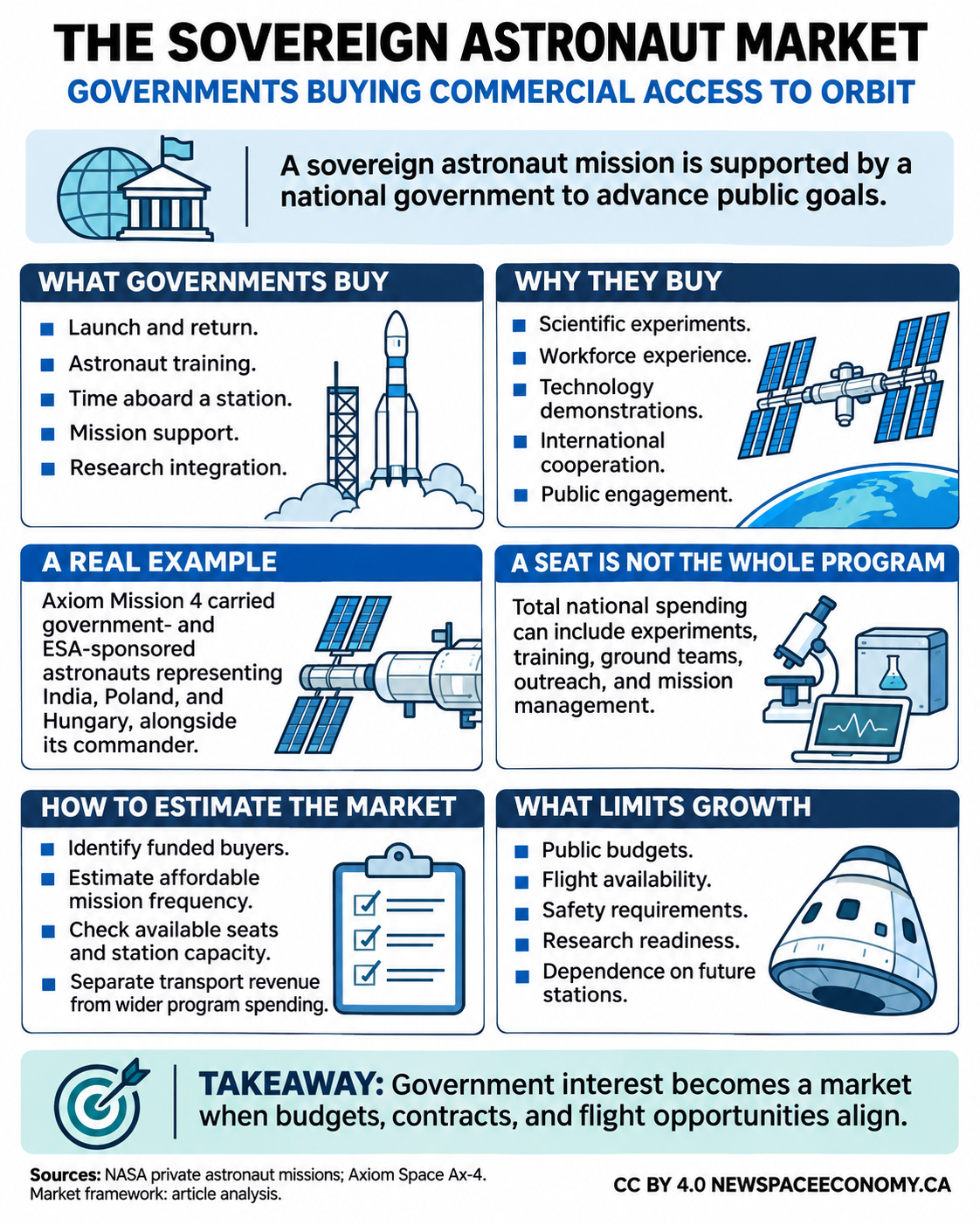
On June 25, 2025, a SpaceX Falcon 9 rocket lifted off from Kennedy Space Center carrying four astronauts toward the International Space Station (ISS). Three of those four seats belonged to national governments that do not operate their own orbital crew vehicles: India, Poland, and Hungary. Operated by Houston-based Axiom Space as Axiom Mission 4 (Ax-4), the 18-day orbital flight executed more than 60 scientific experiments representing 31 nations. The manifest marked a decisive commercial turning point. Just three years earlier, Axiom Mission 1 had flown three private investors alongside a retired government commander. By mid-2025, the sovereign astronaut market had overtaken private space tourism as the primary commercial demand engine for human flights to Low Earth Orbit (LEO).
Non-launch nations have sought human access to orbit for nearly five decades, moving through four distinct procurement eras. The first era began in 1978 when the Soviet Interkosmos program launched Czechoslovak cosmonaut Vladimír Remek aboard Soyuz 28. Over the following decade, Moscow flew guest cosmonauts from Poland, Hungary, Cuba, Mongolia, Vietnam, and India as instruments of Cold War diplomacy. Host governments paid minimal cash for those seats, gaining symbolic prestige in exchange for geopolitical alignment.
The second era emerged during the 1980s and 1990s through two parallel channels. NASA flew international payload specialists aboard the Space Shuttle alongside national satellite deployments, including Saudi Arabia’s Prince Sultan bin Salman Al-Saud in 1985. After the Soviet collapse, Russia began selling visiting flights to the Mir space station for hard currency to sustain its orbital infrastructure, establishing an early precedent for paid national access.
The third era centered on the ISS, where partner agencies from Europe, Japan, and Canada earned crew allocations through hardware barter rather than direct seat purchases. Nations outside the core ISS partnership had to negotiate scarce seats on Russian Soyuz spacecraft or arrange bilateral agreements with NASA. The United Arab Emirates (UAE) demonstrated the ceiling of that transitional model through the Mohammed Bin Rashid Space Centre (MBRSC). The agency flew Hazzaa AlMansoori on an eight-day Soyuz flight in 2019 and later secured a six-month ISS increment for Sultan AlNeyadi on SpaceX Crew-6 in 2023.
The fourth era arrived with NASA’s decision to open the ISS to Private Astronaut Missions (PAMs). Fixed-price turnkey packages combining launch on a SpaceX Crew Dragon, months of training, orbital habitation, and mission control created a predictable commercial product. Between May 2023 and September 2026, sovereign governments booked the overwhelming majority of available seats across both Axiom Space and newer entrant Vast. In June 2026, France signed a two-mission agreement with Vast covering both an ISS flight and a later mission to Vast’s commercial Haven-1 station. Days later, the European Space Agency (ESA) contracted Vast on behalf of the Czech Republic for pilot Aleš Svoboda, followed in September 2026 by a third European seat for Greek astronaut Adrianos Golemis on the same 2027 mission.
The table below summarizes publicly disclosed commercial sovereign missions contracted through November 2026, illustrating how total national outlays scale above the base launch seat price once domestic science programs are included.
| Mission and Year | Sovereign Nations | Reported National Outlay | Primary Strategic Objective |
|---|---|---|---|
| Axiom Mission 2 (2023) | Saudi Arabia (two seats) | Approximately $55 million per seat | Stem cell research and national visibility |
| Axiom Mission 3 (2024) | Italy, Türkiye, Sweden | $55 million (Türkiye); $43 million (Sweden) | All-European commercial flight and co-funding |
| Axiom Mission 4 (2025) | India, Poland, Hungary | $59–70M (India); $74M (Poland); $99M (Hungary) | Gaganyaan preparation and domestic space heritage |
| Vast-PAM-1 (2027 Planned) | France, Czechia, Greece | Approximately $90 million (Czech program) | Commercial ISS bridge and Haven-1 pathway |
These disclosed budgets reveal an important pricing nuance. Although the baseline commercial seat fare on a SpaceX Crew Dragon has hovered near $55 million per astronaut, governments rarely spend only the ticket price. Sweden negotiated a discounted 450 million Swedish kronor package, roughly $43 million, by filling a late-opening seat with co-funding from its national space agency, armed forces, and defense contractor Saab. Conversely, Hungary committed $99 million to its Hungarian to Orbit (HUNOR) program, Poland allocated roughly €65 million (about $74 million), and the Czech government budgeted approximately two billion Czech koruna (about $90 million) because those totals financed full domestic experiment development, astronaut selection, ground infrastructure, and public outreach alongside the orbital seat.
National Space Budgets and the Four-Tier Affordability Framework
Sizing future sovereign astronaut demand requires anchoring mission ambitions to fiscal reality. According to Paris-based consultancy Novaspace, global government space budgets climbed to $137.4 billion in 2025, comprising $71.8 billion in defense expenditures and roughly $65.6 billion in civil programs. That public outlay anchors a broader global space economy valued at $626.4 billion by Novaspace and $686 billion by the Space Foundation, reflecting methodological differences analyzed in how space market intelligence organizations measure the sector. More than 90 countries now invest public funds in space activities, and the Organisation for Economic Co-operation and Development (OECD) reported in September 2026 that the number of nations with formal space regulations has grown 50 percent over the past decade.
Yet spending remains highly concentrated at the top. Data compiled by Orbital Radar shows the United States leading with roughly $79.7 billion in annual government space spending, followed by China at $19.9 billion. Both superpowers operate sovereign human spaceflight systems and are excluded from the addressable pool of commercial sovereign seat buyers, although NASA’s anchor contracts underwrite the commercial stations that other nations will rent. Russia ($3.4 billion) similarly relies on its domestic Soyuz architecture.
Below those three launch powers sits a rapidly expanding group of allied and mid-tier spacefaring nations. Japan ($4.9 billion), France ($4.5 billion), Germany ($2.7 billion), Italy ($2.3 billion), India ($1.9 billion), and the United Kingdom ($1.5 billion) all maintain billion-dollar-plus budgets. Further down the ladder, South Korea ($700 million) and Canada ($612 million) have accelerated funding sharply. At the November 2025 ESA Council of Ministers, member states agreed to a record €22.1 billion (roughly $26 billion) three-year budget for 2026 through 2028. Notably, countries that had just purchased or prioritized human spaceflight posted the steepest percentage increases: Poland raised its ESA commitment by 277 percent to €731 million, Hungary boosted its pledge by 134 percent to €204 million, and contributing member Canada surged 404 percent to €408 million.
Segmenting Addressable Demand by Fiscal Capacity
Because space agencies normally spread the cost of an astronaut mission across a two-year to three-year budget cycle, fiscal feasibility depends on how large a single flight looms relative to a nation’s multi-year space appropriation. In practice, recurring agency-funded human spaceflight becomes sustainable when a single seat accounts for no more than roughly 15 percent of a country’s three-year cumulative space budget. Applying that benchmark across more than 90 space-investing nations divides the sovereign astronaut market into four distinct tiers.
Tier 1 consists of roughly six major allied space powers with annual budgets between $1.5 billion and $5 billion: Japan, France, Germany, Italy, India, and the United Kingdom, supplemented by pooled ESA mechanisms. At $60 million per seat, a single mission represents less than one percent of a Tier 1 nation’s three-year space budget. These countries exhibit low price elasticity, prioritize sustained microgravity research over symbolic first flights, and will require regular 30-day to 90-day crew rotations once the ISS retires.
Tier 2 encompasses approximately 12 wealthy or high-ambition mid-tier nations with annual budgets between $300 million and $1.5 billion, or access to dedicated sovereign wealth backing. Members include the UAE, Saudi Arabia, Canada, South Korea, Spain, Poland, Australia, Israel, Brazil, Switzerland, Norway, and the Netherlands. For a typical Tier 2 country, a $60 million seat represents three to 10 percent of a three-year space budget. This group forms the core commercial growth engine for station operators, capable of sustaining one sovereign flight every two to four years, particularly when tied to industrial hardware offsets.
Tier 3 comprises roughly 22 emerging entrants with annual space budgets between $50 million and $300 million, including Hungary, the Czech Republic, Sweden, Türkiye, Greece, Singapore, Argentina, Mexico, Indonesia, Qatar, Thailand, and Vietnam. At $60 million per seat, one flight consumes roughly 13 percent of a midpoint Tier 3 nation’s three-year budget, rising above 20 percent once national R&D payloads are added. Consequently, Tier 3 missions today rely on extraordinary cabinet-level appropriations or defense co-funding and occur episodically every five to eight years. However, if commercial seat prices compress toward $35 million in the 2030s, the three-year budget burden drops below eight percent, unlocking repeat flight cadences across this tier.
Tier 4 includes more than 50 nascent space nations with annual space budgets under $50 million across Africa, Latin America, Central Asia, and Southeast Asia. At current $55 million to $65 million seat prices, a single orbital ticket would absorb more than 80 percent of a Tier 4 nation’s three-year space spending. Solo missions are fiscally unviable in this tier today. Unlocking Tier 4 demand requires either regional shared-mission consortia, such as joint flights organized through the Association of Southeast Asian Nations (ASEAN) or African regional agencies, or next-generation reusable launch vehicles pushing seat prices below $25 million.
Commercial Space Station Supply After the Orbital Reef Withdrawal
Demand alone cannot build a market if orbital destinations are unavailable. As of November 2026, zero free-flying commercial space stations operate in orbit, leaving the ISS as the sole Western destination for sovereign commercial flights. With NASA targeting ISS deorbit around 2030, NASA’s transition from the ISS to commercial platforms has entered its decisive procurement phase. On October 9, 2026, NASA issued the final Request for Proposals (RFP) for its Commercial LEO Destination Contract (CLDC), setting a December 8, 2026 bid deadline and targeting contract awards in spring 2027. The multi-award Indefinite-Delivery, Indefinite-Quantity (IDIQ) structure carries a combined ceiling of up to $34.06 billion, with at least $100 million guaranteed, covering station design, certification, operations, and crew and cargo transportation under NASA’s Commercial Low Earth Orbit Destinations program.
The competitive field narrowed dramatically just weeks before the December 2026 bid deadline. On November 12, 2026, Blue Origin confirmed it would not submit its Orbital Reef concept for the next phase of NASA’s CLD competition, placing its station plans on hold to concentrate engineering and capital on lunar transportation and Artemis infrastructure, as reported in coverage of Blue Origin’s Orbital Reef withdrawal. Originally unveiled with Sierra Space and Boeing as an 830-cubic-meter commercial outpost supporting up to 10 crew members, Orbital Reef’s pause concentrates near-term Western station supply among three active contenders: Vast, Axiom Space, and Starlab Space.
The table below compares the active and paused commercial LEO station programs as of November 2026 across architecture, crew capacity, target schedules, and sovereign customer traction.
| Station Program | Lead and Partners | Volume and Crew | Status as of November 2026 |
|---|---|---|---|
| Vast Haven-1 | Vast, SpaceX transport | 45 m³ habitable; four crew | Targeting Q1 2027 launch; France signed mission deal |
| Vast Haven-2 | Vast (modular ISS successor) | 220 m³ habitable by 2030 | Proposed module launches starting 2028; ESA MOU signed |
| Axiom Station | Axiom, Thales Alenia, MDA Space | Modular multi-node; four to eight crew | PPTM targets 2028 ISS attachment; four PAMs flown |
| Starlab | Voyager, Airbus, Mitsubishi, MDA | 340 m³ habitat; four to eight crew | Single-launch metallic station targeting 2029 |
| Orbital Reef | Blue Origin, Sierra Space, Boeing | 830 m³ pressurized; 10 crew | On hold; withdrawn from NASA CLDC in Nov 2026 |
Each active station operator pursues a distinct architectural and commercial pathway to capture sovereign budgets. Following the November 2025 flight of its Haven Demo orbital testbed, Vast targets early 2027 for Haven-1, a single-module station with 45 cubic meters of habitable volume designed for two-week, four-person Dragon visits. Vast plans to follow with Haven-2 modules starting in 2028, reaching 220 cubic meters of habitable volume by 2030. In October 2026, Vast strengthened its European pipeline by signing a post-ISS cooperation Memorandum of Understanding (MOU) with ESA.
Axiom Station retains the deepest operational heritage in sovereign human spaceflight after executing four ISS missions and contracting Ax-5 for early 2027. Under its revised assembly architecture, Axiom plans to launch its Payload Power Thermal Module (PPTM) to the ISS no earlier than 2028 before detaching to join its Habitat One module in free flight. Meanwhile, Starlab aims to deploy a 340-cubic-meter metallic station in a single heavy-lift launch no earlier than 2029, supporting four continuous astronauts and up to eight during crew handovers with a regenerative Environmental Control and Life Support System (ECLSS).
A powerful commercial pattern is already visible across these consortia. Starlab includes Airbus in Europe, Mitsubishi Corporation in Japan, and MDA Space in Canada as equity and strategic partners. Axiom similarly sources pressurized structures from Italy’s Thales Alenia Space and robotics from MDA Space. Sovereign governments consistently prefer purchasing crew time on stations where domestic aerospace suppliers hold equity stakes or subsystem workshare, turning one-off flights into recurring industrial commitments.
Sizing the Sovereign Astronaut Market Through 2036
To quantify the commercial sovereign astronaut market across the 2027 to 2036 decade, a bottom-up scenario simulation was built around three core variables: annual sovereign seat volume, turnkey seat and habitation pricing, and the national R&D payload attach rate. The model counts only government-funded commercial missions by non-superpower nations, excluding NASA, Roscosmos, and Chinese sovereign-vehicle rotations. Annual market revenue equals seats flown multiplied by the turnkey commercial fare, plus domestic spending on experiment hardware, integration, and science operations.
Starting prices are anchored to verified 2025 and 2026 benchmarks, where turnkey ISS seats average roughly $55 million to $62 million and total national program allocations sit 18 to 30 percent higher. Because launch pricing, station certification timelines, and national budget elasticity remain uncertain, three deterministic scenarios were modeled alongside a 5,000-iteration Monte Carlo simulation.
The table below presents the 10-year cumulative outcomes across the Conservative, Baseline, and Accelerated scenarios, together with the stochastic Monte Carlo confidence bounds.
| Scenario (2027–2036) | 10-Year Seats | Turnkey Price Path | Cumulative Revenue | 2036 Annual Run-Rate |
|---|---|---|---|---|
| Conservative | 86 seats | $62M to $48M | $5.51 billion | $679.7 million |
| Baseline | 150 seats | $60M to $38M | $8.36 billion | $1,112.6 million |
| Accelerated | 255 seats | $58M to $22M | $10.53 billion | $1,295.4 million |
| Monte Carlo P10–P90 | 114 to 187 seats | Stochastic variance | $6.22B to $10.55B | Median $8.20B total |
Under the Conservative scenario, commercial station certifications slip 12 to 18 months following Orbital Reef’s withdrawal, producing a temporary orbital capacity pinch around the 2030 ISS retirement. SpaceX Crew Dragon retains dominant pricing power, limiting turnkey price declines from $62 million in 2027 to $48 million by 2036. Annual sovereign demand grows modestly from five seats in 2027 to 12 seats in 2036, totaling 86 seats and $5.51 billion in cumulative revenue ($4.67 billion for seats and habitation plus $840 million in R&D add-ons) at a 7.1 percent Compound Annual Growth Rate (CAGR).
Under the Baseline scenario, Haven-1 initiates commercial visits in 2027, Axiom and Starlab enter operational service between 2028 and 2029, and Haven-2 scales smoothly through the 2030 ISS handover. Competition among three active station networks and higher launch cadence lowers turnkey mission fares from $60 million in 2027 to $38 million by 2036. Annual sovereign seats expand from six in 2027 to 24 by 2036, reaching 150 cumulative seats and $8.36 billion in total spend ($6.85 billion in seats and habitation plus $1.51 billion in national R&D payloads). The market crosses the $1 billion annual threshold in 2034, finishing 2036 at $1.11 billion per year with a 10.9 percent CAGR.
Under the Accelerated scenario, crew-rated reusable heavy-lift vehicles and expanded multi-station capacity drive turnkey seat prices down from $58 million to $22 million by 2036. That 62 percent price reduction triggers substantial demand elasticity, unlocking regular Tier 3 repeat flights and Tier 4 regional consortium missions. Annual seat volume climbs from seven in 2027 to 46 in 2036, totaling 255 seats and $10.53 billion in cumulative spend as national R&D attach rates rise to 28 percent. Notably, revenue growth flattens slightly in 2036 even as seat count rises because steeper per-seat price compression offsets higher flight volume.
To stress-test these deterministic paths, the 5,000-run Monte Carlo simulation simultaneously varied national budget adoption multipliers, annual price compression variance with inverse price elasticity, station readiness delays, and R&D attach rates between 15 and 30 percent. Ninety percent of simulated outcomes exceeded $6.22 billion in 10-year revenue (P10), with a median of $8.20 billion across 147 seats and a P90 upside of $10.55 billion across 187 seats. The simulation confirms that even under supply delays, sovereign astronauts represent a lasting multi-billion-dollar anchor for the post-ISS commercial economy.
Six Pillars of Sovereign Return on Investment
Spending $55 million to $99 million to fly a single citizen into orbit frequently sparks domestic political debate, particularly when most of the initial launch contract flows to American aerospace providers. Editorial critics in India questioned the Department of Space’s ₹548 crore outlay for Ax-4, and European commentators asked whether purchasing commercial American flights undermines European institutional autonomy. Evaluating sovereign human spaceflight solely as an outbound cash expense overlooks how national governments capture measurable Return on Investment (ROI) across six interconnected pillars.
Macroeconomic Multipliers and Industrial Space Heritage
Broad economic impact studies consistently document positive output multipliers for public space exploration. A November 2023 report by the European Space Policy Institute (ESPI) estimated that a major European space exploration program generates a Gross Domestic Product (GDP) multiplier exceeding 5x the overall budget. In the United States, NASA’s economic impact assessment for fiscal year 2021 found that a $23.3 billion agency budget generated $71.2 billion in total economic output, supporting more than 339,600 jobs and $7.9 billion in tax revenues, a direct multiplier of roughly 3.1x before counting multi-decade commercial spinoffs. Applying similar logic to national commercial missions, the Czech government projected an eight-fold domestic economic return on its investment in Aleš Svoboda’s flight.
The mechanism converting orbital spending into domestic growth is industrial space heritage. Qualifying sensors, medical monitors, radiation detectors, and food systems in real microgravity opens export doors across international aerospace supply chains. During Ax-4, Hungarian firm 27G-Technology flew ten prototype RadNano Infinity astronaut dosimeters, generating peer-reviewed radiation mapping data published in Scientific Reports in 2026. Similarly, Poland used its Ignis mission to flight-qualify domestic technology demonstrations and specialized space foods from Kielce-based Lyofood, immediately preceding Poland’s 277 percent surge in ESA industrial commitments.
Microgravity Research and the Client-to-Investor Flywheel
Microgravity research offers targeted commercial upside in life sciences and advanced materials, a sector examined closely in microgravity manufacturing and the economics of saleable output. A retrospective study of NASA life sciences R&D found that $64 million invested across 15 technologies produced more than $1.5 billion in value-added benefits and stimulated an additional $200 million in private research spending. Sovereign commercial crews are already advancing clinical-stage research: Ax-4 tested real-time glucose monitoring and insulin delivery in microgravity alongside cancer drug candidate Rebecsinib, which entered clinical trials in 2025. As commercial platforms standardize rack leases through microgravity as a service, national research institutes can run iterative orbital campaigns without owning a space station.
Commercial flights also catalyze a striking client-to-investor capital flywheel. Governments and domestic conglomerates increasingly pair astronaut seat purchases with strategic equity investments in station operators. After Saudi Arabia purchased two seats on Ax-2, Saudi-backed Aljazira Capital co-led Axiom Space’s $350 million Series C round. Following Tibor Kapu’s Ax-4 mission, Hungarian telecom and space group 4iG invested $100 million into Axiom Space to co-develop orbital data centers, and Indian launch startup Skyroot signed a commercial partnership with Axiom. Rather than viewing the flight fee as a sunk cost, these nations treated it as an entry ticket into high-growth orbital infrastructure.
Program De-Risking, Talent Pipelines, and Space Diplomacy
For nations developing independent human spaceflight systems, commercial LEO seats function as low-cost operational risk reduction. The Indian Space Research Organisation (ISRO) spent roughly ₹548 to 550 crore, or $59 million to $70 million, to fly Group Captain Shubhanshu Shukla as Ax-4 pilot. That expenditure represented a fraction of India’s indigenous Gaganyaan human spaceflight budget yet delivered 20 days of live orbital operations, rendezvous training, and ISS science execution directly transferable to India’s first domestic crewed launches.
Finally, sovereign astronauts generate intangible returns in education and strategic alignment. When the UAE launched its astronaut corps, more than 4,000 citizens applied for two slots, and 15 UAE schools flew student experiments aboard the ISS. At the geopolitical level, co-funding astronaut missions through defense ministries, as Sweden did with its armed forces on Ax-3, deepens allied space interoperability and signals technological maturity to regional partners.
Mission Unit Economics and Value-Chain Shifts
Understanding who captures value inside a sovereign astronaut mission clarifies how station business models will evolve over the next decade. At a representative 2027 total sovereign outlay of $73 million ($60 million commercial contract plus $13 million in domestic R&D payloads), launch transportation commands the largest slice of the budget. According to NASA Office of Inspector General and Commercial Crew contract benchmarks, a SpaceX Crew Dragon seat carries an underlying cost of $55 million to $72 million depending on mission extension tranches, whereas Boeing’s Starliner was audited near $90 million per seat. Consequently, crew launch and recovery absorb roughly 55 to 65 percent of total commercial contract value in 2027.
Station habitation, docking, consumables, and life support currently account for an estimated 15 to 20 percent of the commercial package, with astronaut training, medical certification, and mission control representing the remaining 10 to 15 percent. Domestic R&D hardware, experiment integration, and post-flight commercialization sit on top as an 18 to 22 percent ecosystem add-on.
That economic split will invert substantially between 2027 and 2036 as reusable launch vehicles mature and multi-station utilization climbs. Once competing crew-rated spacecraft enter service alongside Falcon 9 and Dragon, launch transport’s share of total mission cost is projected to compress toward 35 to 45 percent by 2035. Station operators stand to capture the expanding margin pool as habitation, power, orbital data processing, and laboratory rack leases rise to 25 to 30 percent of mission value. Because commercial stations carry high fixed orbital operating costs, sovereign flights provide predictable, high-credit utilization that pushes stations past their roughly 60 percent break-even occupancy threshold, mirroring broader shifts across business models of the space economy.
Structural Bottlenecks and Strategic Playbooks
Four structural risks could constrain the sovereign astronaut market below Baseline projections. First, the potential ISS-to-CLD transition gap between 2029 and 2031 remains acute. Blue Origin’s November 2026 withdrawal of Orbital Reef leaves zero margin for prolonged delays across Haven-2, Axiom Station, and Starlab, complicating NASA’s evolving stance on continuous presence in LEO. If multiple commercial stations slip beyond 2030, sovereign seat supply will tighten sharply.
Second, single-provider launch dependence keeps ticket prices sticky. Until a second reusable Western crew vehicle achieves full human rating and competitive cadence, SpaceX sets the effective price floor for orbital transport, slowing adoption among price-sensitive Tier 3 and Tier 4 nations.
Third, U.S. International Traffic in Arms Regulations (ITAR) and export controls restrict which non-allied countries can place astronauts or sensitive payloads aboard U.S.-built commercial stations. That regulatory boundary naturally splits global demand, pushing non-aligned or Belt-and-Road nations toward bilateral crewed agreements aboard China’s Tiangong space station.
Fourth, rising global defense spending creates fiscal competition for civil space budgets. European NATO members agreed at the June 2025 Hague Summit to work toward a long-term five percent GDP defense target by 2035, according to the ESA Report on the Space Economy 2026. Unless national space agencies link sovereign astronaut flights directly to dual-use technology validation and domestic economic returns, finance ministries may scrutinize $70 million human flights during tight budget cycles.
Playbooks for Station Operators and National Governments
Commercial station operators can accelerate sovereign contract velocity through three concrete moves. Offering industrial offsets, subsystem workshare, or sovereign lab racks converts reluctant Tier 1 and Tier 2 ministries into multi-year anchor customers. Introducing modular starter packages priced between $15 million and $25 million, combining uncrewed microgravity payload flights with shared regional crew seats, builds an early pipeline among Tier 3 and Tier 4 states. Standardizing pre-cleared export-control payload interfaces and bilateral ESA or agency training tracks can also compress mission lead times below 12 months, aligning with NASA’s Low Earth Orbit Microgravity Strategy.
National governments seeking to maximize domestic ROI should avoid the “flag-and-footprints” leakage trap, where 80 percent of mission spending exits the domestic economy to foreign launch providers. Ring-fencing at least 20 to 30 percent of total program funding for local university experiments, startup space-heritage hardware, and post-flight intellectual property commercialization ensures lasting economic capture. Tier 3 and Tier 4 states can pool regional budgets through multilateral consortia to negotiate volume seat discounts, whereas Tier 1 and Tier 2 nations should follow France’s two-mission Vast framework by structuring multi-flight roadmaps that build institutional continuity across the post-ISS decade.
Summary
The sovereign astronaut market has matured from an episodic diplomatic gesture into an $8.36 billion baseline commercial opportunity between 2027 and 2036, spanning an estimated 150 government-funded seats and crossing $1 billion in annual spend by the mid-2030s. With global government space budgets at a record $137.4 billion and Blue Origin’s withdrawal of Orbital Reef concentrating Western station supply around Vast, Axiom Space, and Starlab, sovereign governments hold growing leverage as the highest-credit non-NASA anchor customers in Low Earth Orbit. Nations that pair commercial seat procurement with disciplined domestic R&D ring-fencing, industrial workshare, and multi-mission continuity will capture compounding scientific, industrial, and macroeconomic returns well beyond the cost of launch.


