


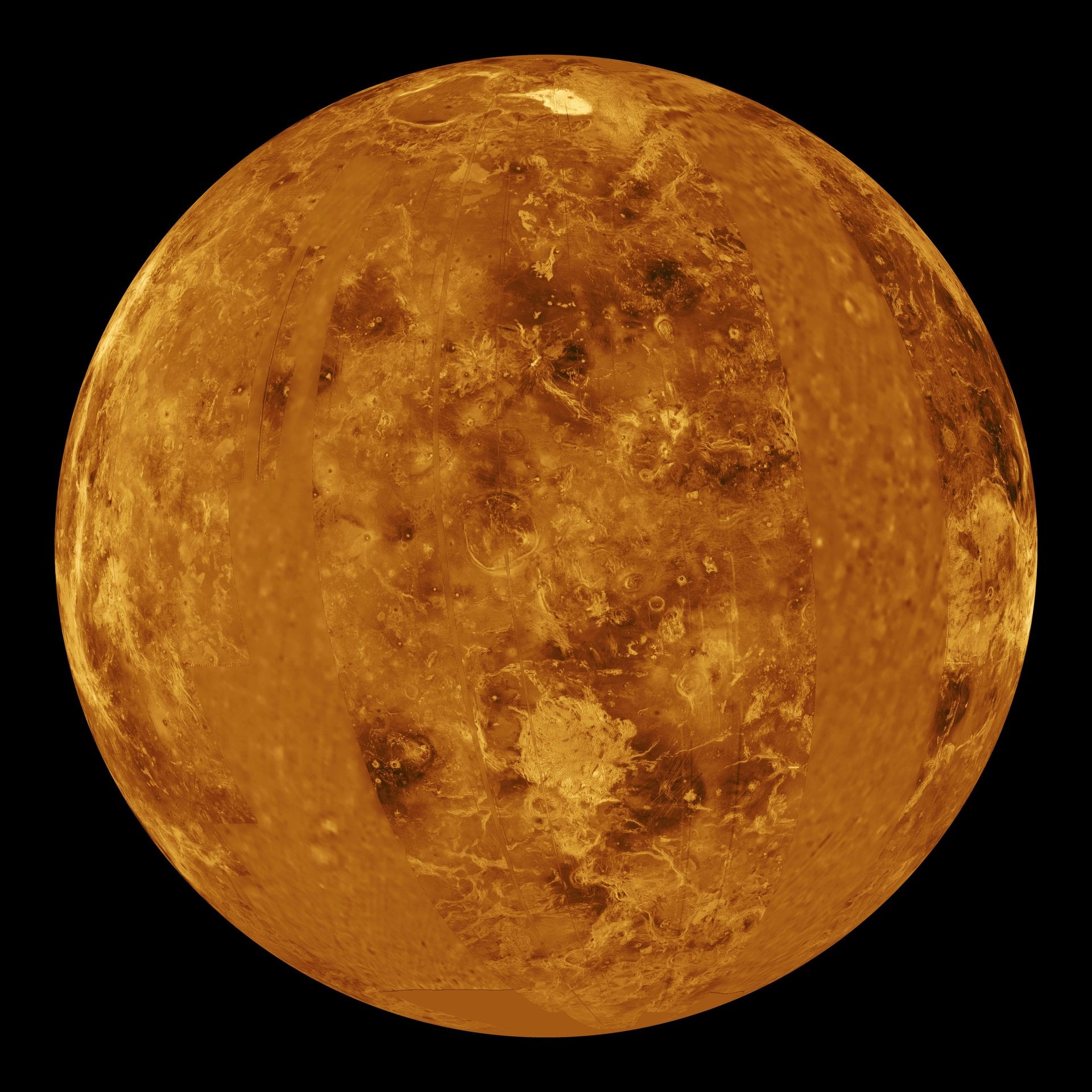
Venus will be drawing a lot of attention in the near future. So far, no spacecraft has survived on its surface for more than a few hours, and that was back in the 1970s and‘80s. But a series of new missions coming up should give us a clearer picture of what exactly exists on the surface there. And a new paper, available in The Planetary Science Journal from Sara Taeko Port, a postdoc researcher at the University of Texas San Antonio, provides some clues as to what we would expect to find there, and whether what we do see means there used to be water on our “evil twin.”
Venus itself is largely considered an actual hellscape. Read anything about the planet and you will immediately understand how hostile it is. Temperatures average around 460 degrees Celsius, hot enough to melt lead. The atmospheric pressure is around 93 times what Earth’s average ocean-level pressure is – the equivalent of diving a kilometer into the ocean. Oh, and the air is made of carbon dioxide topped by clouds of sulfuric acid.
While this might sound pretty terrible for humans, for the rocks that make up Venus’ surface, it’s just another day on the planet. But what they are and how they form can give planetary scientists an insight into their history. And what they used to be could provide insight into whether there used to be water on Venus’ surface or not.

Fraser talks about our future exploration of Venus.
To prove this point, Dr. Port and her colleagues turned to the Glenn Extreme Environment Rig (GEER), at NASA’s Glenn Research Center in Cleveland. This specialized test chamber is an 811-liter stainless steel pressure vessel engineered specifically to replicate the temperature, pressure, and chemical mixture of Venus’ lower atmosphere. And it’s one of the only places in the world where those conditions can be found.
The research team put a combination of slabs and powders of three carbonate minerals (siderite, calcite, and magnesite) and three minerals that contain water (phlogopite, brucite, and muscovite). They then turned the chamber on and let the samples sit there for sixty days.
Underpinning this experiment is a theory held by many planetary scientists that Venus used to be much more hospitable. In this theory, it was almost Earth-like at one point, before a runaway greenhouse effect boiled away its oceans. Indeed, clues like a significantly high deuterium/hydrogen ratio in its atmosphere point to the planet losing a massive amount of water over time. So, if there was water on its surface at one point, planetary scientists would expect to find signs of that in the geological record.

Fraser talks about why plate tectonics are so important to Venus’ environment.
But there’s a big question mark about whether the minerals formed around liquid water would have survived Venus’ transition to its current state. The planet’s atmosphere, along with what scientists believe to be active volcanoes, is potentially damaging enough that any water-formed minerals could have been drastically changed over the course of the last few billion years. Dr. Port and her colleagues thought the best way to test that would be to watch what happened to actual samples of potential minerals.
The answers to that question were somewhat surprising. Brucite, a magnesium-rich mineral that is formed in liquid water on Earth, dried out, then cracked, and changed into a different mineral called magnesite, a type of tough carbonate mineral. Once that magnesite was formed, though, it didn’t change much. This means if a future mission finds magnesite on a Venusian plain, it could be a sign of past water, depending on the surrounding geology since technically magnesite can also form without it.
Another surprise came from a class of materials known as micas. These are flaky, water-bearing materials that usually form in wet volcanic environments and go by names like phlogopite or muscovite. Typically, the extreme heat and sulfur dioxide present on Venus would strip the water molecules out of these minerals, causing them to break down. However, Venus’ atmosphere also contains trace amounts of hydrogen fluoride gas. In the environmental chamber, fluorine atoms swapped out with the water-associated hydroxyl groups in the chemical structure of the minerals, turning them into minerals with even crazier names like fluorophlogopite and fluoromuscovite.

Fraser discusses the oddities of Venus with Dr. Paul Byrne.
That swap also protects the minerals from the heat. Swapping hydroxyl for fluorine boosts a mica’s resistance to high temperatures, allowing it to exist even in the harsh temperatures of Venus’ surface for billions of years. So in this particular case, a toxic gas in Venus’ environment might actually help preserve a mineral that was formed when the planet still had plenty of liquid water.
Speaking of volcanoes, the paper adds yet more evidence that Venus must be currently volcanically active. In the experiment, almost every sample absorbed sulfur or fluorine, forming their respective sulfates, sulfides, and fluorides as a type of outer crust. If that absorption process happened over millions of years (such as the 500-million years since the last major resurfacing event on Venus), calculations in the paper show all of those gases would have vanished from the atmosphere long ago unless something was continuously dumping them back in. The most logical explanation would be volcanoes doing so.
That meshes well with previous missions to Venus – archival radar data from NASA’s Magellan spacecraft revealed that a volcanic vent on Maat Mons, Venus’ tallest volcano, reshaped itself over the course of eight months back in 1991. But there are also plenty more missions to come, including NASA’s DAVINCI and VERITAS and ESA’s EnVision spacecraft. This paper on our sister planet’s mineralogy provides a clear roadmap to what those missions’ scientists should look for as potential signs of where our two geological paths diverged so drastically.
Learn More:
UT San Antonio – UT San Antonio researchers uncover new clues to understanding Venus
S. T. Port et al – New Insights into Venus’s Volatile Cycles Revealed by the Formation of Magnesite and Fluoro–Micas
UT – Scientists Discover New Geological Link Between Earth and Venus
UT – NASA’s VERITAS Mission Breathes New Life
Originally published by Universe Today. Read the original article. Licensed under CC BY 4.0.


