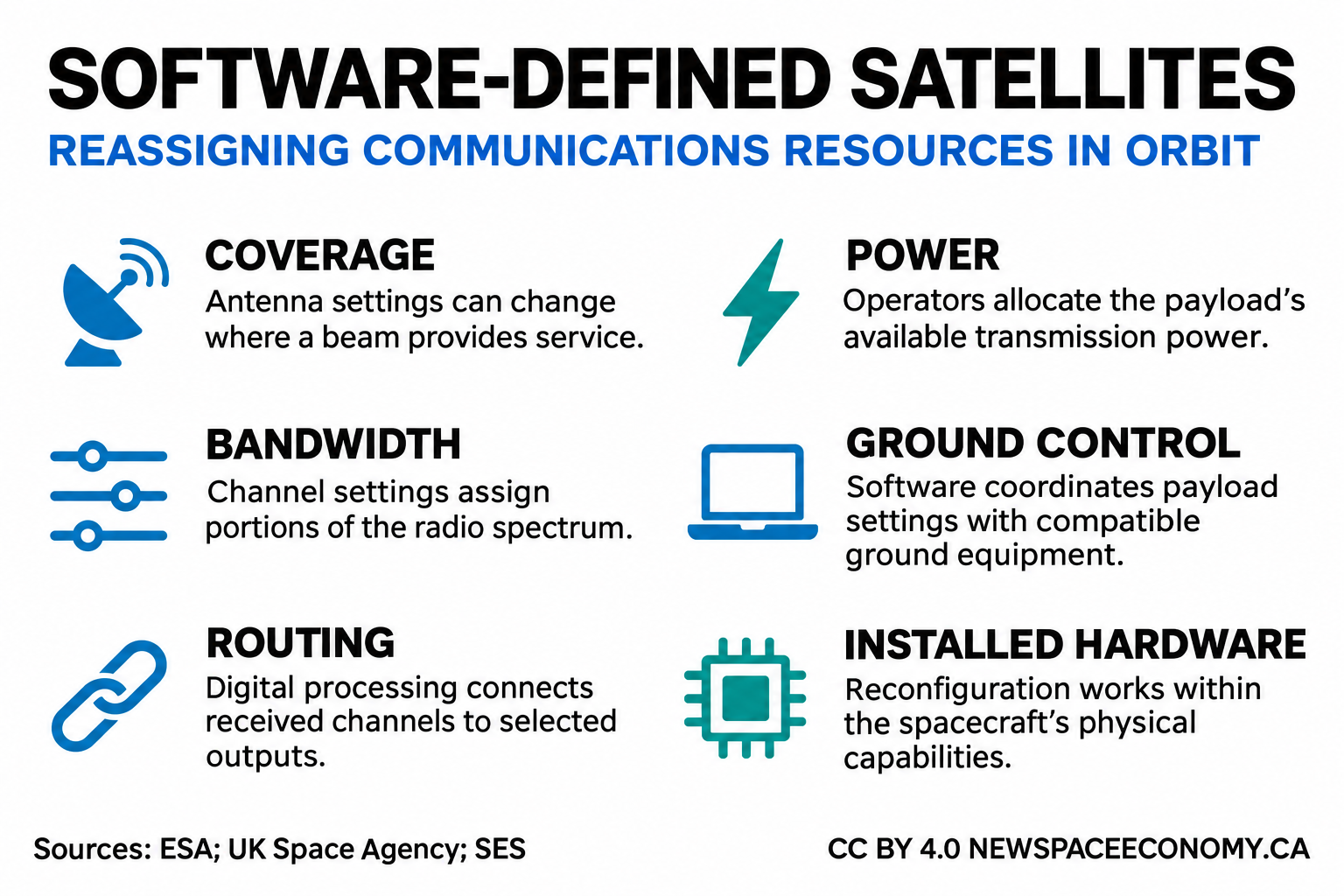
Software-defined satellites allow operators to change communications payload settings after launch. Depending on the hardware, those settings can include beam coverage, channel bandwidth, signal routing, and power allocation. Software controls how installed resources are assigned to services, reducing the amount of a satellite’s commercial configuration that must remain fixed throughout its working life.
The underlying spacecraft still supplies physical capabilities. Antennas establish radio coverage, amplifiers provide transmission power, and processors handle signals. Reconfiguration changes how that equipment operates within its designed capabilities. The practical change is that an operator can adapt a communications service without replacing the spacecraft carrying it.
Several Different Settings Define a Connection
A satellite communications service has both a geographic dimension and a radio-frequency dimension. Coverage describes the areas reached by its beams. Bandwidth describes the width of the radio-frequency channel assigned to a signal. Power allocation affects the strength of the transmitted signal, and routing determines which received signals are connected to which outgoing paths.
Changing these settings addresses different parts of the service. Redirecting a beam changes where capacity is offered. Adjusting a channel changes the spectrum assigned to a connection. Altering routing connects different inputs and outputs within the payload. A flexible satellite combines these controls so they can support the intended service together.
The UK Space Agency’s Eutelsat Quantum description, published after the spacecraft’s July 2021 launch, identifies coverage, bandwidth, power, and frequency as parameters that can be altered in orbit. Those are operational properties of the communications payload. They describe what reconfiguration changes, rather than suggesting that software can replace any physical spacecraft component.
The distinction is useful because spacecraft have long used software for commands and control. The commercial meaning of a software-defined communications satellite concerns the breadth of payload resources that can be reassigned. The relevant question is which service characteristics the installed hardware allows its operator to change.
Digital Processing Changes the Internal Signal Path
A digital communications payload can convert incoming analog signals into digital form for processing, then convert the processed output back for radio transmission. Between those conversions, the payload can divide the received spectrum into channels, adjust their gain, and connect them to selected outputs.
ESA’s completed digital transparent processor project describes this sequence. Its processor architecture included input conversion, digital filtering and routing, and output conversion. The equipment allowed the number, width, and frequency positions of channels to be configured.
Channelization means separating the input spectrum into defined portions that can be handled individually. Routing associates those portions with outgoing connections. These functions make the frequency plan adjustable rather than tying every input permanently to one fixed output arrangement.
The processor is also a physical product with a defined number of connections and processing capability. ESA’s project description explains that its modular equipment could be configured for different numbers of input and output ports during manufacture. That manufacturing choice establishes the equipment installed on the spacecraft; in-orbit commands then configure the available channels and connections.
Thales Alenia Space’s payload processor documentation describes transparent, regenerative, and hybrid processing products. Its transparent processor provides channel-level gain control and input-to-output connectivity. The hybrid product combines that function with regenerative processing supporting specified communications standards.
These distinctions concern what happens to a signal onboard. A transparent processor can alter the signal’s channel and route without making the satellite the endpoint of the customer’s application. More extensive processing can perform communications functions onboard that otherwise reside elsewhere in the network.
Antenna Flexibility Changes the Coverage
The antenna system determines where the payload can receive or transmit signals. Electronic beam control provides another level of flexibility alongside digital channel processing. The operator can change a beam’s direction or coverage shape within the antenna’s design.
Eutelsat Quantum provides a documented commercial example. ESA reported in August 2022 that the satellite was in commercial use and that Eutelsat had sold six of its eight beams. The report described beams that could be redirected and reshaped to support data and mobile communications.
This capability connects the satellite’s resources to users whose locations change. A mobile communications service can require coverage along a transport route, and a network can require different coverage as its customer locations change. Beam flexibility changes where the installed payload is applied.
Beam control and channel control are complementary. A beam establishes a geographic radio connection; the channel plan determines how signals use that connection. Reassigning communications capacity involves matching the coverage arrangement with the frequencies, bandwidth, and power used for the service.
Ground Software Coordinates the Changes
An operator needs a way to translate service requirements into payload settings. ESA’s Quantum program explanation describes operational software that predicts, operates, and manages the spacecraft’s configuration. The software allocates payload resources in response to changing requests.
This means reconfiguration involves planning as well as sending commands. Coverage, channel assignments, and power settings interact. The operating software represents the resources available and the configuration needed to deliver the selected service.
The ground network must also match the spacecraft configuration. Gateways and modems use corresponding frequencies and communications settings. A payload change becomes a usable connection when the equipment at both ends operates with compatible parameters.
SES documented this relationship during September 2023 system testing for O3b mPOWER. The company reported that its Adaptive Resource Control software configured the satellite payload, gateway, and modem platform during radio-frequency tests. The demonstration covered connected space and ground components, rather than an isolated change inside the spacecraft.
The test illustrates the operational scope of software-defined service delivery. Satellite commands are one part of a coordinated network action. Ground equipment and payload resources are configured together so that a signal can pass through the intended route.
Flexible Payloads Change Procurement and Service Assignment
A fixed communications configuration reflects expectations formed before launch. A payload that can be reconfigured allows some service decisions to be made later. ESA described Quantum as moving toward a more generic payload approach, with the operator able to respond to geographic and performance demand that changed during manufacturing or after deployment.
Airbus’s OneSat product description connects this flexibility with a standardized, modular manufacturing approach. The company describes adjustable coverage, capacity, and frequency, supported by a ground system and software suite. A common product architecture and a configurable operating arrangement address different stages of the satellite’s life.
Standardization concerns the spacecraft being built. Reconfiguration concerns the service delivered using that spacecraft. Combining them allows a shared hardware architecture to support service assignments that can change after the manufacturing decisions have been completed.
New Space Economy’s explanation of software-defined satellite components discusses this relationship between reprogrammability and operating flexibility. The commercial unit becomes an assigned communications service backed by configurable resources, rather than only a permanently arranged section of payload capacity.
SES described its O3b mPOWER resource-control architecture in June 2022 as coordinating power, throughput, beams, and frequency allocation across space and ground assets. The company presented automated service assignment as an operating objective. Its later system testing provided a specific example of software coordinating those assets.
The lasting distinction is between hardware capability and service configuration. The spacecraft carries a finite set of antennas, processors, and power resources. Software-defined operation lets the operator assign those resources to different communications arrangements as customers and traffic patterns change.