


Key Takeaways
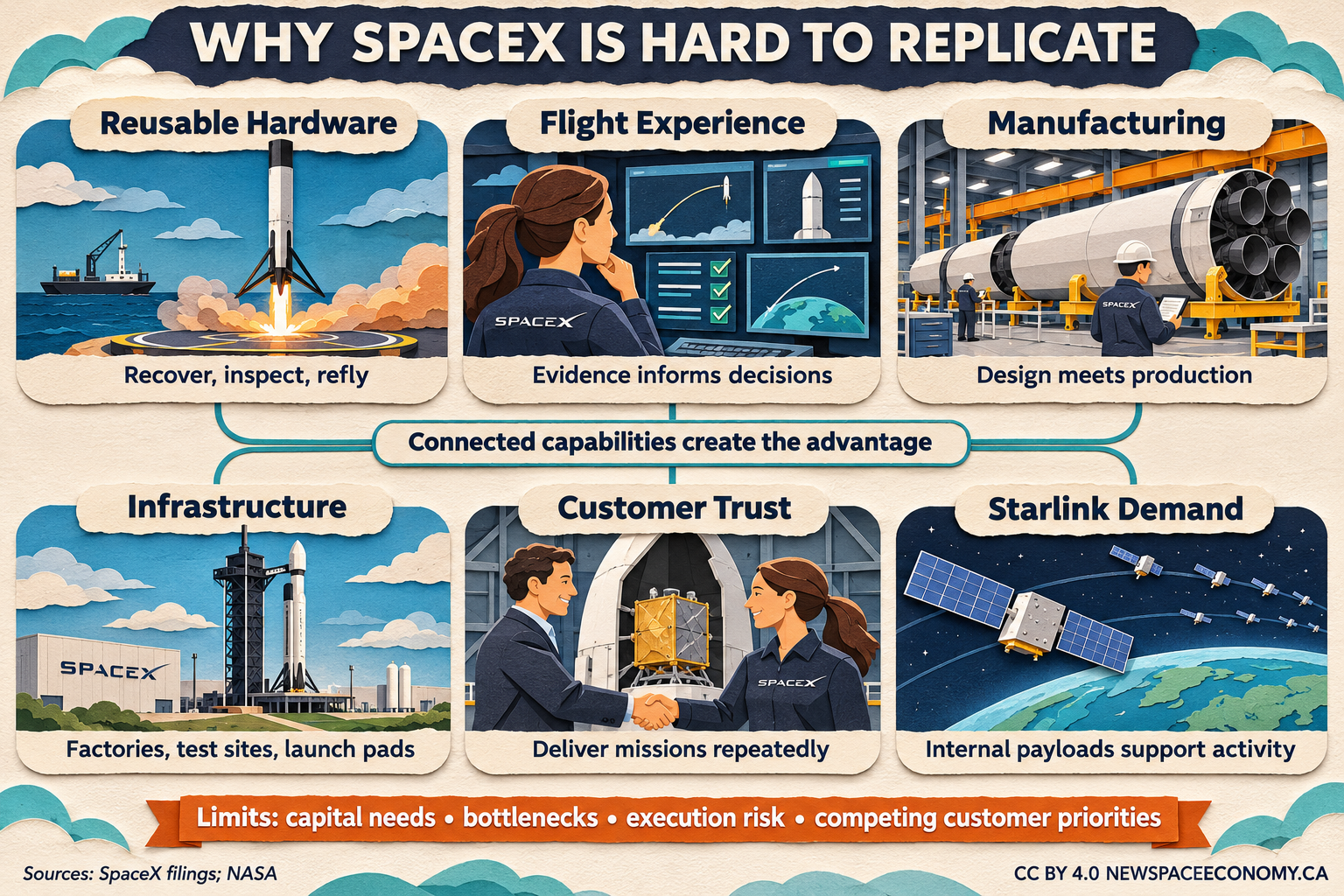
- SpaceX’s advantage combines reusable hardware, operating experience, production, and internal demand.
- High flight activity creates learning opportunities, but results depend on disciplined execution.
- Competitors can serve distinct customer needs without reproducing SpaceX’s entire business system.
SpaceX’s Competitive Advantage Extends Beyond the Rocket
SpaceX’s May 2025 Falcon user’s guide records the first reflight of an orbital-class first stage in 2017. That historical milestone established a practical distinction between demonstrating a rocket flight and returning major hardware to service. The company’s Falcon documentation also describes inspecting recovered equipment as a source of information about performance. SpaceX’s competitive advantage becomes easier to understand when reuse is viewed as part of an operating system rather than an isolated landing achievement.
The rocket is the most visible product, but an orbital transportation business requires much more. Hardware must move through production, testing, launch preparation, flight, and any recovery process. Customers need integration support and delivery to useful destinations. A competitor seeking comparable results must coordinate these activities, not simply build a vehicle that resembles Falcon 9.
Competitive advantage means an ability to deliver something customers value under conditions that support a sustainable business. It can arise from lower cost, greater suitability, more dependable execution, or combinations of those attributes. A technical accomplishment becomes commercially important when it changes an actual purchase or improves the economics of supplying it.
New Space Economy’s discussion of defensible competitive advantage distinguishes the underlying asset from the benefit it produces. A factory, flight record, or software capability does not have identical value in every market. Its usefulness depends on the customer, the required outcome, and the alternatives available.
For SpaceX, the relevant analytical question is how its activities reinforce one another. Reusable hardware can support repeated flights. Repeated activity can support operational learning. Manufacturing and maintenance must then provide the equipment needed to sustain that activity. Internal satellite deployment can supply demand that is different from winning an unrelated launch contract each time.
None of these relationships establishes that the company is unbeatable. An advantage can weaken if costs rise, execution deteriorates, customers prefer another supplier, or a competing architecture better serves a particular market. Its durability must be judged through continuing performance rather than through a celebrated historical milestone.
Replication also has several meanings. Matching one service for a defined customer is a narrower task than reproducing the entire organization. A company can compete successfully in a particular orbit, payload class, region, or service without owning every capability that SpaceX operates. Evaluating competitors against the whole enterprise can obscure viable businesses built around a smaller objective.
The strongest interpretation is that SpaceX presents a coordination challenge. Its position reflects connected technical, operational, and commercial capabilities accumulated over time. A rival can purchase equipment, hire experienced staff, and adopt known engineering ideas. Converting those inputs into a dependable, economically useful service remains a separate undertaking.
Reuse Requires an Operating System That Can Refly
Reusability changes how manufacturing effort supports flight activity. An expendable component must be replaced after each mission. A reusable component can support additional missions after the work needed to return it to service. The economic opportunity is to obtain more useful deliveries from an asset that has already been manufactured.
That opportunity is conditional. Recovery consumes resources, inspection requires labor and equipment, and preparation may involve replacement parts. Hardware can also be unavailable between flights. An attractive reuse system must manage the full cycle, including the time and expense incurred after landing. Landing is an enabling event rather than a complete cost calculation.
SpaceX’s June 2026 company prospectus identifies Falcon 9 boosters and fairing halves as reusable components and describes their refurbishment. It also states that the rocket’s engines are developed and manufactured internally. Those are distinct elements of the system: recovering an existing asset and controlling the production of equipment used within it.
The business consequence of reuse depends partly on demand. A vehicle capable of another flight produces no additional transportation until a mission is available and the rest of the system is ready. The useful comparison is completed service over time, with all associated support work included. Theoretical lifetime and achieved utilization are different measures.
Fleet planning adds another layer. The operator needs enough available hardware to accommodate maintenance, mission assignments, and uncertainty. A fleet with little reserve may appear efficient until an unexpected issue removes equipment from service. A larger reserve can improve flexibility but ties up resources. Managing that balance is part of the competitive capability.
A new entrant must develop judgments about what to inspect, when to repair, and when to retire equipment. Those judgments cannot be supplied entirely by a generic aspiration to reuse rockets. They depend on engineering evidence, acceptable risk, and the actual condition of flown hardware. An overly optimistic maintenance assumption can undermine both safety and economics.
The public price of a launch does not reveal the internal cost of the reusable system. Pricing also reflects service scope, customer requirements, competition, and commercial decisions. A claim that one company can undercut another requires more evidence than the observation that a booster has flown repeatedly.
This distinction helps explain why copying a visible feature may not reproduce its commercial effect. The value lies in a repeatable sequence that returns useful equipment to a productive role. Recovery hardware, trained teams, inspection methods, spare parts, mission planning, and available demand all contribute. Removing one weak link may improve the system more than increasing the theoretical performance of its most celebrated component.
Flight Cadence Creates Opportunities to Learn
Launch cadence is the rate at which missions are flown. A higher rate creates more occasions to exercise equipment, procedures, and organizational coordination. It can also spread some continuing expenses across more deliveries. Neither effect means that every additional flight automatically lowers cost or proves that all future missions will succeed.
The relevant mechanism is feedback. Flight data and observations can reveal differences between expected and actual behavior. Engineers and operators can then investigate those differences and decide whether a change is warranted. The commercial benefit arises when the organization turns evidence into a better decision, a more reliable process, or less avoidable work.
More data alone is insufficient. An operator must preserve its quality, identify the configuration to which it relates, and distinguish a meaningful pattern from noise. Poorly organized information can accumulate without improving understanding. The ability to interpret evidence is as important as the number of events producing it.
Repetition also affects people. Teams can become more practiced at handoffs, preparation, and recognizing unusual conditions. That experience can reduce uncertainty about the work still required before a mission. It remains dependent on training, staffing continuity, and procedures that retain useful knowledge rather than leaving it only in individual memory.
For a challenger, time is an important constraint. Funding can support simultaneous engineering and manufacturing activity, but some evidence requires actual operations. A flight record must be accumulated through flights. Attempts to compress the calendar do not remove the need to resolve findings before they affect subsequent missions.
New Space Economy’s examination of vertical integration and competition connects cadence, demand, and production control. The useful implication is that these capabilities can reinforce one another. It would be too strong to assume that reinforcement is automatic or that every organizational arrangement produces the same result.
A busy operation can also propagate a problem rapidly if a common issue goes unrecognized. Frequent activity increases the importance of configuration tracking and disciplined response to anomalies. Speed has value when the organization preserves its ability to identify and correct mistakes. Repetition without effective correction can multiply exposure instead of reducing it.
A fair competitive assessment separates three questions: whether a provider can fly, whether it can fly repeatedly, and whether repeated operations improve its service economics. The first successful mission answers only part of that sequence. Durable competition requires a working relationship between operational tempo, technical evidence, and the business that pays for the activity.
Manufacturing Control Must Produce Consistent Results
Vertical integration means bringing multiple stages of production or service delivery within one organization. SpaceX’s manufacturing model includes internal development and production of major systems. The strategic attraction is closer coordination among design, production, testing, and operations. Ownership can simplify some interfaces, but it cannot eliminate the underlying work.
A design change illustrates the potential benefit. Engineers may identify a modification that makes a part easier to manufacture or service. When relevant teams work within the same organization, management can coordinate the tradeoff directly. The change still needs technical review, production preparation, and evidence that it performs its intended function.
The competing consideration is specialization. An outside supplier can spread expertise and investment across several customers. Bringing the activity inside a single company transfers responsibility for equipment, workforce development, quality, and future upgrades to that company. Internal production is advantageous only when its benefits justify those responsibilities.
Manufacturing scale also differs from manufacturing quality. A facility can produce many units and still struggle with inconsistent results. Competitive value depends on the proportion of work that becomes acceptable hardware, the effort spent correcting defects, and the predictability of delivery. Production volume without those controls can consume capital rapidly.
Standardization can help by allowing tools, methods, and training to support repeated work. It reduces the need to treat each unit as a separate development project. The tradeoff is that a standardized process may be less accommodating of unusual customer requirements. A supplier must decide where variation creates value and where it creates avoidable complexity.
New Space Economy’s discussion of space as industrial infrastructure places repeated satellite production alongside the operation of large networks. The relevant distinction is between designing a single spacecraft and supporting a continuing flow of useful hardware. These activities require related but different management capabilities.
For a rival, purchasing manufacturing equipment is only an initial step. The equipment must be installed, qualified for the intended process, maintained, and used by trained personnel. Production information has to connect to engineering decisions and acceptance evidence. A factory’s physical appearance reveals little about the reliability of those relationships.
The limits of integration become particularly apparent when the organization expands. Adding activities increases the number of decisions management must coordinate and the number of internal bottlenecks it can create. A sound strategy identifies the activities worth owning and the capabilities better obtained from suppliers. Replicating the extent of SpaceX’s ownership without replicating effective execution would reproduce obligations more readily than advantage.
Infrastructure and Customer Confidence Take Time to Build
A launch service depends on places and systems that support work before and after flight. Manufacturing space, test capability, payload processing, launch facilities, communications, and recovery arrangements serve different purposes. Their value emerges through coordinated use. A rocket cannot compensate for the absence of a necessary supporting capability.
Infrastructure creates an investment challenge because much of it must be available before it can support revenue-producing activity. Building ahead of demand can leave expensive assets underused. Building too slowly can constrain delivery when customers are ready. The practical task is to sequence investment so that the organization can grow without assuming that every planned mission will arrive on time.
The same principle applies to bottlenecks. Increasing production capacity has limited value if testing or launch preparation cannot accommodate the additional hardware. A system’s output is constrained by the activity that prevents the next useful delivery. Improving the wrong activity can increase inventory rather than service.
Customer confidence adds a less tangible asset. Buyers need evidence that a supplier can perform the mission they intend to purchase. Flight heritage, technical reviews, integration support, and clear responsibilities can reduce uncertainty during procurement. Confidence is specific to the required service and does not make every capability transferable to every mission.
NASA’s November 2020 certification of the SpaceX crew transportation system illustrates the point. The agency described a process involving design, testing, reviews, and demonstration. Certification was a milestone for a defined transportation system and mission purpose, not an unrestricted endorsement of every future company project.
A challenger faces the task of establishing appropriate evidence for its intended customers. Some customers can accept greater development risk than others. Some need extensive documentation, mission assurance, or continuity of supply. A provider that understands those differences can target a service for which its evidence and resources are adequate.
Existing customer relationships may reduce repeated coordination work because teams know the interfaces and decision process. That familiarity has value, but it does not establish permanent loyalty. Changes in price, scheduling, strategic priorities, or service quality can lead a buyer to reconsider. An incumbent must continue delivering the benefits that originally justified the relationship.
Financing also changes the timetable available to a challenger. An organization with limited resources may have to choose between building reserve capacity and extending development work. The choice affects its ability to absorb delays without abandoning the intended service. Access to capital can expand those choices, but spending alone does not establish that the resulting assets will work together. The investment case needs milestones that connect expenditure to demonstrated capability and, eventually, to customer delivery.
The combined barrier is consequently broader than the cost of a launchpad or factory. It includes the ability to operate supporting assets, demonstrate readiness, coordinate customers, and sustain performance. These capabilities are difficult to assemble quickly because each depends on evidence of how the others work. Their durability rests on continuing execution rather than ownership alone.
Starlink Supplies Demand but Also Creates Tradeoffs
SpaceX’s filing for the six months ended June 30, 2026, reported 77 Falcon launches, comprising 17 customer launches and 60 internal launches. The quarterly filing distinguishes customer missions according to their primary payload and mission purpose. These historical figures demonstrate that internal activity was a substantial part of the launch operation during that period; they are not a statement of the full-year total.
Starlink gives the company a reason to use launch capacity for its own network. That relationship changes the demand problem compared with a provider dependent on external launch purchases. Deployment can create company-owned infrastructure whose services are sold later. The economic result must be evaluated across transportation and network operations.
Internal demand is not free demand. Satellites require manufacturing, deployment, ground support, operations, and eventual replacement. The network must provide services that customers value sufficiently to support its costs. An internally useful launch can contribute to that effort, but the activity itself does not establish a profitable end-to-end business.
New Space Economy’s Starlink market analysis explains why satellite broadband brings a different set of competitors and customer expectations into the company. Internet users judge connectivity, availability, price, and support. Success in launch engineering does not independently settle those telecommunications questions.
The connection can improve coordination. Satellite production and launch planning can be considered together, and technical choices can reflect the transportation system available within the company. An outside satellite operator has to negotiate those relationships across organizational boundaries. Internal coordination may simplify decisions, though it still requires tradeoffs among competing uses of equipment and capital.
External customers can face a different incentive structure. They purchase access to a supplier that also has substantial internal objectives. The important issue is how capacity is allocated and what the contract commits to deliver. The existence of internal demand does not prove that a particular customer will be disadvantaged, but it makes allocation relevant to the purchasing decision.
New Space Economy’s analysis of Starship’s potential market effects identifies internal payload demand as a strategic consideration. That framework should remain separate from claims about any particular test flight or future commercial capability. A planned improvement can influence strategy without being treated as an achieved operating result.
For competitors, the lesson is not necessarily to create a satellite broadband network. A different source of recurring demand, a narrower customer segment, or a service with distinct requirements may support another business model. Copying Starlink would add an entire telecommunications undertaking. The relevant objective is dependable demand that fits the competitor’s capabilities and resources.
Competitors Can Challenge Parts of the System
Replicating SpaceX in full would require coordinating several capital-intensive businesses and accumulating evidence across them. Competing with a particular SpaceX service can be a much narrower undertaking. That distinction matters because customers buy specific outcomes, even when the supplier operates a broad portfolio.
A rival can seek customers whose requirements place value on a different combination of attributes. Mission timing, destination, payload handling, regional access, and strategic independence can all influence procurement. These considerations do not guarantee a viable competitor. They define possible reasons for a customer to choose something other than the most widely discussed supplier.
A smaller scope can also reduce the number of capabilities a new company must build simultaneously. A specialist can purchase transportation, components, or infrastructure access and concentrate on the activity it performs well. That choice introduces supplier dependencies, but it can preserve resources and reduce the burden of owning an entire production chain.
The useful test is whether the selected position can sustain the business. A technically distinctive service needs enough customers willing to pay for its difference. A low-cost offer needs a cost structure that supports continued delivery. Demand, execution, and financing have to meet at the same point; excellence in one cannot permanently compensate for the absence of the others.
Incumbents also face renewal costs. Existing facilities, software, and procedures must be maintained and adapted. New systems can require different skills and investments from those that made earlier systems successful. Past performance provides useful evidence, but it does not remove the uncertainty involved in a major transition.
A credible assessment should track operational outcomes rather than announcements alone. Useful evidence includes completed missions, demonstrated turnaround, delivered hardware, customer acceptance, and the ability to repeat those results. Planned capacity and signed intentions are relevant, but they belong in a different category from sustained execution.
SpaceX’s position can remain difficult to challenge even as competitors succeed. Markets can support multiple providers when customer needs differ or when buyers value alternatives. Competition need not produce an identical organization or a single replacement winner. It can change price, service availability, and bargaining conditions through several narrower successes.
The hardest feature to reproduce is the fit among activities: demand supports operations, operations generate evidence, and production and infrastructure turn that evidence into subsequent service. That fit can take years to develop. Its strength should be evaluated alongside its costs and limitations, with room for alternative systems that serve particular customers more effectively.
Summary
SpaceX’s competitive advantage is best understood as a combination of reusable hardware, operational experience, manufacturing capability, supporting infrastructure, customer confidence, and internal demand. These elements can reinforce one another, but each requires continuing investment and effective management. Their existence does not establish unlimited capacity or permanent superiority.
Replicating the whole arrangement is more demanding than matching one technical feature. Reuse requires a workable return-to-service process, cadence requires readiness throughout the operation, and internal satellite demand requires a useful communications business. The connected system explains much of the difficulty competitors face.
Competition can still develop around narrower objectives. A provider can offer a different destination, service model, customer relationship, or strategic role without copying the entire enterprise. The lasting test for every participant is whether it repeatedly delivers an outcome customers value under economics that sustain the work.
Appendix: Top Questions Answered in This Article
What Makes SpaceX’s Competitive Advantage Difficult to Copy?
Its capabilities are connected across hardware, production, flight operations, infrastructure, customers, and internal demand. Matching one visible feature does not reproduce those relationships. A competitor must turn its own resources into repeatable delivery, with enough demand and suitable economics to sustain the operating system it builds.
Does Reusability Automatically Make Launches Inexpensive?
Reusability creates an opportunity to obtain more flights from manufactured hardware, but recovery and preparation still require resources. The economic result depends on maintenance, turnaround, fleet availability, and demand. A successful landing does not by itself reveal the full cost of providing another launch service.
Why Does Launch Cadence Matter?
Repeated flights provide occasions to exercise hardware and procedures and collect operational evidence. They can also spread some continuing expenses across more deliveries. These benefits depend on the organization’s ability to interpret findings and correct problems; a high flight rate alone is not a guarantee of improvement.
Is Vertical Integration Always the Best Strategy?
Owning several activities can improve coordination between design, manufacturing, testing, and operations. It also brings responsibility for equipment, personnel, quality, and investment. A specialist supplier may perform some tasks more effectively, so the appropriate ownership boundary depends on the company’s capabilities and the service it intends to deliver.
How Does Starlink Support the Launch Business?
Starlink provides internal reasons to deploy satellites rather than requiring every launch opportunity to originate with an external customer. This connects transportation planning to the construction of company-owned communications infrastructure. The network still needs customers and sustainable operations, so internal deployment should not be treated as costless or automatically profitable demand.
Can Internal Demand Create Problems for External Customers?
Internal missions and external customers can require the same capacity, making allocation an important commercial issue. The customer’s actual agreement determines the supplier’s commitments. Internal demand does not prove that a specific buyer will be disadvantaged, but it makes dependable access and scheduling terms relevant to procurement.
Why Is Infrastructure More Than a Launchpad?
A launch operation also requires manufacturing, testing, payload preparation, communications, and other supporting capabilities. These activities must be ready in a coordinated sequence. Increasing capacity in one area may not increase completed deliveries if another activity remains the bottleneck preventing hardware or missions from moving forward.
Does Past Success Guarantee Future Performance?
A flight record supplies useful evidence about an operating system, but it does not eliminate risk or establish every future capability. Changes in hardware, mission requirements, staffing, and infrastructure require evaluation. Major transitions should be judged through demonstrated results rather than an assumption that earlier success transfers without qualification.
Must Competitors Build a Broadband Network?
A competitor does not need to reproduce the same telecommunications business to serve a viable market. It can seek recurring demand or differentiated customer requirements through another model. Building a broadband network would add substantial responsibilities, so the appropriate goal is demand suited to the competitor’s capabilities and resources.
What Evidence Best Demonstrates a Competitive Challenge?
Completed missions, delivered hardware, customer acceptance, and repeated operating performance provide stronger evidence than announcements alone. Plans and commitments remain relevant to future activity but do not establish achieved capability. The commercial test also includes whether customers value the result enough to support the cost of continued delivery.
Appendix: Glossary of Key Terms
Reusability
The ability to use hardware on additional missions after the recovery, inspection, maintenance, and preparation it requires. Its economic value depends on the complete operating cycle and available demand, rather than on the recovery event alone.
Competitive Advantage
An ability to provide a product or service under conditions that support a stronger commercial position relative to alternatives. The benefit can involve cost, suitability, execution, or customer relationships. Its durability depends on continued performance and the responses of competitors.
Utilization
The extent to which an available asset or capability is used for productive activity. In launch operations, equipment that could support another mission provides additional value only when demand and readiness allow that mission to proceed.
Launch Cadence
The rate at which launches occur over a defined period. Cadence describes completed activity rather than simply announced capacity. Its commercial implications depend on the missions performed, associated costs, supporting infrastructure, and the organization’s ability to learn from operations.
Vertical Integration
The ownership of multiple stages of production or service delivery within one organization. It can improve coordination but also expands investment and management responsibilities. The appropriate degree of integration depends on which activities the company can perform effectively.
Bottleneck
An activity or resource that limits the output of a larger process. Improving another part of the process may not increase completed deliveries until this constraint is addressed. Bottlenecks can shift as production, testing, infrastructure, and demand change.
Flight Heritage
The accumulated record of hardware or systems used in actual flight. It provides evidence relevant to future assessments, but its applicability depends on configuration, mission conditions, and subsequent changes. Heritage supports evaluation rather than guaranteeing success.
[meta keywords=“SpaceX competitive advantage, reusable rockets, launch cadence, vertical integration, aerospace manufacturing, Starlink demand, launch infrastructure, flight heritage, space industry competition, launch economics, customer confidence, operational learning”]


