


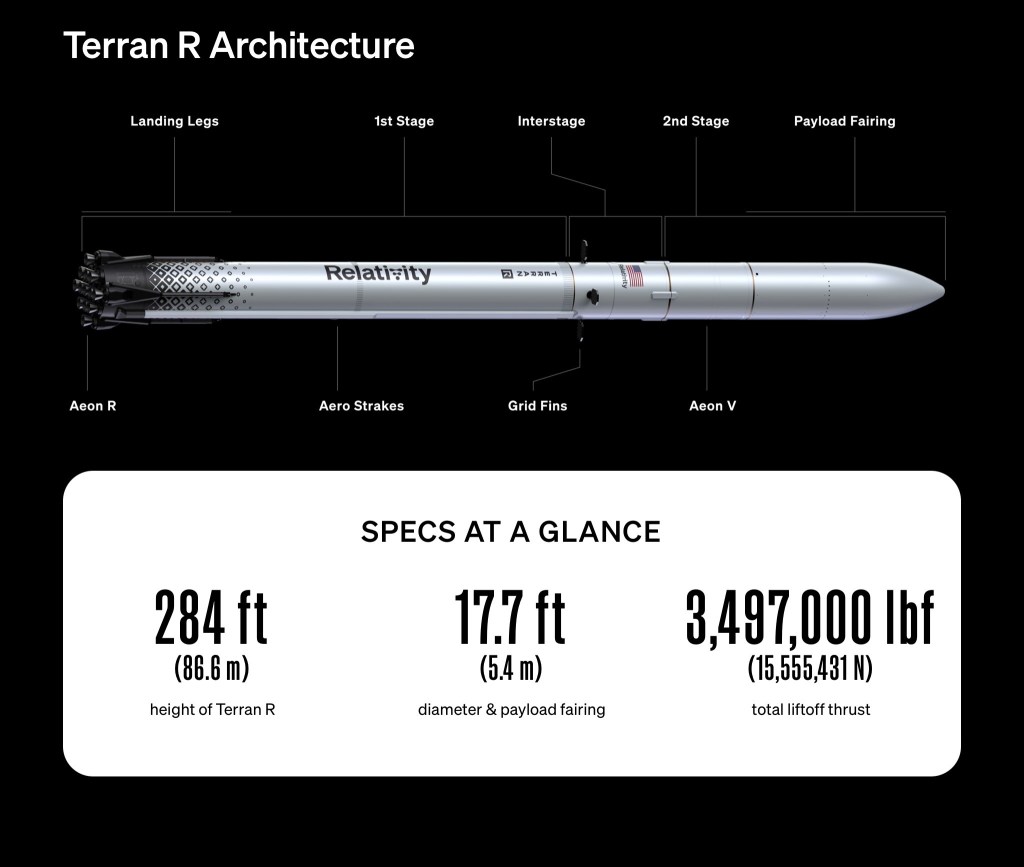
In the rapidly evolving landscape of commercial spaceflight, Relativity Space continues to push boundaries with its ambitious Terran R rocket. As of November 2025, the company has made significant strides in developing this reusable, medium-to-heavy lift vehicle, blending cutting-edge additive manufacturing with proven traditional techniques. Originally renowned for its heavy reliance on 3D printing, Relativity has refined its approach for Terran R, prioritizing efficiency, reliability, and scalability to meet the demands of a competitive market.

A Shift from Full 3D Printing to a Hybrid Model
Relativity Space burst onto the scene with Terran 1, the world’s first largely 3D-printed rocket, which demonstrated the potential of additive manufacturing to accelerate production and reduce costs. However, lessons learned from Terran 1’s development and its inaugural flight in 2023 led to a strategic pivot. For Terran R, the company has adopted a hybrid manufacturing strategy, moving away from end-to-end 3D printing for the entire vehicle in favor of more conventional methods for large structural components.
This evolution reflects a pragmatic response to the challenges of scaling 3D printing for massive rocket structures. Primary elements like the rocket’s stages, panels, barrels, thrust structures, and fairings are now produced using friction stir welding of high-strength aluminum alloys (such as 2195, 2196, 7140, and 7050), complemented by in-house machining. Grid fins are crafted from titanium, while payload fairings utilize carbon composites. These methods enhance structural integrity and production speed, allowing Relativity to release over 50% of the vehicle’s mass for manufacturing by early 2025.
Despite this shift, additive manufacturing remains a cornerstone of Relativity’s innovation. The company continues to leverage 3D printing through its Stargate platform, particularly for complex, intricate parts where rapid iteration is important. This commitment is evident in ongoing investments, including the establishment of Horizon Manufacturing Technologies – a new business unit dedicated to advancing 3D-printing solutions – and the “Dark Matter Lab” for experimental R&D.
Powering Terran R: The 3D-Printed Aeon R Engines

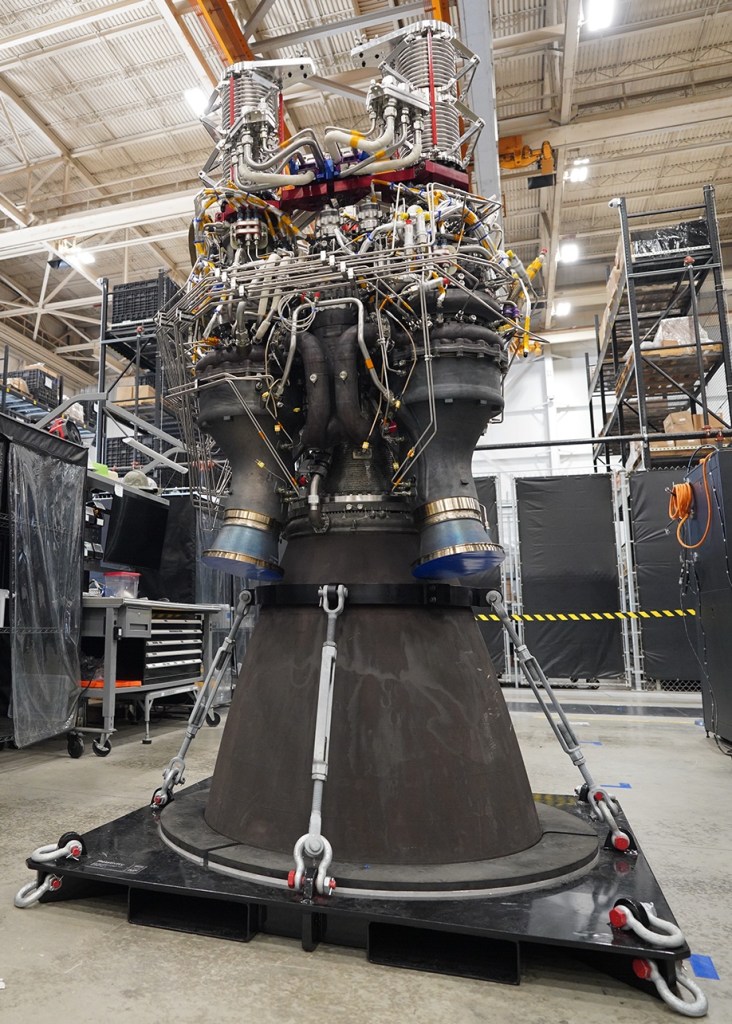
At the heart of Terran R’s propulsion system are the Aeon R engines, where 3D printing shines brightest. The first stage is equipped with 13 of these liquid oxygen-methane fueled engines, each delivering 269,000 pounds of thrust via a gas generator cycle. The second stage features a single vacuum-optimized variant with 323,000 pounds of thrust, sharing about 80% design commonality with its sea-level counterparts.
Additive techniques like powder bed fusion (PBF) and wire arc additive manufacturing (WAAM) enable the production of key engine components, such as the full-length printed sea-level regeneratively cooled nozzles and heat exchangers. This approach has facilitated extensive testing, with development units accumulating over 6,300 seconds of runtime. By October 2025, flight-ready Aeon R engines had completed 475-second static fires – simulating full ascent durations – and tests with densified liquid oxygen. Critical design reviews for the vacuum engine were finalized in late summer, paving the way for qualification hardware.
Recent Milestones and Production Momentum
Relativity’s progress in 2025 underscores the effectiveness of its refined manufacturing strategy. In March, the company announced the completion of the vehicle-level Critical Design Review (CDR) from December 2024, following earlier reviews that validated subsystems and architecture. Flight production ramped up at their Long Beach facility, with manufacturing underway for first-stage panels, second-stage barrels, thrust structures, and avionics.
By October, the thrust section – a highly complex assembly at the rocket’s base – was fully built and rigorously tested, enduring 3.7 million pound-force of tension and peak loads of 478,000 pound-force. This section, now integrated into the first flight vehicle, supports hardware-in-the-loop testing, with a full vehicle simulation targeted before year-end. All eight first-stage structural barrels are welded and painted, and the second stage’s tank section is complete. Construction of the second flight’s thrust structure is already in progress. Recent coverage includes this October 2025 NASA Spaceflight update.
Reusability features, including landing legs, grid fins, heat shields, and throttle valves, are advancing through wind tunnel tests and material qualifications. Avionics and software development includes flight simulations and navigation algorithms, ensuring Terran R can achieve downrange barge landings after delivering payloads up to 23,500 kg to low Earth orbit (or 30 tons in expendable mode).
Looking Ahead: Launch Timeline and Market Impact
With a first launch slated for late 2026 from Launch Complex 16 at Cape Canaveral Space Force Station, Terran R positions Relativity as a key player in the medium-to-heavy payload segment. Recent expansions, such as the multi-launch agreement with SES (now including Intelsat satellites), highlight growing customer confidence.
By integrating 3D printing where it excels – such as in engine development – while embracing traditional methods for scale, Relativity is not abandoning its innovative roots but adapting them for real-world viability. This balanced approach could redefine efficiency in space manufacturing, opening new opportunities for scientific missions and commercial ventures alike. As the company continues to iterate, the space industry watches closely, eager for Terran R’s debut to propel the next era of reusable rocketry.


