



A Milestone in the Atlantic
On November 13, 2025, the sky over Cape Canaveral, Florida, was split by the intense blue-white flame of seven methane-fueled engines. At 3:55 p.m. ET, Blue Origin’s long-awaited New Glenn rocket, a towering 321-foot-tall vehicle, majestically lifted off from Launch Complex 36. This mission, designated NG-2, was only the rocket’s second flight, but it carried the weight of decades of development and the ambitions of its founder, Jeff Bezos.
The launch, which had been delayed for days by stormy terrestrial weather and a powerful solar storm, proceeded flawlessly. The rocket’s primary task was to send two small NASA satellites, the twin-spacecraft ESCAPADE mission, on a long, looping course to Mars. These probes are designed to study how the solar wind has slowly stripped away the Red Planet’s once-thick atmosphere, a key question in understanding planetary evolution. The rocket’s upper stage successfully deployed the ESCAPADE spacecraft, along with a secondary payload for Viasat that executed a successful technology demonstration.
But the main event, the achievement that arguably reshapes the commercial space industry, happened just minutes after liftoff.
After separating from the upper stage, the rocket’s massive 188-foot-tall first stage – nicknamed “Never Tell Me The Odds” – began its controlled fall back to Earth. It executed a series of engine burns, slowing itself from hypersonic speeds as it plunged through the atmosphere. Then, 375 miles downrange in the Atlantic Ocean, its engines re-ignited for a final propulsive landing burn. The enormous booster settled gently onto the deck of an autonomous landing platform named ‘Jacklyn’, after Bezos’s mother, and powered down.
This was a significant breakthrough. The rocket’s maiden flight in January 2025, NG-1, had successfully reached orbit, but its booster failed during the landing attempt and was lost at sea. That failure made this second attempt a test of the entire program’s viability. The success was palpable. Blue Origin CEO Dave Limp noted, “never before in history has a booster this large nailed the landing on the second try.”
For more than a decade, one company, SpaceX, has held an absolute monopoly on the operational recovery and reuse of orbital-class rocket boosters. This capability allowed it to completely dominate the global launch market, slashing prices and setting a cadence that competitors simply couldn’t match. The successful landing of New Glenn’s booster on November 13, 2025, shattered that monopoly. It announced the arrival of a second, operational, reusable heavy-lift launch provider, fundamentally altering the strategic landscape.
Yet, as New Glenn transitions from a developmental project into an operational behemoth, another new titan is rising in a California factory. This rocket, Relativity Space’s Terran R, is being built on a completely different philosophy, one that challenges the very foundations of how we build machines destined for the heavens. The contrast between New Glenn and Terran R isn’t just a competition between two rockets; it’s a tale of two philosophies, two funding models, and two divergent visions for humanity’s future in space.
Two Contenders, Two Visions
At the heart of these two launch vehicles are two companies with deeply different origins and worldviews.
Blue Origin was founded in 2000 by Jeff Bezos. Its long-term vision is grand and philosophical: to enable “millions of people… living and work[ing] in space.” The company’s official mission is to build “a road to space for the benefit of Earth.” The core of this vision is a belief that Earth’s resources are finite, and to save the planet, humanity must eventually move heavy industry and harness the vast resources of the solar system, starting with the Moon.
To achieve this, the company’s primary objective is to “radically reduce the cost of access to space.” And the key to that is reusability. New Glenn, named after John Glenn, the first American to orbit the Earth, is the vehicle designed to be this reliable, reusable workhorse. It’s the foundational piece of infrastructure, the “road” itself, upon which this future space-based economy will be built.
Relativity Space is a much younger and, in many ways, more radical company. It was founded in 2015 by Tim Ellis and Jordan Noone, two young engineers who had spent time inside the new-space revolution. Ellis was an intern at Blue Origin, and Noone was a propulsion engineer at SpaceX. They saw the “old” aerospace industry – a 60-year-old paradigm of building rockets with massive, complex, and slow supply chains – as the fundamental bottleneck.
Relativity’s long-term vision is also multi-planetary, but with a different focus: to “upgrade humanity’s industrial base on Earth and on Mars.” Their core belief is that building a sustainable industrial base on another planet, particularly Mars, will be impossible with traditional manufacturing. It’s not feasible to ship a complex, globe-spanning supply chain of parts, tools, and factories to another world.
The only way to do it, in their view, is with an automated, relocatable manufacturing process that can build what it needs from raw materials. Their answer is additive manufacturing, or 3D printing. This philosophy forces them to pioneer an entirely new way of building. Terran R, their first large-scale rocket, isn’t just a launch vehicle; it’s the primary product intended to prove that this disruptive manufacturing model is not only possible but commercially superior.
This fundamental difference in vision dictates every subsequent decision. Blue Origin’s “road to space” vision implies a massive, permanent, industrial-scale infrastructure on Earth to support space activities. This philosophy logically leads them to spend over a billion dollars building a massive, traditional rocket factory in Florida. Relativity’s “industrial base on Mars” vision demands a process that can be automated and relocated. This philosophy forces them to invent the “Factory of the Future.”
The Architectures: A Side-by-Side Comparison
While both are two-stage, methane-fueled, reusable-first-stage rockets, their scale and design reflect their different target markets.
New Glenn: The Heavy-Lift Behemoth

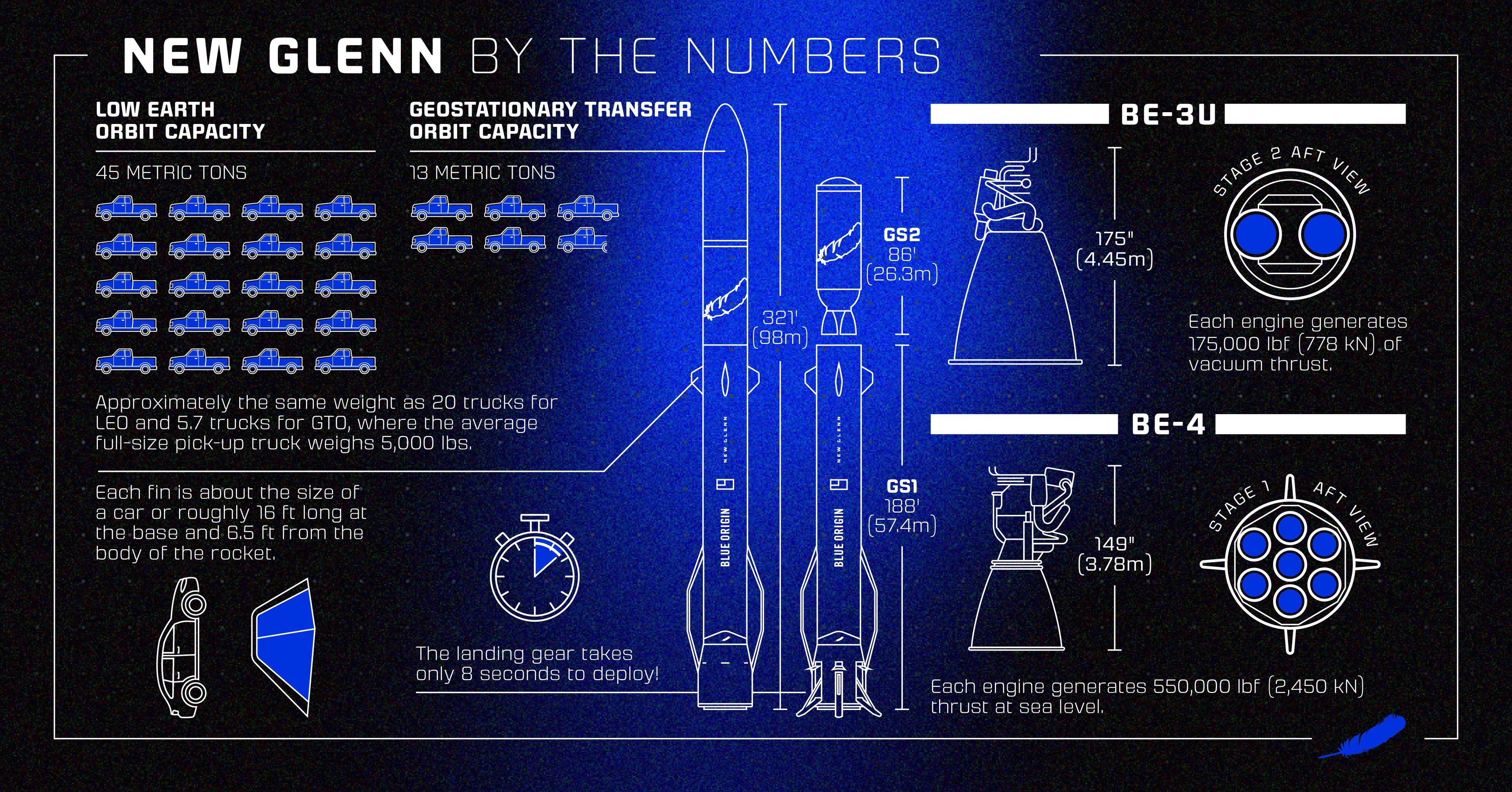
New Glenn is an absolute giant. Standing 98 meters (322 feet) tall, it’s one of the largest rockets ever to fly.
Its most defining feature is its massive 7-meter (23-foot) diameter. This dimension is consistent from the base of the rocket all the way to the top of its payload fairing. This isn’t a vanity metric; it’s a significant strategic advantage. This fairing offers twice the payload volume of the 5-meter class rockets that currently dominate the market, such as SpaceX’s Falcon 9 and ULA’s Vulcan.
For a non-technical audience, this means New Glenn’s advantage isn’t just about how much weight it can lift, but the size and shape of what it can lift. Many large, complex satellites, particularly for national security and scientific applications, are not limited by their mass but by their volume. They must be folded up like complex origami to fit inside a 5-meter fairing. New Glenn’s 7-meter “garage” eliminates this constraint, allowing for larger, more powerful, and potentially less complex satellites to be launched whole. It’s also a major benefit for deploying large batches of internet satellites, like those for Amazon’s Project Kuiper.
This enormous airframe allows for a massive lift capability. New Glenn is firmly in the heavy-lift class, designed to launch:
- 45,000 kg (99,000 lbs) to Low Earth Orbit (LEO)
- 13,600 kg (30,000 lbs) to Geostationary Transfer Orbit (GTO)
- 7,000 kg (15,400 lbs) to Trans-Lunar Injection (TLI)
To power this, the first stage (GS1) uses seven of Blue Origin’s BE-4 engines. The second stage (GS2) is unique in this new generation of rockets. Instead of using methane, it’s powered by two BE-3U engines, which run on high-performance liquid oxygen and liquid hydrogen (LOX/LH2). This makes the upper stage highly efficient for the high-energy “insertion” burns needed to get heavy payloads to GTO or interplanetary trajectories, as it just demonstrated with the ESCAPADE mission.
Terran R: The Disruptive Challenger

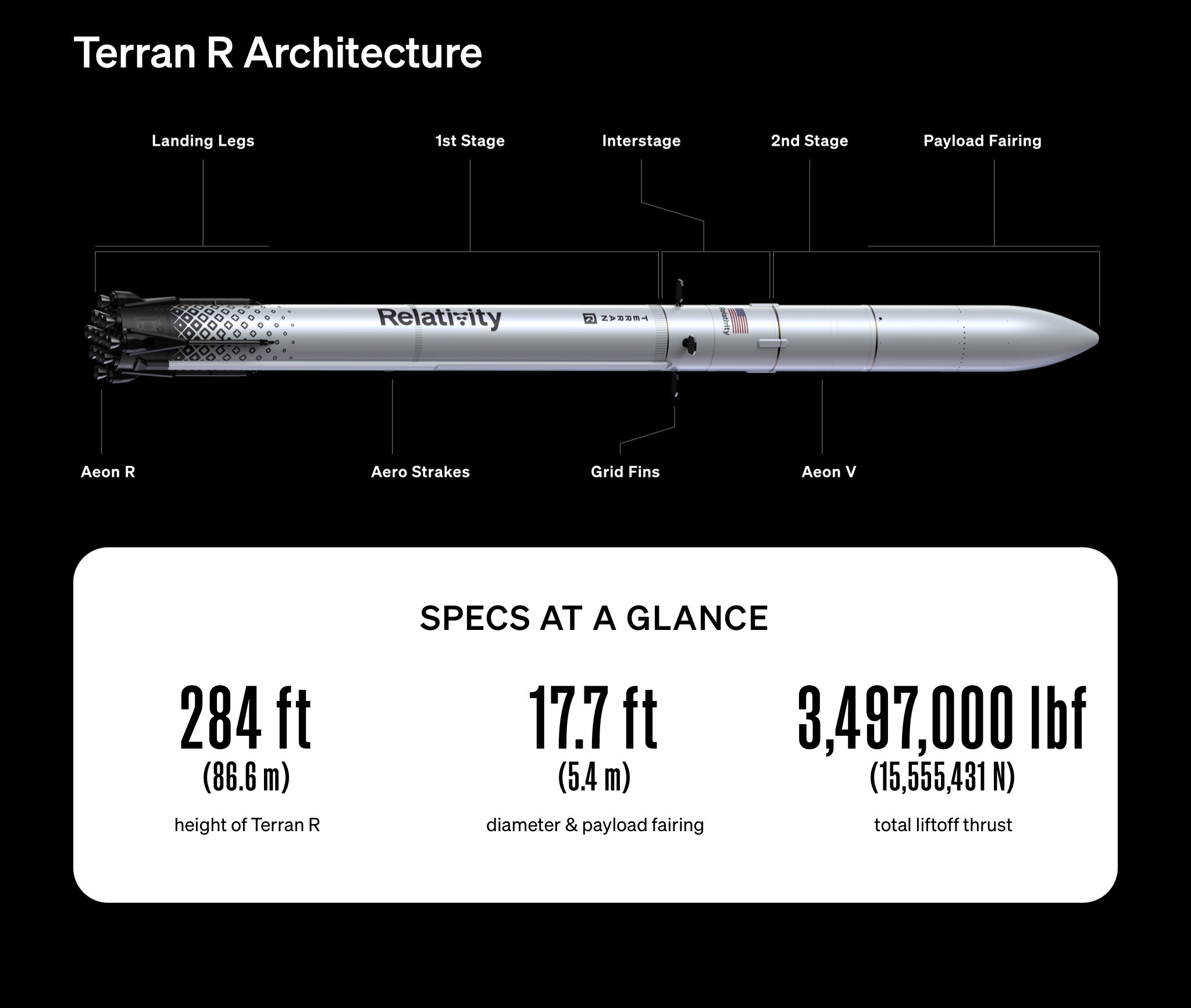
Terran R is also a very large rocket, but it’s sized for a different purpose. It stands 86.6 meters (284 feet) tall, slightly shorter than New Glenn. Its 5.4-meter (17.7-foot) diameter is also a deliberate strategic choice.
This 5.4-meter dimension positions Terran R as a direct, head-to-head competitor in the most lucrative segment of the commercial launch market: the 5-meter class. It’s not trying to be the biggest; it’s trying to be the most “perfectly sized” vehicle for the LEO constellation market it is designed to serve.
Its payload capacity is flexible and highly competitive, placing it in the medium-to-heavy lift class. It’s designed to launch:
- Reusable (Downrange Landing): 23,500 kg (51,800 lbs) to LEO. This is its standard mission profile and the one it’s selling to most customers.
- Reusable (Downrange Landing): 5,500 kg (12,100 lbs) to GTO.
- Expendable: 33,500 kg (73,900 lbs) to LEO. This higher-mass option is available by sacrificing the first-stage booster, giving customers a powerful “surge” capability if needed.
Unlike New Glenn’s mix of propellants, Terran R is a methane rocket through and through. The first stage is powered by thirteen of Relativity’s 3D-printed Aeon R engines. The second stage is powered by a single, vacuum-optimized Aeon V engine, also fueled by methane.
The most important difference, of course, is their status. As of mid-November 2025, New Glenn is an operational, flight-proven rocket. Terran R is in an advanced stage of development, with hardware for its first flight being manufactured and tested in Relativity’s Long Beach factory. Its first launch is currently scheduled for late 2026 from Launch Complex 16, just down the road from New Glenn’s pad.
Vehicle Specification Comparison (as of November 2025)
This table provides a clear, side-by-side look at the two vehicles, based on the specifications available today. The most direct comparison is between their reusable configurations, as this is the primary economic model for both.
| Metric | Blue Origin New Glenn | Relativity Space Terran R |
| Status (Nov 2025) | Operational (2 flights) | In Development (First flight NET 2026) |
| Height | 98 m (322 ft) | 86.6 m (284 ft) |
| Diameter | 7 m (23 ft) | 5.4 m (17.7 ft) |
| Fairing Volume | Twice 5m-class fairings | Standard 5m-class fairing |
| First Stage Engines | 7 × BE-4 | 13 × Aeon R |
| Second Stage Engines | 2 × BE-3U | 1 × Aeon V |
| First Stage Propellant | LOX / LNG (Methane) | LOX / CH4 (Methane) |
| Second Stage Propellant | LOX / LH2 (Hydrogen) | LOX / CH4 (Methane) |
| Liftoff Thrust | 17,100 kN (3,850,000 lbf) | 15,560 kN (3,497,000 lbf) |
| Payload to LEO (Reusable) | 45,000 kg (99,000 lb) | 23,500 kg (51,800 lb) |
| Payload to LEO (Expendable) | Not advertised (est. >45t) | 33,500 kg (73,900 lb) |
| Payload to GTO (Reusable) | 13,600 kg (30,000 lb) | 5,500 kg (12,100 lb) |
| First Stage Reusability | Yes (Propulsive Landing on Barge) | Yes (Propulsive Landing on Barge) |
| Second Stage Reusability | No (Expendable) | No (Expendable) |
The Battle of Manufacturing Philosophies
The specifications on paper are just the final expression of the two companies’ core strategic conflict: how to build a rocket.
Blue Origin: Step by Step, Ferociously
Blue Origin’s entire operational philosophy is captured in its Latin motto: Gradatim Ferociter, or “Step by Step, Ferociously.” This isn’t just a marketing slogan; it’s an instruction manual. It signifies a patient, methodical, and relentless approach. The company operates on a “willingness to be patient and to iterate,” a philosophy that emphasizes building an unshakeable, long-term foundation before scaling or flying.
While competitors were launching and learning in public, Blue Origin was building. Its strategy has been “infrastructure-first.” They didn’t just lease a launch pad; they spent over $1 billion to completely rebuild Launch Complex 36 at Cape Canaveral from the ground up, turning the historic Atlas pad into a modern launch, integration, and refurbishment center.
Right next to the pad, in Exploration Park, they built a massive, 750,000-square-foot, state-of-the-art manufacturing complex. This is the heart of their philosophy. This factory enables a degree of vertical integration that is rare even in aerospace. The entire lifecycle of a New Glenn booster is designed to happen within a tiny, nine-mile radius. A rocket is fabricated in the factory, integrated in the Horizontal Integration Facility, rolled to the pad at LC-36 for launch, and its booster is recovered at Port Canaveral. It’s then refurbished in the same complex and prepared for its next flight.
This is the Henry Ford assembly line model, applied to reusable orbital rockets. It’s a high-capital, traditional manufacturing approach, optimized for industrial-level quality control, cadence, and efficiency at scale.
This “build it all first” strategy is only possible because of Blue Origin’s unique funding model: the “patient capital” of its founder. Unlike a typical company that must answer to shareholders or venture capitalists, Blue Origin has been historically financed by Jeff Bezos’s personal wealth. This allows the company to operate on timelines that would bankrupt any other business. It gives them the freedom to spend 25 years developing, building, and testing before their first heavy-lift operational flight. The peril of this model, of course, was that for two decades, the company was perceived as slow, secretive, and lagging hopelessly behind its rivals.
The successful launch and landing of NG-2 is the first powerful, public validation of this entire, slow-and-steady, infrastructure-first model. It suggests the 25-year wait wasn’t a sign of failure, but of a deliberate, ferocious focus on getting it right.
Relativity: The Factory of the Future
Relativity Space was founded on the idea that the Gradatim Ferociter model, and indeed all traditional aerospace manufacturing, is fundamentally broken. Their thesis is that the 60-year-old aerospace paradigm – with its tens of thousands of suppliers, millions of individual parts, and rigid, slow, human-led assembly – is the real bottleneck, not the rocket science.
Their solution is “Stargate,” their in-house, AI-driven, 3D-printing robotic factory. This is their core technology. The latest 4th-generation Stargate is a technological leap that underpins their entire business.
- It prints horizontally. Unlike most large 3D printers that build “up” and are limited by factory ceiling height, Stargate prints “sideways.” This new orientation removes previous constraints on part length.
- It’s massive. The new printer is capable of building structures up to 120 feet long and 24 feet wide.
- It’s fast. Relativity claims the new Stargate is seven times faster than its predecessor and that a single printer, at its forecasted run rate, will be able to produce the components for four Terran R rockets per year.
- It’s “smart.” This isn’t just a dumb printing nozzle. It’s a robotic system that integrates machine learning, computer vision, and advanced sensors. It monitors its own work in real-time, checking for quality and defects as it prints.
The goal of this system is radical simplification. Relativity’s stated aim is to build a rocket with “100x fewer parts” in as few as 60 days.
This is the real “so what?” of their strategy. Blue Origin controls its supply chain through vertical integration. Relativity eliminates it. Every single part that Stargate can print – a complex engine manifold, a stringer-stiffened propellant tank wall, a thrust structure – is a part they don’t have to design for traditional manufacturing, a part they don’t have to source from a supplier, a part that doesn’t need to be shipped across the world, and a part that doesn’t need to be bolted, welded, or riveted by a human.
This “Factory of the Future” model enables their other core principle: rapid iteration. If a traditionally-made part fails in testing, a company might have to scrap millions of dollars in fixed tooling and wait months for a new version. If a 3D-printed part fails, Relativity’s engineers can, in theory, change the design file, send it to Stargate, and have a new, improved version ready for testing in days.
The Great Pivot: Scrapping Terran 1
The power of this iterative model was demonstrated by Relativity’s most significant strategic decision. For years, the company’s focus was on its first rocket, the smaller Terran 1. It was 85% 3D-printed by mass and was intended to serve the small-satellite market.
In March 2023, Terran 1 launched for the first and only time. It became the first 3D-printed rocket to reach space, but it suffered an anomaly in its second stage and failed to achieve orbit.
What happened next was stunning. Immediately after this “successful failure,” Relativity announced it was scrapping the entire Terran 1 program. It was pivoting 100% of its resources to the much larger, more complex, and more commercially viable Terran R.
This wasn’t a failure; it was a ruthless, data-driven strategic pivot. The Terran 1 launch, while not reaching orbit, had proven the “Factory of the Future.” It validated their core manufacturing thesis. With that thesis proven, they could abandon the product. They recognized that the small-launch market was a crowded, low-margin “race to the bottom” and that the real money and market demand were in the medium-to-heavy lift sector.
Their “software-defined” factory allowed them to make this pivot at a speed that would be unthinkable for a traditional manufacturer. They didn’t have to throw away a billion-dollar factory tooled for a small rocket. They, in effect, just changed the files. This move demonstrated that Relativity is not a “3D-printing company” that happens to build rockets; it’s a market-driven launch provider that has weaponized 3D printing to move faster than its competition.
Two Paths to Reusability
Both companies are betting their futures on reusability, but their paths to get there – and the design choices they’ve made – are again a story of two different philosophies.
New Glenn’s First Stage and the ‘Jacklyn’ Saga
New Glenn’s first-stage booster is the core of Blue Origin’s business plan. It’s designed to be reused a minimum of 25 times. This “airliner model” is the only way to achieve the “radical reduction” in launch costs that their mission demands.
The booster itself is a technical marvel. It uses its seven BE-4 engines for entry and landing burns, steering with large aerodynamic fins at its top. It lands propulsively on six deployable legs, which are housed in its aft module.
The system for recovering it is where Blue Origin’s patient, capital-intensive philosophy is on full display. The ‘Jacklyn’ (LPV1) that successfully caught the NG-2 booster is an unpowered, custom-built barge. After the rocket lands, a Remotely Operated Vehicle (ROV) is deployed to approach the booster, safe it, and prepare it for transport, all while the human crew remains at a safe distance.
But this barge is not the original plan. This is the “Jacklyn” saga.
In 2018, Blue Origin purchased a 180-meter, roll-on/roll-off cargo ferry, which they also named ‘Jacklyn’. The plan was incredibly ambitious: they would convert this massive, powered ship into a moving landing platform. The ship would be able to steam at speed, and its hydrodynamic stabilization would, in theory, allow it to catch the booster even in very rough seas, increasing the launch window and recovery reliability.
After four years of complex and expensive conversion work, Blue Origin did the unthinkable. In 2022, they abandoned the entire project and sent the ship to be scrapped. They threw away years of work and an immense-but-undisclosed sum of money.
They then started over, building the current ‘Jacklyn’ – a simpler, unpowered, but purpose-built barge – from scratch. This story is perhaps the most potent example of Gradatim Ferociter in action. It demonstrates an almost unbelievable willingness to absorb massive sunk costs to get the technical solution right. It’s the “patient capital” model in its most extreme form. They were willing to delay their first operational flight by years to ensure the long-term reliability of their landing system.
Terran R’s Reusability Pivot
Relativity’s journey to reusability shows a different kind of pivot, one driven by market pragmatism.
When Terran R was first announced in June 2021, the plan was wildly ambitious: a fully reusable rocket. This was a direct shot at SpaceX’s Starship, the holy grail of spaceflight. The original plan called for recovering the first stage, the second stage, and the payload fairings.
The rocket now being built in their Long Beach factory is a different machine. The current 2025 plan is for a partially reusable architecture, one that looks much more like a New Glenn or a Falcon 9. The first stage is designed to be fully reusable, performing a propulsive landing on a downrange autonomous barge. The second stage and payload fairings will be expendable.
This is Relativity’s great, pragmatic concession to the laws of physics and economics. Recovering an orbital-class second stage is exponentially more difficult than recovering a first stage. The upper stage is traveling at orbital velocity (over 17,000 mph) and is in the vacuum of space. To return, it needs a massive heat shield to survive reentry, plus a large reserve of propellant to de-orbit and land. This “dead weight” (the heat shield and extra fuel) decimates the rocket’s primary payload capacity, which is what customers pay for.
Relativity, on its high-pressure, venture-capital-backed timeline, likely concluded that it was impossible to solve both 3D-printing-at-scale and the orbital-reentry-and-landing problem at the same time.
So, they de-risked the program. They adopted the proven and commercially successful Falcon 9 reusability model (expendable upper stage) and chose to focus their innovation on the manufacturing (3D-printing the first stage engines). This move instantly made Terran R a direct competitor to the Falcon 9 – the market leader – rather than a “moonshot” competitor to Starship. It’s a much more achievable, and commercially clear, target for the $3 billion-plus in launch contracts they’ve already signed.
The Engines: The Heart of the Race
Both companies chose to power their rockets with a new generation of methane-fueled engines. This is a key strategic convergence. But the specific engines they designed, and how they designed them, are another perfect window into their core philosophies.
The BE-4: Powering Two Rockets
The Blue Origin BE-4 is the engine that made the New Glenn launch possible. It’s officially the most powerful liquefied natural gas (LNG)-fueled, oxygen-rich staged combustion engine ever flown.
Each BE-4 produces a massive 550,000 pounds of thrust. New Glenn’s first stage clusters seven of them for a total liftoff thrust of over 3.8 million pounds.
The key technical detail is its engine cycle: oxygen-rich staged combustion (ORSC). For a non-technical audience, this is a highly efficient but extremely complex design. It’s difficult to engineer because it involves pumping all the liquid oxygen (a fraction of which is used to power the engine’s own turbopumps) through the pre-burner, creating a hot, pure, highly corrosive oxygen gas environment. This requires advanced metallurgy and engineering to prevent the engine from eating itself.
The BE-4’s development was a long, arduous, decade-plus journey. Blue Origin has stated they consciously designed it as a “medium-performing version of a high-performance architecture.” This means they weren’t aiming for the absolute bleeding edge of performance. They were designing for a “sweet spot” that balanced high performance with the robustness and reliability needed for reusability.
The Aeon R: Designed for Print
Relativity’s Aeon R engine is a very different beast, born from a different process. It’s designed to produce 269,000 pounds of thrust, and Terran R uses thirteen of them in its first stage for a total thrust of just under 3.5 million pounds.
The key contrast here is the engine’s cycle. The Aeon R uses a simpler, more common gas-generator cycle. This is a less efficient but more mature and well-understood design.
This choice is a perfect case study in trade-offs. Blue Origin chose the highest-performance cycle (ORSC) and spent a decade and immense capital perfecting it. Relativity chose a simpler cycle (gas-generator) that was far more amenable to their rapid, 3D-printed iteration process.
Relativity boasts that they went from a clean-sheet design for the Aeon R to a fully qualified engine in just 14 months. They have shown videos of doing 14 different design-print-test iterations on the engine’s main injector, a speed they claim is “impossible with traditional manufacturing.”
Relativity is making a clear bet: they are sacrificing a few percentage points of on-paper engine efficiency in exchange for a massive, game-changing gain in manufacturing speed and design iteration. They are betting that the ability to improve and produce engines faster is a more important long-term advantage than pure performance.
Why Methane? The Strategic Convergence
It is no accident that New Glenn, Terran R, and SpaceX’s Starship all converged on methane (or its liquefied form, LNG) as their fuel of choice. This is one of the most significant technological shifts in the industry.
- Reusability: The primary reason is reusability. The rocket-grade kerosene (RP-1) used by rockets like the Falcon 9 burns “dirty.” It leaves behind a sooty, carbon-coke residue that clogs engine channels and requires extensive, costly, and time-consuming refurbishment between flights. Methane, by contrast, burns very cleanly. This drastically simplifies engine reuse, making a “launch, land, repeat” model much closer to reality.
- Performance and Cost: LNG is low-cost and widely available. It also has performance characteristics that allow for “autogenous pressurization.” This means the rocket can use its own gaseous methane, heated by the engine, to pressurize its own fuel tanks. This eliminates the need for complex, heavy, and expensive helium pressurization systems, which are a major source of cost and failure points.
- The Mars Connection: For both companies, with their long-term multi-planetary goals, methane is the only logical choice. The atmosphere of Mars is 95% carbon dioxide (CO2). With energy (from solar panels or a reactor) and a source of water ice (H2O), future colonists could theoretically use the Sabatier reaction to create methane (CH4) and liquid oxygen (O2) on the Martian surface. This is called in-situ resource utilization (ISRU). Methane is the one rocket propellant you can make on Mars for the return trip home.
Funding the Future: Billionaires and Venture Capital
The deep technical and philosophical differences between Blue Origin and Relativity are a direct result of the two radically different business models that fuel them.
Blue Origin’s Patient Capital
Blue Origin is not a typical company. It’s primarily and historically been financed by its founder, Jeff Bezos, who has famously funded the company by selling billions of dollars in Amazon stock. This is not venture capital; it’s “patient capital.”
This funding model is Blue Origin’s greatest strategic weapon. It allows them to operate on timelines that would be impossible for any other corporation. It’s what allows them to invest over a billion dollars in a factory before having a flying rocket. It’s what allows them to spend four years working on a high-tech landing ship, only to scrap it and start over. It’s what allows them to spend more than a decade perfecting the BE-4 engine.
Blue Origin is not beholden to quarterly earnings reports, shareholder demands, or VC funding rounds that demand specific milestones be met. They are free to play a “long game,” focusing on building a “legacy for the benefit of Earth.” This patient, methodical approach is now, after 25 years, beginning to bear fruit. The company is now supplementing this founder-funding with real revenue from its operational New Shepard suborbital tourism flights and, most importantly, its new, massive government launch contracts.
Relativity’s High-Speed Growth
Relativity Space is the opposite. It’s a venture-capital-backed startup. It has raised $1.3 billion from a wide array of high-profile investors, including Mark Cuban, Fidelity, and Blackrock.
This VC model demands speed and growth. Relativity cannot afford to be patient. It must continuously demonstrate progress, hit development milestones, and secure new customers to justify its high valuation and unlock the next round of funding. This high-pressure environment is the reason their philosophy is “prototype early, test often, and iterate fast.” Their entire corporate culture is a reflection of their funding model.
This also explains their aggressive commercial strategy. Relativity has already secured over $3 billion in pre-sold launch contracts. This is an astounding achievement for a company that has not yet flown its rocket. This backlog is a significant market validation that has, in turn, funded their development.
But this $3 billion+ backlog is a double-edged sword. It’s Relativity’s greatest triumph and its greatest liability. On one hand, it validates their vision and has paid for the development of Terran R. On the other, it’s a ticking clock. That backlog is made up of real customers, like SES and OneWeb, who have real satellites in warehouses that need to be launched.
With New Glenn now operational and ULA’s Vulcan already flying, the pressure on Relativity to get Terran R to the pad and prove its reliability by its 2026 deadline is immense. They are in a high-stakes race to convert their revolutionary manufacturing process into a flight-proven product before that massive backlog begins to sour.
The Market: Securing the Manifest
Both rockets are entering a market that has been, until now, a near-monopoly. To survive, they are securing their futures by targeting slightly different, though overlapping, customer bases.
New Glenn’s Anchor Customers
New Glenn is a heavy-lift rocket, and it’s hunting “whales.” It’s designed for the most demanding, highest-value missions on the market: large national security payloads, major interplanetary science missions, and heavy satellite constellation deployments.
New Glenn’s manifest is built on three massive “anchor” customers:
- Amazon’s Project Kuiper: Blue Origin has a contract for 12 New Glenn launches, with options for 15 more, to deploy Amazon’s competing satellite internet constellation. This “internal” contract (a Bezos-founded company buying launches from another Bezos-founded company) provides a guaranteed financial foundation and a steady, high-cadence launch manifest.
- U.S. Government (NSSL): This is the most significant win. Blue Origin was recently selected as one of three providers for the National Security Space Launch (NSSL) Phase 3 Lane 2 program. These are the U.S. Space Force’s most critical, high-value, and sensitive missions. Blue Origin is projected to receive seven of these lucrative missions, worth an anticipated $2.3 to $2.4 billion.
- NASA: The successful NG-2 flight, carrying the ESCAPADE mission to Mars, was the first. This flawless execution proves New Glenn’s capability for deep space and high-energy missions, positioning it as a prime contractor for future NASA science missions and a key partner in the Artemis program to return to the Moon.
The NG-1 and NG-2 flights were not just test flights; they were the first two certification flights required for the NSSL program. The “full mission success” of NG-2 wasn’t just a technical win; it was a businesswin. It unlocks the door for Blue Origin to immediately begin flying and earning revenue from its multi-billion-dollar backlog of national security launches, cementing its role as a top-tier launch provider.
Terran R’s Constellation Focus
Relativity’s strategy is different. Their official website states Terran R is “perfectly sized to serve the Low Earth Orbit (LEO) constellation market.” It’s designed to be the “disruptive, diversified provider” for this high-cadence commercial sector.
Rather than hunting a few “whales,” Relativity has built its $3 billion+ backlog by signing up a “long-tail” of diverse constellation operators. These are companies like OneWeb, AST SpaceMobile, and SES, all of whom are building next-generation satellite networks and are desperate for a viable, reliable, and competitively-priced alternative to SpaceX.
Relativity’s customer manifest includes:
- SES: A major global satellite operator. In a massive vote of confidence, SES announced an expansion of its multi-launch agreement with Relativity on November 12, 2025, just days ago.
- OneWeb: A direct competitor to Starlink and Kuiper, OneWeb has signed a multi-launch agreement for its second-generation constellation.
- Impulse Space: In a symbolic and high-stakes nod to its long-term vision, Relativity has a contract to launch an uncrewed, private Mars mission for Impulse Space on the very first Terran R flight in 2S026.
Relativity is making a high-stakes bet: that its 3D-printing manufacturing model can achieve a launch cadenceand cost that a traditional manufacturer like Blue Origin can’t match. The constellation market is all about cadence – launching thousands of satellites as quickly as possible. If Terran R can truly be printed in 60 days and launched at a high rate, it could become the default workhorse for this entire market segment, even if it can’t lift as much per flight as New Glenn.
Summary
The race between New Glenn and Terran R is more than a competition between two new rockets. It’s a clash of foundational beliefs about how to build the future of spaceflight.
As of mid-November 2025, the landscape has been fundamentally reset. Blue Origin’s New Glenn, the “silent giant” backed by patient capital, has emerged from its long, 25-year development. It is now an operational, proven, reusable heavy-lift rocket. The successful launch of NASA’s ESCAPADE mission and the flawless landing of its massive booster have validated the Gradatim Ferociter model. Blue Origin has proven that its infrastructure-first, high-performance product works. The SpaceX monopoly on reusable launch is officially over.
Meanwhile, Relativity Space’s Terran R remains a developmental project, but one with enormous momentum and a revolutionary promise. It is a product born from a new process. Backed by venture capital and a $3 billion customer backlog, Relativity is racing to prove that its “Factory of the Future” – the autonomous, AI-driven, 3D-printing Stargate – can build and fly a reliable rocket faster, cheaper, and more flexibly than its rivals. The company has made pragmatic pivots, shifting from a small rocket to a large one, and from a fully-reusable vision to a partially-reusable reality, all to attack the heart of the commercial launch market.
The central question in the space industry is no longer if a competitor to SpaceX’s reusable rockets will emerge. New Glenn’s successful landing proves it is already here.
The new, more fascinating question is one of philosophy and pace. Will the future of launch be dominated by Blue Origin’s traditionally-built, infrastructure-heavy, high-performance product? Or will it be disrupted by Relativity’s rapidly-iterated, 3D-printed, supply-chain-eliminating process? The next few years, beginning with Terran R’s first launch in 2026, provides the answer.


