


A New Strategic Direction
The concept of “Adaptive and Intelligent Space” represents a fundamental shift in humanity’s approach to orbital and deep space operations. It isn’t a single technology, but rather a new doctrine. This doctrine envisions a space environment that is no longer a collection of isolated, passively controlled objects. Instead, it pictures a dynamic, interconnected, and responsive ecosystem. This ecosystem would be capable of thinking for itself, responding to new events, and defending its own assets, all with minimal human intervention.
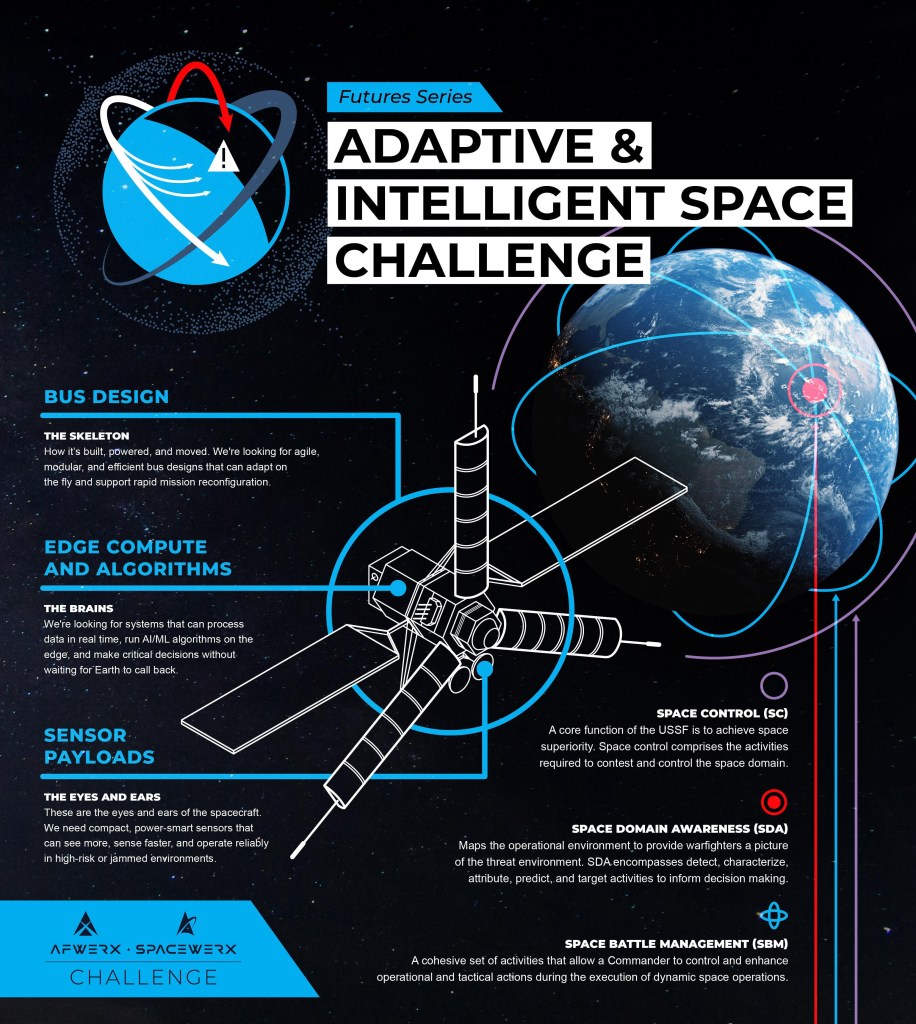
This new strategic direction is highlighted by initiatives like the “Futures Series: Adaptive and Intelligent Space” challenge. This effort, spearheaded by the United States Space Force and its innovation partners, seeks to accelerate the creation of this new reality. The core of the problem is simple: the domain of space has changed. What was once a vast, empty, and peaceful frontier is now a congested, contested, and complex operational theater. The old methods of designing, launching, and controlling space assets are no longer sufficient to meet the challenges of this new era.
For decades, satellites were launched with a specific, inflexible purpose. They would follow a predictable path, controlled by human operators on the ground. This model worked well when space was a relative vacuum, occupied by only a few actors. Today, that is no longer the case. The “congested” nature of space is an immediate physical problem. Thousands of active satellites, from government-run systems to massive commercial constellations, now orbit the Earth. They are joined by a cloud of non-functional objects, or space debris, ranging from spent rocket stages to tiny fragments from past collisions. Each piece of this debris is a high-velocity projectile that can destroy a billion-dollar satellite on contact.
At the same time, space has become “contested.” Nations have recognized that their economic and military well-being is deeply tied to their assets in orbit, which control everything from GPS navigation and global communications to financial transactions and weather forecasting. This dependency has made satellites attractive targets. The development of ground-based anti-satellite weapon systems, electronic jamming capabilities, and potentially other, more clandestine orbital threats has turned space into a domain where active defense is a new requirement. The adaptive and intelligent space concept is the response to this combined physical and strategic dilemma.
The Driving Force: A New Vision for Space Operations
The push for an adaptive space domain comes from a need to maintain an operational edge in this new environment. The United States Space Force, as the organization responsible for protecting U.S. and allied interests in space, is a primary driver. Its goals are directly supported by specialized innovation bodies within the Department of the Air Force.
A key player in this initiative is AFWERX. AFWERX functions as the innovation arm of the department, powered by the Air Force Research Laboratory. Its entire model is built on breaking traditional government acquisition barriers. It acts as a bridge, connecting the creativity and speed of small businesses, startups, and academic institutions with the pressing needs of the military. Instead of spending decades developing a new system, AFWERX uses challenges and rapid funding mechanisms to find and field new technologies in a fraction of the time.
SpaceWERX is the branch of AFWERX dedicated exclusively to space. Its participation in the Adaptive and Intelligent Space challenge signals the specific nature of the problem. The Space Force needs more than just bigger, tougher satellites. It needs entirely new philosophies of operation. SpaceWERX is tasked with finding the “dual-use” technologies that can serve both commercial and government purposes. A company developing a robotic arm to refuel a commercial satellite, for instance, is also developing a technology that can make military satellites more resilient.
This collaboration between the Space Force and its innovation partners is aimed at achieving a “paradigm shift.” This isn’t just about incremental improvement. It’s about moving away from the old, static model of space and embracing a new one based on dynamic, cooperative, and autonomous networks. The strategic goals are clear: to build resilience, to gain a “decision advantage” by processing information faster than adversaries, and to protect the vital national infrastructure that orbits the Earth. This vision requires a complete reimagining of what a space asset is and what it can do.
The Core Challenge: Why Change is Necessary
Understanding the move toward adaptive space requires a deeper look at the vulnerabilities of the traditional space operating model. The systems that have powered the world for the last fifty years are now facing problems they were never designed to solve.
The Problem of a Static Environment
The classic model of space operations is one of static, predictable assets. A satellite, whether for communications, weather, or observation, is a high-value, exquisite piece of hardware. It’s designed on the ground to perform one mission perfectly, launched on a powerful rocket at great expense, and placed into a specific orbital “slot” where it is expected to function for its entire lifespan.
Its “brain” remains on Earth. Every command, every course correction, and every data download is managed by a team of operators in a secure ground station. This model has several baked-in vulnerabilities. The first is the vulnerability of the ground stations themselves. A physical attack on one of these handful of facilities, or even a sophisticated cyber attack, could sever the link to the satellite, rendering it useless.
The second vulnerability is the communication link. These radio signals must travel thousands of miles and can be jammed by an adversary, effectively blinding and muting the satellite. The third is the problem of time. Even at the speed of light, it takes time for a signal to travel from a satellite in Geosynchronous Equatorial Orbit, or GEO, to Earth and back. This lag, combined with the “human-in-the-loop” decision-making process, means that the satellite’s reaction to a sudden event, like a piece of debris or an approaching threat, is measured in minutes or even hours. In a contested environment, that is an eternity.
The Rise of New Threats
The “contested” nature of space is no longer a theoretical concept. Several nations have demonstrated the capability to interfere with or destroy satellites from the ground. An anti-satellite weapon test involves launching a missile from Earth to physically collide with a target satellite. Such an event is not only destructive to the target but also creates a massive cloud of new space debris, endangering every other satellite in that orbit.
Beyond these kinetic, or physical, attacks, there are other, more subtle threats. Electronic warfare, such as jamming, can disrupt the precise GPS signals that underpin modern logistics and finance. “Dazzling” a satellite involves shining a high-powered laser at its optical sensors, temporarily or permanently blinding an imaging satellite. There is also the hypothetical threat of “killer satellites,” or co-orbital systems that can maneuver close to a target and disable it mechanically or electronically.
These threats, both proven and potential, make the old model of launching a single, undefended, and “dumb” satellite a high-risk gamble. The United States Space Force and its allies must assume that any of their assets could be targeted, and they must design a new architecture that can withstand such an attack.
The Challenge of a Congested Domain
Even without active threats, the space environment is becoming more hazardous by the day. The primary issue is space debris. Every launch, every deployment, and every satellite breakup leaves “junk” in orbit. This includes everything from paint flecks to entire, dead satellites. In the vacuum of space, these objects don’t slow down; they travel at speeds over 17,000 miles per hour. A collision with an object the size of a marble can have the impact of a grenade, shattering a satellite into thousands of new pieces of debris.
This escalating problem is known as the Kessler syndrome. This is a scenario where the density of objects in orbit becomes so high that collisions become common. Each collision generates a cascade of new debris, which in turn increases the likelihood of more collisions. This domino effect could eventually render entire orbital bands, especially Low Earth Orbit, unusable for generations.
This natural hazard is now being amplified by human activity. The commercial space boom, led by companies like Starlink, involves launching “mega-constellations” of thousands of satellites. While these systems provide global internet coverage, they also add tens of thousands of new objects to an already crowded LEO.
This massive congestion creates a significant Space Domain Awareness problem. It becomes incredibly difficult to track every object, distinguish a piece of debris from a functional satellite, or identify a new object that might be a threat. It creates a “fog of war” that adversaries can use to hide their activities. An adaptive space requires the intelligence to navigate this complex field of “unknowns” safely.
Pillars of the Adaptive Space Concept
To solve these challenges, the Adaptive and Intelligent Space concept is built on several key pillars of technology. These elements are designed to work together to create an infrastructure that is autonomous, intelligent, resilient, and interconnected.
Autonomy in Orbit
The most fundamental shift is the move toward autonomous systems. Autonomy is not the same as automation. Automation is following a pre-programmed script. A 1990s-era satellite is automated to keep its solar panels pointed at the sun. Autonomy, on the other hand, is the ability to make decisions.
An autonomous satellite would be more like a self-driving car than a remote-controlled one. It would be equipped with sensors that allow it to “perceive” its environment. It could see an approaching piece of debris, detect that its communications are being jammed, or notice that a nearby satellite is behaving erratically. Instead of waiting for instructions from Earth, it would have the onboard processing power and the authority to decide on a course of action. It might, for example, independently decide to fire its thrusters to dodge the debris or switch to a different, more secure communication frequency.
The benefits of this approach are immense. It cuts the cord to the ground, making the satellite less vulnerable to attacks on Earth-based infrastructure. Most importantly, it dramatically shortens the reaction time from hours to milliseconds. This speed is essential for survival in a high-speed, contested environment. Autonomy also allows for the management of complex “swarms” or “constellations.” A human operator can’t effectively micromanage a hundred satellites at once, but an autonomous system can, allowing the satellites to coordinate their actions like a single entity.
Artificial Intelligence: The Brain of the System
If autonomy is the goal of self-governance, artificial intelligence (AI) is the “brain” that makes it possible. Specifically, the subset of AI known as machine learning is the engine that drives this new capability. AI is the tool that allows a system to process massive, overwhelming streams of data and find the patterns that matter.
In the context of space, AI has several applications. The first is in Space Domain Awareness. A satellite network equipped with AI could sift through terabytes of sensor data – radar, optical, and radio frequency – to build a real-time, high-fidelity map of its orbital environment. The AI could instantly spot a new, uncataloged object, predict its path, and flag it as potential debris or a potential threat.
The second application is in satellite operations. An AI-powered satellite could perform continuous self-diagnostics. It could monitor its own power levels, fuel consumption, and component health. If it detects that a solar panel is degrading, it could automatically re-route power and change its operational plan to conserve energy, extending its own life without human intervention. This is a powerful tool for making systems more robust.
Finally, AI is the decision-making engine for autonomous systems. When a satellite’s sensors detect a jamming signal, its AI would analyze the signal, characterize its source, and instantly “war-game” the best possible responses. It might decide to shut down the jammed receiver, switch to a laser-based communication link with a neighboring satellite, and re-route its data, all before a human operator on Earth even knows a problem has occurred.
Resilience: The Ability to Endure and Recover
Resilience is the ability of a space architecture to continue its mission even when parts of it are attacked or fail. The old model is brittle; if the single, billion-dollar satellite fails, the mission fails. The new model of resilience is based on new designs and a new philosophy.
One key concept is “disaggregation.” Instead of building one massive, exquisite satellite, this approach involves building a “swarm” of many smaller, cheaper, and simpler satellites. This disaggregated network is inherently more resilient. An adversary would have to find and destroy every single satellite in the swarm to stop the mission, a task that is far more difficult and expensive than targeting a single, known object. If one or two nodes in the network are lost, the others can autonomously re-configure themselves to pick up the slack, and the mission continues.
Another major component of resilience is the idea of serviceability. For decades, satellites were “disposable.” Once launched, they could never be repaired. When they ran out of fuel or a component failed, they simply became another piece of space debris. This is changing with the advent of On-orbit satellite servicing (OOS).
OOS involves robotic “servicer” spacecraft that can approach and interact with other satellites. These “fixer” robots could rendezvous with a client satellite to refuel it, extending its life by years. They could use a robotic arm to replace a broken component, like a faulty solar panel. They could even act as “tow trucks,” grabbing a malfunctioning satellite and moving it to a new orbit, or safely de-orbiting it so it doesn’t become a hazard. This makes space assets more like cars – serviceable, upgradable, and durable – and less like disposable lighters.
Networked Operations: The Connected Fabric
The final pillar is the shift from isolated assets to a fully networked system. This involves creating a “mesh network” in space, where satellites can talk directly to each other, not just to the ground. This is often accomplished using high-bandwidth optical links, or lasers.
This “inter-satellite link” technology changes everything. In the old model, a spy satellite over a remote territory would have to wait until it passed over a ground station in a friendly country to download its images. With a mesh network, that satellite can take a picture, “whisper” that data to a communications satellite in a higher orbit using a laser, which then relays it to another satellite, and so on, passing the data around the globe in seconds. The data can reach a command center on the other side of the world without ever having to touch a vulnerable ground station in the region.
This networked fabric is also key to resilience. If an adversary jams the ground-link of one satellite, that satellite doesn’t go silent. It simply re-routes its communications through its neighbors. This creates a redundant, self-healing “internet in the sky” that is much harder to disrupt. It also allows for the “coordinated satellite operations” that the AIS challenge is seeking. A swarm of observation satellites can use this network to coordinate their sensors, autonomously focusing on a single target from multiple angles to provide a richer, more detailed picture than any single satellite could.
The New Operational Theaters
The Adaptive and Intelligent Space challenge is not just focused on the orbits we already use. It is a forward-looking initiative that recognizes the strategic importance of new, emerging orbital regimes. An intelligent architecture must be able to operate across this entire, expanded domain.
Low Earth Orbit (LEO)
Low Earth Orbit, or [LEO], is the region of space from about 100 to 1,200 miles up. This is where the International Space Station flies and where commercial mega-constellations like Starlink operate. Because it’s close to Earth, it’s ideal for high-resolution imaging and low-latency communications.
The challenge in LEO is that it is, by far, the most congested and debris-filled orbit. The Kessler syndrome is a LEO problem. For an adaptive system, LEO is a high-speed, high-threat environment. Autonomy here is non-negotiable. Satellites must be able to perform thousands of “collision avoidance” maneuvers, navigating the debris field and the dense traffic of other constellations, all without constant-human supervision.
Geosynchronous Equatorial Orbit (GEO)
Geosynchronous Equatorial Orbit, or [GEO], is a very specific, high-altitude orbit about 22,236 miles above the equator. In this orbit, a satellite’s speed perfectly matches the rotation of the Earth, causing it to appear “stationary” in the sky over a fixed point on the ground.
This makes GEO incredibly valuable. It is where the most important strategic assets are placed: the large communications satellites that broadcast television and manage global data, and the high-value missile-warning satellites that provide 24/7 strategic defense. These are the “crown jewels” of any nation’s space infrastructure.
Because they are so valuable and “stuck” in a handful of desirable orbital slots, GEO assets are prime targets. The challenge here is not congestion, but protection. Adaptive and intelligent systems in GEO would be focused on resilience. This could include “bodyguard” satellites, autonomous “neighborhood watch” sensors that patrol the GEO belt looking for threats, and On-orbit satellite servicing vehicles stationed nearby, ready to refuel or repair these critical assets.
Beyond GEO: XGEO and Cislunar Space
A key part of the AIS challenge is its focus on these “emerging orbital regimes.” Extended Geosynchronous Orbit (XGEO) refers to orbits beyond GEO. Cislunar space is the vast region of space between the Earth and the Moon.
This region is rapidly becoming a new area of strategic interest. As nations and companies, such as those involved in the Artemis program, set their sights on returning to the Moon, Cislunar space is becoming the new “high ground.” Controlling this domain, and the “lines of communication” that run through it, will be essential for future space exploration and commerce.
The challenge here is one of vastness and awareness. This domain is huge, and we have very few “eyes” on it. Traditional ground-based sensors can’t effectively monitor this area. An adaptive and intelligent space architecture would need to deploy autonomous sensors into Cislunar space to establish Space Domain Awareness. It would need to create a communications and navigation network to support future missions to the Moon, all of which must operate autonomously, far from the real-time control of Earth.
Desired Outcomes and the Path Forward
The Adaptive and Intelligent Space challenge is not seeking to build a single, finished system. Its purpose is to plant the seeds for an entire ecosystem. By funding early-stage research and bridging the gap between innovators and government needs, the Space Force and SpaceWERX are trying to foster the “dual-use” technologies that will build this future.
The desired outcome is a future where space assets are no longer fragile, passive targets. They will be intelligent, self-sufficient, and cooperative. They will be able to manage their own health, navigate a hazardous environment, and defend themselves against threats. This architecture will be “resilient by design,” capable of absorbing losses and continuing its mission.
Success for this initiative will mean that the U.S. and its allies can continue to operate in space, protecting the vital services that underpin modern life. It will mean that as humanity pushes further out, into the Cislunar space domain and beyond, it will be doing so with an infrastructure that is as smart, adaptable, and resilient as the pioneers it supports. The path forward is not about building higher fences, but about creating a system that can think, react, and adapt on its own.
Summary
The domain of space has fundamentally changed. It is no longer a vast, empty void but a crowded, contested, and complex environment. The traditional model of operating isolated, ground-controlled satellites is no longer viable in the face of new threats and the mounting hazard of space debris.
The “Adaptive and Intelligent Space” concept, championed by the United States Space Force and its innovation partners like AFWERX and SpaceWERX, is a necessary response to this new reality. This article has explored the core of this new doctrine.
This approach is built on four interconnected pillars: autonomous systems that can make their own decisions; artificial intelligence that provides the “brain” for those decisions; resilience through new architectures like disaggregation and On-orbit satellite servicing; and a networked fabric that allows satellites to communicate and cooperate directly with each other.
The goal is to apply these principles across all operational theaters, from the congested Low Earth Orbit to the high-value Geosynchronous Equatorial Orbit, and into the emerging strategic frontier of Cislunar space. The result will not be a single new satellite, but a dynamic, self-managing, and robust ecosystem capable of protecting vital assets and ensuring that space remains a sustainable and secure domain for the future.


