


- Key Takeaways
- Space Value Chain Meaning and Scope
- Mission Design Sets the Economic Path
- Manufacturing Turns Requirements Into Space Hardware
- Launch Converts Space Hardware Into Orbital Infrastructure
- The Space Segment Performs the Mission
- Links and Ground Systems Move Value Back to Earth
- Data Processing Turns Signals Into Products
- Distribution and Customer Workflows Create Economic Value
- Business Models Decide Who Captures Margin
- Regulation, Standards, and Risk Management Shape Every Link
- End Users Reveal Whether the Chain Works
- Summary
- Appendix: Useful Books Available on Amazon
- Appendix: Top Questions Answered in This Article
- Appendix: Glossary of Key Terms
Key Takeaways
- The space value chain turns hardware, launch, operations, data, and services into customer value.
- Ground systems, links, software, and user terminals are as important as spacecraft.
- End users usually buy outcomes such as connectivity, timing, forecasts, alerts, and insight.
Space Value Chain Meaning and Scope
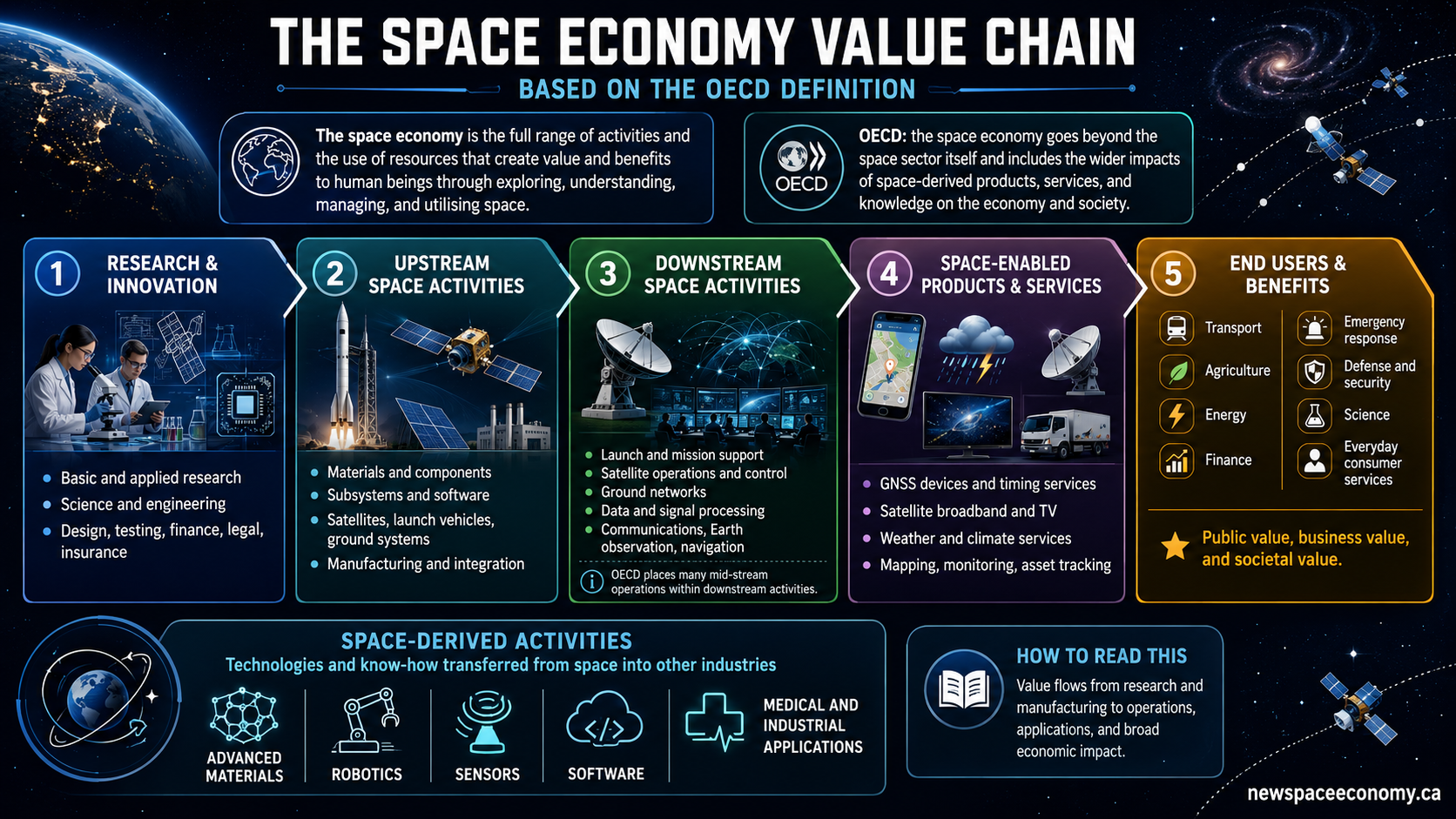
The Organisation for Economic Co-operation and Development describes the space economy as all activities and resources that contribute to human progress through the exploration, research, understanding, management, and use of space. A value chain turns that definition into a working map. It shows how materials, engineering, capital, launch access, spacecraft, ground networks, software, regulation, data processing, distribution, and customer adoption combine to create useful services.
The space value chain begins with requirements, funding, materials, components, engineering, and manufacturing. It continues through launch, deployment, orbital operations, communications links, ground systems, data handling, product design, sales, customer support, and end-user workflows. A rocket launch sits near the middle of the chain, not at the end. The customer value appears later, when a farmer receives a crop-stress map, a ship maintains connectivity at sea, a bank receives timing support, an airline gets better weather information, or a defense agency receives resilient communications.
A supply chain and a value chain are related, but they are not the same thing. A supply chain asks how inputs move into production: electronics, structures, propellants, test services, software, launch slots, and ground equipment. A value chain asks how economic value is created and captured. New Space Economy’s article on the difference between a supply chain and a value chain makes this distinction useful for space markets because hardware movement and value creation do not always follow the same path.
A satellite may cost a great deal to build, but the largest value may sit downstream in services, software, terminals, analytics, or customer decisions. A launch provider may collect revenue for transportation to orbit, but the satellite operator may collect years of service revenue. A data company may buy imagery from a satellite owner and earn revenue by turning it into insurance, agriculture, or security products. A customer may care little about the spacecraft and care deeply about the answer delivered into an existing dashboard.
The European Space Agency uses upstream, downstream, and space-related categories when discussing measurement. Upstream activity includes the systems that make space activity possible. Downstream activity includes operations for terrestrial use and products or services that rely on satellite technology, signals, or data. Space-related activity includes applications and products linked to space technology transfer even when they do not depend on a satellite service. That structure is helpful, although real companies often cross category lines.
Space systems can also be understood through technical segments. New Space Economy’s overview of space system segments identifies launch, space, ground, link, and user segments. This article uses that structure as a practical teaching model because it follows the service path from a physical spacecraft to the customer.
A working space value chain depends on five broad links. The launch segment places infrastructure in orbit. The space segment performs the mission. The link segment carries commands, telemetry, signals, or data. The ground segment connects orbital assets to terrestrial networks and operators. The user segment turns the service into value for people, firms, public agencies, or machines.
This chain is rarely linear in business terms. A firm may own launch vehicles, satellites, ground systems, and consumer services. Another may sell only propulsion components. Another may operate a ground-station network. Another may buy satellite data and sell analytics. Vertical integration, specialization, public procurement, defense requirements, and customer concentration all affect value capture.
A space economy beginner may picture a rocket carrying a satellite into orbit and then imagine the job is done. In business terms, that is only one handoff. A satellite must receive commands, maintain attitude, manage power, communicate with ground systems, protect itself from cyber and physical risks, move data, meet license terms, avoid debris, serve customers, and generate enough revenue or public value to justify its existence. Every handoff can create cost, delay, risk, or margin.
The table below gives a compact view of the chain by function.
| Chain Link | Main Function | Typical Sellers | Value Created |
|---|---|---|---|
| Inputs | Materials And Components | Suppliers And Labs | Mission Readiness |
| Launch | Transport To Orbit | Launch Providers | Orbital Access |
| Space | Mission Operations | Satellite Operators | Signals Or Data |
| Ground | Control And Downlink | Ground Networks | Usable Flow |
| User | Decision Or Service | Service Firms | Customer Outcome |
The value-chain view helps explain why some space companies prosper without building rockets and why some technically impressive spacecraft do not become strong businesses. Every segment must fit the customer’s need. The chain can fail through launch delay, manufacturing defects, weak ground coverage, poor software integration, legal limits, high terminal cost, low customer trust, or a product that does not change a decision.
Mission Design Sets the Economic Path
Every space value chain begins with a mission requirement. The requirement may come from a government agency, commercial operator, research team, defense organization, telecom company, climate-monitoring program, navigation authority, or private customer group. The requirement defines the chain because the mission determines the orbit, spacecraft design, payload, launch needs, ground architecture, data flow, regulatory path, operations model, and customer product.
A communications mission begins with coverage, capacity, latency, frequency bands, user equipment, target customers, and network integration. An Earth observation mission begins with measurement needs: resolution, revisit rate, spectral bands, latency, tasking model, calibration, archive depth, and analytic output. A science mission begins with the research question, instrument performance, trajectory, communications distance, power, thermal conditions, and mission life. A defense mission begins with threat environment, resilience, security, timing, classification, interoperability, and assured access.
Mission design is where economic tradeoffs become technical choices. A satellite in low Earth orbit can offer lower latency and higher imaging resolution for a given payload size, but it moves quickly relative to Earth and may need a constellation for persistent service. A satellite in geostationary orbit can provide continuous coverage over a broad region, but it sits much farther away and requires more power for communications. Medium Earth orbit can balance coverage and latency for some navigation and communications services.
The payload drives much of the spacecraft. A synthetic aperture radar instrument needs power, thermal handling, data storage, downlink capacity, and precise attitude control. A broadband satellite needs antennas, processors, spectrum rights, beam-forming capability, and user-terminal compatibility. A weather instrument needs calibration, stable operations, and integration into forecasting models. A technology demonstrator may prioritize cost, speed, and learning rather than service revenue.
NASA’s Small Spacecraft Technology State-of-the-Art report illustrates how mission designers think about subsystems, including power, propulsion, structures, thermal control, command and data handling, avionics, communications, guidance, navigation, control, and payload support. Smaller spacecraft can lower cost and shorten schedules, but they still require deliberate design tradeoffs.
Economic choices appear early. A firm may choose a standard satellite bus to reduce cost and schedule risk. It may choose custom hardware for performance. It may buy a hosted payload arrangement instead of owning a spacecraft. It may purchase data from another operator instead of launching a constellation. It may use cloud-based ground services instead of building its own network. Each choice moves capital spending, operating cost, control, schedule, and risk.
Mission assurance also enters early. Space hardware can be difficult or impossible to repair once deployed. Testing, redundancy, radiation tolerance, quality control, supplier qualification, software validation, and configuration management all affect reliability. A low-cost small satellite can accept more risk if many units form a constellation. A billion-dollar science or national-security spacecraft may require stricter assurance because replacement is slow and costly.
A value-chain view shows why a lower-cost satellite is not automatically better. If lower cost reduces reliability, service life, data quality, or customer trust, it can lower lifetime value. If low cost allows rapid replenishment and iteration, it can strengthen the business. The correct tradeoff depends on mission economics.
The financing model also shapes mission design. A venture-backed startup may prioritize a minimum viable constellation, early revenue, and fast customer validation. A government science mission may prioritize measurement quality and mission assurance. A defense system may prioritize resilience and security. A telecom operator may prioritize capacity, terminal economics, and spectrum strategy. A university CubeSat may prioritize education and demonstration.
Regulation should be designed into the mission from the start. Communications missions need spectrum coordination and market access. Remote sensing missions may need imaging licenses and customer restrictions. Launch and reentry plans need approvals. Debris mitigation requires disposal planning. Export controls can affect suppliers and customers. Data privacy and cybersecurity requirements can affect architecture.
Early design also determines the ground chain. If a mission produces large data volumes, it needs frequent downlink, high-rate communications, processing capacity, and archive management. If it serves near-real-time customers, latency becomes a design parameter. If it serves defense users, encryption, secure ground stations, classified handling, and resilience may shape the entire system. If it serves consumers, user terminals, billing, installation, support, and network operations may become as important as spacecraft.
The mission-design stage is where technology ambition must meet customer reality. A satellite mission that cannot deliver data at the right speed, quality, price, and format will struggle. A launch plan that depends on a vehicle not yet available creates schedule risk. A ground network that cannot scale creates a bottleneck. A business plan that assumes customer adoption before product proof creates financing risk.
A strong mission design begins with the end user and works backward. The technical system exists to create a service. The service exists to change a decision, deliver a connection, reduce cost, increase safety, provide assurance, or satisfy a public mission. Rockets and spacecraft matter because they enable that chain, not because hardware alone completes it.
Manufacturing Turns Requirements Into Space Hardware
Space manufacturing converts mission requirements into hardware and software that can survive launch and operate in orbit. This stage includes spacecraft buses, payloads, propulsion, power systems, structures, thermal systems, avionics, radios, antennas, sensors, onboard software, separation systems, harnessing, mechanisms, ground-support equipment, and test equipment. It also includes integration work that makes the parts function as a mission system.
A spacecraft bus is the platform that supports the payload. It supplies power, pointing, communications, computing, thermal control, and structure. The payload performs the mission, such as communications, imaging, weather sensing, navigation signal generation, scientific measurement, or technology demonstration. Some companies sell standard buses. Others build custom spacecraft around specific payload needs. Operators choose based on cost, performance, schedule, supplier confidence, and mission life.
Manufacturing approaches differ across the market. Large geostationary communications satellites may require long design cycles, high reliability, large power systems, and heavy payloads. Small satellites may use standardized components, modular buses, and shorter production schedules. Large low Earth orbit constellations may use assembly-line production, design iteration, and fleet-level redundancy. Science missions may use custom instruments with long calibration and testing programs.
The Satellite Industry Association publishes annual satellite industry performance summaries. BryceTech’s 2024 satellite revenue summary reported $20 billion in satellite manufacturing revenue for 2024 and $155.3 billion in ground equipment revenue. Those figures show that manufacturing matters, but they also show how much value sits outside the spacecraft factory.
Manufacturing is constrained by quality and environment. Launch vibration, acoustic loads, vacuum, radiation, thermal cycling, micrometeoroids, and orbital operations impose requirements that ordinary electronics and mechanisms may not meet. A satellite must run with limited power, limited cooling, limited physical access, and delayed troubleshooting. A production defect can become a mission failure.
Testing translates design confidence into flight readiness. Thermal vacuum testing checks behavior in vacuum and temperature extremes. Vibration and acoustic testing simulate launch loads. Electromagnetic compatibility testing checks interference. Deployment tests confirm mechanisms. Software-in-the-loop and hardware-in-the-loop tests check command behavior. Environmental testing can be costly, but it reduces the probability of failure after launch.
Digital engineering has changed this stage. Simulation, model-based systems engineering, software test frameworks, digital twins, automated manufacturing tools, additive manufacturing, and data-driven quality control can reduce errors and speed iteration. Yet space hardware still demands physical proof. A model cannot replace every vibration, thermal, radiation, or deployment test.
The supplier base can be as important as the prime contractor. A spacecraft builder may depend on propulsion vendors, solar-array suppliers, optics specialists, semiconductor companies, radio-frequency component makers, battery providers, structures firms, and launch-adapter suppliers. Delays in one component can delay a satellite. Export restrictions can prevent a supplier from serving certain customers. A shortage in radiation-tolerant electronics can alter schedules or designs.
Manufacturing location has strategic meaning. Governments increasingly view space manufacturing as industrial capability. Domestic satellite production, launch-vehicle production, propulsion manufacturing, optics, sensors, and secure electronics can support national security and economic development. This is why space industrial policy often includes grants, tax incentives, research centers, procurement commitments, and workforce training.
A value-chain view helps separate unit cost from lifetime economics. A more expensive spacecraft may deliver longer life, higher capacity, better data quality, or higher reliability. A cheaper spacecraft may be better if it can be produced quickly, launched often, and replaced easily. Constellations make this tradeoff more flexible because the service can survive individual satellite failures if the fleet has redundancy.
Mass production changes the manufacturing logic. A company building one satellite can optimize for mission-specific performance. A company building thousands must optimize for production flow, quality control, supplier reliability, launch packaging, failure tracking, software updates, and design feedback. Starlink is the best-known example of constellation-scale production, but the principle applies to other large fleets.
Manufacturing also shapes downstream service. A communications satellite’s antenna design affects coverage and capacity. An Earth observation satellite’s sensor and pointing performance affect image quality. A navigation satellite’s clock stability affects timing precision. A weather satellite’s instrument quality affects forecast data. The customer may never see the hardware, but hardware decisions shape the service.
Satellite operators sometimes outsource manufacturing. Others integrate vertically to control cost, schedule, and design. Vertical integration can reduce handoff friction and speed feedback from operations to production. It can also require enormous capital, manufacturing discipline, and management capacity. Specialization can keep firms focused and allow suppliers to serve many operators.
Manufacturing is where the value chain becomes physically real. Requirements become equipment, software, documentation, test results, risk registers, and delivery schedules. If manufacturing fails, launch access cannot rescue the mission. If manufacturing succeeds but the product does not fit the customer, technical success may still fail economically.
Launch Converts Space Hardware Into Orbital Infrastructure
Launch is the transportation link that places spacecraft into operational environments. It includes vehicle production, payload integration, mission planning, range coordination, licensing, fueling, launch operations, flight safety, stage recovery where applicable, payload deployment, and early orbit support. Launch is spectacular, but its economic function is practical: move a payload from Earth to the orbit or trajectory needed for the mission.
The launch customer buys more than thrust. The customer buys schedule confidence, orbit accuracy, payload accommodation, integration services, reliability, insurance compatibility, regulatory support, and mission-specific performance. A small satellite rideshare customer may accept less control over orbit in exchange for lower price. A national-security customer may pay more for mission assurance, domestic launch, schedule protection, secure handling, and orbital precision.
Commercial launch revenue is only one segment of the larger satellite market. BryceTech’s 2024 summary reported $9.3 billion in launch services revenue within satellite industry revenues. By comparison, satellite services and ground equipment were far larger categories in that summary. Launch attracts attention because every mission needs access to space, but downstream services often capture greater recurring revenue.
Launch economics affect spacecraft design. If launch is expensive or rare, operators may design satellites for long life and high reliability. If launch becomes cheaper and frequent, operators may accept shorter satellite life, faster iteration, and more replenishment. Rideshare lowers entry barriers for small satellites but can create schedule and orbit compromises. Dedicated small launch offers more control but often at higher price per kilogram.
Reusable launch has changed expectations. Falcon 9 demonstrated that booster reuse and high cadence can support a new operating model. Reuse can reduce marginal hardware cost, increase fleet experience, and support frequent missions, provided refurbishment, inspection, range access, production, and demand align. New Space Economy’s discussion of SpaceX launch cadence connects reusability to operational scale, not simply launch price.
Heavy-lift systems could alter payload design if they become reliable and economically available. Larger fairings and higher mass capacity could support larger modules, more massive satellites, in-space infrastructure, and lunar cargo. New Space Economy’s article on Starship launch economics examines how operational Starship flights could affect downstream markets if cost, cadence, and reliability match commercial expectations.
Launch is not frictionless even when a vehicle exists. Payloads need integration, structural checks, electromagnetic compatibility reviews, hazardous processing support, deployment systems, and documentation. Launch ranges need safety approvals. Airspace and maritime safety zones may be required. Environmental and local concerns can affect operations. Weather can delay launches. Vehicle anomalies can ground fleets.
The launch segment also includes launch and early orbit phase support. After separation, satellites may deploy solar arrays, establish communications, detumble, begin commissioning, raise orbit, calibrate instruments, and verify subsystems. Ground teams monitor health and correct anomalies. A successful launch does not automatically mean a mission is operational.
Orbit selection matters. Low Earth orbit is common for Earth observation, low-latency communications, human spaceflight, and technology demonstration. Medium Earth orbit supports navigation and some communications architectures. Geostationary orbit supports broad regional communications, broadcasting, and weather monitoring. Highly elliptical orbits can serve high-latitude coverage. Lunar and deep-space missions require more complex trajectories.
Launch providers compete on more than price. They compete on reliability, cadence, performance, fairing size, launch site location, customer service, insurance acceptance, national eligibility, integration flexibility, schedule control, and access to desired orbits. A government customer may select a launcher for strategic reasons. A commercial operator may value availability more than lowest price if delay harms revenue.
Spaceports create local economic links. They require infrastructure, safety processes, range systems, tracking, environmental compliance, transport access, skilled labor, emergency response, security, and community acceptance. They can support suppliers, tourism, education, and technical jobs, but they are not automatically self-sustaining. A spaceport needs launch demand and regulatory permission.
Launch also creates risk beyond the customer. Failed launches can create debris, environmental concerns, public safety issues, and insurance claims. Reentries must be managed. Stages may fall into designated zones or return for reuse. Public regulators balance commercial activity against safety, airspace use, maritime activity, and local environmental effects.
A value-chain perspective prevents launch from crowding out the rest of the market. Launch is necessary for orbital infrastructure, but it is not the final product for most customers. The chain must continue through spacecraft commissioning, ground connection, service design, and user adoption. A rocket can place a satellite in orbit. Only the full chain can turn that satellite into revenue, public value, or operational effect.
The Space Segment Performs the Mission
The space segment includes satellites, spacecraft, stations, probes, hosted payloads, orbital transfer vehicles, and other systems operating beyond Earth’s surface. In the value chain, this segment performs the mission function: transmitting communications, observing Earth, generating navigation signals, collecting science data, hosting crew, relaying data, demonstrating technology, or moving payloads.
A satellite must act as both machine and service node. It maintains attitude, manages power, handles thermal conditions, runs onboard software, communicates with ground stations or other satellites, stores data, processes commands, and keeps the payload working. In a constellation, each satellite also interacts with fleet scheduling, routing, collision avoidance, replenishment, and customer demand.
The space segment’s role depends on orbit. Low Earth orbit satellites move quickly across the sky, so they can provide frequent revisits, lower latency, and lower signal path lengths. They need many satellites for continuous coverage. Geostationary satellites remain fixed relative to Earth’s surface, so they can serve a region continuously with fewer spacecraft. They sit far away, which affects latency and link budgets. Medium Earth orbit systems can provide broader coverage than low Earth orbit with lower latency than geostationary orbit in some designs.
Communications spacecraft convert spectrum, antennas, power, onboard processing, and network management into capacity. Older designs often functioned as bent-pipe relays that received signals and retransmitted them. Newer high-throughput satellites use spot beams, frequency reuse, digital payloads, and software-defined capabilities. Some networks include optical inter-satellite links that move traffic between satellites before reaching the ground.
Earth observation spacecraft convert sensors into measurements. Optical satellites collect reflected sunlight. Radar satellites transmit signals and measure returns, allowing imaging at night and through clouds. Hyperspectral satellites measure many spectral bands to identify materials or environmental conditions. Thermal sensors measure heat patterns. Radio-frequency satellites detect emissions. Each sensor type has economic tradeoffs.
Navigation satellites generate precise timing and positioning signals. They need stable clocks, accurate orbit knowledge, signal integrity, ground control, and user equipment. The value appears in receivers and systems that translate signals into location, movement, and time. Because many navigation systems are publicly funded, the direct revenue may sit in devices and services rather than in the signal provider.
Weather satellites measure atmospheric, ocean, land, and cloud conditions. They feed numerical weather prediction models, public forecasts, aviation planning, emergency management, energy operations, and climate monitoring. The satellite itself is part of a wider system that includes models, sensors, ground stations, data-sharing arrangements, and meteorological expertise.
Human spaceflight systems add life support, safety, docking, crew operations, cargo logistics, emergency planning, medical support, and mission control. Commercial space stations and private astronaut missions depend on vehicles, stations, training, insurance, research demand, crew health management, and government approvals. NASA’s Commercial Low Earth Orbit Program Office frames future low Earth orbit activity as a service market in which NASA can buy capabilities from commercial providers.
The space segment is becoming more software-defined. Satellites can update software, change beam patterns, adjust tasking priorities, compress data, process imagery onboard, reroute traffic, and support autonomous fault handling. Software flexibility can extend service life and adapt to changing customers. It also increases cybersecurity needs and operational complexity.
Constellations change the economic unit from one satellite to a fleet. Fleet-level design can trade individual satellite reliability against replenishment, redundancy, and software management. A low-cost satellite that fails after three years may be acceptable if replacement is routine and service continuity remains strong. A unique science spacecraft cannot use that model because its mission value sits in a single asset.
The space segment must also manage collision risk. Operators track conjunction warnings, plan maneuvers, monitor fuel, coordinate with other operators, and comply with disposal rules. A satellite without maneuvering capability can be cheaper, but it may pose greater long-term risk. A satellite with propulsion and autonomy may cost more but protect the mission and operating environment.
Spacecraft operations do not stop once a system begins service. Operators monitor telemetry, manage anomalies, upload software, optimize payload use, schedule contacts, balance power, manage thermal conditions, plan maneuvers, and adjust to customer demand. For Earth observation, operators may task satellites to image specific sites. For communications, they may manage network load. For weather and science, they may calibrate instruments and protect data continuity.
Space segment ownership can take many forms. A company may own and operate satellites. A government may own satellites and contract operations. A firm may host another customer’s payload on its spacecraft. A data company may buy capacity from satellite operators. A service provider may use multiple constellations. The space segment can be a product, a service platform, a shared asset, or an input.
The economic value of the space segment depends on what it enables downstream. A satellite with high technical performance but no user access, weak data pipeline, or poor pricing model can fail commercially. A modest spacecraft with a strong service model can succeed. The space segment performs the mission, but the value chain decides whether the mission matters to paying users.
Links and Ground Systems Move Value Back to Earth
A satellite without a working link to Earth is stranded infrastructure. Links and ground systems move commands, telemetry, data, voice, video, positioning signals, and customer traffic between orbital systems and terrestrial networks. They provide the bridge between spacecraft and usable services.
The link segment includes radio-frequency links, optical links, inter-satellite links, feeder links, user links, command links, telemetry links, and relay paths. Each link has engineering and regulatory requirements. Frequencies must be coordinated. Antennas must point correctly. Power and bandwidth must match service needs. Weather can affect some high-frequency and optical paths. Interference must be managed. Security must protect commands and data.
The ground segment includes mission-control centers, antennas, ground stations, network operations centers, data centers, cloud services, processing pipelines, customer gateways, user-terminal management, and support systems. New Space Economy’s ground segment revolution explains why the ground segment has moved toward service models as more operators seek access without building global infrastructure.
Ground stations perform several jobs. They send commands to spacecraft. They receive telemetry about spacecraft health. They downlink payload data. They connect satellite networks to the internet or private networks. They support launch and early orbit operations. They can also support ranging and orbit determination. Some ground stations serve one operator. Others offer shared access to many missions.
A mission that needs frequent downlink may need ground stations in multiple regions. A low Earth orbit satellite passes over each station for a limited time, so the number and location of stations affect latency and data volume. A high-data-rate Earth observation mission may need more ground capacity than a small technology demonstrator. A global communications network needs gateways, backhaul, network management, and user-link coordination.
Ground Station as a Service changes the buying model. Instead of building and operating antennas, a satellite operator can buy access from providers such as KSAT, SSC, AWS Ground Station, Leaf Space, Atlas Space Operations, and others. New Space Economy’s article on Ground Stations as a Service describes how this model lets operators use global coverage, cloud integration, and mission support without owning every facility.
Cloud platforms have become part of the value chain. Data can move from a ground station into cloud storage and processing systems, then into customer tools. This reduces the delay between downlink and product delivery. It also creates dependencies on cloud security, data architecture, application programming interfaces, and customer integration. For many customers, the data pipeline matters more than the satellite antenna.
Optical communications may alter link economics for high-data-volume missions. Laser links can move large amounts of data without relying on crowded radio-frequency spectrum, but they can face pointing, atmospheric, weather, and ground-network challenges. New Space Economy’s article on satellite optical communications explains the attraction of optical links and the practical limits that remain.
User links differ from feeder links. A user link connects a satellite to a customer device, such as a satellite phone, broadband terminal, aircraft antenna, ship terminal, Internet of Things device, or direct-to-device handset. A feeder link connects the satellite to a gateway or network hub. The business may depend on the cost and usability of user terminals as much as on satellite capacity.
Terminals can be a bottleneck. A satellite broadband service may need affordable, easy-to-install terminals. A maritime service may need rugged antennas that work in motion and weather. Aviation terminals must meet certification and integration requirements. Direct-to-device services must work with ordinary phones, spectrum rights, and partner networks. The end-user device is part of the value chain, not an accessory.
Spectrum regulation shapes the link segment. The International Telecommunication Union supports international coordination for satellite networks and space services. National regulators, such as the FCC Space Bureau, handle domestic licensing and market access. Spectrum access affects service quality, interference risk, and competitive entry.
Ground systems also create cybersecurity risk. Command systems must be protected because unauthorized access could damage or disable spacecraft. Data pipelines must be protected because customers rely on authenticity. User terminals can become attack surfaces. Ground stations may sit in politically sensitive locations. Cloud integrations may expose data to misconfiguration or intrusion.
Latency and timeliness often depend on the ground segment. An Earth observation satellite may collect an image, but the product is valuable only if it reaches the customer when needed. A wildfire detection alert arriving hours late may lose value. A defense intelligence product may need minutes. A climate archive can tolerate slower processing. The ground architecture must match the use case.
A value-chain analysis should ask where the data actually flows. Does the satellite downlink directly to owned ground stations? Does it use shared ground services? Does it relay through another satellite? Does the data enter a cloud system? Who processes it? Who verifies quality? Who owns the archive? Who distributes products? Who supports the user?
The link and ground segments explain why space services resemble digital infrastructure. A satellite is one node in a larger network. The service depends on spectrum, antennas, software, cloud computing, cybersecurity, operations, and customer devices. Space value returns to Earth through those systems.
Data Processing Turns Signals Into Products
Signals and raw data rarely create customer value by themselves. A satellite downlink may contain images, telemetry, radar returns, weather measurements, communications traffic, navigation signals, or instrument readings. The customer often needs a map, alert, forecast, score, connection, timestamp, compliance record, or operational recommendation. Data processing turns spacecraft output into usable products.
Earth observation provides the clearest example. A raw image may need calibration, georeferencing, atmospheric correction, cloud masking, mosaicking, change detection, classification, and quality checks. A radar product may need signal processing, speckle reduction, terrain correction, and interpretation. A hyperspectral product may need material identification and validation. The customer may never see the raw data.
New Space Economy’s article on satellite data analytics describes how satellite data becomes useful when processed into insights for industries and public agencies. That movement from measurement to insight is where many downstream firms seek value.
Data processing includes many layers. The raw satellite output becomes a Level 0 product. After calibration and formatting, it becomes higher-level data. After analysis, it may become a product such as a ship-detection alert, vegetation index, flood map, methane plume estimate, road-change report, construction activity measure, or crop-yield forecast. Each layer can be sold, bundled, or used internally.
Communications data processing has a different form. A broadband network must route traffic, manage capacity, authenticate users, handle billing, monitor congestion, coordinate gateways, and protect security. The customer experiences internet service, not spacecraft operations. Network software and service management create much of the value.
Navigation and timing services depend on signal generation, control segments, receiver processing, augmentation systems, integrity monitoring, and user equipment. The space segment broadcasts signals. Receivers and software convert them into position, velocity, and time. Augmentation services can improve accuracy or integrity for aviation, maritime, surveying, agriculture, and autonomous systems.
Weather processing connects satellites to models. Satellite observations feed numerical weather prediction systems along with ground stations, aircraft data, buoys, radar, balloons, and other measurements. Forecasters, private weather firms, energy traders, airlines, farms, emergency managers, and insurers use model outputs. The satellite is one input to a complex decision system.
Artificial intelligence and machine learning now affect many processing chains. Models can detect objects, classify land cover, identify change, forecast demand, route networks, flag anomalies, compress data, and support onboard processing. These tools can reduce labor and increase scale, but they also require training data, validation, explainability, and error management. Customers using outputs for insurance, safety, defense, or regulation need confidence in results.
Product design matters as much as algorithms. A customer may reject a technically accurate product if it is hard to use. The product must fit the customer’s workflow, software environment, decision timing, procurement process, legal risk, and staff capability. A farmer may need a simple field map. A defense analyst may need tasking, metadata, chain-of-custody, and secure delivery. An insurer may need auditability and policy compatibility.
Data rights affect value. A satellite operator may sell raw data, processed data, archive access, tasking rights, analytics, alerts, or exclusive access. Customers may want rights to share, store, combine, or use data for machine learning. Governments may restrict distribution for security reasons. Commercial terms can decide whether the data becomes an internal input or a marketable product.
Pricing models vary. Some firms sell subscriptions. Others sell per-image tasking, area monitoring, application programming interface access, enterprise licenses, government contracts, or usage-based capacity. Communications providers sell monthly service plans, enterprise capacity, mobility plans, or government packages. Weather and analytics firms sell data feeds, forecast products, and customized services.
Quality assurance is a value-chain requirement. Customers need to know accuracy, latency, resolution, coverage, uptime, confidence levels, error rates, and limitations. A flood map used by an emergency agency has different tolerance than a marketing graphic. A methane detection product used for compliance needs measurement credibility. A ship-detection alert used for security needs false-positive controls.
Archives create value in Earth observation and climate markets. Historical imagery allows change detection, trend analysis, baseline construction, and legal evidence. A company with a long, consistent archive can sell more than new images. Public archives such as Landsat and Copernicus have supported many downstream businesses because they provide long-term data continuity.
Interoperability affects adoption. Customers may need data in standard geospatial formats, cloud-optimized formats, enterprise software integrations, or secure feeds. A product that requires extensive custom handling may scale slowly. Standard interfaces and documentation can lower adoption cost.
The processing layer is where many space businesses become ordinary software and data companies. Their competitive advantage may come from satellite access, proprietary data, customer integration, analytics quality, domain knowledge, or distribution. A firm that understands agriculture, maritime insurance, or defense operations may capture more value than a firm with better raw pixels but weaker product fit.
The space value chain becomes customer-facing at this stage. The satellite has done its job. The ground system has delivered data. The processing layer must now produce something a user trusts enough to act on. That trust is the basis of downstream revenue.
Distribution and Customer Workflows Create Economic Value
The end user usually pays for a result, not for an orbital object. That result may be a broadband connection, a location fix, a timestamp, a vessel alert, a wildfire map, a crop-health dashboard, a weather forecast, or a secure communications link. Distribution and workflow integration decide whether the result becomes routine use.
A product reaches customers through sales channels, application programming interfaces, enterprise software, consumer hardware, mobile apps, government procurement portals, managed services, reseller networks, telecommunications partners, defense contracts, or data marketplaces. A space company can fail if it cannot distribute well, even when its spacecraft perform well.
Customer workflow means the service fits into the user’s decision process. An airline does not buy weather data as a curiosity. It buys data that supports routing, safety, fuel planning, and schedule management. A farmer does not buy satellite imagery for its own sake. The farmer needs input decisions, irrigation planning, yield estimates, or compliance records. A bank does not buy timing signals as a space service. It needs synchronized transactions.
New Space Economy’s guide to space-enabled applications shows how space systems reach communications, navigation, weather, finance, safety, and public services. This is where space value becomes less visible and more economically relevant.
Distribution can be hardware-heavy. Satellite broadband requires user terminals, installation processes, network activation, customer support, billing systems, and local market permissions. Maritime and aviation connectivity require certified antennas, equipment integration, service contracts, maintenance, and reliability guarantees. Internet of Things satellite services need low-cost modules, power efficiency, network availability, and device management.
Distribution can also be software-heavy. Earth observation analytics may reach users through web dashboards, cloud platforms, geographic information systems, alerts, or data feeds. Financial users may consume data through application programming interfaces. Government users may need secure portals, audit logs, and procurement-compliant delivery. Climate and environmental users may need data formats that integrate with modeling tools.
The same satellite service can have different value depending on workflow. A high-resolution image delivered after a natural disaster may be valuable to emergency responders if it arrives fast and includes clear damage assessments. The same image may have lower value if it arrives after decisions have already been made. Latency, format, and interpretation can change the product’s economic worth.
Customer adoption often requires training. A mining firm, insurer, farm cooperative, or public works department may need staff who can interpret satellite-derived products. If the product requires expert analysis every time, adoption may slow. If the product arrives as a simple decision aid with confidence levels and context, adoption may improve. Education and support are part of the chain.
Procurement affects distribution. Government customers may require approved vendor lists, security review, domestic sourcing, data rights, service-level agreements, accessibility compliance, auditability, and long contracting cycles. Enterprise customers may require cybersecurity review, privacy assessment, integration testing, legal review, and pilot programs. Consumer markets require marketing, retail distribution, app design, customer support, and price clarity.
Space services also face competition from non-space alternatives. A drone can inspect a bridge at higher resolution. Fiber can provide faster broadband in dense regions. A terrestrial weather radar can provide localized data. A ground sensor can measure conditions directly. A human inspector may be cheaper for a small site. Space must win by offering coverage, scale, speed, resilience, or measurement that alternatives cannot match at the same cost.
The downstream business often decides the value capture. A satellite operator may sell wholesale data at modest margins. A downstream analytics firm may sell a high-value decision product. A telecom operator may combine satellite capacity with terrestrial services and customer relationships. A defense integrator may combine satellite data with other sensors, software, and command systems. The customer may pay the firm that reduces operational complexity.
Consumer adoption has a different pattern. Users judge service by price, convenience, reliability, and support. A satellite phone or direct-to-device service must work in the moments when users need it. Satellite broadband must deliver acceptable speeds and latency. Navigation must work quietly. Weather apps must feel trustworthy. The space origin of the service may be secondary.
Brand trust matters. Customers buying space-enabled products often cannot verify the underlying system. They rely on reliability, reputation, contracts, service levels, government approvals, and peer adoption. A single outage, cyber incident, or inaccurate product can harm trust. This is why operations and customer support remain part of the value chain after sale.
The user segment can feed information back into the chain. Customer complaints reveal coverage gaps. Usage data can guide satellite tasking or capacity allocation. Product adoption can shape next-generation spacecraft design. Enterprise users may request new formats. Defense users may request security changes. Farmers may need region-specific models. This feedback loop turns the chain into a cycle.
A mature space value chain looks ordinary to the user. Data arrives in software. Connectivity appears as a subscription. Positioning appears on a phone. Weather appears in a forecast. The customer does not need to understand the chain. Professionals do, because each link determines cost, resilience, margin, and customer satisfaction.
Business Models Decide Who Captures Margin
The space value chain contains many business models. Some companies sell hardware. Some sell launch services. Some sell capacity. Some sell data. Some sell analytics. Some sell consumer subscriptions. Some sell government services. Some sell mission support. Some sell insurance, financing, software, or ground access. The same mission can generate revenue at many points.
Hardware suppliers earn revenue when they sell components, subsystems, spacecraft, terminals, or test equipment. Their margins depend on production volume, reliability, specialization, supplier competition, and qualification burden. A supplier of a rare high-performance component can hold strong pricing power. A supplier of standard components may compete on cost and delivery.
Launch providers earn revenue by transporting payloads. Their margins depend on cadence, reliability, vehicle reuse, fixed-cost absorption, launch-site operations, insurance confidence, and customer demand. A launcher with many missions can spread overhead across more flights. A vehicle with low cadence may struggle even if technically capable.
Satellite operators earn revenue by selling capacity, data, services, or access. A communications operator may sell bandwidth, managed connectivity, broadband subscriptions, mobility services, or government packages. An Earth observation operator may sell imagery, tasking, archive access, or data licenses. A weather data provider may sell observations or forecast support.
Ground-service providers earn revenue by selling access to antennas, mission-control tools, cloud-connected downlink, launch and early orbit support, and network operations. The customer avoids building a global ground network. The provider monetizes shared infrastructure and operational expertise. This model can scale if many missions need similar access.
Analytics firms earn revenue by transforming space data into customer products. They may not own satellites. Their value may sit in data fusion, algorithms, domain expertise, customer workflows, and distribution. In agriculture, insurance, defense, energy, or finance, the customer may pay more for a validated decision product than for raw satellite data.
Platform companies try to sit between data providers and users. They may host archives, provide tools, support application programming interfaces, manage billing, or create marketplaces. Platform economics depend on scale, network effects, data rights, customer trust, and developer adoption. A platform can grow if it reduces friction for both data suppliers and customers.
Government contracting creates a distinct model. A company may receive research and development funding, milestone payments, service contracts, fixed-price contracts, cost-plus contracts, data purchases, or long-term procurement agreements. Government revenue can support early markets, but it may create customer concentration and procurement dependence. A company serving both government and commercial customers may have stronger revenue diversity.
Consumer subscriptions require a different organization. Starlink is an example of a vertically integrated network selling broadband directly to households, businesses, maritime customers, aviation customers, and governments. Consumer service requires billing, logistics, terminals, installation guidance, support, capacity management, local permissions, and brand trust. Hardware and launch integration help, but customer operations matter.
Business models also differ by capital intensity. A component supplier may need equipment and qualification processes but not a constellation. A launch provider needs factories, engines, pads, and vehicles. A satellite broadband operator may need spacecraft production, launch, ground gateways, terminals, and customer support before revenue scales. A data analytics firm may start with public data and software, then add proprietary data later.
Value capture depends on scarcity. Launch capacity can be scarce. Spectrum can be scarce. Regulatory approvals can be scarce. High-quality datasets can be scarce. Customer trust can be scarce. A company that controls a scarce link may capture more value. If a service becomes commodity data, margins may move to applications, distribution, or bundled platforms.
New Space Economy’s article on business models of the space economy describes how different models depend on different revenue sources, customer segments, and capital structures. Treating every space company as the same type of business hides these differences.
Integration can shift margins. A company that controls manufacturing, launch, satellites, terminals, and service delivery may reduce handoff costs and capture more of the chain. Vertical integration can create speed and cost advantages, but it also concentrates execution risk. A specialized company can remain profitable by being the best supplier at one link.
Partner models are common. A satellite operator may partner with telecom carriers for market access. A remote sensing firm may partner with analytics firms. A launch provider may work with payload integrators. A ground network may integrate with cloud providers. A defense contractor may combine commercial satellite services into a larger system. Partnerships can lower market-entry barriers but split margin and control.
Recurring revenue is often more attractive than one-time hardware sales. Investors value predictable service revenue, customer retention, and expansion potential. Yet recurring revenue requires operations, support, reliability, and churn management. A company cannot simply label a hardware business as a service business without changing the operating model.
The strongest business model depends on the customer. A defense customer may pay for resilience and security. A farm customer may pay for low-cost seasonal insights. A consumer may pay for broadband only if terrestrial alternatives are poor. An airline may pay for passenger connectivity and operational benefits. A science agency may pay for a mission result. The chain creates value only when business design matches customer behavior.
Regulation, Standards, and Risk Management Shape Every Link
The space value chain operates inside national and international rules. These rules are not external to the market. They shape which systems can launch, communicate, image, reenter, sell, insure, and serve customers. Regulation, standards, and risk management sit across the full chain.
Launch regulation affects vehicles, sites, safety, environmental review, airspace, maritime notices, flight termination systems, reentry, and accident investigation. Operators need permissions before conducting launches. Launch sites need infrastructure and safety procedures. A business model based on high cadence can be constrained by licensing, range availability, weather, or local conditions.
Spectrum regulation affects communications, navigation augmentation, telemetry, tracking, command, and satellite network coordination. The International Telecommunication Union supports international procedures for satellite network filings and radio-frequency coordination. National regulators manage domestic authorizations. Without spectrum access, a satellite cannot deliver communications service at scale.
Remote sensing regulation affects what imagery can be collected, sold, or distributed. Governments may control high-resolution imagery, customer access, foreign sales, or temporary restrictions during security events. A remote sensing company must understand license terms before promising global data products. The legal right to sell a product can be as important as sensor performance.
Orbital debris rules affect spacecraft design and mission planning. Operators may need post-mission disposal plans, collision avoidance capability, passivation, tracking, and responsible maneuvering. The United Nations Office for Outer Space Affairs provides background on space debris mitigation through international discussions and guidelines. National regulators translate parts of that concern into licensing expectations.
Insurance and liability influence value-chain behavior. Launch insurance, in-orbit insurance, third-party liability, indemnification, and customer contracts allocate risk. Insurers look at launcher reliability, satellite design, operator record, orbit, mission complexity, and coverage limits. If risk rises, insurance cost can alter project economics.
Export controls affect suppliers, customers, and technical data. Space systems may include controlled technologies. Companies must manage international sales, foreign staff access, technical assistance, manufacturing location, and data sharing. Export rules can protect national security but also limit market reach and partnership options.
Cybersecurity standards now affect space systems throughout the chain. Satellite command links, ground stations, software supply chains, user terminals, cloud data pipelines, and customer interfaces must be protected. A cyber incident can interrupt service, damage spacecraft, leak sensitive data, or undermine trust. Defense and public-infrastructure users often require stronger assurance.
Standards reduce transaction cost. They support interoperability, data formats, safety practices, interface control, quality assurance, and responsible operations. Without common expectations, every integration becomes custom. Standards can help smaller firms enter the market because customers understand what they are buying.
Risk management begins before launch. Mission designers identify technical, financial, regulatory, operational, supplier, schedule, and customer risks. Some risks are reduced through design. Some are transferred through insurance. Some are accepted. Some are mitigated through redundancy, backup suppliers, phased deployment, or customer contracts. Good risk management makes a mission financeable.
Space-domain awareness supports operational risk management. Operators need tracking data to avoid collisions and plan maneuvers. Governments need awareness for safety and security. Commercial services now support conjunction assessment and orbital safety. As the number of satellites grows, this segment becomes more relevant to market confidence.
Customer risk also matters. A company may assume that a customer will change behavior because space data is available. That assumption may fail if the product does not fit budgets, software systems, legal requirements, training levels, or organizational incentives. Customer adoption should be treated as a risk category, not a marketing detail.
Public trust can influence regulation. Concerns about satellite brightness, launch-site effects, reentry debris, data privacy, military use, or spectrum interference can lead to stricter rules or public opposition. Companies that treat public concerns as distractions may create long-term business risk. Responsible operations support market continuity.
New Space Economy’s article on public databases related to the space economy shows how launch records, satellite catalogs, regulatory systems, procurement data, and public archives support transparency. Better information helps operators, investors, journalists, customers, and policymakers assess risk.
A space value chain without regulation would not be efficient. It would be unstable. Shared orbits, shared spectrum, safety risk, national-security concerns, and cross-border services require rules. The economic task is to build rules that protect safety and access without freezing innovation. The business task is to design systems that can operate inside those rules.
End Users Reveal Whether the Chain Works
The end user is where the space value chain proves itself. Every upstream investment, launch campaign, spacecraft design, ground network, data pipeline, license, and business model should be tested against user value. If the user receives a better service, the chain works. If the user sees no improvement, the chain is incomplete no matter how impressive the hardware looks.
End users can be consumers, firms, agencies, researchers, pilots, ship operators, farmers, soldiers, emergency managers, insurers, scientists, telecom carriers, or machines. A sensor in a remote pipeline may be an end user of satellite connectivity. A phone may be an end user of positioning signals. A trader may be an end user of time synchronization. A wildfire command center may be an end user of satellite-derived alerts.
The user segment often hides the space origin. A person opening a map app does not think about satellites. A cargo manager tracking containers may see a logistics dashboard. A pilot sees weather and navigation tools. A bank sees timing infrastructure. A public works department sees land movement data. Space becomes a background input.
This invisibility is good for adoption. Mature infrastructure does not ask the user to admire it. It works. Satellite services become valuable when they are reliable enough to disappear inside daily operations. The customer remembers the service mainly when it fails.
Different users value different qualities. A consumer broadband user values price, speed, latency, availability, and support. A defense user values resilience, security, availability, and operational control. A farmer values cost, actionable timing, and local relevance. An insurer values accuracy, auditability, and legal defensibility. A weather agency values data quality, continuity, calibration, and model impact. A telecom carrier values integration and service-level performance.
This means one space service can be strong in one market and weak in another. A satellite network that works well for remote households may not meet aviation certification needs. An Earth observation product that serves media monitoring may not meet insurance audit requirements. A direct-to-device messaging service may support emergency texts but not broadband. User fit matters more than category label.
Customer support is part of the value chain. Satellite broadband users need installation help, troubleshooting, billing, and equipment replacement. Enterprise data customers need documentation, integration support, training, and service-level commitments. Government users need compliance support. A company that invests in orbital assets but neglects support may lose customers to a less advanced but easier-to-use service.
Adoption can require organizational change. A city may need to train staff to use satellite-derived infrastructure maps. An insurance firm may need to adjust underwriting rules. A farm cooperative may need to combine satellite data with local agronomy. A port authority may need to integrate vessel detection into operations. Space data must enter existing routines.
Trust is the user’s final filter. A forecast that failed during a storm will be questioned. An image classification that produces false alerts may be ignored. A satellite connection that drops during a important operation will be replaced where alternatives exist. A timing service that lacks integrity monitoring may not be accepted for high-assurance uses. Trust accumulates slowly and can be lost quickly.
Pricing must align with value. A satellite service that saves a customer $10,000 cannot cost $50,000 unless it delivers other benefits. A consumer terminal priced beyond household budgets narrows the market. A defense service can command higher prices if it provides resilience and security. A climate monitoring service may need public funding if benefits are diffuse.
The end user also defines the correct performance metric. For Earth observation, resolution alone is not enough. Revisit, latency, accuracy, coverage, consistency, archive depth, and analytic fit matter. For broadband, peak speed alone is not enough. Consistency, congestion, support, and terminal cost matter. For navigation, availability alone is not enough. Integrity, accuracy, anti-jamming, and timing stability matter.
Feedback from end users should return upstream. Customer demand can influence new sensors, orbits, software, pricing, terminals, and regulatory strategy. A company that learns from customer use can refine its next satellites. A public agency that understands user needs can improve procurement. A manufacturer that hears operational feedback can redesign components.
End users also expose overbuilt systems. A satellite may deliver more precision than customers will pay for. A data product may offer detail that slows decisions. A network may serve a market already covered by cheaper terrestrial options. A launch system may enable missions without customers. The value chain is only as strong as the demand it serves.
Space professionals should read customer behavior more carefully than announcements. Paying users, renewals, service expansion, integration depth, and budget allocation reveal whether the chain works. Press releases and demonstrations may show promise. Customer reliance shows value.
Summary
The space value chain works by turning requirements into hardware, hardware into orbital infrastructure, orbital infrastructure into signals or data, signals or data into products, and products into customer outcomes. Launch is an important link, but it is only one part of the chain. Space value appears when each link supports the next and the end user receives something worth paying for or publicly funding.
The chain begins with mission design. Requirements set the orbit, payload, spacecraft, launch plan, ground system, regulatory route, data pipeline, and service model. Manufacturing then converts those requirements into hardware and software. Launch moves the system into orbit. The space segment performs the mission. Links and ground systems bring value back to Earth. Data processing turns raw output into usable products. Distribution and customer workflows decide whether the service becomes adopted.
Business models determine who captures margin. Hardware suppliers, launch providers, satellite operators, ground-service providers, data firms, analytics companies, platforms, and customer-facing service providers each operate at different points. A company can specialize in one link or integrate several. Neither approach guarantees success. The stronger model is the one that matches customer demand, capital needs, regulation, and operational capability.
Regulation and risk management sit across the full chain. Spectrum, launch licensing, remote sensing rules, export controls, debris mitigation, insurance, cybersecurity, standards, and public trust all shape market access. These factors may seem separate from engineering, but they can decide whether a service reaches customers.
The end user reveals whether the chain works. Users buy connectivity, timing, forecasts, alerts, maps, analytics, research access, safety, and operational confidence. They rarely buy space for its own sake. A professional understanding of the space economy starts with that fact and traces value backward from the customer to the spacecraft, the rocket, and the industrial base that made the service possible.
Appendix: Useful Books Available on Amazon
- The Space Economy
- Space Is Open for Business
- Space 2.0
- The Case for Space
- Introduction to Satellite Communication
Appendix: Top Questions Answered in This Article
What Is the Space Value Chain?
The space value chain is the sequence of activities that turns space hardware and services into customer value. It includes mission design, manufacturing, launch, orbital operations, ground systems, data processing, distribution, regulation, and user adoption. The chain is useful because it shows where cost, risk, and revenue appear.
How Is a Space Value Chain Different From a Space Supply Chain?
A supply chain tracks the movement of inputs such as components, materials, software, launch services, and equipment into production. A value chain tracks how those inputs become economic value for customers. A supplier can be essential to the supply chain without capturing much downstream value.
Why Is Launch Only One Part of the Chain?
Launch places spacecraft into orbit, but the customer value appears after deployment. The satellite must operate, communicate, downlink data, connect to ground systems, process information, serve users, and generate revenue or public value. A successful launch does not automatically create a successful service.
What Does the Ground Segment Do?
The ground segment connects satellites with operators, networks, data systems, and customers. It includes ground stations, mission-control centers, telemetry systems, data processing, cloud links, network operations, and user gateways. Without the ground segment, a satellite cannot deliver useful services on Earth.
Why Are User Terminals Part of the Value Chain?
User terminals convert satellite capability into usable service. Broadband terminals, satellite phones, aircraft antennas, ship terminals, and Internet of Things modules affect price, ease of use, reliability, and adoption. A strong satellite network can struggle if customer equipment is too costly or difficult to use.
How Does Earth Observation Data Become a Product?
Earth observation data becomes a product through calibration, correction, georeferencing, classification, change detection, analytics, and customer delivery. Many customers do not want raw imagery. They want flood maps, crop alerts, damage assessments, maritime detections, emissions estimates, or compliance records.
Who Captures the Most Value in the Space Chain?
Value capture depends on scarcity, customer access, data rights, regulation, and service design. Launch providers, satellite operators, ground networks, analytics companies, telecom firms, and platforms can each capture margin. The firm closest to the customer may capture more value if it controls the decision product.
Why Does Regulation Matter to the Space Value Chain?
Regulation controls access to launch, spectrum, remote sensing markets, reentry, debris disposal, exports, and national-security customers. A service can be technically possible but commercially blocked if permissions are missing. Strong space businesses design regulatory compliance into the mission from the beginning.
What Makes a Space Service Successful for End Users?
A space service succeeds when it fits the user’s workflow, budget, timing, accuracy needs, and support expectations. Customers usually buy outcomes rather than spacecraft. Connectivity, forecasts, alerts, timing, maps, and analytics must be reliable enough to become part of routine operations.
How Should Professionals Analyze a Space Company?
Professionals should identify where the company sits in the chain, what it sells, who pays, what alternatives compete, what regulation applies, and how revenue scales. They should separate launch success from service adoption, total market size from obtainable demand, and technical performance from customer value.
Appendix: Glossary of Key Terms
Space Value Chain
The full sequence that turns space-related inputs into customer value. It includes requirements, components, manufacturing, launch, orbital operations, ground systems, communications links, data processing, distribution, and end-user adoption. It helps explain where costs, risks, and revenue appear.
Supply Chain
The network of suppliers, materials, components, software, facilities, labor, and services required to build and operate space systems. A supply chain focuses on production inputs and delivery paths rather than the full creation of customer value.
Mission Design
The process of defining what a space system must do and how it will do it. Mission design covers orbit, payload, spacecraft, launch, ground systems, data flow, risk, regulation, cost, and customer needs. Early decisions shape the whole chain.
Satellite Bus
The spacecraft platform that supports the payload. It provides power, structure, thermal control, attitude control, communications, computing, and other mission support functions. The payload performs the mission, but the bus keeps it alive and useful.
Payload
The mission-specific equipment carried by a spacecraft. A payload can include cameras, radar instruments, communications equipment, navigation systems, weather sensors, scientific instruments, or technology demonstrations. Payload requirements often drive spacecraft design and mission cost.
Launch Segment
The part of the space value chain that transports payloads from Earth to orbit or another trajectory. It includes launch vehicles, integration, launch sites, licensing, safety, deployment, and early mission support. It provides access but not the final customer service.
Space Segment
The spacecraft, satellites, stations, probes, or orbital vehicles that perform the mission beyond Earth’s surface. The space segment creates signals, data, communications capacity, science measurements, or other mission outputs. It must operate reliably in the space environment.
Link Segment
The communications paths that move commands, telemetry, data, and user traffic between satellites, other spacecraft, ground stations, and user terminals. Links may use radio-frequency signals, optical communications, inter-satellite links, feeder links, or user links.
Ground Segment
The terrestrial infrastructure that connects space systems to operators and users. It includes ground stations, antennas, mission-control centers, network operations, cloud systems, data processing, gateways, and security systems. It turns orbital output into accessible services.
Ground Station as a Service
A commercial model where satellite operators buy access to ground antennas and related services instead of building their own ground network. It can reduce capital costs and improve global coverage for missions that need flexible downlink or command access.
User Segment
The part of the chain where customers, devices, software, and operations receive value from space systems. It includes terminals, applications, dashboards, data feeds, workflows, and support. The user segment determines whether space capability becomes routine service.
Downstream Application
A customer-facing product or service that uses space-based signals, data, or infrastructure. Examples include satellite broadband, navigation, crop monitoring, maritime tracking, weather forecasting, disaster mapping, insurance analytics, and emergency communications.
Space-Domain Awareness
The ability to track and understand objects and activity in space. It supports collision avoidance, debris monitoring, satellite safety, defense planning, and operational confidence. Space-domain awareness becomes more important as orbital traffic grows.
Service-Level Agreement
A contract commitment that defines expected service performance. It may cover uptime, latency, data delivery, accuracy, support, security, or response time. Service-level agreements help customers judge whether a space-enabled service fits operational needs.
Inter-Satellite Link
A communications path between satellites. Inter-satellite links can move data within a constellation before it reaches a ground station. They can reduce latency, increase network flexibility, and reduce dependence on immediate ground-station visibility.


