


- Key Takeaways
- What Human-Animal Communication Means in Scientific Practice
- Why Training Opened the Door to Communication Research
- What Sign Language and Symbol Boards Revealed
- What Mimicry and Vocal Learning Show About Other Species
- How Digital Buttons, Sensors, and AI Changed the Research
- Why Meaning Depends on Context, Not Just Sound
- What Ethics Demand When People Study Animal Communication
- How Animal Communication Research Changes the Search for Intelligence
- Summary
- Appendix: Useful Books Available on Amazon
- Appendix: Top Questions Answered in This Article
- Appendix: Glossary of Key Terms
Key Takeaways
- Animals exchange rich information, but human language is a poor universal template.
- Training, symbols, soundboards, sensors, and AI reveal different layers of cognition.
- Ethical research must protect animals from stress, distortion, and over-interpretation.
What Human-Animal Communication Means in Scientific Practice
In 1907, psychologist Oskar Pfungst showed that Clever Hans, a horse believed to solve arithmetic problems, was responding to subtle human body cues rather than doing mathematics. The Clever Hans case still shapes human-animal communication research because it exposed a standing danger: people can mistake their own expectations for an animal’s understanding. Any claim about cross-species communication must separate deliberate animal behavior from human prompting, unconscious cueing, training history, and selective interpretation.
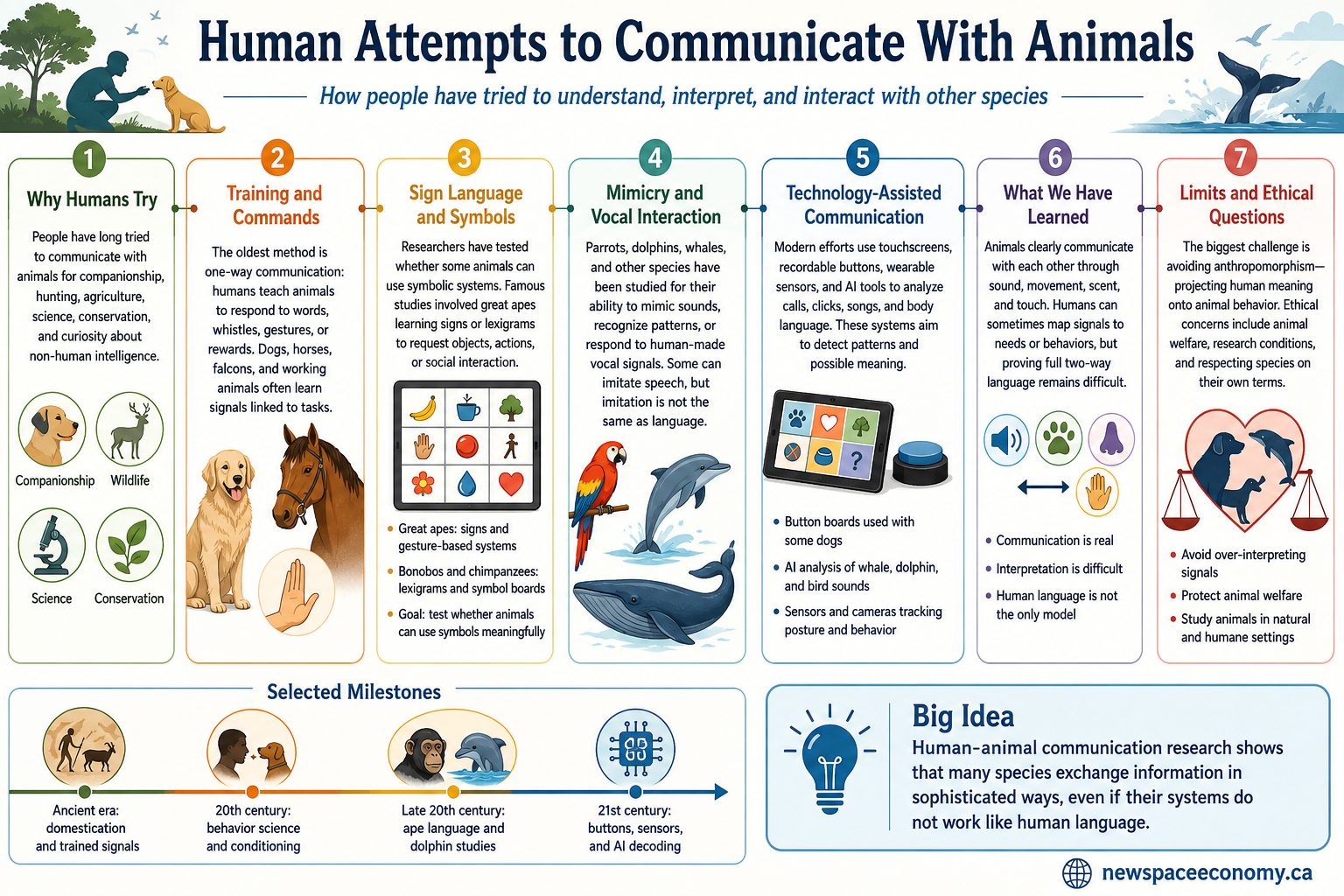
Human-animal communication does not mean proving that animals secretly speak human languages. It means studying how humans and other species exchange information through learned responses, gestures, vocalizations, symbols, objects, scent, body movement, touch, technology, and shared routines. The attached infographic captures that broad record well: training, commands, symbol systems, vocal imitation, soundboards, artificial intelligence, and ethics all belong to the same long effort to understand minds that do not work exactly like human minds.
That distinction matters because animal communication is real even when it is not language in the human sense. NOAA describes whale sounds as tools for communication, locating food, and finding one another. Dogs can learn commands and, in rare cases, object names. Parrots can imitate speech and, under controlled training, associate some words with objects or categories. Bonobos can use lexigrams to request food, social contact, or activities. None of these examples requires claiming that animals use grammar exactly as humans do.
A better framing treats communication as a spectrum of abilities. At one end sit trained responses, such as a dog sitting on command or a falcon returning to a handler. At another end sit flexible, context-dependent systems that researchers test for meaning, memory, social use, and combination. Between those ends sit many cases that are neither simple reflex nor full human language: a parrot naming colors, a dolphin responding to an artificial whistle, a bonobo pressing a symbol, or a whale using patterned clicks in a social group.
New Space Economy has drawn a useful parallel between animal communication and the search for extraterrestrial intelligence: both require humility about unfamiliar minds. A system can contain structure before humans understand meaning, and a message can matter to its users even when outsiders cannot translate it cleanly. That comparison helps explain why animal communication research has value beyond biology. It trains people to recognize intelligence without forcing every species into a human mold.
The main methods can be grouped by what humans ask animals to do. Some methods train animals to respond to human cues. Some invite animals to use symbolic tools. Some record natural behavior without asking animals to perform. Newer methods use sensors, cameras, hydrophones, machine learning, and citizen science data to search for patterns that would be difficult for humans to hear or see unaided. Each method can reveal something, and each can mislead when researchers overstate what has been shown.
This table organizes the main approaches and the scientific question each one tends to answer.
| Method | Typical Species | Research Question |
|---|---|---|
| Training And Commands | Dogs, Horses, Birds | Can animals associate human cues with actions? |
| Symbol Boards | Bonobos, Chimpanzees, Dogs | Can symbols support choice or request-making? |
| Vocal Studies | Parrots, Dolphins, Whales | Do sounds vary by context, individual, or social use? |
| AI-Assisted Analysis | Dogs, Birds, Dolphins, Whales | Can large datasets reveal structure humans miss? |
Why Training Opened the Door to Communication Research
Training is the oldest practical bridge between people and animals. Long before formal laboratories, humans worked with dogs, horses, falcons, pigeons, oxen, elephants, camels, and other species through repeated routines. The point was usually cooperation rather than research: hunting, herding, carrying, guarding, navigation, or companionship. In scientific terms, those routines showed that animals could associate human cues with outcomes, remember tasks, and modify behavior in response to rewards or consequences.
Modern learning theory gave that practical experience a more systematic vocabulary. Ivan Pavlov demonstrated how one stimulus could become associated with a response, and B. F. Skinner helped explain how consequences shape behavior through operant conditioning. These frameworks remain relevant because many human-animal communication attempts begin with learned association rather than spontaneous symbolic expression.
Training, though, does not settle the question of meaning. A dog that hears “sit” and lowers its body has learned a reliable response. That does not prove the dog understands the word as a human would. It may recognize a sound pattern, a gesture, a posture, the handler’s tone, or the situation in which the command usually appears. Good research design tries to test those alternatives by changing the speaker, hiding gestures, varying context, and checking whether the animal can generalize.
Dogs make this problem both attractive and difficult. Their long domestic history gives them unusual sensitivity to human behavior. Some dogs respond to many words in daily life, and gifted individual dogs have produced striking results under test conditions. Chaser, a border collie studied by John Pilley and Alliston Reid, learned the names of 1,022 objects over three years and showed understanding of separate object names and commands.
Work published in Science in January 2026 pushed canine word learning further. The paper on Gifted Word Learner dogs reported that a small group of dogs with large object-label vocabularies could learn new labels by overhearing human interactions. That finding does not mean ordinary dogs acquire language like children. It does show that some dogs can use social context in ways that complicate older assumptions about training and word learning.
The same caution applies to horses, marine mammals, birds, and working animals. Training creates a shared routine, and that routine can become sophisticated. A sheepdog may respond to whistles, position, pressure, and distance. A falcon may return to a handler after flight. A horse may respond to leg pressure, reins, voice, posture, and pattern. These systems are forms of interspecies coordination, but they often depend on repeated context and human management.
Training opened the door because it showed that cross-species cooperation could be precise. It also introduced the danger of over-reading. Clever Hans remains the warning label attached to every performance that seems too human. Researchers must ask what information the animal received, how the animal learned the task, whether the response survives hidden-cue controls, and whether independent observers can reproduce the result.
The strongest conclusion from training research is neither dismissive nor romantic. Animals can learn from humans, adjust to human expectations, and sometimes use learned cues flexibly. Yet trained behavior alone cannot prove humanlike language. It is a platform for testing cognition, not a guarantee that the test subject shares human categories.
What Sign Language and Symbol Boards Revealed
Ape language studies changed public expectations in the 1960s and 1970s. Researchers tried to move beyond spoken commands by giving apes access to gestures or visual symbols. Chimpanzees and bonobos lack the vocal anatomy for human speech, so sign language and lexigrams seemed to offer a fairer test. The goal was not just obedience. Researchers wanted to know whether apes could request, label, combine, and understand symbols in ways that revealed cognition.
Washoe, a chimpanzee taught signs adapted from American Sign Language, became one of the best-known cases. Koko the gorilla became another public symbol of ape signing, although interpretations of her abilities remain debated. Kanzi, a bonobo associated with Sue Savage-Rumbaugh’s research, became famous for using lexigrams and for apparent comprehension of spoken English. The Ape Initiative says its bonobos use lexigram symbols to request favorite foods, indicate preferred social partners, and ask caregivers to play.
The best-known ape studies produced two legacies. One is positive: they showed that some apes can learn arbitrary symbols, remember them, and use them in social exchanges with people. That matters because symbols are not tied directly to a natural gesture or sound. A lexigram for “banana” does not look like a banana. A bonobo that uses it must connect a visual mark, a desired object, and a social act.
The other legacy is methodological caution. Critics argued that some ape signing and symbol use could reflect prompting, imitation, reward seeking, or human interpretation rather than independent grammar. Irene Pepperberg’s review of animal language studies describes the broad controversy: whether nonhuman animals can learn actual human language remains disputed, even though several species have acquired elements of two-way systems useful for testing cognitive capacities.
Kanzi’s case remains influential because researchers reported abilities beyond simple labeling. He used a lexigram keyboard, responded to spoken words, and participated in long-running cognitive studies. Since Kanzi died in March 2025, discussion of his work has moved from living research subject to legacy. Yet his record still requires careful phrasing. Saying that he used symbols is safer than saying he possessed human language. Saying that he understood some spoken English is safer than saying he understood language as humans do.
The ape studies also changed ethics. Raising apes in humanlike environments created deep bonds, but it could also create welfare problems. Some projects ended with animals moved between homes, laboratories, sanctuaries, or research facilities. Later readers often judge those projects differently from the way the public viewed them during their peak. Scientific curiosity now sits beside stronger concern for captivity, choice, enrichment, social life, and long-term care.
Symbol boards remain valuable because they give animals a way to act on preference. Even when the result is not language, it can improve welfare. A bonobo choosing an activity, a dog pressing a button for outside, or a parrot requesting an object can all shift the relationship from one-way command to some degree of animal agency. Researchers still have to prove what the symbols mean to the animal, but the welfare value of choice should not be dismissed.
That is why the debate has matured. The question is no longer simply whether an ape can “talk.” Better questions ask how symbols work in a species with its own social needs, how much flexibility the animal shows, whether the behavior survives controls, and whether the tool gives the animal more control over daily life.
What Mimicry and Vocal Learning Show About Other Species
Parrots, dolphins, whales, seals, elephants, and many songbirds have drawn attention because sound sits closer to human expectations of language. A parrot that speaks a word or a dolphin that responds to a whistle feels more conversational than a dog sitting on command. Yet vocal ability can mislead. Mimicry is not automatically meaning, and meaning does not require mimicry.
Parrots show why the distinction matters. Many parrots can imitate human speech, but imitation alone says little about understanding. Irene Pepperberg used research with African grey parrots, particularly Alex, to test whether a bird could associate vocal labels with objects, colors, shapes, quantities, and relations. The Alex Foundation describes her work as focused on the cognitive and communicative abilities of grey parrots and on comparisons with great apes, marine mammals, and young children.
Alex became famous because he did more than repeat sounds in a household setting. Under structured testing, he identified categories such as color and shape, used vocal labels for objects, and demonstrated some numerical abilities. Researchers and journalists have sometimes overstated his capacities, but the conservative finding remains strong: a bird with a small brain by mammalian standards could perform cognitive tasks once treated as far beyond parrots.
Dolphin research sits on a different foundation. Dolphins use sound underwater in complex social environments, and researchers have long built artificial systems to test comprehension. Earlier work with marine mammals showed that dolphins could respond to artificial acoustic or gestural instructions. Newer projects shift attention toward their own vocal systems, asking how dolphins structure whistles, clicks, burst-pulsed sounds, and social exchanges.
Google’s DolphinGemma reflects that shift. Announced in April 2025 and developed with the Wild Dolphin Project and Georgia Tech, the model was trained on a dataset of underwater audio and video cataloged by individual dolphins and behavior. That does not mean a full dolphin translator exists. It means researchers now have machine-learning tools that can search large audio archives for structure, pattern, and context.
Whales raise the scale further. NOAA explains that whales use clicks, whistles, and pulsed calls for communication, locating food, and finding one another. Project CETI applies machine learning, robotics, biology, linguistics, and natural language processing to sperm whale codas, which are patterned click sequences used in social groups. The project’s stated work combines recordings, field robotics, and artificial intelligence to uncover patterns in whale communication.
Mimicry and vocal learning also reveal how easily humans privilege speech-like behavior. A talking parrot may appear more intelligent than a silent crow, even though crows solve difficult social and physical problems. A dolphin whistle may impress more than a bee dance, even though the bee dance encodes practical information. Human ears bias human judgment. Scientific method has to compensate for that bias by comparing function, flexibility, context, and learning rather than surface resemblance to human speech.
The best lesson from vocal research is restraint. Sound can reveal identity, mood, location, social status, alarm, mating, coordination, or learned labels. It can also reflect arousal, imitation, stress, or play. Researchers need recordings, context, repeated observation, and experimental controls before assigning meaning. Technology can find structure, but structure is not the same as translation.
How Digital Buttons, Sensors, and AI Changed the Research
Touchscreens, soundboards, wearable sensors, hydrophones, camera traps, accelerometers, and artificial intelligence have changed the scale of human-animal communication research. Older studies often involved one famous animal and a small team of observers. Newer work can include home-based data from many dogs, long-term acoustic recordings from whales, underwater robots, and machine-learning models trained on large sound archives.
The public face of this shift is the talking-button dog. Thousands of pet owners have used augmentative interspecies communication devices, often built as floor soundboards with buttons that play prerecorded human words. Viral clips can invite overstatement, yet peer-reviewed work has started testing whether the behavior is deliberate, nonrandom, and responsive to word meaning. A 2024 PLOS ONE study tested whether soundboard-trained dogs responded appropriately to food-related, play-related, and outside-related words under controlled conditions.
A related 2024 Scientific Reports study analyzed button presses by 152 dogs over 21 months and examined whether two-button combinations were non-accidental, non-random, and not mere repetitions of owner presses. The study reported more than 260,000 button presses, including about 195,000 by dogs. This still does not prove dog grammar, but it moves the discussion away from isolated viral anecdotes and toward testable data.
Sensors matter because communication often depends on behavior beyond sound. A whale click sequence means less without knowing who produced it, who was nearby, whether the animal was diving, feeding, resting, nursing, or traveling. Project CETI’s work uses underwater recording and field robotics for that reason. In May 2026, Reuters reported that Project CETI researchers had developed an autonomous underwater robot capable of tracking sperm whale communication in real time by detecting codas, using a glider equipped with hydrophones and autonomous navigation software.
Earth Species Project represents a broader AI-centered approach. The organization says it develops machine-learning tools to study animal communication across species, with an emphasis on open science and conservation applications. Its framing is ambitious, but the scientific boundary remains clear: artificial intelligence can help detect structure, classify sounds, and connect patterns with behavior. It cannot bypass the need for biology, field observation, and careful interpretation.
A useful comparison comes from New Space Economy’s discussion of animal sounds and extraterrestrial messages. In both areas, the existence of structure is only an opening. Researchers might detect repeated patterns, turn-taking, individual signatures, or context-linked sounds before they know meaning. The same logic applies to the search for extraterrestrial intelligence: a detectable pattern may show design or intelligence before anyone knows what the message says.
This table shows how current tools fit into the research process without overstating what they can prove.
| Tool | Use | Main Limit |
|---|---|---|
| Soundboards | Let animals trigger recorded words | Meaning can be hard to confirm |
| Hydrophones | Record underwater vocal behavior | Context still needs field data |
| Wearable Sensors | Connect sound with movement | Attachment can affect behavior |
| Machine Learning | Finds patterns in large datasets | Pattern is not translation |
The promise of these tools is scale. A human observer can miss low-amplitude bird calls, overlapping whale clicks, or subtle timing relations. A model can compare far more sound clips than a single laboratory could handle manually. Yet models can also learn shortcuts, reflect biased data, or produce confident classifications with weak biological meaning. The old Clever Hans lesson has returned in digital form: an impressive output may be right for the wrong reason.
For that reason, the strongest work pairs computation with field biology. Audio alone is rarely enough. Researchers need video, behavioral annotation, social history, individual identification, location, season, age, sex, group composition, and ecological setting. Without that context, an algorithm may cluster sounds beautifully and still tell humans little about what the animal is doing.
Why Meaning Depends on Context, Not Just Sound
A sound, button press, gesture, or body movement gains meaning from the situation in which it appears. A dog pressing “outside” near a door differs from a dog pressing it after an owner models the button. A whale coda during social contact differs from a coda during travel. A parrot naming an object during a test differs from a parrot repeating a household phrase for attention. Human-animal communication research often turns on these contextual distinctions.
Context includes the animal’s own world. Dogs live in human households and read human routines. Bonobos live in social groups with complex relationships. Dolphins and whales inhabit acoustic environments where sound travels differently than it does in air. Birds may communicate through song, call, posture, and movement. Scent, touch, and spatial arrangement matter in many species, even when humans focus on sound because it resembles speech.
Anthropomorphism remains the standing risk. People easily project human categories onto animals, particularly familiar animals such as dogs, cats, parrots, and horses. A dog pressing “love you” may produce a moving human response, but researchers still have to ask what pattern the dog has learned. The animal may be seeking attention, reproducing a rewarded sequence, making a request, exploring a button, or using a learned association in a way that has meaning within its own social world.
The reverse error is also possible. Fear of anthropomorphism can lead researchers to understate animals’ capacities. A parrot that labels colors, a dog that remembers object names, or a bonobo that requests an activity should not be dismissed as a machine-like response just because it is not human language. Balanced interpretation requires testing without contempt and caution without denial.
Comparative cognition has moved toward that balance. The question is rarely “Does this animal have language?” in the fullest human sense. Better questions ask whether the animal can learn arbitrary labels, use them flexibly, combine them, understand another individual’s attention, remember labels over time, apply them to new cases, or adjust communication to social context. Those questions produce smaller claims, but they stand up better scientifically.
Whale and dolphin research shows why meaning is hard. Their vocalizations occur in fluid, mobile, often low-visibility environments. Individuals may be far apart. Social relationships can be long-lived. Sound can serve navigation, social contact, prey detection, or group coordination. NOAA’s description of marine mammal sounds underscores that underwater sound carries multiple functions, which makes single-purpose interpretation risky.
Button research has a similar issue in homes. Dogs live with people who respond physically, verbally, and with visible affection to button presses. The home is rich in cueing. Owners may unintentionally reinforce some sequences and ignore others. That does not make the data useless, but it means citizen science requires strong controls, careful logging, and humility about interpretation.
The most reliable claims usually involve repeated behavior under changed conditions. A dog that responds to a word from an unfamiliar person, a parrot that labels a color across different objects, or a bonobo that requests a desired activity without a visible reward cue offers stronger evidence than a one-time performance. Repetition, control, and context are the difference between a charming anecdote and scientific evidence.
What Ethics Demand When People Study Animal Communication
Ethics cannot be treated as a footnote to communication research. The subject is not a tool, a puzzle, or a content generator. It is a living animal with its own needs, social relationships, stress responses, sensory world, and welfare interests. The more people claim an animal can communicate, the greater the obligation to listen to what the animal’s behavior may be saying about comfort, fear, boredom, frustration, or preference.
Formal animal research ethics often draw on the principles of Replacement, Reduction, and Refinement, known as the 3Rs. The NC3Rs describes these principles as a framework for more humane animal research: replacing animal use where possible, reducing the number of animals used, and refining methods to reduce suffering and improve welfare. The National Academies’ laboratory animal guide provides a major reference point for institutions that conduct animal research.
Communication research raises added concerns because the work often requires close relationships. A dog, parrot, ape, dolphin, or horse may bond with trainers, handlers, researchers, or caregivers. That bond can support learning, but it can also make the animal dependent on a human environment designed around research goals. Ape language studies taught the field that long-term care matters as much as data collection. A project does not end ethically when a paper is published.
Captive marine mammal research poses another tension. Dolphins are highly social and wide-ranging animals. Studies in controlled settings can reveal cognitive capacities, but captivity itself raises welfare questions. Field studies avoid some captivity concerns, yet they can still disturb animals through boats, drones, tags, or close human presence. Ethical design must ask whether the research question justifies the intrusion and whether less invasive methods can answer it.
Pet-based soundboard research has its own ethical profile. It may appear harmless because it occurs at home, but welfare still matters. Owners may pressure animals to perform for cameras, interpret ordinary behavior as messages, or keep animals in repeated testing routines that serve human attention more than animal choice. Good practice would treat buttons as optional enrichment, not as a demand that a dog constantly explain itself to humans.
AI brings a newer ethical problem: control. If humans become better at predicting animal responses, they could use that knowledge to protect animals, reduce conflict, and improve welfare. They could also use it to manipulate animals more efficiently. A translation claim could support conservation, but it could also become entertainment, branding, surveillance, or training pressure. The direction depends on governance, transparency, and restraint.
Research language matters. Saying “a dog asked for help” may be appropriate only if the evidence supports that interpretation. Saying “a whale language has been decoded” may mislead if researchers have identified structure but not meaning. Overstatement can harm animals by turning them into spectacle. Understatement can harm them by ignoring capacities that should affect welfare decisions. Ethical communication requires careful verbs.
The strongest ethical standard is simple: study animals on terms that respect their species-specific lives. That means observing natural settings when possible, giving captive animals meaningful choice, publishing limits along with findings, and avoiding claims that convert animal behavior into human fantasy. Communication research should widen respect, not tighten control.
How Animal Communication Research Changes the Search for Intelligence
Human attempts to communicate with animals have reshaped the idea of intelligence. The older ladder model placed humans at the top and ranked animals by how closely they resembled people. Newer research is less comfortable with that ladder. Intelligence may involve memory, social understanding, navigation, tool use, vocal learning, imitation, problem solving, mood, planning, or cooperation. Different species solve different problems because they live different lives.
Animal communication research teaches that intelligence may appear in unfamiliar form. A whale’s acoustic culture, a parrot’s learned labels, a dog’s response to human attention, a bonobo’s lexigram choice, or a bird’s alarm-call structure may each reveal part of a mind. None has to become a miniature human to deserve study. This point connects directly to New Space Economy’s writing on animal communication and alien languages, which stresses that unfamiliar minds may use unfamiliar media and structures.
The search for extraterrestrial intelligence and animal communication share a problem of translation without shared context. Humans trying to understand whales face a species that lives underwater, navigates by sound, and experiences the environment through senses and pressures unlike human life. Humans imagining extraterrestrial contact face an even greater gap. Animal communication is not a rehearsal for alien contact in a literal sense, but it is a practical school for humility.
The comparison also warns against human-centered assumptions. Early animal language studies often asked whether animals could learn human symbols. That was a reasonable question, but it placed humans at the center. Newer work increasingly asks what animals already communicate to one another. The same shift would matter in any search for nonhuman intelligence beyond Earth. The task is not only sending messages humans find elegant. It is learning how another intelligence may organize information.
Artificial intelligence may make that shift easier and riskier. Models can search for patterns in whale codas, dolphin whistles, bird calls, and dog barks at large scale. They can help researchers compare timing, frequency, repetition, and association with behavior. Yet they can also give the illusion of translation before meaning has been demonstrated. The phrase “animal translator” should be used carefully unless a system has been tested against behavior, context, and prediction.
For the space economy, the link is indirect but real. Technologies developed for remote sensing, acoustics, autonomous robotics, edge computing, and AI-assisted pattern recognition often move between fields. Underwater robots that follow whales and spacecraft that monitor Earth both depend on sensors, autonomy, communication links, and interpretation of complex data. New Space Economy’s broader coverage of human-animal communication makes the topic useful for readers thinking about nonhuman intelligence, SETI, and the limits of translation.
The public should expect progress, not miracles. Researchers are likely to identify more species-specific structures, individual identifiers, context-linked calls, and meaningful responses to human tools. Full two-way translation, if it ever arrives for any species, will probably be narrow at the beginning. It may apply to specific contexts such as requests, social contact, distress, play, or movement rather than open-ended conversation.
The deepest shift is conceptual. Human-animal communication research does not shrink the gap between humans and other species by pretending the gap is gone. It makes the gap more precise. Humans learn where other animals share capacities with people, where they differ, and where human categories fail. That knowledge can support better science, better welfare, and better decisions about how to live with other minds on the same planet.
Summary
Human attempts to communicate with animals began with practical cooperation and became a scientific effort to understand cognition, meaning, and welfare. Training showed that animals can associate human cues with actions, but it also introduced the risk of unconscious prompting. Symbol systems showed that some apes and other animals can use arbitrary marks to make choices or requests, even though claims about full humanlike language remain disputed. Vocal research with parrots, dolphins, whales, and birds demonstrated that sound can carry complex information without needing to match human speech.
Digital tools have widened the field. Soundboards, sensors, hydrophones, robotics, and AI can collect and analyze far more data than older laboratory studies. They can reveal structure, repeated patterns, and context-linked behavior. They cannot turn structure into meaning without field knowledge, experimental controls, and careful interpretation. The best current research treats technology as an aid to biology, not a replacement for it.
The ethical lesson is as important as the scientific one. Animals should not be forced into human categories or used as performance devices for human fascination. Communication research has the greatest value when it increases animal agency, improves welfare, and helps people understand other species on their own terms. That lesson matters for pets, wildlife, conservation, and even the way humans imagine communication with intelligence beyond Earth.
Appendix: Useful Books Available on Amazon
- Alex & Me
- Are We Smart Enough to Know How Smart Animals Are?
- In the Company of Animals
- The Dolphin in the Mirror
- Beyond Words
- Animal Wise
- Animals in Translation
Appendix: Top Questions Answered in This Article
Can Animals Really Communicate with Humans?
Yes, but the answer depends on what “communicate” means. Many animals can learn to respond to human cues, and some can use symbols, buttons, gestures, or vocal labels in limited contexts. That does not prove they use human language. It shows that cross-species information exchange can be real, structured, and useful without being identical to human speech.
Do Talking Parrots Understand What They Say?
Some parrots merely imitate sounds, but controlled research with African grey parrots shows that trained birds can associate words with objects, colors, shapes, and quantities. Alex, the best-known parrot in Irene Pepperberg’s research, became influential because his responses were tested under structured conditions. Even then, researchers distinguish learned symbolic use from full human language.
Did Apes Learn Sign Language?
Some apes learned signs or visual symbols and used them to request objects, activities, or social contact. Washoe, Koko, Kanzi, and other famous animals shaped public debate, but the interpretation of their abilities remains contested. The cautious view is that some apes learned meaningful symbol use, yet evidence for humanlike grammar remains limited.
Are Dog Soundboards Real Communication or Owner Interpretation?
Soundboards can support communication-like behavior, but they require careful interpretation. Peer-reviewed studies have found evidence that some dogs respond to soundboard words and produce nonrandom button combinations. Those findings do not prove open-ended dog language. They show that some button behavior is worth serious study rather than instant dismissal.
Can AI Translate Animal Communication?
AI can help detect patterns in large audio and behavioral datasets, but pattern detection is not the same as translation. Projects involving dolphins, whales, birds, and other species may reveal structure that humans miss. Meaning still requires context, field observation, controlled testing, and biological knowledge.
Why Is Clever Hans Still Discussed?
Clever Hans showed that an animal can appear to perform a complex cognitive task by responding to unconscious human cues. That case changed research design in animal cognition. It remains relevant because modern studies, including AI-assisted work, can still produce impressive results for the wrong reason if controls are weak.
What Species Have Been Central to Human-Animal Communication Research?
Dogs, horses, parrots, chimpanzees, bonobos, gorillas, dolphins, whales, and songbirds have all been central. Each species offers different strengths. Dogs excel at reading human social behavior, parrots at vocal learning, apes at gesture and symbol use, and cetaceans at acoustic communication in complex social settings.
Does Animal Communication Research Prove That Animals Think Like Humans?
No. It shows that many animals process information, learn from context, form social relationships, and sometimes use learned symbols or sounds flexibly. The strongest science does not need to claim that animals think like humans. It asks how each species solves problems in its own sensory and social world.
Why Does Animal Welfare Matter in Communication Studies?
Communication studies often involve close contact, training, captivity, or repeated testing. Animals can experience stress, boredom, frustration, and social deprivation. Ethical research must reduce harm, provide enrichment, respect species-specific needs, and avoid turning animals into spectacles for human entertainment.
What Is the Biggest Lesson from Human Attempts to Communicate with Animals?
The biggest lesson is that communication is broader than human language. Animals exchange information in many ways, and some can learn limited human-made systems. The strongest research respects both sides of the truth: animals are not speechless machines, and they are not hidden humans in fur, feathers, or fins.
Appendix: Glossary of Key Terms
Animal Cognition
Animal cognition is the study of how nonhuman animals perceive, learn, remember, solve problems, and respond to their surroundings. It includes research on attention, memory, social learning, planning, tool use, communication, and decision-making across many species.
Anthropomorphism
Anthropomorphism means assigning human thoughts, motives, emotions, or meanings to nonhuman animals without enough evidence. It can make animal behavior easier to relate to, but it can also distort scientific interpretation when human expectations replace observation.
Artificial Intelligence
Artificial intelligence refers to computer systems designed to perform tasks such as classification, prediction, pattern recognition, language processing, and decision support. In animal communication research, AI can help analyze large sound and behavior datasets.
Clever Hans Effect
The Clever Hans effect occurs when an animal or system appears to solve a task but is actually responding to unintended cues. The phrase comes from a horse whose apparent arithmetic ability depended on subtle human body language.
Conditioned Reflex
A conditioned reflex is a learned response created by association. Pavlov’s work with dogs made the concept famous by showing how a neutral cue could become linked to a biological response after repeated pairing with food.
Lexigram
A lexigram is a visual symbol used to represent a word, object, action, or idea. Bonobo communication studies have used lexigram keyboards to let apes request foods, activities, or social contact.
Machine Learning
Machine learning is a form of artificial intelligence in which software finds patterns in data and improves performance through training examples. In bioacoustics, machine learning can classify sounds, compare recordings, and search for recurring structures.
Operant Conditioning
Operant conditioning is learning shaped by consequences. A behavior that leads to reward may become more likely, and a behavior that leads to an unwanted result may become less likely.
Soundboard
A soundboard is a set of buttons that play recorded words or phrases when pressed. Some pet owners and researchers use soundboards to study whether dogs and other animals can associate buttons with actions, objects, or requests.
Vocal Learning
Vocal learning is the ability to modify sounds through experience. Parrots, songbirds, dolphins, and some other animals can learn or alter vocalizations, making them valuable subjects for communication research.


