


Key Takeaways
- Starbase Louisiana combines launch, propellant, power, processing, shipping, and residential functions.
- SpaceX plans construction in 2027, with an initial Starship launch targeted for as early as 2029.
- Louisiana could gain a large aerospace center, but permitting, coastal effects, infrastructure, and execution remain open.
What SpaceX Announced at Starbase Louisiana
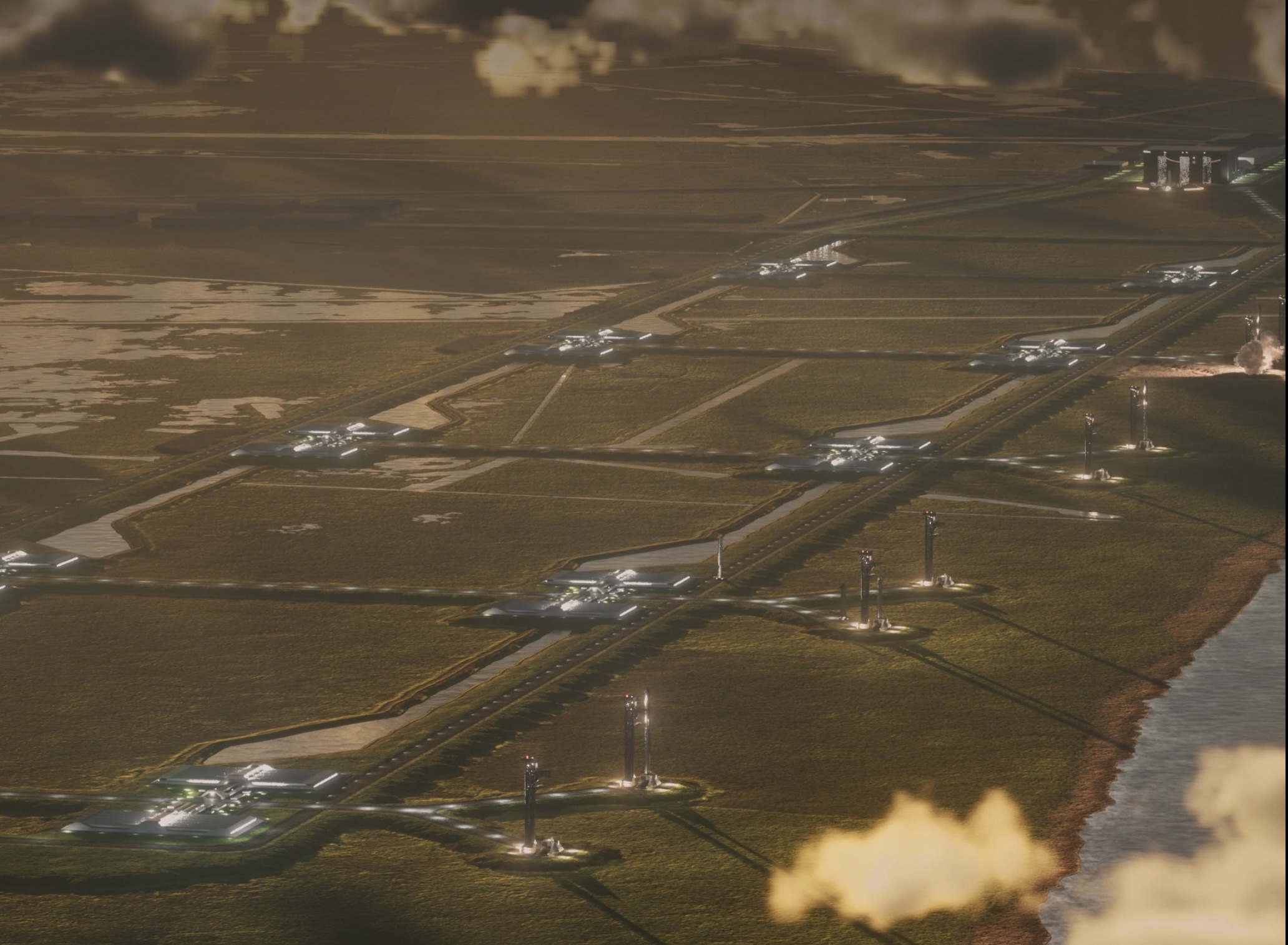
On August 25, 2026, SpaceX formally announced Starbase Louisiana, a planned Starship complex in Vermilion Parish on Louisiana’s Gulf Coast. The company’s dedicated Starbase Louisiana project page and the Louisiana Economic Development announcement describe a project intended to become SpaceX’s fourth and largest launch site. Louisiana says SpaceX plans to invest $100 billion, begin construction in 2027, and target an initial Starship launch for as early as 2029.
The proposed site covers approximately 125,000 acres near Pecan Island, according to Reuters coverage of the announcement. The acreage is more significant than the footprint of the launch pads themselves because high-energy launch operations require large safety areas, industrial separation, utilities, transportation corridors, environmental mitigation areas, and room for future development.
The $100 billion figure should be read as an announced investment commitment associated with the planned development rather than money already spent. As of August 25, 2026, neither SpaceX nor Louisiana had published a complete year-by-year capital spending schedule showing how the entire amount would be deployed. Construction progress, permitting, vehicle development, and operational requirements can change the timing and composition of spending on a project of this scale.
Louisiana Economic Development says SpaceX expects to create 3,000 direct jobs over 10 years with an average annual salary of $92,600. The state agency estimates more than 8,100 indirect jobs, producing more than 11,100 potential job opportunities in the Acadiana region. These figures remain projections tied to the development plan rather than employment already created.
At full buildout, Louisiana says the complex is expected to contain five launch complexes, each equipped with two launch pads and a propellant farm. Other planned facilities include propellant production, dedicated power generation, vehicle processing, and residential housing for SpaceX employees and their families. SpaceX has also described maritime and aviation infrastructure associated with the property, including deep-water shipping and airport access.
That combination makes Starbase Louisiana fundamentally different from a conventional launch pad. It is being conceived as an integrated industrial and transportation complex designed around high-frequency operation of one launch system.
The principal announced components can be summarized as follows.
| Element | Announced Plan | Operational Implication |
|---|---|---|
| Launch Complexes | Five Complexes With Two Pads Each | Potential High-Cadence Starship Operations |
| Propellant Production | On-Site Production and Storage | Reduces Dependence on Delivered Propellant |
| Power Generation | Dedicated Energy Infrastructure | Supports Large Industrial Loads |
| Vehicle Processing | Integrated Starship Processing | Keeps Servicing Near Launch Operations |
| Maritime Logistics | Deep-Water Shipping Capability | Supports Oversized Hardware Transport |
| Residential Development | Housing for Employees and Families | Creates a Company-Centered Industrial Community |
Louisiana describes the completed facility as capable of supporting thousands of launches annually. That is a long-term design objective, not a licensed or demonstrated operating rate as of August 25, 2026. The distinction matters because infrastructure can be designed for a future capacity years before vehicle reliability, market demand, environmental permissions, and flight licensing permit that capacity to be used.
Starbase Louisiana Extends SpaceX’s Vertically Integrated Spaceport Model
SpaceX’s Texas Starbase provides the clearest existing example of the company’s approach to launch-site integration. SpaceX’s June 2026 corporate materials describe Starbase, Texas as a combined development, manufacturing, testing, integration, refurbishment, and launch location for Starship and Super Heavy.
Instead of treating the launch site as independent infrastructure serving several rocket companies, SpaceX treats much of the ground infrastructure as part of the vehicle system. Manufacturing facilities, integration structures, launch towers, propellant systems, transport equipment, test facilities, and recovery equipment are coordinated around Starship.
That structure resembles the vertically integrated spaceport model described in New Space Economy’s analysis of commercial spaceport business models. Under that model, the launch operator controls a larger share of the infrastructure required to build, process, launch, recover, and prepare vehicles for another mission. The economic value of the facility comes primarily from improving the operator’s own transportation system rather than collecting launch fees from unrelated tenants.
Starbase Louisiana takes that idea much farther geographically and industrially. Five launch complexes with two pads each would create substantial redundancy if all are completed. Propellant production reduces dependency on long-distance delivery. Dedicated power gives SpaceX greater control over energy availability. Processing facilities reduce the distance vehicles or major components must travel between operational stages. Maritime access creates another route for moving structures that are difficult to transport by road.
Vehicle and launch-site design are tightly connected because Starship’s reusable architecture depends on its towers and other ground equipment. The Super Heavy booster is intended to return toward its launch site and can be captured by mechanical arms on the launch tower. A system built around tower recovery changes what counts as part of the rocket. The pad, tower, control software, propellant infrastructure, range procedures, transport systems, and recovery process all contribute to turnaround time.
New Space Economy’s analysis of SpaceX launch cadence and reusability describes cadence as an industrial capability rather than a property of the vehicle alone. Reusable hardware does not automatically create a high-frequency transportation service. The operator also needs enough pads, trained personnel, replacement components, propellant, inspection capacity, maintenance equipment, mission demand, regulatory authorization, and scheduling flexibility to return recovered hardware to service.
Starbase Louisiana appears designed around that constraint. SpaceX is planning ground capacity that could become available as Starship matures instead of waiting for vehicle flight frequency to overwhelm a smaller site.
This approach carries a financial cost. Large amounts of capital must be committed before high launch volumes exist. New Space Economy’s examination of spaceport financial models notes that spaceport economics depend heavily on launch assumptions, regulatory pathways, power, transportation, site preparation, environmental obligations, maintenance, staffing, and infrastructure utilization. A site designed for exceptionally high throughput is valuable if flight activity grows into the capacity. Underused infrastructure creates the opposite result.
Why the Pecan Island Location Fits the Proposed Operating Model
The Pecan Island area offers SpaceX three attributes that are difficult to reproduce near dense population centers: large acreage, Gulf access, and proximity to Louisiana’s energy and maritime industries.
The acreage allows SpaceX to separate hazardous functions, create launch safety areas, reserve expansion space, develop utilities, and position industrial facilities at distances that would be difficult within a smaller parcel. The proposed site also gives SpaceX more freedom to design the entire property around Starship rather than fit Starship into infrastructure built for earlier vehicles.
Louisiana Economic Development identifies abundant natural gas as one of the reasons the state considers the site suitable for SpaceX. Starship’s Raptor engines use liquid methane and liquid oxygen. On-site propellant production could connect the launch operation to Louisiana’s established energy infrastructure, although the exact production methods, capacity, energy consumption, and suppliers had not been publicly detailed on August 25, 2026.
The Gulf Coast location also supports maritime logistics. Large rocket components create transportation problems because road routes must accommodate vehicle height, width, turning radius, bridge capacity, utilities, traffic restrictions, and security. Barges and other marine transportation can carry oversized industrial structures more efficiently when suitable waterways and loading facilities exist.
Louisiana already has a workforce experienced in offshore energy, shipbuilding, petrochemicals, pipelines, fabrication, industrial construction, cryogenic systems, pumps, pressure vessels, heavy equipment, corrosion management, marine operations, and complex maintenance. Aerospace production imposes its own standards and qualification requirements, but the underlying industrial capabilities overlap with many activities required at a large launch facility.
The location creates disadvantages as well. Coastal Louisiana experiences hurricane exposure, storm surge, flooding, subsidence, saltwater corrosion, wetland loss, and severe weather. High-value launch infrastructure in such an environment requires extensive drainage, structural protection, emergency planning, corrosion control, backup power, evacuation procedures, and recovery planning.
The site’s location does not automatically determine which orbital trajectories SpaceX can use. Launch paths must account for public risk, airspace, maritime traffic, vehicle performance, mission destination, overflight considerations, and Federal Aviation Administration approval. Louisiana’s Gulf location may offer useful mission geometries, but specific trajectories will become clear only when SpaceX submits operational proposals and regulators evaluate them.
The large property also cannot isolate every effect of high-frequency rocket operations. Launches can generate noise, vibration, sonic booms, bright lighting, road activity, temporary airspace restrictions, marine restrictions, construction traffic, and debris risks. If SpaceX eventually seeks hundreds or thousands of Louisiana launches annually, those effects would be examined at a scale far above the site’s initial launch activity.
Louisiana Prepared Its Aerospace Policies Before the Announcement
Louisiana’s 2026 legislative session produced several measures designed to make the state more attractive to large aerospace projects.
The most direct financial measure is Act 190 of the 2026 Regular Session. The law creates sales and use tax rebates for qualifying purchases associated with approved aerospace facilities. A facility owner must attest that the project will create at least 200 new direct, permanent, full-time Louisiana jobs and intends to make at least $1 billion in new capital investment between July 1, 2026, and July 1, 2031.
The initial rebate agreement can run for 20 years. The statute includes provisions allowing Louisiana to terminate an agreement and recover rebates when an approved facility does not fulfill specified obligations. Louisiana Economic Development said on August 25 that SpaceX is expected to participate in the Aerospace Facilities and Activities Rebate established under Act 190.
Louisiana also enacted Act 343 governing aerospace flight claims. The law took effect August 1, 2026 and establishes a special motion-to-strike procedure for covered lawsuits involving aerospace flight entities. A plaintiff can overcome the motion by establishing a probability of success on the claim. The statute also provides for reasonable attorney fees and costs for the prevailing party on the motion and generally stays discovery after such a motion is filed.
Act 343 is not blanket immunity from liability. It establishes a procedural mechanism intended to resolve certain claims earlier in litigation. The distinction matters because descriptions of state aerospace legislation can otherwise create the impression that launch operators have been insulated from every form of civil liability, which the enacted text does not say.
Louisiana’s incentive package for SpaceX extends beyond those statutes. The state’s August 25 announcement says the incentives are conditioned on investment, job creation, and a $25 million charitable contribution to the Community Foundation of Acadiana. SpaceX is also expected to participate in Louisiana’s High Impact Jobs program and receive recruitment assistance through LED FastStart.
The local fiscal arrangement is substantial. Louisiana Economic Development says SpaceX entered into a Payment in Lieu of Taxes agreement with local taxing bodies. Under the announced terms, SpaceX will pay $25 million to the parish each year for 25 years, with annual increases through an agreed escalator, plus an additional $20 million up-front payment. The state estimates more than $820 million in direct local payments over the arrangement.
These provisions show that Starbase Louisiana is as much an industrial-policy project as an aerospace project. Louisiana is combining land, incentives, workforce development, regulatory coordination, legal policy, infrastructure, and community payments to attract an unusually large private investment.
The economic result will depend on execution. Announced investment does not automatically create equivalent local economic value. Long-term benefits depend on construction contracts, permanent employment, salaries, supplier spending, infrastructure improvements, tax arrangements, educational investment, and whether skills created for SpaceX remain transferable to other industries.
Starbase Louisiana Is a Bet on Much Higher Starship Flight Cadence
SpaceX’s description of a Louisiana facility capable of thousands of launches annually reveals the assumption behind the entire project. SpaceX expects Starship eventually to operate at a frequency far beyond traditional heavy-lift rockets.
The present program has not reached that operating level. SpaceX’s twelfth Starship flight test launched from Starbase, Texas on May 22, 2026. That mission marked the initial flight of the V3 Starship and Super Heavy architecture, the initial use of Raptor 3 engines in flight, and the initial Starship launch from Pad 2.
Flight 12 demonstrated substantial progress, but its outcome also illustrates why Starship remained a development program in August 2026. Super Heavy suffered an incomplete boostback burn and ended with a hard splashdown. Starship lost one vacuum Raptor during ascent but reached its planned trajectory, deployed 20 Starlink simulators and two modified Starlink spacecraft, conducted an in-space Raptor relight demonstration, survived reentry, and completed its planned descent sequence.
New Space Economy’s comparison of Starship versions from V1 through V4 shows how quickly the vehicle configuration and supporting infrastructure are changing. Starship V3 introduced Raptor 3 and substantial vehicle changes, and later configurations remain under development. A Louisiana launch complex beginning construction in 2027 may consequently be optimized for vehicle hardware different from the V3 system that flew in May 2026.
SpaceX’s own June 2026 corporate materials describe Starship V3 as expected to carry approximately 100 metric tons and future generations as potentially reaching 200 metric tons. Those statements are company projections, not demonstrated operational payload records for a routinely reusable Starship service.
Flight frequency changes the economics of a reusable vehicle. A rocket that flies once every several months cannot distribute fixed costs as effectively as one that flies repeatedly. Production facilities, launch towers, engineering teams, support ships, tracking equipment, software, maintenance organizations, and regulatory staff create costs whether a rocket flies or remains on the ground.
High cadence lets operators spread those expenses across more missions. It can also increase learning because recurring operations produce repeated maintenance, scheduling, fueling, recovery, and turnaround experience.
SpaceX has already demonstrated this effect with Falcon 9. Its Starlink constellation gives the company a large internal source of launch demand, allowing rockets and launch infrastructure to remain active even when external commercial missions alone would not sustain the same cadence. Starship could extend that strategy to larger Starlink spacecraft, lunar missions, tankers, commercial payloads, government missions, and possible future orbital infrastructure.
Thousands of launches would require far greater demand than exists for heavy-lift services in 2026. Starbase Louisiana therefore represents a wager that cheaper and more frequent transportation will create new demand rather than simply divide today’s launch market among more flights.
New Space Economy’s discussion of the space value chain helps explain the possible demand expansion. Lower transportation costs can affect spacecraft manufacturing, communications, Earth observation, research, logistics, orbital servicing, government procurement, defense missions, and future in-space activity. Those markets do not automatically expand at the same rate as launch capacity, but a large reduction in transportation constraints could change spacecraft design and mission economics.
Louisiana Could Gain an Aerospace Manufacturing and Logistics Center
The employment implications of Starbase Louisiana extend beyond rocket engineers. A facility containing 10 launch pads, propellant infrastructure, power generation, processing buildings, housing, transportation systems, and supporting utilities would require extensive construction and operational labor.
Potential occupations include welders, electricians, machinists, industrial technicians, controls specialists, heavy-equipment operators, marine workers, construction managers, safety specialists, security staff, mechanics, engineers, information technology specialists, utility operators, emergency personnel, and logistics professionals.
Louisiana’s existing workforce gives the state an unusual base for some of these occupations. Offshore energy and petrochemical industries already train workers to operate complex systems involving high pressures, cryogenic materials, hazardous substances, large steel structures, rotating machinery, industrial automation, marine transportation, and continuous maintenance.
SpaceX could create a new demand channel for those capabilities. The extent of local participation will depend on hiring practices, required qualifications, training capacity, procurement decisions, and the willingness of existing suppliers to qualify for aerospace work.
Supplier effects may extend beyond Vermilion Parish. A project of this scale can purchase concrete, steel, electrical equipment, industrial gases, valves, pumps, instrumentation, communications hardware, software, transportation services, housing, food services, maintenance, environmental services, professional services, and specialized manufacturing.
SpaceX has joined Louisiana’s Source Louisiana supplier database, according to the state announcement, which gives Louisiana businesses a formal route for identifying procurement opportunities associated with major projects.
Maritime logistics could broaden the impact. Louisiana’s ports, fabrication yards, barge operators, heavy-lift companies, and marine contractors already handle oversized industrial cargo. Starship hardware and launch-site structures are well suited to water transport where appropriate facilities are available.
The employment effect will not be entirely positive by default. Thousands of high-paying jobs entering a sparsely populated region can push up housing demand, increase traffic, strain utilities, raise demand for public services, and create competition for skilled trades already needed by energy and industrial projects.
Schools and technical colleges may need to expand training programs. Roads may require improvement. Emergency services may need more personnel and specialized equipment. Housing development could accelerate beyond the immediate Starbase property.
The economic value of the project will be stronger if Louisiana turns SpaceX-specific demand into transferable capabilities. A worker trained in advanced welding, industrial controls, propulsion support, cryogenic systems, or automated manufacturing can potentially work in several sectors. A supplier that meets aerospace quality requirements may be able to sell to defense, aviation, energy, maritime, and other space customers.
Dependence on one company creates another risk. If a regional supplier base becomes highly dependent on SpaceX, changes to Starship development, launch frequency, procurement strategy, automation, or corporate investment could affect the broader local economy. Diversification would make the industrial gains more resilient.
Coastal and Community Effects Will Shape the Project
Starbase Louisiana is proposed for a part of the state where wetlands, fisheries, hurricane protection, energy infrastructure, private property, and coastal restoration already compete for space and resources.
Louisiana Economic Development says SpaceX has engaged the Louisiana Department of Wildlife and Fisheries, Coastal Protection and Restoration Authority, and other state agencies concerning possible effects on wildlife, fisheries, and habitat. SpaceX also says it intends to work with conservation organizations to avoid, reduce, or compensate for environmental effects where possible.
These commitments do not constitute completed environmental approval. Detailed facility plans, permit applications, wetland impacts, hydrological studies, mitigation requirements, operational flight profiles, noise exposure, and construction footprints provides a more useful basis for evaluating environmental effects as the project advances.
Environmental organizations have already raised objections. On August 25, the Louisiana Wildlife Federation, National Wildlife Federation, and Pontchartrain Conservancy announced comments regarding the federal regulatory framework for commercial space activity and cited the environmental sensitivity of Pecan Island. Their concerns include habitat, water, wetlands, coastal resources, and the consequences of streamlining environmental requirements for launch projects.
Federal policy is also changing. The Federal Aviation Administration’s July 2026 proposal would establish broader authority to waive requirements associated with 13 federal environmental and natural-resource laws in certain commercial space licensing circumstances when the agency concludes those requirements are unnecessary for the statutory safety, property, national-security, or foreign-policy purposes governing commercial space licensing.
As of August 25, 2026, that FAA action remained a proposal rather than a completed final rule. The distinction affects any assessment of how Starbase Louisiana will be reviewed. It would be premature to state that the Louisiana project has received a particular federal environmental waiver or that normal environmental requirements no longer apply.
The FAA remains the federal agency responsible for licensing U.S. commercial launches, reentries, and commercial launch sites under its statutory authority. Louisiana state support does not replace federal launch authorization.
The FAA’s continuing work on Starship operations at Boca Chica demonstrates the range of issues that can accompany launch-site modifications. These include airspace closures, reentry trajectories, landing areas, wildlife impacts, safety analysis, and modifications to existing licenses.
Louisiana would require analysis based on the operations SpaceX actually proposes for the site. Approval for a certain launch rate would not mean approval for every future flight rate. A facility physically capable of supporting thousands of annual missions could begin with a far smaller authorized cadence.
Community effects will also matter. SpaceX says it intends to conduct town halls and other engagement activities in the surrounding area. Questions from residents are likely to focus on employment, traffic, housing, schools, property, wetlands, fisheries, noise, emergency response, access restrictions, and whether public services can scale with the project.
Louisiana’s announced incentives attempt to address some of those pressures through direct local payments and the $25 million charitable commitment. Their effectiveness will depend on how money is allocated and whether development needs emerge faster than local government can respond.
Starbase Louisiana Still Faces a Long Path to an Operational Launch Site
A 2027 construction start followed by a potential launch as early as 2029 creates an ambitious schedule for a facility of this size. Before Starship can fly from Louisiana, SpaceX must progress through engineering, site preparation, utilities, road construction, launch-pad construction, tower installation, propellant infrastructure, communications, safety systems, processing facilities, regulatory submissions, environmental work, testing, and commissioning.
Not every part of the eventual 125,000-acre development needs to be complete before an initial launch. SpaceX can phase construction, putting initial pads and essential supporting infrastructure into service before later launch complexes or residential areas are finished. That approach would also allow capital deployment to follow actual flight demand.
Regulatory authorization remains one of the largest schedule variables. The FAA licenses commercial launch and reentry operations under federal law. Launch licensing involves public safety, flight trajectories, casualty-risk calculations, hazard areas, airspace coordination, and other safety requirements. Environmental obligations can involve federal and state agencies depending on the activity, land, permits, and applicable law.
The proposed federal regulatory changes introduced in July 2026 could alter some environmental procedures, but they had not reached final-rule status on August 25. Starbase Louisiana should consequently be viewed as an announced project entering a permitting and development process rather than an approved 10-pad operating spaceport.
Starship itself must also mature. Flight 12 showed V3 progress, yet routine reuse of both stages remained under development. The economic case for exceptionally high cadence depends on rapid inspection, high engine life, thermal-protection reliability, accurate recovery, low refurbishment demand, pad resilience, dependable ground equipment, and predictable licensing.
Payload demand is another gate. Thousands of annual flights would require an amount of cargo, tanker activity, internal SpaceX demand, government missions, or new commercial activity far above today’s heavy-lift market.
Orbital refueling could generate substantial Starship demand because deep-space missions may require multiple tanker flights for one departing spacecraft. Large Starlink deployments could provide another internal demand source. Future orbital computing, large platforms, lunar logistics, or other high-mass applications could create additional traffic.
Louisiana Economic Development specifically connected the proposed facility with Earth-orbit activity including orbital data centers and expanded internet connectivity, along with lunar and Mars missions. These uses should be understood as intended future markets rather than established demand sufficient to fill 10 pads.
Execution should be measured through observable milestones rather than headline figures. Land transactions, permit applications, site clearing, road projects, power installations, launch-tower foundations, construction contracts, hiring, supplier awards, FAA documents, environmental filings, and completed vehicle-processing facilities provides better indicators of progress.
A $100 billion announcement establishes scale of intent. Physical infrastructure and authorized operations will establish scale of achievement.
What Starbase Louisiana Means for the Space Economy
Starbase Louisiana may prove significant because it shows how SpaceX expects reusable space transportation to scale if Starship achieves its design goals.
Traditional orbital launch facilities were designed around relatively infrequent missions. Each launch could involve lengthy preparation, specialized payload campaigns, extensive range coordination, and hardware that was discarded after flight. Starship is being designed around a different model in which the vehicle returns, ground crews prepare it again, propellant is replenished, and another mission follows.
At high cadence, a launch site starts resembling other large transportation systems. Propellant becomes a continuous supply-chain requirement. Vehicle inspection resembles fleet maintenance. Launch pads become reusable infrastructure. Scheduling, logistics, automation, weather forecasting, spare parts, traffic management, and maintenance planning become as important as individual rocket performance.
SpaceX’s decision to include propellant production, energy, processing, transportation, housing, and multiple launch complexes supports that interpretation. The Louisiana proposal is closer to an industrial transportation campus than to a standalone pad.
If the model works, effects could spread through the space economy. Satellite manufacturers may accept higher spacecraft mass because transportation becomes less restrictive. Operators may deploy larger communications platforms. Research organizations could launch heavier instruments. Government agencies could purchase larger blocks of transportation capacity. Orbital-servicing businesses could design missions around more frequent logistics.
The effect on launch pricing remains uncertain. Full reusability can reduce hardware replacement costs, but total mission cost also depends on labor, maintenance, propellant, capital expenditure, financing, insurance, ground infrastructure, range operations, refurbishment, regulatory compliance, and utilization.
A $100 billion launch site must generate enough economic value to justify enormous infrastructure investment. Lower cost per flight depends partly on spreading fixed costs over enough missions. A lightly used 10-pad facility would have very different economics from one supporting multiple Starship flights per day.
Starbase Louisiana therefore links two questions that are sometimes treated separately: whether Starship can become rapidly reusable and whether enough demand will exist to use that capability.
Supply can create demand by making previously uneconomic missions possible. The history of transportation and communications contains many examples of capacity expansion creating new uses. Spaceflight may follow that pattern, but the degree cannot yet be measured with confidence.
Louisiana is positioning itself to capture some of the industrial activity if that change occurs. The state’s wager includes aerospace manufacturing, launch operations, energy, ports, construction, workforce development, and supplier activity.
For SpaceX, the project represents geographic diversification. Starship infrastructure already exists in Texas and is being developed in Florida. Louisiana would add another Gulf Coast operating center with its own land, utilities, industrial capacity, and launch infrastructure.
A network of sites can reduce dependence on any single pad or location. Weather, maintenance, accidents, construction, regulatory actions, and mission requirements can temporarily limit one facility. Multiple launch centers offer more scheduling flexibility if vehicle production and mission demand grow enough to use them.
The scale also changes competition. Other launch companies would not simply be competing against a rocket. They would be competing against an integrated network of manufacturing plants, launch pads, propellant infrastructure, internal satellite demand, recovered vehicles, logistics systems, and increasingly standardized operations.
That does not guarantee SpaceX’s success. Large integrated systems can create high fixed costs and organizational complexity. Technical failures can affect multiple parts of the network. Environmental and community opposition can slow projects. Government policy can change. Market demand can fall short of forecasts.
Starbase Louisiana makes those risks larger because the investment ambition is larger. It also makes the potential impact larger if SpaceX succeeds.
Summary
SpaceX’s August 25, 2026 announcement puts Louisiana inside the company’s long-term Starship infrastructure strategy. The proposed Starbase Louisiana complex in Vermilion Parish combines multiple launch complexes with vehicle processing, propellant production, power generation, logistics infrastructure, housing, and a very large coastal property.
Louisiana says SpaceX intends to invest $100 billion, create 3,000 direct jobs over 10 years, and begin construction in 2027, with an initial Starship launch targeted for as early as 2029. At full buildout, the state’s announced plan calls for five launch complexes containing two pads each.
These are development targets rather than completed assets. No Starship had launched from Louisiana as of August 25, 2026, and no evidence available on that date showed that the FAA had licensed Louisiana for the thousands of annual flights envisioned for the completed facility.
The project makes economic sense only in relation to SpaceX’s broader Starship strategy. Full reuse is intended to turn rockets from individually consumed hardware into repeatedly operated transportation assets. Such a system needs far more than reusable stages. It requires propellant, power, launch towers, processing capacity, repair facilities, trained workers, transportation, regulation, safety systems, and enough missions to keep the infrastructure heavily used.
Louisiana has prepared for the investment through aerospace tax legislation, civil-procedure changes, workforce programs, economic-development incentives, local fiscal agreements, land availability, and regulatory coordination. The state could gain a significant aerospace manufacturing and logistics sector if the project develops into sustained operations.
The project also creates environmental and community questions that cannot be settled by the announcement. Wetland impacts, coastal engineering, launch noise, traffic, housing, emergency services, marine restrictions, federal environmental policy, launch licensing, and community participation will become more measurable as SpaceX submits detailed plans and begins construction.
The larger implication extends beyond Louisiana. Starbase Louisiana reveals the scale at which SpaceX expects reusable launch infrastructure to operate. The company is preparing for a future in which a spaceport behaves less like a specialized launch range and more like a vertically integrated transportation and manufacturing center.
Whether that future arrives will depend on what SpaceX can build, permit, license, recover, refurbish, and repeatedly fly. The infrastructure announcement is immense. The more consequential measure will be whether Starship eventually generates enough reliable transportation demand to use it.


