


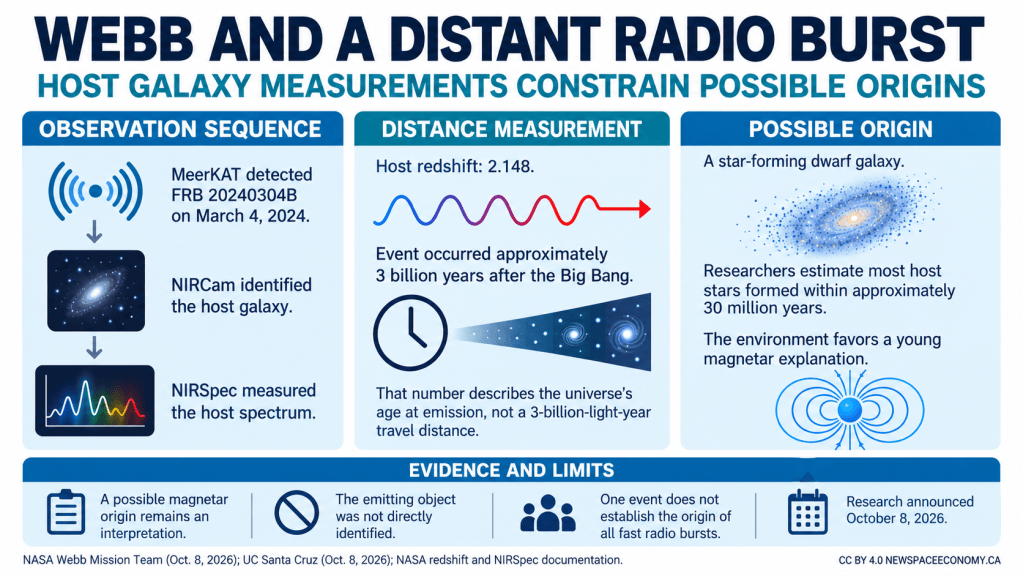
Astronomers used the James Webb Space Telescope to identify the host galaxy of a fast radio burst detected by South Africa’s MeerKAT telescope on March 4, 2024. Research announced on October 8, 2026, reports a host-galaxy redshift of 2.148, corresponding to an event approximately three billion years after the Big Bang. The finding connects a brief radio detection with a galaxy whose properties can be studied through infrared observations.
The burst, designated FRB 20240304B, provides evidence about both the conditions surrounding its source and the matter along its path to Earth. NASA’s research announcement describes it as the most distant fast radio burst identified at the time of publication. The source’s exact physical mechanism remains uncertain. Measuring its distance establishes a firmer basis for investigating possible origins without proving that a particular object produced the burst.
Fast radio bursts are flashes of radio emission lasting milliseconds. Their brevity makes the original detection different from a conventional image of a persistent astronomical object. A radio telescope records the event and estimates its position, but astronomers may need observations at other wavelengths to identify the surrounding galaxy. The scientific sequence separates detection, localization, host identification, and interpretation. Each step supplies information that the previous step alone cannot establish.
The MeerTRAP team detected this event using MeerKAT, an array of radio antennas in South Africa. The radio observations suggested a large distance, but confirming that interpretation required a host-galaxy measurement. A radio signal’s propagation through intervening matter can affect its arrival times at different frequencies. Distance and the material encountered along the path influence interpretation, so an independent galaxy measurement helps reduce ambiguity.
Webb supplied two complementary observations. Its Near-Infrared Camera detected a galaxy at the identified location. Its Near-Infrared Spectrograph measured the galaxy’s redshift. An image can establish the presence and appearance of a candidate host; a spectrum supplies wavelength information needed to investigate its distance and physical properties. The combination matters because finding a faint object at a radio position does not, by itself, provide its place in cosmic history.
NASA’s spectrograph documentation explains that the instrument separates incoming light into a spectrum. Atoms and molecules produce recognizable spectral features. Comparing those features with their known wavelengths allows researchers to determine how much the light has shifted. Spectroscopy can also provide evidence about a galaxy’s composition and physical conditions, which makes the observation useful for more than a single distance estimate.
The measured redshift describes the expansion of wavelengths during the light’s travel. NASA’s cosmological redshift explanation relates that stretching to the expansion of space. At a redshift of 2.148, the observed wavelength is 3.148 times its emitted wavelength. Redshift is a dimensionless measurement, rather than a distance expressed in miles or light-years. Converting it into an age or distance requires a cosmological model.
The reported three-billion-year figure refers to the age of the universe when the event occurred. It does not mean the burst traveled only three billion light-years to Earth. Light-travel time, the universe’s age at emission, and distance measured in an expanding universe describe different quantities. Keeping them separate prevents a result about an early event from becoming an inaccurate claim about a nearby source.
Ground-based observations helped establish the need for Webb. The University of California, Santa Cruz, described the observing sequence, including an unsuccessful search for the host using the Keck Observatory. A nondetection does not show that no galaxy exists at the location. It establishes that the observations did not reveal one under the conditions and sensitivity achieved. That information supported a request for infrared observations from space.
The host is a dwarf galaxy actively forming stars. Researchers inferred from its star-formation properties that most of its stars may have formed within approximately 30 million years. That estimate describes a stellar population, rather than a directly measured age for the individual object that emitted the burst. It supplies an environmental constraint that can be compared with the timescales expected under competing explanations.
One proposed explanation involves a young magnetar, a neutron star with a strong magnetic field. Neutron stars are compact remnants associated with stellar evolution. In a young stellar population, the formation of a magnetar after the death of a massive star can provide a relatively short route to an energetic event. The researchers interpret the host properties as more consistent with such an origin than with a model requiring a long delay before two neutron stars merge.
That conclusion remains specific to the evidence for this burst. The observations did not directly image a magnetar producing the radio flash. They also do not establish a single origin for the entire fast-radio-burst population. A host galaxy contains many objects, and its general properties constrain possible mechanisms without identifying the emitting object with certainty. Additional observations and comparisons with other hosts remain necessary.
Magnetar formation itself has uncertainties. NASA’s account of a magnetar’s uncertain origin describes Hubble observations of SGR 0501+4516 and research into alternatives to a supernova origin. That separate investigation illustrates why the term magnetar does not settle every question about an object’s history. The age and environment of each source remain relevant to interpreting a proposed mechanism.
Fast radio bursts also support investigations of matter outside visible galaxies. New Space Economy’s coverage of matter between galaxies explains this application. A burst’s frequency-dependent arrival times contain information about electrons encountered along the path. Interpreting those measurements requires separating contributions from the source environment, intervening structures, and the Milky Way.
For FRB 20240304B, the practical scientific advance is a host measurement that connects radio timing with infrared evidence about distance and stellar populations. Webb’s observations make the event useful for testing source models and studying intervening matter. The remaining task is to determine which physical mechanism satisfies those measured constraints, rather than treating a favored explanation as a confirmed identification.
Useful Books Available on Amazon


