


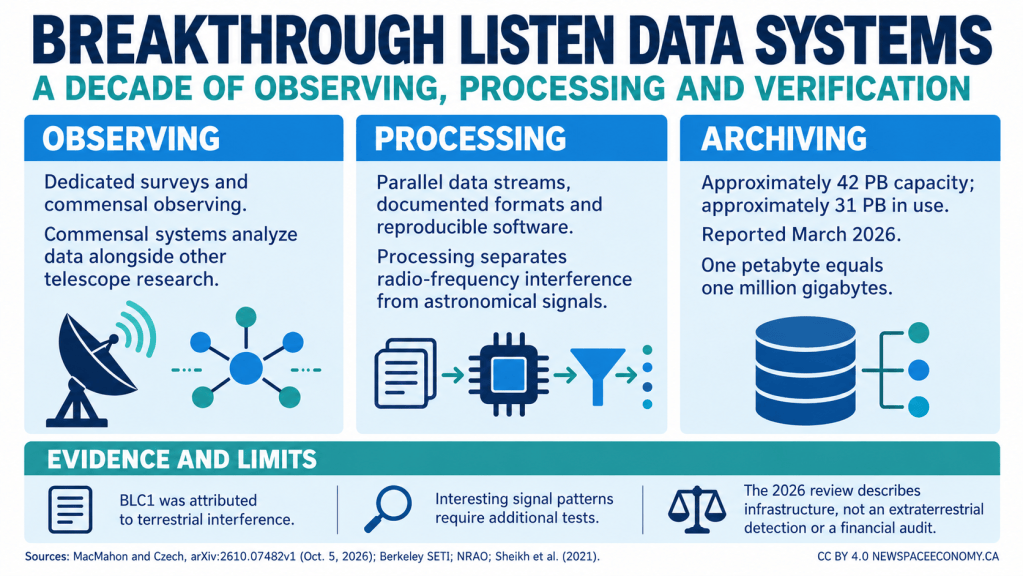
Breakthrough Listen’s first decade produced a distributed system for collecting and analyzing astronomical signals, according to an engineering review posted on October 5, 2026. David H. E. MacMahon and Daniel J. Czech describe the program’s development from dedicated telescope recordings to observations conducted alongside other research. Their first-decade review examines instrumentation, observatory partnerships, processing, and archives. Its subject is the infrastructure required to conduct a search for evidence of extraterrestrial technology.
That infrastructure has implications beyond the search itself. Radio observatories must move large amounts of information from receivers into computers, distinguish useful measurements from interference, and retain records that other researchers can examine. The review provides a program participant’s account of those engineering decisions. It is a conference paper available as a preprint, rather than an independent financial evaluation or evidence that extraterrestrial intelligence has been detected.
Breakthrough Initiatives announced the program on July 20, 2015, with a $100 million commitment over 10 years. The announcement described radio and optical searches and promised public access to data and software. That figure identifies the original funding commitment. It does not establish the amount actually spent, the cost of every participating observatory, or a continuing annual budget. Those distinctions matter when assessing how a philanthropic research program supports shared scientific facilities.
The review reports approximately 42 petabytes of storage capacity, with approximately 31 petabytes in use, by March 2026. A petabyte is one million gigabytes in decimal units. The distinction between installed capacity and occupied storage prevents the larger number from being mistaken for the amount of scientific data already held. The reported scale illustrates why an observing program needs an archive policy as well as a receiver and a search algorithm.
An archive must preserve enough information to make later analysis useful. A stored measurement without its observing time, target position, instrument configuration, or processing history can be difficult to interpret. Those records also help researchers separate changes in the sky from changes in the observing system. Storage decisions consequently affect which questions can be investigated after an observation has finished, including questions that were absent from the original observing plan.
The Berkeley public data portal demonstrates another part of the infrastructure. It provides access to observations and documentation, including material from radio telescopes and optical instruments. Different products require different analysis methods. An optical spectrum, an image, and a record of radio intensity over time are not interchangeable files, even when all are publicly downloadable. Public access removes an ownership restriction; it does not remove the technical work required to understand a measurement.
For an outside research group, documented formats and available software reduce the need to recreate basic processing tools. They also make it easier to compare results obtained by different teams. Reproducibility still requires attention to software versions, calibration, and the choices made during analysis. An independent result gains evidentiary value when another team can identify the inputs and repeat the relevant steps, rather than relying solely on the originating group’s description.
Observing alongside another project offers a different way to obtain data. This arrangement, called commensal observing, allows separate analyses to use information collected during the same telescope operation. The National Radio Astronomy Observatory’s COSMIC hardware announcement described a system designed to receive a parallel data stream from the Very Large Array. That example shows how an additional scientific search can be integrated into an existing observatory without requiring every observation to be scheduled exclusively for that search.
The arrangement creates engineering obligations of its own. A secondary processing system has to receive data reliably and work within the observatory’s operating environment. Its target coverage follows the observations available to it, so commensal access does not automatically provide the same sample as a dedicated survey. Comparisons between surveys need to account for differences in observing direction, frequency coverage, duration, and sensitivity. More observing opportunities alone do not make two searches equivalent.
Radio-frequency interference is a continuing limitation. The NRAO interference explanation describes unwanted transmissions that enter sensitive astronomical receiving systems. Human-made signals can originate outside the observatory or within its equipment. A signal can have technological characteristics and still come from Earth. Identifying artificial emission is only one part of establishing whether its source lies beyond the terrestrial environment.
The BLC1 investigation provides a documented example. A 2021 verification study, led by Sofia Sheikh, examined a candidate identified in Parkes observations toward Proxima Centauri. Researchers found related signals and evidence consistent with local electronic interference. The result showed why a candidate’s frequency behavior and apparent association with a target require additional tests. New Space Economy’s discussion of artificial-looking radio signals explains that distinction between an interesting pattern and an established extraterrestrial source.
Verification also affects the design of data systems. Investigators need sufficient records to compare candidate signals with other observations and instrumental behavior. If the information needed for those comparisons has already been discarded, a promising detection may remain difficult to evaluate. Planning for investigation before a candidate appears is consequently a practical requirement of the search, rather than a task that can always be added afterward.
The engineering history should also be read within its institutional limits. Its authors work within the program and describe systems they helped develop or study. Their experience supplies operational detail, but the review does not establish commercial demand for those systems or quantify a financial return from open data. Procurement, staffing, maintenance, and scientific usefulness would require separate evidence in any assessment of economic performance.
Breakthrough Listen’s first decade supports a defined conclusion about scientific infrastructure: observing capacity becomes useful evidence through documented processing, accessible records, and repeatable verification. A larger archive or a longer observing campaign can expand the material available for investigation. The strength of any eventual scientific claim will still depend on the measurements retained, the alternatives tested, and the ability of independent researchers to evaluate the result.
Useful Books Available on Amazon


