
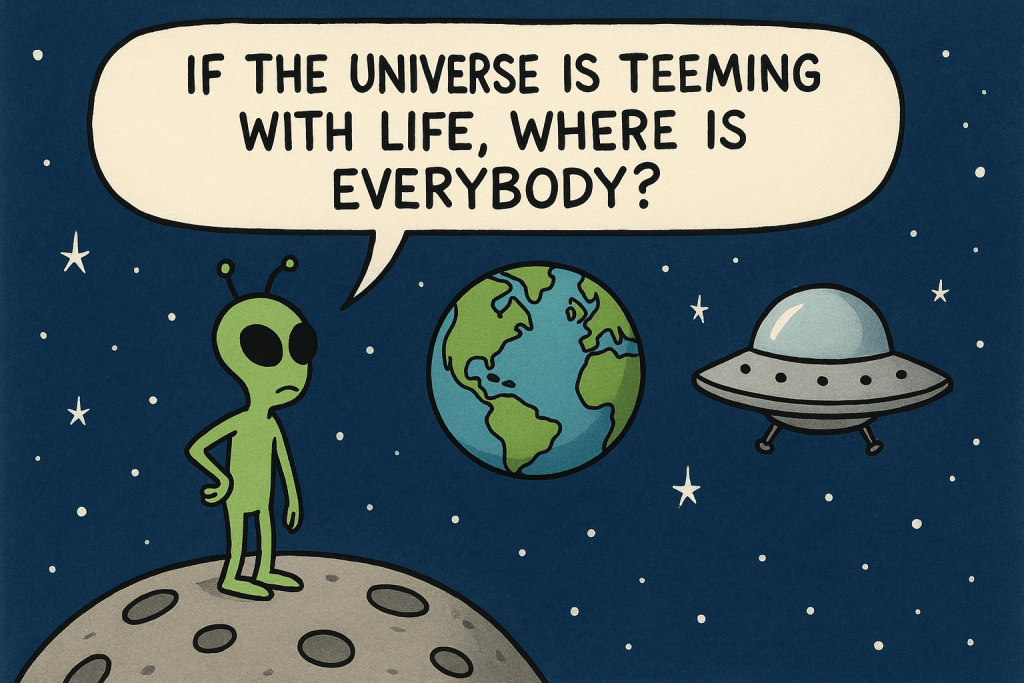
What is the Fermi Paradox?
The Fermi Paradox highlights a significant and unsettling contradiction: the universe is extraordinarily vast, suggesting a high statistical likelihood that extraterrestrial civilizations exist, yet there is a complete absence of confirmed observational evidence for them. This isn’t merely about not having seen alien spacecraft; it’s about the lack of any verifiable signs of their activities, technologies, or even their indirect influence on the cosmos. The silence from the stars is puzzling given the sheer scale of potential habitats. This discrepancy between high probability and zero confirmed contact forms the core of the paradox.
The scale involved is difficult to comprehend. The observable universe is estimated to contain at least 100 billion galaxies. Our own Milky Way galaxy is thought to host between 100 billion and 400 billion stars. Many of these stars are similar to our Sun, and scientific estimates suggest a significant number of them could possess planets orbiting within their “habitable zones” – regions where conditions might allow for liquid water, a important ingredient for life as we understand it. The more we learn about the prevalence of planets, the more potential abodes for life we identify. For instance, early estimations were based on the number of stars, but as astronomical detection methods have improved, the number of known and inferred exoplanets has skyrocketed. This ever-increasing count of potential life-harboring worlds, without any corresponding detection of extraterrestrial signals, only deepens the mystery. The problem isn’t diminishing with new data; it’s becoming more pronounced.
The paradox is famously named after the physicist Enrico Fermi. During a 1950 luncheon at Los Alamos National Laboratory, amidst discussions about recent UFO sightings, Fermi reportedly posed the simple yet deeply resonant question: “Where is everybody?”. This query wasn’t just a casual remark; it stemmed from his quick calculations which suggested that if extraterrestrial civilizations were common and capable of interstellar travel, Earth should have been visited multiple times over its long history. The very act of labeling this discrepancy a “paradox” shapes our perception of it. It frames the issue as a stark contradiction demanding a resolution, rather than merely an unanswered question or a field with insufficient data. This framing elevates its importance in both scientific and public discourse, implying that our current understanding of either the universe’s capacity to generate life, the typical behavior of civilizations, or perhaps both, is fundamentally flawed or incomplete.
The Man Behind the Question
Enrico Fermi was an Italian-American physicist of immense stature, celebrated for his pioneering contributions to nuclear physics. His work included achieving the first self-sustaining nuclear chain reaction, a pivotal moment in the atomic age, and significant advancements in quantum theory and particle physics. His contributions were recognized with the Nobel Prize in Physics in 1938. Fermi was known not just for his theoretical and experimental prowess but also for his ability to tackle complex problems with surprisingly simple, order-of-magnitude calculations – these became known as “Fermi questions”.
The now-famous question, “Where is everybody?”, emerged from such an environment of intellectual curiosity and estimation. It was posed during an informal lunchtime conversation in the summer of 1950 at the Fuller Lodge at Los Alamos National Laboratory. Fermi was with his colleagues Emil Konopinski, Edward Teller, and Herbert York. The conversation had meandered from a recent increase in UFO sightings and a humorous New Yorker magazine cartoon depicting aliens stealing trash cans, to the possibility of faster-than-light travel. It was in this context that Fermi interjected with his question. Eyewitness accounts suggest he followed up with some basic mathematical estimations regarding the probability of Earth-like planets, the likelihood of life arising, the chances of intelligence evolving, and the potential duration of high-technology civilizations. His rough conclusion was that Earth should have already been visited by alien life, possibly many times over. He never published these specific calculations nor pursued the topic with significant research, but the question lingered, eventually becoming a cornerstone of discussions about extraterrestrial intelligence.
The timing and setting of Fermi’s question are also noteworthy. The query arose in 1950 at Los Alamos, a nerve center of atomic research, in the shadow of World War II and at the dawn of the Cold War and the Space Race. The backdrop included a rising public and scientific fascination with UFOs, reflecting both a sense of wonder and perhaps an underlying anxiety about unknown aerial phenomena and the potential for advanced, possibly threatening, technologies from elsewhere. Fermi’s question can be seen not merely as an abstract scientific puzzle but as one subtly colored by the era’s spirit of rapid technological advancement, new existential risks like nuclear annihilation, and the tantalizing prospect of new frontiers in space. His approach, characteristic of “Fermi questions,” treated the problem as something amenable to logical estimation, however rough. This very methodology underpins many subsequent formal attempts to quantify the likelihood of extraterrestrial civilizations, most notably the Drake Equation.
Why Expect Company? The Scale of Possibility
The expectation that we might not be alone in the universe is rooted in the sheer scale of cosmic real estate and the immense timescales involved. Our galactic home, the Milky Way, is a vast spiral galaxy estimated to contain between 100 billion and 400 billion stars. Many of these stars are similar in size and composition to our own Sun. The Sun itself is located about 27,000 light-years from the Galactic Center, on an inner edge of one of the spiral arms. This vast stellar population alone provides an enormous number of potential “opportunities” for life to arise.
Compounding this is the prevalence of planets. Modern astronomical observations, particularly data from exoplanet-hunting missions like NASA’s Kepler Space Telescope, have revolutionized our understanding, indicating that planets are not rare exceptions but common companions to stars. It’s now estimated that there are at least as many planets as there are stars in the Milky Way, and possibly many more. A significant fraction of these planets are believed to orbit within their star’s “habitable zone.” This is the region around a star where the temperature is just right for liquid water to exist on a planet’s surface, a condition considered essential for life as we know it. While not every planet in a habitable zone will be Earth-like or harbor life, the sheer number of candidates – potentially billions in our galaxy alone – strengthens the statistical argument for the existence of extraterrestrial life. The underlying assumption here often connects to the “Principle of Mediocrity” or the “Copernican Principle,” which posits that Earth and humanity are not cosmically special or unique. If the processes that led to life here are common, then given the vast number of potential incubators, life should have arisen elsewhere. The Fermi Paradox directly challenges this: if we are not special, where are the others?
The age of the universe adds another compelling dimension to this expectation. The universe is approximately 13.8 billion years old. Our Solar System, including Earth, is considerably younger, having formed about 4.5 to 4.6 billion years ago. This means that many stars and their planetary systems within the Milky Way are billions of years older than our Sun. If life arises and evolves towards intelligence and technology, these older systems would have had a significant head start – billions of years more for complex life to emerge, for intelligence to develop, and for civilizations to potentially master interstellar communication or travel. Even at relatively slow speeds of interstellar travel, a civilization could theoretically traverse the entire Milky Way galaxy in a few million years – a mere blink in cosmic timescales. This temporal aspect makes the current silence even more significant.
However, this vastness of time is a double-edged sword. While it provides ample opportunity for civilizations to arise and spread, it also means that countless civilizations could have risen and fallen long before humanity developed the capacity to listen for them. Their “detectable window” – the period during which they might be broadcasting signals we could pick up – could be very short and easily missed in the grand sweep of cosmic history. Thus, the universe’s age both fuels the expectation of company and offers potential explanations for their apparent absence, making it a complex element in the Fermi Paradox.
Potential Explanations for the Silence
The enduring question of “Where is everybody?” has spurred a multitude of proposed explanations, broadly categorized by whether they suggest intelligent life is rare, that it exists but remains undetected, or that the nature of civilizations themselves leads to their apparent absence.
Table: Major Categories of Fermi Paradox Hypotheses
| Category | Brief Description | Key Ideas / Sub-hypotheses |
|---|---|---|
| Intelligent Life is Rare or Non-Existent | The conditions for, or evolution of, intelligent life are exceedingly uncommon in the universe. | Rare Earth hypothesis, abiogenesis is rare, intelligence itself is rare, periodic natural extinctions. |
| Intelligent Life Exists, But Undetected | Civilizations are present, but various practical, technological, or sociological limitations prevent us from finding them. | Vast distances, insufficient/improper search, incomprehensible signals/technology, deliberate hiding (e.g., Zoo Hypothesis), Earth deliberately isolated, brief signal duration. |
| The Nature of Intelligent Civilizations | Intrinsic behaviors, evolutionary paths, resource limitations, or catastrophic events common to civilizations prevent widespread detection or colonization. | The Great Filter, self-destruction, destruction of others, non-expansionist behavior, resource/economic limits, isolation in virtual worlds. |
Siri Siri
Hypothesis Category 1: Intelligent Life is Rare or Non-Existent
One set of explanations posits that the silence is simply because there’s no one, or very few, out there to make noise. This could be because the emergence of life itself, or the subsequent evolution of intelligence, is an exceptionally rare event.
A fundamental argument is that life itself is a fluke. The spontaneous generation of life from non-living matter, a process known as abiogenesis, might be an extraordinarily improbable occurrence. If the specific chemical and environmental conditions required are so precise and unlikely to align, then Earth could be one of very few planets, or perhaps even the only one in our galaxy or beyond, where this incredible event transpired.
Even if simple, microbial life turns out to be relatively common across the cosmos – a possibility some scientists entertain – the evolutionary journey from these basic forms to complex, multicellular organisms, and then further to tool-using, technologically adept intelligence, could represent an immense bottleneck. Intelligence of the kind that can build radio telescopes or starships might be an exceedingly rare outcome of evolution. On Earth, for instance, after billions of years of life, only one species – humans – has developed this kind of technological capability, suggesting it’s not an inevitable evolutionary endpoint.
This line of thought is elaborated in the “Rare Earth” Hypothesis, put forward by paleontologist Peter Ward and astronomer Donald Brownlee. They argue that while microbial life might indeed be widespread, the unique and numerous astrophysical and geological conditions that fostered the development of complex life on Earth are exceptionally uncommon. These prerequisites include being located in a “galactic habitable zone” (not too close to the hazardous galactic center, but not so far out in the stellar suburbs that heavy elements for planet formation are scarce), orbiting the right kind of stable star at the correct distance (the circumstellar habitable zone), and possessing a planet of the right mass with a large moon to stabilize its axial tilt (and thus climate). Other factors include the presence of plate tectonics (which drives important geological cycles), a protective magnetic field (to shield against harmful solar and cosmic radiation), and a suitable atmosphere and oceans. If this long list of requirements is indeed necessary for complex life, then planets like Earth could be exceedingly rare, effectively dissolving the paradox by challenging its premise of high probability for ETI. The Rare Earth hypothesis inverts the Principle of Mediocrity by asserting that Earth is, in fact, quite special.
Another possibility is that even if life and intelligence can arise, they may not persist. Cosmic cataclysms, such as massive asteroid impacts, the radiation from nearby supernovae, or powerful gamma-ray bursts, could periodically sterilize planets or wipe out nascent civilizations before they reach an advanced, detectable stage. Such events would act as recurring “resets,” preventing life from gaining a long-term, stable foothold necessary for complex evolution and technological advancement across much of the galaxy.
The challenge in evaluating these hypotheses is our significant lack of data. With Earth as our only example of a life-bearing planet and humans as our sole instance of technological intelligence, it’s difficult to assess the true probability of these events. Our definitions of “life” and “intelligence” are inherently shaped by our terrestrial experience, and these biases might limit our ability to conceive of, or search for, truly alien forms.
Hypothesis Category 2: Intelligent Life Exists, But We Haven’t Detected It
Another broad category of explanations suggests that extraterrestrial civilizations are out there, perhaps even in large numbers, but for various practical, technological, or sociological reasons, we simply haven’t found them yet.
The sheer scale of the universe, often cited as a reason to expect life, also presents a formidable barrier to detection – the tyranny of distance. The closest star system to ours, Alpha Centauri (which includes Proxima Centauri), is over four light-years away. This means even a signal traveling at the speed of light would take more than four years to reach us from our nearest stellar neighbors. For more distant stars, this travel time stretches to decades, centuries, millennia, or much longer. Signals, whether light or radio waves, naturally weaken as they spread out over these vast cosmic distances, making them harder to detect. Physical travel between stars presents even greater challenges, requiring immense energy and time, potentially taking thousands of years even for relatively nearby destinations with current or foreseeable technology. Enrico Fermi himself reportedly favored the idea that interstellar travel might simply be unfeasible due to these enormous distances.
Beyond distance, there’s the possibility that we are simply looking in the wrong way, at the wrong time, or with inadequate tools. Our organized search for extraterrestrial intelligence (SETI) has been ongoing for only a few decades – a mere instant in cosmic terms. These searches have only managed to survey a tiny fraction of the stars in our galaxy, across a limited range of frequencies and signal types. It’s akin to dipping a glass into the ocean and concluding there are no fish because none were caught in that single sample. Civilizations might also broadcast detectable signals for only a brief portion of their existence. As technology advances, they might shift to more efficient, less “leaky” forms of communication (like fiber optics or focused transmissions), or they might simply outgrow the need or desire to broadcast widely. If their “on-air” window doesn’t happen to align with our relatively recent “listening” window, we would miss them entirely. Furthermore, we might be searching for the wrong kinds of signals. Our efforts are largely based on technologies we understand, such as radio waves or lasers. An advanced civilization might use communication methods that are currently incomprehensible to us or beyond our technological capacity to detect.
The very nature of alien intelligence could also be a factor. Extraterrestrial life, if it exists, might be so significantly different from us – biologically, cognitively, or technologically – that we wouldn’t recognize their signals, their artifacts, or even their presence as signs of intelligence. Their motivations, values, and modes of existence might be so far removed from human experience that we lack the framework to comprehend them. This possibility highlights a significant limitation in our search: anthropocentric bias. We tend to look for beings or signals that mirror our own capabilities or expectations. If ETIs are vastly different, our current methods might be fundamentally unsuited to finding them.
Finally, there are hypotheses suggesting a deliberate silence or isolation. The “Zoo Hypothesis” proposes that advanced extraterrestrial civilizations are aware of humanity but intentionally avoid contact. They might be observing us from a distance, perhaps to allow our natural evolution and societal development to proceed without interference, much like zookeepers observing animals in a protected habitat. Some versions suggest they might be waiting for humanity to reach a certain level of technological or ethical maturity before initiating contact, perhaps to ensure we are not a threat to ourselves or others. Related ideas include the possibility that Earth is deliberately isolated, perhaps declared off-limits by a galactic community, or that it simply lies in a sparsely populated “galactic backwater”. Alternatively, communication itself might be perceived as inherently dangerous. If the galactic environment is potentially hostile, advanced civilizations might choose to remain hidden to avoid attracting unwanted attention from predatory species. These sociological explanations imply that the absence of evidence is not evidence of absence, but rather a consequence of deliberate choices made by others. The “search problem” for ETI is thus multidimensional and exponentially complex, involving not just where and when to look, but also what to look for across an enormous range of possibilities.
Hypothesis Category 3: The Nature of Intelligent Civilizations
A third category of explanations focuses on the intrinsic characteristics, evolutionary paths, or common fates of intelligent civilizations themselves. These theories suggest that something about the way civilizations develop or behave prevents them from becoming widespread, long-lasting, or easily detectable.
A prominent concept here is the “Great Filter” theory, popularized by economist Robin Hanson. This theory posits that in the long sequence of steps required for life to arise from simple beginnings and evolve into a technologically advanced, galaxy-colonizing civilization, there is at least one step that is exceedingly improbable – a “filter” that most potential life forms or civilizations fail to pass. Hanson outlined several critical steps, such as the formation of a suitable star system, the emergence of reproductive molecules, the development of simple and then complex cells, the evolution of tool-using intelligence, and finally, the capacity for interstellar colonization.
The location of this Great Filter has significant implications for humanity’s future. If the filter is in our past – meaning we have already successfully navigated an incredibly difficult step, such as the origin of life or the evolution of intelligence – then humanity might be exceptionally rare and fortunate. This could imply that the cosmos is largely open for our future expansion, a somewhat lonely but optimistic prospect. Conversely, if the Great Filter lies in our future, it suggests a grim outlook. This would mean that there’s a common, almost insurmountable challenge that civilizations at or beyond our current stage of development typically fail to overcome. Such a future filter could be technological self-destruction, resource exhaustion, an inability to manage the existential risks of advanced technology, or some other as-yet-unforeseen catastrophe. The search for any extraterrestrial life, even simple microbial forms on Mars, for example, takes on added existential weight in this context. Finding that simple life is common elsewhere would lend credence to the idea that the Great Filter is still ahead of us, as it would imply the early steps of life are not the major hurdle.
The idea of self-destruction is a recurring theme within this category. It’s theorized that intelligent civilizations might inherently tend to develop technologies that lead to their own demise before, or shortly after, they achieve the capacity for interstellar communication or travel. Potential culprits include nuclear war, uncontrolled artificial intelligence, catastrophic environmental damage, or genetically engineered pandemics. The very intelligence that drives technological progress might also carry the seeds of its own annihilation, suggesting a potential disconnect between intellectual capability and the wisdom required for long-term survival. The lifespan of a technologically communicative civilization (L in the Drake Equation framework) becomes a dominant but highly uncertain variable here. If L is typically short, then even if many civilizations arise, the probability of two or more co-existing and being detectable simultaneously becomes vanishingly small. Our own very brief history of radio technology (around a century) offers little basis for estimating L for others.
A darker variant suggests that some civilizations might be predatory. It could be the nature of some intelligent life to actively destroy other emerging intelligences to eliminate potential competition or perceived threats. This is sometimes linked to the “Dark Forest” hypothesis, which posits a galactic environment where the safest strategy upon detecting another civilization is to eliminate it swiftly and silently, as one cannot be sure of the other’s intentions. Such a scenario would provide a strong incentive for all civilizations to remain hidden, contributing to the cosmic silence.
Finally, the assumption that advanced civilizations would inevitably seek to expand and colonize the galaxy might be incorrect. They might lack the desire, finding interstellar colonization too resource-intensive or uninteresting. Perhaps they discover that “inner space” – such as sophisticated virtual realities or deeper levels of consciousness – offers more compelling avenues for exploration and development than physical expansion into outer space. It’s also possible that transmitting information is deemed far more efficient and less costly than transporting physical beings or materials across interstellar distances. If colonization isn’t a universal drive, then the galaxy might be home to many long-lived, technologically advanced but essentially sedentary or inwardly-focused civilizations that leave few detectable traces beyond their home systems.
The Search for Answers: Listening to the Cosmos
In the face of this significant silence, humanity has not remained passive. The Search for Extraterrestrial Intelligence (SETI) encompasses a variety of scientific endeavors aimed at actively listening for potential artificial signals emanating from space. These projects primarily utilize large radio telescopes to scan the skies, but also include searches in the optical part of the electromagnetic spectrum, looking for powerful laser pulses. The core objective is to identify “technosignatures” – any evidence of technology that could not be produced by natural astrophysical phenomena.
Technosignatures represent a broader approach than just listening for deliberate messages. They could include a wide array of indicators, such as the characteristic radio or light signals from communication or propulsion systems, the waste heat or infrared glow from massive astroengineering projects like Dyson spheres (hypothetical structures built around stars to capture their energy), unusual atmospheric compositions on exoplanets caused by industrial pollution, or even the artificial illumination of city lights on the night side of distant worlds. This expanded search acknowledges that civilizations might not be actively trying to contact us, but their mere existence and technological activities could still leave detectable traces. This shift from primarily passive listening for intentional beacons to more proactive hunting for any sign of technology significantly broadens the search parameters.
However, the challenges involved in detecting such signals are immense. One of the most fundamental is the combination of signal strength and distance. Our own most powerful radio signals would become incredibly faint and difficult to detect even by the time they reached the nearest star system. For an alien civilization’s signal to be detectable across interstellar or intergalactic distances, it would need to be extraordinarily powerful, or very narrowly beamed directly at us.
Then there’s the “haystack problem.” The sky is unimaginably vast. Scientists must make difficult choices about where to point their telescopes, which specific frequencies to monitor out of an enormous spectrum, and for how long to observe each target. Given limited resources and time, it’s impossible to continuously monitor all potential targets across all plausible frequencies.
Temporal alignment is another significant hurdle. A civilization might have existed and broadcast signals millions or billions of years ago, long before we developed the technology to listen, or they might only become detectable far in humanity’s future. The window during which a civilization broadcasts easily detectable signals might also be relatively short. As their technology evolves, they might transition to more efficient, directed, or encrypted forms of communication that are much harder for outsiders to pick up – a trend arguably visible in humanity’s own shift from powerful broadcast television and radio to fiber optics and digital communications. This means the “signal” itself is a moving target, dependent on the technological evolution of both the transmitting civilization and our own detection capabilities. SETI strategies must constantly adapt to consider hypothetical alien technological advancements and the ever-changing nature of what might constitute a detectable signature.
Finally, distinguishing a genuine extraterrestrial technosignature from the cacophony of natural cosmic radio noise and, importantly, from terrestrial interference (our own radio signals bouncing off objects or originating from satellites) is a persistent and complex challenge.
Living with the Question: Implications of the Paradox
The Fermi Paradox is more than just an astronomical puzzle; it forces humanity to confront fundamental questions about its own existence and significance in the grand cosmic scheme. Are we truly alone in this vast universe? Are we, by some incredible cosmic lottery, one of the first intelligent species to arise, or are we cosmic latecomers to a galaxy already teeming with life that we are, for some reason, unable to perceive?. The continued silence from the stars resonates deeply, prompting reflection on our place and purpose.
If humanity is indeed alone, or effectively so, it could imply a significant sense of cosmic loneliness. This realization might be perceived by some as terrifying, diminishing our sense of connection to a larger living cosmos. For others this uniqueness could be seen as liberating. If we are the sole bearers of advanced consciousness and intelligence in our galactic neighborhood, or perhaps even beyond, it could bestow upon humanity a unique responsibility – an obligation to survive, to cherish and understand life, and perhaps to act as the universe’s custodians or explorers. The very questions raised by the paradox – about our origins, our future, and the nature of life and intelligence – often mirror our own societal anxieties and aspirations. Discussions about civilizational self-destruction, for instance, reflect contemporary fears about nuclear war or environmental collapse, while dreams of benevolent, advanced civilizations or a unique human destiny echo our hopes for progress and meaning.
The absence of evidence for extraterrestrial civilizations is not necessarily conclusive evidence of their absence. Many proposed solutions to the paradox suggest that ETI could exist but remain undetected for a host of reasons. However, the persistent silence, especially as our own detection capabilities slowly improve, compels a continuous re-evaluation of the assumptions that underpin our expectation of finding them. These include assumptions about how easily life originates, the presumed linearity of technological development, the motivations of advanced civilizations (such as an inherent drive for expansion), and even what constitutes a recognizable signal of intelligence. The paradox thus serves as a powerful intellectual catalyst, pushing the boundaries of our scientific and philosophical thinking about life, intelligence, and civilization in a cosmic context.
Regardless of what the ultimate answer to Fermi’s question turns out to be, the enduring nature of the paradox and the ongoing efforts to address it, such as SETI projects, underscore a fundamental aspect of the human spirit: our innate curiosity, our relentless drive to explore the unknown, to understand our origins, and to seek out our place within the vastness of the universe.
Summary
The Fermi Paradox remains one of the most compelling and unresolved questions in science, highlighting the stark contradiction between the high statistical probability of extraterrestrial civilizations emerging in our vast universe and the complete lack of verifiable evidence for their existence. This “Great Cosmic Silence” has puzzled scientists and thinkers for decades since Enrico Fermi first posed his disarmingly simple question, “Where is everybody?”.
Over the years, a diverse array of potential explanations has been proposed. These hypotheses span a wide spectrum of possibilities: some suggest that the conditions for intelligent life, or life itself, are so extraordinarily rare that Earth might be unique, or nearly so. Others propose that extraterrestrial civilizations do exist, perhaps in abundance, but remain undetected due to immense interstellar distances, the limitations of our current search technologies, their use of incomprehensible communication methods, or even deliberate choices to remain hidden or isolated. A third category of theories considers the intrinsic nature of advanced civilizations, suggesting that they might face common “Great Filters” – insurmountable challenges or self-destructive tendencies that prevent them from achieving interstellar presence or longevity.
The Fermi Paradox is not a static problem; it evolves as our scientific understanding of the cosmos deepens. Discoveries in fields like exoplanetology and astrobiology continually refine the parameters of the debate, often making the silence even more pronounced for some theories while bolstering others. It’s also plausible that the true “solution” is not a single, elegant explanation but rather a complex interplay of multiple factors – perhaps life is somewhat uncommon, interstellar travel is exceptionally difficult, and the detectable lifespan of technological civilizations is typically short.
Despite ongoing SETI efforts and significant theoretical advancements, no definitive answer to Fermi’s question has yet emerged. The paradox continues to be a powerful catalyst for scientific research, challenging our most fundamental assumptions about the universe and our place within it. It prompts deep philosophical reflection on humanity’s own future, our responsibilities, and the ultimate meaning of our existence in the face of an apparently silent cosmos. The quest for a resolution underscores our species’ enduring curiosity and highlights the significant implications that any eventual answer – whether we are alone or part of a vast cosmic community – will hold.
