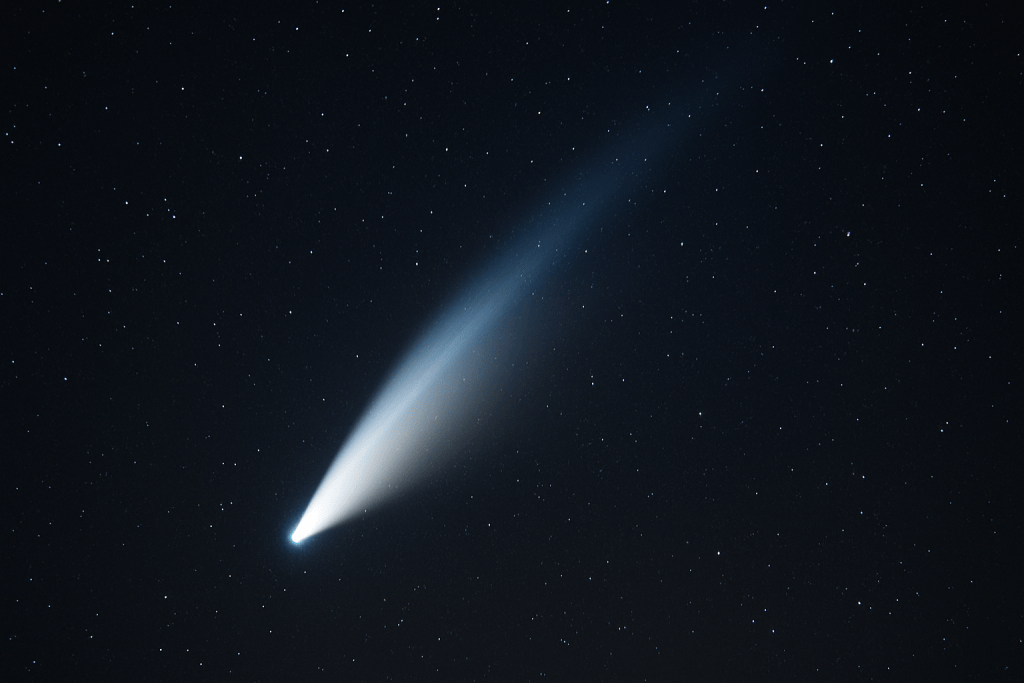
In July 2025, astronomers spotted a rare celestial traveler: an interstellar comet named 3I/ATLAS. This icy visitor, originating from beyond our solar system, is only the third known object of its kind to pass through our cosmic neighborhood. Its discovery has sparked excitement among scientists, offering a fresh opportunity to study an object from another star system. This article explores the comet’s discovery, its journey, its characteristics, and what it means for our understanding of the universe.
A Surprise from the Stars
The comet, officially designated C/2025 N1 (ATLAS), was first detected on July 1, 2025, by the Asteroid Terrestrial-impact Last Alert System (ATLAS) telescope in Rio Hurtado, Chile. This telescope, designed to track near-Earth objects, caught the faint glow of an object moving unusually fast across the sky. Unlike most comets, which orbit our Sun, this one followed a path suggesting it came from interstellar space—the vast region between stars.
Early observations showed the comet approaching from the direction of the Sagittarius constellation. Its trajectory was unlike anything bound to our solar system. Instead of following a closed, elliptical orbit around the Sun, it traced a hyperbolic path, meaning it would pass through once and never return. This behavior marked it as an interstellar interloper, a rare guest from another star system.
A Unique Path Through the Solar System
Comet 3I/ATLAS is on a one-way journey through our solar system. At the time of its discovery, it was about 420 million miles from the Sun, roughly 4.5 times the distance from Earth to the Sun (known as an astronomical unit, or AU). It’s traveling at a remarkable speed of about 38 miles per second, far faster than most objects in our solar system.
The comet will reach its closest point to the Sun, called perihelion, on October 29, 2025, at a distance of 1.36 AU—just inside the orbit of Mars. At this point, it will be about 126 million miles from the Sun. Earth has no cause for concern, as the comet will stay at least 150 million miles away from our planet, posing no risk of collision.
After passing the Sun, the comet will become too close to our star to observe from Earth, as the Sun’s glare will obscure it. By early December 2025, it will reappear in the night sky, allowing astronomers to continue tracking its path. Eventually, it will exit our solar system, continuing its journey back into interstellar space.
What Makes 3I/ATLAS a Comet?
Comets are often described as “dirty snowballs” because they’re made of ice, frozen gases, dust, and rocky material. As they approach a star like the Sun, heat causes their ices to vaporize, releasing gas and dust that form a glowing halo called a coma and sometimes a visible tail. Observations of 3I/ATLAS confirmed it as a comet when telescopes detected a faint coma and a short tail, about 16,000 miles long, stretching behind it.
The comet’s activity is relatively weak compared to other known comets, suggesting its icy core, or nucleus, may be less volatile. Its reddish coma, observed through specialized filters, indicates the presence of dust, similar to another interstellar comet, 2I/Borisov, discovered in 2019. The exact size of 3I/ATLAS’s nucleus remains uncertain due to the reflective dust cloud surrounding it, but estimates suggest it could range from half a mile to 15 miles in diameter, with a smaller size being more likely.
A Rare Interstellar Guest
Comet 3I/ATLAS is the third confirmed interstellar object to visit our solar system. The first, 1I/‘Oumuamua, discovered in 2017, puzzled scientists with its cigar-shaped form and lack of clear cometary activity. The second, 2I/Borisov, was a more typical comet, displaying a prominent tail. Unlike these predecessors, 3I/ATLAS stands out for its high speed and extreme orbital path, with an orbital eccentricity of 6.14, the highest of the three. This value indicates a trajectory far more open than a typical orbit, confirming its origins outside our solar system.
The comet likely formed around another star billions of years ago and was ejected into interstellar space, perhaps by gravitational interactions with other objects. For eons, it drifted through the void until it wandered into our solar system. Its hyperbolic trajectory ensures it won’t stay long, making it a fleeting opportunity for study.
Observing the Cosmic Traveler
Astronomers have been tracking 3I/ATLAS with telescopes worldwide, including the Zwicky Transient Facility in California and the Nordic Optical Telescope. These observations, some dating back to mid-June 2025 before its official discovery, helped confirm its interstellar nature. The comet’s faint glow and position against the dense star field of the Galactic Center initially made it hard to spot, but follow-up studies revealed its cometary features.
The comet’s brightness varies little, likely due to its dusty coma obscuring the rotation of its nucleus. This stability makes it challenging to determine how fast the nucleus spins, a detail that could reveal more about its structure. Astronomers expect to continue observing it until September 2025, when it becomes too close to the Sun, and again after it reappears in December.
| Feature | Details |
|---|---|
| Name | 3I/ATLAS (C/2025 N1) |
| Discovery Date | July 1, 2025 |
| Discovered By | ATLAS telescope, Rio Hurtado, Chile |
| Origin | Interstellar (outside our solar system) |
| Closest Approach to Sun | October 29, 2025, at 1.36 AU |
| Closest Distance to Earth | At least 150 million miles |
| Estimated Nucleus Size | 0.5 to 15 miles (likely smaller) |
| Orbital Eccentricity | 6.14 |
| Speed | Approximately 38 miles per second |
Why It Matters
Studying interstellar objects like 3I/ATLAS offers a glimpse into the environments of distant star systems. Because comets carry pristine material from their formation, analyzing their composition can reveal what other parts of the galaxy are made of. The comet’s ice, dust, and gases may hold clues about the chemistry of its home system, shedding light on how stars and planets form elsewhere.
The discovery also highlights the power of modern telescopes. Systems like ATLAS, originally built to detect potential asteroid threats, are now uncovering rare interstellar visitors. Each observation adds to our knowledge of these objects, which are far rarer than the thousands of comets orbiting our Sun.
Summary
Comet 3I/ATLAS is a remarkable visitor from beyond our solar system, discovered in July 2025 by the ATLAS telescope in Chile. Its hyperbolic trajectory, high speed, and faint cometary features mark it as the third known interstellar object to pass through our cosmic backyard. As it approaches the Sun in late October 2025, astronomers are seizing the chance to study its composition and behavior before it vanishes into interstellar space. This fleeting guest underscores the vastness of the universe and the ongoing efforts to understand the objects that travel between stars.