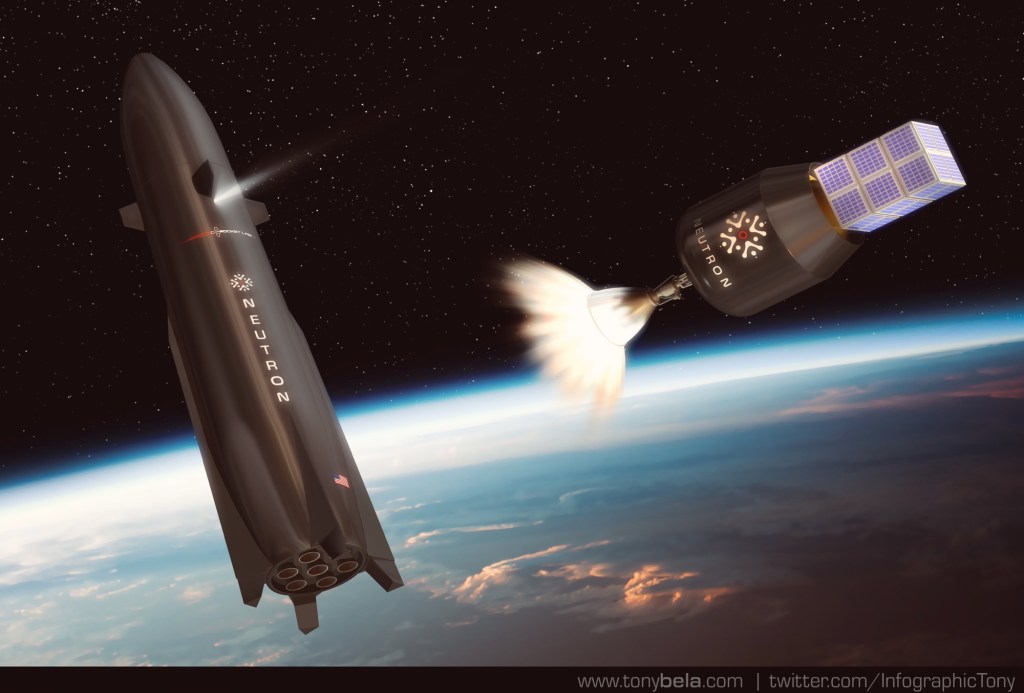
Rocket Lab’s Neutron rocket is a new medium-class launch vehicle under development. Designed to carry about 13,000 kg (13 metric tons) to Low Earth Orbit (LEO), Neutron is much larger than Rocket Lab’s existing small launcher, Electron. Neutron will be fully reusable, meaning its first stage (booster) and payload fairing return to Earth after flight. By mid-2025 the rocket’s design was finalized and the company was preparing for the first flight in late 2025. This launch vehicle is intended to serve a wide range of missions, from deploying large satellite constellations to supporting government space programs and future space exploration.
Design and Capabilities
Neutron is a two-stage rocket about 43 meters tall and 7 meters in diameter. Some key features include:
- Payload capacity: ~13,000 kg to LEO, roughly 1,500 kg on missions to Mars or Venus.
- Propulsion: 9 liquid-oxygen/methane “Archimedes” engines on the first stage, and 1 vacuum-optimized Archimedes engine on the second stage.
- Structure: Lightweight carbon-composite tanks and airframe for strength with reduced mass.
- Reusability: Both the first stage and the payload shroud (fairing) are designed to be recovered and reused. Neutron’s fairing is integrated so it stays attached to the booster and opens like a mouth during staging.
- Landing: The booster will land vertically back at the launch site, or on a specially equipped sea platform (an offshore barge named Return on Investment).
These features allow Neutron to reuse hardware and lower launch costs. The fuel choice of liquid methane (with oxygen) provides high performance and cleaner engine re-ignition compared to traditional kerosene. In all, Neutron’s design combines powerful engines and modern materials to provide a high-capacity, rapid-turnaround rocket.
| Specification | Neutron rocket |
|---|---|
| Height | 43 meters |
| Diameter | 7 meters |
| Payload (LEO) | ~13,000 kg |
| Payload (Mars/Venus) | ~1,500 kg |
| Mass (full) | ~480,000 kg |
| Propellant | Liquid methane (CH₄) and liquid oxygen |
| First stage engines | 9 × Archimedes (sea-level) |
| Second stage engine | 1 × Archimedes (vacuum-optimized) |
Development Progress
Rocket Lab began Neutron’s development in the early 2020s. By 2021–2022 the basic design was complete and work shifted to hardware. A new manufacturing plant and test facilities were built at Wallops Island, Virginia. In 2022 the company fired up new test stands and started building large composite tanks for Neutron. The engine design evolved to use an oxygen-rich staged combustion cycle, optimizing performance.
By 2023, full-scale flight hardware was under construction. In mid-2023, assembly of the second stage tanks was completed and tested. In 2024 the first Archimedes engine was built and successfully hot-fired on a test stand. Ground and systems tests (for avionics, software, and controls) have been carried out. As of July 2025, the second stage had passed structural and cryogenic testing, and the first stage was being assembled. The launch complex infrastructure at Wallops was finished or nearing completion, ready for fueling tests.
| Year | Milestone |
|---|---|
| 2021 | Neutron concept revealed; initial design (7 m diameter, 7 engines) completed. |
| 2022 | Design updated (9 engines, 7 m diameter fairing); Wallops production facility ground-breaking. |
| 2023 | Assembly of stage 2 tanks and avionics; engine test stand completed at Stennis (MS). |
| 2024 | First Archimedes engine hot-fire test; stage builds and subsystem tests progress. |
| 2025 | Second-stage structure passed pressure tests; first-stage build in progress; launch pad ready; first flight planned late 2025. |
Throughout this period Rocket Lab refined Neutron’s design based on test results. Wind-tunnel studies and computer simulations guided tweaks to aerodynamics. The timeline above shows that by mid-2025 most development work remained on schedule for a debut in the second half of 2025.
Launch Infrastructure
Neutron’s primary launch site is Launch Complex 3 (LC-3) at the Mid-Atlantic Regional Spaceport (MARS) in Virginia. This new pad, built on NASA’s Wallops Flight Facility, was under construction in 2024–2025. By early 2025 LC-3 had a concrete launch mount, fueling systems, and safety equipment in place. Adjacent to the pad, Rocket Lab finished a 250,000-square-foot factory to build Neutron rockets. Launch Complex 3 will support fueling, assembly of the rocket, and serve as the landing zone for returning boosters.
Rocket Lab also operates pads in New Zealand (Māhia Peninsula) and had a smaller pad (LC-2) at Wallops for its Electron rocket. Neutron will initially fly from the Virginia site. The sea-based landing platform (Return on Investment) adds flexibility: Neutron can launch missions that require extra fuel (to reach high orbits) and still recover the booster on the barge. Recovery options both on land and at sea make the operation more versatile than rockets that must always fly back to the launch site.
Contracts and Missions
Several contracts and test programs will give Neutron its first missions. In 2025 Rocket Lab announced a partnership with the U.S. Air Force Research Laboratory (AFRL) to use Neutron for the Rocket Cargo program. This is a United States Space Force initiative to explore rapid global cargo delivery via rocket. In that test (expected in 2026), Neutron will launch a cargo payload on a suborbital flight and return the booster, demonstrating point-to-point delivery.
Neutron is also positioning for U.S. national security launches. Its schedule aligns with the Space Force’s National Security Space Launch (NSSL) program, a multi-billion-dollar contract for military payloads. Rocket Lab plans to bid Neutron into NSSL Phase 3, which will select new providers for government satellite launches.
On the commercial side, Rocket Lab signed a multi-launch contract (announced in late 2024) with an unnamed satellite constellation operator. Under that deal, Neutron will launch at least two dedicated flights to deploy a large communications or Earth-observation constellation, starting in mid-2026. These missions will use Neutron’s full capacity for stacking many satellites in one launch.
Other future customers are expected to include government science and commercial companies. Rocket Lab has mentioned its own plans for constellations and space-based services; Neutron would enable launching those in large batches. For example, a planned flat-panel satellite bus named “Flatellite” is designed to fly on Neutron so many satellites can be stacked on each flight.
In summary, by mid-2025 Neutron had major test contracts lined up: the AFRL rocket-cargo demo and a multi-launch commercial constellation. The vehicle is also on track to enter the U.S. military’s launch manifest (NSSL). Success in these programs is critical for Neutron’s early business.
Future Plans and Outlook
If development stays on schedule, Neutron’s maiden flight is expected in the second half of 2025. That first launch will likely carry a demonstration payload (the exact mission has not been publicized). By 2026, multiple flights should follow, including the government and commercial missions noted above.
After launch, Rocket Lab plans rapid refurbishment and relaunch of each booster, targeting a high flight rate. The company has said it will iterate on Neutron’s design over time. For example, they may test an extended second stage or higher-performance engines to serve heavier payloads or even crewed missions in the future. Currently no human-rated upgrades are specified, but the reusable architecture could eventually support crewed flights or deep-space missions if regulatory approval and design changes occur.
The offshore landing platform is a notable future element. Named Return on Investment, this barge will be adapted with a landing pad and support facilities. It will allow Neutron to land at sea, like SpaceX’s drone ships, which means certain missions can use more of Neutron’s fuel for payload and still recover the booster far downrange. This sea-recovery capability is expected to be available after the rocket completes a few initial landings at Wallops.
Looking beyond immediate tests, Rocket Lab envisions Neutron enabling new applications. Its capacity could launch planetary probes, supply future space stations, or deploy satellite networks around the Moon or Mars. The company has discussed eventual deep-space missions, although these are long-term prospects. For now, the focus is on proving the reusable rocket and serving the expanding market for medium-lift launches.
Summary
The Neutron rocket represents Rocket Lab’s leap into larger-scale launch operations. It is a 13-tonne-class, two-stage rocket with reusable first stage and payload shroud. By July 2025, the vehicle had completed major component tests and launch pad construction, putting it on track for a first flight in late 2025. With key contracts from the U.S. military (for a rocket-cargo demo and national security launches) and commercial satellite operators, Neutron’s future missions are already defined. In the coming years, Rocket Lab plans to fly Neutron frequently to deploy large satellite constellations and support government payloads. This new capability will expand Rocket Lab’s services far beyond small satellites, making Neutron a key player in the evolving launch market.