- A New Window on the Cosmos
- A New Kind of Telescope
- The Origins and Vision of the ATA
- How the Allen Telescope Array Works
- The Primary Mission: The Search for Technosignatures
- Beyond SETI: A Versatile Tool for Radio Astronomy
- Challenges, Upgrades, and a New Era
- The ATA in the Modern Landscape of Astronomy
- Summary
A New Window on the Cosmos
The question of whether humanity is alone in the universe is one of the most persistent and fundamental inquiries of our species. For millennia, we have looked to the stars and wondered. In the 20th century, that wonder evolved into a scientific discipline: the Search for Extraterrestrial Intelligence (SETI). This field moves beyond philosophical speculation, applying scientific methods and advanced technology to actively search for evidence of technologically advanced civilizations beyond Earth.
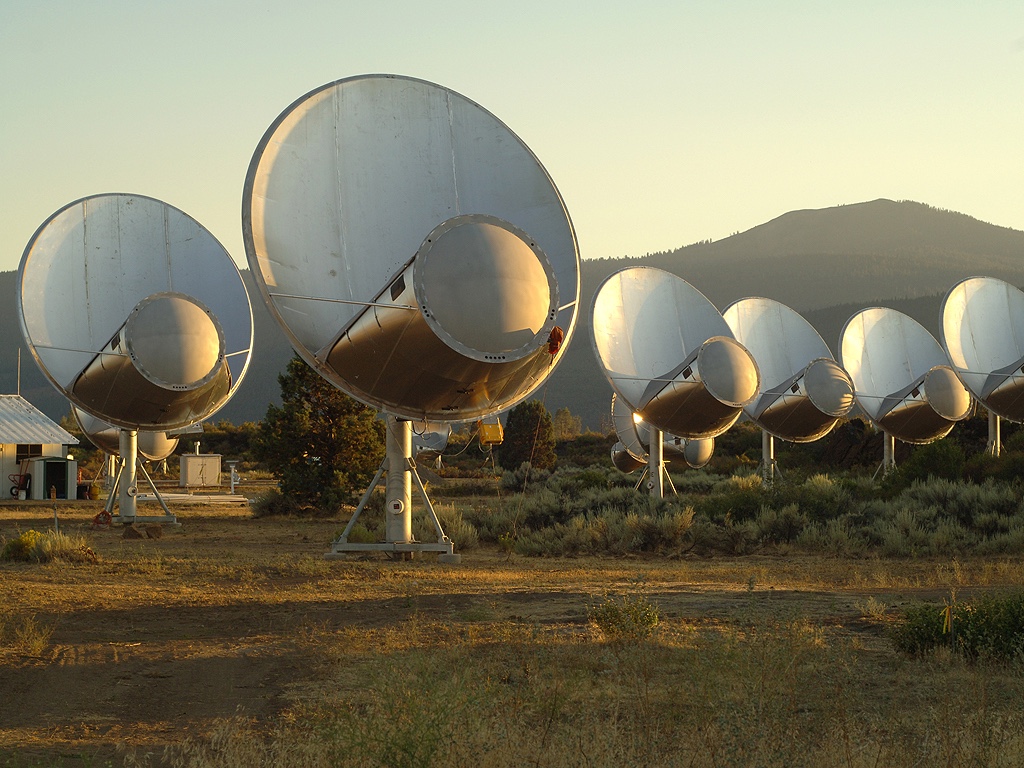
For most of its history, SETI was a part-time endeavor, often “piggybacking” on telescopes built for other astronomical purposes. Scientists would borrow observation time, squeezing their searches into the gaps between studies of pulsars or distant galaxies. But in the early 21st century, a new instrument was built from the ground up with SETI as a primary design driver. Located in the quiet, remote Cascade Mountains of Northern California, the Allen Telescope Array (ATA) represents a unique and pioneering approach to scanning the cosmos for signals that cannot be explained by nature.
Operated by the SETI Institute, the ATA is not a single, colossal dish. Instead, it’s an array of many smaller dishes, linked together by powerful computers to function as one massive, versatile instrument. Its innovative design allows it to scan huge swaths of the sky across a vast range of radio frequencies simultaneously, making it a powerful “listening” device for the galaxy. While its main quest is the search for “technosignatures,” the ATA is also a capable tool for conventional radio astronomy, studying phenomena like mysterious Fast Radio Bursts (FRBs) and the behavior of gas in our own Milky Way galaxy.
This article explores the Allen Telescope Array, from its conceptual origins and technological innovations to its operational challenges, scientific contributions, and its enduring role in humanity’s quest to find an answer to the ultimate question.
A New Kind of Telescope
To understand the Allen Telescope Array, one must first understand the basics of radio telescopes. Unlike optical telescopes that collect visible light, radio telescopes use large, dish-shaped antennas to capture radio waves – a form of light invisible to the human eye. Cosmic objects, from stars and planets to gas clouds and black holes, emit radio waves naturally. A radio telescope acts like a giant satellite dish, gathering these faint signals and focusing them onto a receiver, allowing astronomers to “see” the invisible universe.
For any telescope, two factors are paramount: sensitivity and resolution. Sensitivity, or its “collecting area,” determines how faint an object it can detect. This is typically achieved by building a massive single dish, like the iconic, now-lost Arecibo Observatory or the Green Bank Telescope. Resolution, or its “sharpness,” determines how much detail it can see. A telescope with poor resolution might see two separate stars as a single, blurry blob.
In radio astronomy, resolution is a major challenge. Because radio waves are much longer than light waves, even a giant dish has the resolving power of a very small optical telescope. To get a sharp radio image, a telescope would need to be impractically large – miles or even continents wide.
The solution to this problem is a technique called interferometry. Instead of building one impossibly large dish, astronomers build many smaller, separated dishes and link them electronically. A central processing unit, known as a correlator, combines the signals from each pair of antennas. By analyzing the tiny differences in the arrival time of the same radio wave at each dish, the computer can synthesize an image with the same resolution as a single dish whose diameter is equal to the farthest separation between the antennas in the array. This is the principle behind renowned instruments like the Very Large Array (VLA) in New Mexico.
The ATA takes this concept in a new direction. It follows a design philosophy known as “Large N, Small D,” meaning a large number of small-diameter dishes. The array consists of 42 antennas, each 6.1 meters (20 feet) in diameter. This approach has several distinct advantages, particularly for a survey instrument like a SETI telescope.
A key benefit is the field of view. The area of the sky that a single antenna can see at one time is inversely proportional to the size of its dish. A very large dish, like the 100-meter Green Bank Telescope, has a very narrow, “pencil-beam” field of view, much like looking at the sky through a drinking straw. The ATA’s small dishes, by contrast, have a very wide field of view, more like looking through a pair of binoculars. When combined, the full array can see a much larger patch of sky at once, making it ideal for scanning large areas for unknown signals – the very definition of the SETI search.
The Origins and Vision of the ATA
The idea for the Allen Telescope Array grew from a long-standing need within the SETI community. For decades, SETI research was conducted on borrowed time. Astronomers like Frank Drake, who conducted the first modern SETI search (Project Ozma) in 1960, had to beg for a few dozen or hundred hours on telescopes dedicated to other research. This was inefficient and severely limited the scope of any search. The SETI Institute, a non-profit organization founded in 1984, recognized that a dedicated instrument was necessary to conduct a systematic, long-term search.
The technological and conceptual seeds for the array were sown in the 1990s. The SETI Institute, along with scientists at the University of California, Berkeley’s (UC Berkeley) Radio Astronomy Lab, began developing the concept for a new type of telescope. They envisioned an instrument built from many small, inexpensive, mass-produced antennas, all linked by powerful digital electronics. This would not only be a powerful SETI search machine but also a superb instrument for “conventional” radio astronomy. It was initially called the One Hectare Telescope (1hT), describing its total collecting area of one hectare (10,000 square meters).
The project’s key champion was pioneering SETI astronomer Jill Tarter. She and her colleagues advocated for this new design, emphasizing that the explosion in computing power and the falling cost of electronics made it possible.
The project remained a concept on paper until it captured the attention of Microsoft co-founder Paul Allen. Allen, a philanthropist with a deep interest in science and technology, had been fascinated by the SETI question since childhood. He saw the potential in the team’s innovative design. In 2001, the Paul G. Allen Family Foundation made a foundational donation of $11.5 million to begin constructing the array. This was later followed by another $13.5 million from Allen and his associates, including Nathan Myhrvold. In recognition of this foundational support, the instrument was named the Allen Telescope Array.
The chosen location was the Hat Creek Radio Observatory (HCRO), a site in the remote, mountainous region near Lassen Peak. HCRO was already operated by UC Berkeley and was located in a “radio-quiet” zone, naturally shielded by mountains from the interfering radio noise of cities, cell phones, and Wi-Fi. Construction began, and the original plan was highly ambitious: 350 dishes. This full array would have had an enormous collecting area and unprecedented survey speed.
The ATA-42, consisting of the first 42 antennas, was formally inaugurated in October 2007. This represented the first phase of the project and became the operational instrument. The economic realities of the late 2000s meant that further expansion to the planned 350 dishes was put on hold indefinitely. The focus shifted to maximizing the scientific potential of the 42-dish array.
How the Allen Telescope Array Works
The ATA’s innovation isn’t just in the number of its dishes, but in their sophisticated design and the digital “brain” that connects them. The entire system is built for speed, flexibility, and, most importantly, the ability to scan an enormous range of frequencies at once.
The All-Seeing Feed
At the focal point of each of the 42 dishes is a component called a “feed horn.” This is the actual antenna that captures the radio waves reflected by the dish. Most radio telescopes use feeds that are “tuned” to a specific, narrow frequency range. To observe at a different frequency, astronomers often have to physically swap out the receiver, a process that can take hours.
The ATA’s feeds are revolutionary. They are a “log-periodic” design, resembling a metallic, cone-shaped spiral. This special shape allows a single feed to receive radio waves over an exceptionally broad frequency range simultaneously – from 0.5 to 11.2 Gigahertz (GHz).
This capability is perhaps the ATA’s single greatest advantage for SETI. The “needle in a haystack” problem of SETI isn’t just about where to look in the sky; it’s also about what frequency to listen to. No one knows what frequency an alien civilization might use. The ATA’s wideband feed is like a radio that can listen to billions of channels at the same time, instead of just one. It covers the “cosmic water hole” (a quiet part of the radio spectrum between 1.4 and 1.7 GHz) and much, much more, all at once.
The Signal Path
The journey of a cosmic signal through the ATA is a high-speed, high-tech process:
- Collection: A faint radio wave from space, perhaps from a distant quasar or, hypothetically, an alien transmitter, arrives at Earth. It strikes the 42 dishes at the Hat Creek Radio Observatory.
- Focusing: The 6.1-meter parabolic dishes reflect these waves and focus them onto the log-periodic feeds.
- Amplification: The signal is incredibly weak. To be processed, it must be amplified immediately. A Low-Noise Amplifier (LNA), cooled to cryogenic temperatures to minimize its own electronic “noise,” boosts the signal.
- Conversion and Transmission: The amplified analog signal is then sent over optical fibers from each of the 42 antennas to a central processing building. Using fiber optics prevents the signal from degrading or picking up interference over the long cable runs.
- Digitization: Inside the building, the analog signals (smooth waves) are converted into digital signals (a stream of 1s and 0s) by high-speed electronics.
- The Digital Brain: This is where the real “magic” happens. The digital streams from all 42 antennas are fed into two different systems simultaneously: a correlator and a beamformer.
Correlator and Beamformer: Two Brains in One
The ATA’s digital processing system allows it to conduct two types of science at the same time. This is known as “commensal observing,” which means “eating at the same table.”
The correlator is the traditional tool of interferometry. It mathematically compares, or “correlates,” the signal from every dish with the signal from every other dish. This computationally intensive process is what allows the array to create detailed radio images of astronomical objects, like a map of a gas cloud or the structure of a galaxy. This is the part of the system that performs conventional radio astronomy.
The beamformer, on the other hand, is the ATA’s primary SETI tool. A beamformer is a digital signal processor that can electronically “point” the telescope. It does this by adding microscopic time delays to the digital signal from each antenna before combining them. By precisely controlling these delays, the system can synthesize a “beam” focused on a specific point in the sky.
The advantage is that this steering is purely electronic. The dishes themselves don’t have to move. This makes it possible to “point” at different locations within the wide field of view almost instantly. The ATA’s powerful beamformer can even form multiple beams at once, allowing it to “stare” at several different stars simultaneously, dramatically speeding up a SETI survey.
This commensal system is highly efficient. While the correlator is busy making a radio map of a galaxy for an astronomy project, the beamformer can simultaneously use the same data stream to search for technosignatures from stars within that galaxy’s field of view. The SETI search gets to run 24 hours a day, 7 days a week, without interfering with other astronomical research.
The Primary Mission: The Search for Technosignatures
The Allen Telescope Array was built to find technosignatures – evidence of technology created by an intelligent civilization. The most sought-after signature is an artificial radio signal. Natural cosmic objects, like pulsars and gas clouds, emit radio waves over a very broad range of frequencies. Their signal is “wideband,” like static. A “narrow-band” signal, by contrast, is one that is confined to a very small slice of the radio dial, like a modern FM radio station. We know of no natural phenomenon that can produce a powerful, persistent, narrow-band signal. Finding one would be a smoking gun for an artificial transmitter.
The SETI search is often described as a multi-dimensional “needle in a haystack” problem. The ATA’s design is a direct attempt to search this “haystack” more effectively than ever before.
- The Spatial Haystack (Where to look?): There are billions of stars in our galaxy. The ATA’s wide field of view and rapid electronic steering allow it to survey the sky much faster than a large single dish. Its strategy includes:
- Targeted Search: Pointing the array at specific, high-interest targets, such as star systems known to have exoplanets, especially those in the “habitable zone.”
- Galactic Plane Survey: Systematically scanning the dense, star-rich band of the Milky Way, where the majority of the galaxy’s stars reside.
- Galactic Center: Staring at the supermassive black hole at the center of our galaxy, a region of high energy and speculation.
- The Frequency Haystack (What “channel” to listen to?): The radio spectrum is vast. As mentioned, the ATA’s unique log-periodic feeds and digital backend allow it to observe a massive range of frequencies at the same time. Its signal processing system can sift through billions of narrow frequency channels in real-time.
- The Temporal Haystack (When to look?): A signal might not be on all the time. It could be pulsed, or it might be a “beacon” that sweeps past Earth only occasionally. The ATA’s dedication to SETI means it can conduct long-term monitoring of target fields, increasing the chances of catching an intermittent signal that a short “snapshot” observation would miss.
- The Signal Type Haystack (What to look for?): The ATA’s computers don’t just look for simple, continuous “carrier” tones. They also search for more complex signals, such as trains of pulses that might be used for navigation or communication. The system is programmed to flag any signal that appears artificial and “re-observe” it to rule out a false positive.
The most common false positive is radio-frequency interference (RFI) – signals from our own technology. Satellites, aircraft, cell phones, and even a faulty microwave oven can create signals that look artificial. The ATA’s design as an interferometer is a powerful defense against RFI. A signal from an Earth-orbiting satellite or a terrestrial source will be detected by all 42 antennas almost simultaneously. A true cosmic signal will show a characteristic delay pattern as it crosses the array. The system’s software is designed to automatically filter out and reject signals that are clearly of Earthly origin.
Beyond SETI: A Versatile Tool for Radio Astronomy
While the SETI Institute‘s mission is its primary driver, the Allen Telescope Array is also a powerful and flexible instrument for conventional science. Its unique capabilities – a wide field of view, broad frequency coverage, and rapid-response pointing – make it a valuable asset for studying the “transient” radio sky.
Fast Radio Bursts (FRBs)
One of the most exciting fields in modern astronomy is the study of Fast Radio Bursts (FRBs). These are unbelievably powerful, millisecond-long bursts of radio waves that originate in distant galaxies. Their cause is still unknown, though many theories involve neutron stars with extreme magnetic fields, called magnetars.
Because FRBs are unpredictable and last for the blink of an eye, they are very difficult to “catch.” This is where the ATA’s wide field of view is a huge advantage. It can monitor a large patch of sky, waiting for a burst to happen. When one is detected, its wide frequency coverage allows astronomers to study how the signal has “traveled,” which provides clues about the sparse matter in intergalactic space.
Pulsars and Magnetars
Pulsars are the rapidly spinning, super-dense remnants of massive stars. They sweep beams of radio waves across space, appearing from Earth as a “pulse” with clock-like regularity. The ATA can be used to search for new pulsars and to monitor the timing of known ones, which can be used to test Albert Einstein’s theory of general relativity. It is also used to monitor magnetars, the likely source of FRBs, looking for bursts or changes in their behavior.
Mapping Our Galaxy
The most abundant element in the universe is hydrogen. Neutral hydrogen gas emits a faint but distinct radio signal at a specific frequency (1.42 GHz). By mapping this “hydrogen line,” astronomers can trace the invisible gas clouds that form the spiral arms of our Milky Way galaxy. The ATA’s ability to create radio images makes it a good tool for this kind of galactic cartography, helping to build a more complete picture of our own cosmic neighborhood.
Space Situational Awareness
The ATA’s abilities have also found a practical, down-to-Earth application. Its sensitive receivers and fast steering can be used to track objects in Earth’s orbit. It can monitor the radio “chatter” from active satellites or find “dark” objects, like spent rocket stages or dead satellites, by bouncing signals off them (a form of radar). This contributes to “space situational awareness,” the effort to catalog and track the cloud of space debris that poses a threat to active satellites and human spaceflight.
Challenges, Upgrades, and a New Era
The ATA’s journey has not been without significant challenges. Operating a cutting-edge astronomical facility is expensive, and the project’s reliance on private funding, combined with the 2008 financial crisis, led to a budgetary shortfall. In 2011, operations were suspended, and the array was placed in “hibernation.”
This news sparked a massive public response. The SETI Institute launched an emergency fundraising campaign called “SETIStars,” appealing directly to the public to save the array. The response was immediate and global, with thousands of individuals donating. This public support, combined with a significant gift from an United States Air Force program (interested in the array’s space debris tracking potential), allowed the ATA to resume operations by the end of 2011.
This event marked a shift. In 2012, the SETI Institute took over sole ownership and management of the array from its partner, UC Berkeley. The institute re-focused its efforts on upgrading the array’s now-aging digital hardware.
The 2010s saw a revolution in computing, particularly in the power of Graphics Processing Units (GPUs). These “graphics cards,” originally designed to render complex video game graphics, turned out to be exceptionally good at the specific type of parallel mathematics required for radio astronomy signal processing.
The SETI Institute began a comprehensive digital overhaul of the ATA. The original, custom-built correlator and beamformer were replaced with a new, more powerful, and flexible system based on commercial, off-the-shelf GPU hardware. This new digital “backend,” which heavily utilizes open-source software like GNU Radio, massively increased the array’s processing capacity. It can now analyze a much larger “chunk” of the radio spectrum at any given time, making its SETI searches far more powerful and efficient.
In 2016, the ATA received another major boost when it became a key instrument for the Breakthrough Listen initiative. This $100 million, 10-year project, funded by philanthropist Yuri Milner, is the most extensive SETI search ever undertaken. Breakthrough Listen uses several of the world’s largest telescopes, including the Green Bank Telescope and the Parkes Observatory in Australia. Its partnership with the Allen Telescope Arrayprovides dedicated funding for ATA operations and access to its unique, wide-field survey capabilities, integrating it into a coordinated, global search effort.
The ATA in the Modern Landscape of Astronomy
The Allen Telescope Array occupies a special niche in the world of radio astronomy. It is not the most sensitive telescope – a single large dish like Green Bank can collect more signal from a single point. It is not the highest-resolution telescope – arrays with much longer “baselines” (separations between dishes), like the VLA, can make sharper images.
The ATA’s strength is its combination of a wide field of view, enormous frequency coverage, and operational flexibility. It is a “survey machine” par excellence. It can scan the sky faster and over a wider range of parameters than almost any other instrument.
Its most important legacy may be technological. The ATA was a pioneer and a critical testbed for the “Large N, Small D” concept. It proved that an array built from hundreds of small, mass-produced dishes with a sophisticated digital backend was not only possible but highly effective.
This very concept is the foundation for the next generation of radio astronomy “mega-telescopes.” The Square Kilometre Array (SKA) is an international project to build the world’s largest radio telescope, with thousands of dishes and antennas spread across two continents (South Africa and Australia). The design of the SKA and its pathfinders, like MeerKAT in South Africa, draws directly on the lessons learned from the ATA’s design, construction, and operation. The ATA helped prove the technologies for antenna design, signal transport, and massive digital processing that will define radio astronomy for the 21st century.
Below is a comparison of the Allen Telescope Array with other major radio interferometer arrays.
| Telescope | Number of Dishes | Dish Diameter | Total Collecting Area (sq. m) | Primary Focus |
| Allen Telescope Array (ATA) | 42 (operational) | 6.1 meters | ~1,227 m² | SETI Surveys, Transients (FRBs), Wide-Field Mapping |
| Karl G. Jansky Very Large Array (VLA) | 27 | 25 meters | ~13,250 m² | High-Resolution Imaging, Deep Space Objects |
| MeerKAT (SKA Precursor) | 64 | 13.5 meters | ~9,156 m² | Pulsars, Hydrogen Surveys, Galaxy Evolution |
| Square Kilometre Array (SKA-Mid) | 197 (Phase 1) | 15 meters | ~34,800 m² | Pulsars, Gravitational Waves, Cosmic Magnetism |
Summary
The Allen Telescope Array is more than just a collection of dishes in the California mountains. It’s the physical embodiment of a scientific quest, representing a systematic, long-term, and technologically advanced effort to answer one of humanity’s oldest questions. It rose from an ambitious concept to a working reality through a novel partnership of private philanthropy and scientific research institutions.
Its innovative design – using a large number of small dishes with an extremely wideband feed – makes it a uniquely powerful instrument for sifting the cosmic haystack for signs of intelligence. It can scan vast regions of the sky and the radio dial simultaneously, conducting conventional astronomy and SETI searches at the same time.
The array has proven its resilience, surviving financial hibernation through the dedicated support of the public and the scientific community. It has since been reborn through major technological upgrades, integrating cutting-edge computing hardware and sophisticated software to become more powerful than ever. As a key partner in the Breakthrough Listen initiative, it continues its primary mission while also serving as a valuable tool for studying some of the universe’s most dynamic mysteries, like Fast Radio Bursts.
While its original vision of 350 dishes remains a future aspiration, the operational ATA-42 has forged a significant legacy. It has demonstrated the power of the “many-small-antennas” approach, paving the way for the next generation of radio telescopes like the Square Kilometre Array. The Allen Telescope Array continues its quiet, patient vigil, listening to the static of the cosmos for a single, structured signal that could change our perception of the universe forever.