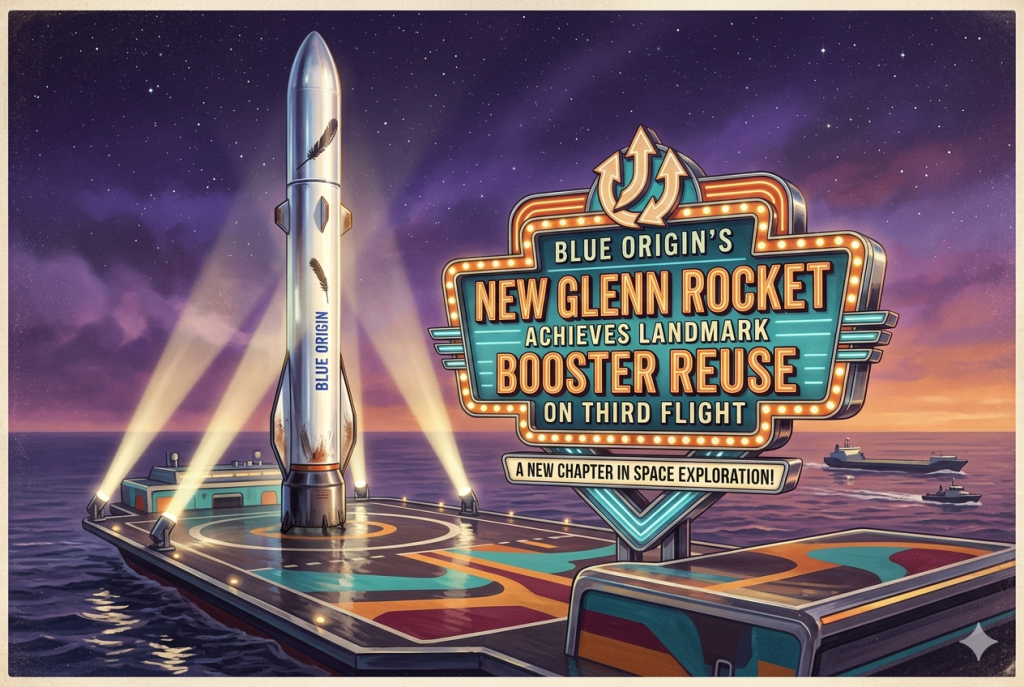
On April 19, 2026, Blue Origin successfully launched its New Glenn heavy-lift rocket for the third time from Launch Complex 36 at Cape Canaveral Space Force Station in Florida. The mission, designated NG-3, marked a historic milestone: the first reuse of a New Glenn first-stage booster. The booster, previously flown on the NG-2 mission in November 2025 and nicknamed “Never Tell Me the Odds,” performed flawlessly, separating from the upper stage and executing a precise propulsive landing on Blue Origin’s floating droneship Jacklyn in the Atlantic Ocean.
Liftoff occurred at 7:25 a.m. EDT (11:25 UTC) after a brief countdown hold at T-minus 3 minutes, 57 seconds. The seven BE-4 engines on the first stage ignited, propelling the 322-foot-tall (98-meter) vehicle skyward on a south-easterly trajectory. First-stage burnout and separation happened approximately 3.5 minutes into flight, followed by the booster’s autonomous descent and touchdown roughly six minutes later. Blue Origin teams celebrated the recovery, highlighting upgrades to the thermal protection system and guidance for improved reentry performance.
However, the mission was not without complications. While the upper stage successfully separated the payload – AST SpaceMobile’s massive BlueBird 7 satellite – Blue Origin later confirmed that the spacecraft was deployed into an “off-nominal orbit.” The company stated that payload separation was verified, AST SpaceMobile confirmed the satellite had powered on, and teams were assessing the situation for further updates. It remains unclear whether BlueBird 7 can maneuver into its intended low Earth orbit or if the anomaly will impact its operational lifespan.
The Payload: Advancing Space-Based Cellular Connectivity
BlueBird 7 is the latest Block 2 satellite in AST SpaceMobile’s constellation, designed to deliver direct-to-cellphone broadband connectivity from space. Spanning an enormous 2,400-square-foot (223-square-meter) antenna array, it joins BlueBird 6 (launched on India’s LVM3 in December 2025) as one of the largest commercial satellites ever deployed. The mission aimed to expand network capacity and support initial service rollout later in 2026, potentially connecting billions of unmodified mobile phones globally without relying on terrestrial towers.
This was New Glenn’s first commercial payload on a Block 2-class satellite, underscoring Blue Origin’s growing role in serving high-value customers beyond government contracts.
A Brief History of New Glenn: From Concept to Operational Heavy Lifter
New Glenn, named after NASA astronaut and Mercury pioneer John Glenn, represents Blue Origin’s entry into the orbital launch market. Development began in earnest before 2013, with public announcement in 2016. The rocket evolved into a two-stage, partially reusable design featuring a 7-meter (23-foot) diameter core. The first stage was unveiled on the pad in February 2024, and the maiden flight followed on January 16, 2025 (NG-1).
- NG-1 (January 16, 2025): The inaugural flight successfully reached orbit on the first attempt, injecting the Blue Ring Pathfinder payload into medium Earth orbit. However, the first stage was lost during descent at around Mach 5.5 and 84,000 feet altitude – no landing was attempted. Blue Origin CEO Dave Limp praised the achievement of orbital insertion on debut.
- NG-2 (November 13, 2025): The second flight deployed NASA’s twin Escape and Plasma Acceleration and Dynamics Explorers (ESCAPADE) spacecraft toward Mars. Critically, it achieved Blue Origin’s first successful booster landing on the Jacklyn droneship, validating reusability for the “Never Tell Me the Odds” booster. This made New Glenn the second orbital-class rocket (after SpaceX’s Falcon family) to recover a first stage.
NG-3 built directly on NG-2’s success by reflown that same booster core (with fresh engines) just five months later – a rapid turnaround demonstrating Blue Origin’s refurbishment capabilities. The company designs first stages for up to 25 flights.
Technical Specifications: A Beast Built for Scale and Reusability
New Glenn stands 98 meters (322 feet) tall in its operational 7×2 configuration and is powered by seven BE-4 engines on the first stage. These oxygen-rich staged-combustion engines burn liquid oxygen and liquefied natural gas (methalox), each producing 640,000 lbf (2,846 kN) of sea-level thrust for a total of about 4.48 million lbf. The second stage uses two BE-3U engines burning liquid oxygen and liquid hydrogen (hydrolox) for high-efficiency performance in vacuum.
Payload capacities in the current configuration include 45,000 kg (99,000 lb) to low Earth orbit (LEO) and 13,600 kg (30,000 lb) to geostationary transfer orbit (GTO). A larger 9×4 “super heavy” variant under development – featuring nine BE-4 engines and four BE-3U engines – will boost capacities above 70,000 kg to LEO and support an expanded 8.7-meter fairing. The rocket’s first stage is engineered for vertical propulsive landings on droneships or land pads, with aluminum tanks and autogenous pressurization for reliability.
At $68–110 million per launch, New Glenn positions Blue Origin as a cost-competitive alternative to SpaceX’s Falcon Heavy while offering larger fairings and higher per-mission throughput for constellation builders.
Significance and the Road Ahead
The NG-3 mission’s booster reuse success is a pivotal step for Blue Origin, ending SpaceX’s near-monopoly on orbital booster recovery and signaling a maturing multi-player reusable launch market. It accelerates the company’s cadence goals (aiming for up to eight launches per year) and supports a diverse manifest, including Amazon’s Project Kuiper satellites, NASA lunar landers, and commercial telecom payloads.
Future flights include additional AST SpaceMobile satellites, Blue Origin’s own Blue Moon Mark 1 lunar lander (targeted for uncrewed lunar landing in summer 2026), and potential polar missions from Vandenberg Space Force Base. A reusable upper stage concept was explored but deferred after early flights.
While the off-nominal orbit of BlueBird 7 introduces uncertainty for this specific customer, the core technical achievements – rapid booster turnaround, reliable ascent, and pinpoint landing – affirm New Glenn’s maturation. Blue Origin, founded by Jeff Bezos to “build a road to space for the benefit of Earth,” continues to close the gap with rivals. As reusability becomes table stakes, today’s flight underscores that New Glenn is not just flying – it’s evolving into a workhorse capable of transforming access to orbit. Updates on the satellite’s status and any corrective maneuvers will be closely watched by the industry.