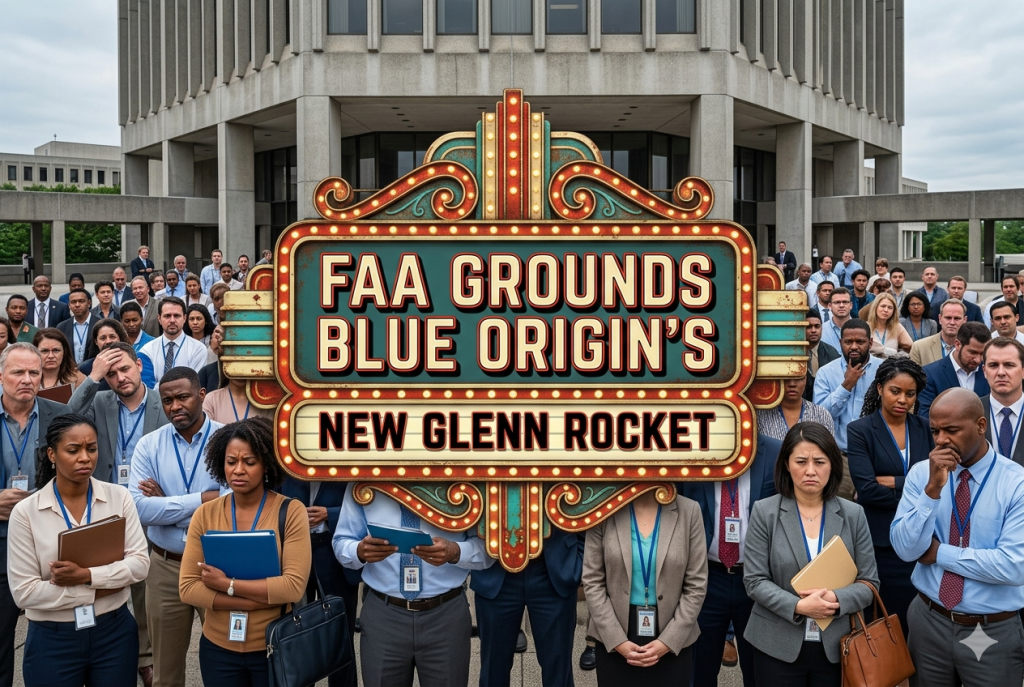
The Federal Aviation Administration (FAA) has grounded Blue Origin’s New Glenn heavy-lift rocket after its third mission on April 19, 2026, ended in an upper-stage failure that stranded a commercial satellite in the wrong orbit.
The rocket lifted off successfully from Launch Complex 36 at Cape Canaveral Space Force Station in Florida. For the first time, Blue Origin flew a previously used booster – named “Never Tell Me The Odds,” which had flown on the second New Glenn mission in November 2025. The first stage performed flawlessly, separating and landing intact on the recovery vessel Jacklyn in the Atlantic Ocean, marking a key milestone in reusability for the vehicle.
However, the second stage encountered a problem during its flight sequence. According to early data shared by Blue Origin, the stage’s second engine burn did not deliver sufficient thrust to reach the planned orbital altitude. The payload – an AST SpaceMobile BlueBird 7 communications satellite – was deployed into an “off-nominal” orbit at roughly 95–154 miles (about 150–250 km) altitude, far below the intended roughly 285-mile (460 km) target orbit. The satellite lacked enough onboard propellant to raise itself to operational altitude and is now considered a total loss; it will be deorbited and burn up in the atmosphere. Insurance is expected to cover the hardware cost.
The upper stage was also scheduled to perform a third burn after payload separation to deorbit itself safely into the open ocean, but that maneuver apparently did not occur as planned.
FAA Orders Mishap Investigation
The FAA promptly classified the event as a “mishap” and has required Blue Origin to lead a formal investigation with FAA oversight. The agency’s statement read: “The FAA is aware that Blue Origin New Glenn 3 experienced a mishap during the second-stage flight sequence following a successful launch.” It notified NASA, the National Transportation Safety Board (NTSB), and the U.S. Space Force.
Per standard FAA procedure, New Glenn will remain grounded until the investigation determines the root cause, identifies corrective actions, and confirms that no systems, processes, or procedures related to the mishap affect public safety. “A mishap investigation is designed to enhance public safety, determine the root cause of the event, and identify corrective actions to avoid it from happening again,” the FAA noted. There were no reports of injuries or property damage.
Blue Origin CEO Dave Limp addressed the issue on X, saying: “While we are pleased with the nominal booster recovery, we clearly didn’t deliver the mission our customer wanted, and our team expects. We have been in steady communication with the team at AST SpaceMobile, we appreciate their partnership, and we’re looking forward to many flights together.” The company stated it is analyzing data and plans to implement improvements “to quickly return to flight operations.”
AST SpaceMobile confirmed the satellite was unusable and will be deorbited.
This marks the second time the FAA has grounded New Glenn. The rocket’s debut flight in January 2025 successfully reached orbit on the first attempt – the first commercial rocket to do so – but the booster failed to relight its engines for a controlled landing and was lost. That led to a 2.5-month grounding while corrective actions were verified. The second flight in November 2025 was fully successful.
Blue Origin had been licensed by the Space Force for up to 12 New Glenn launches per year and had publicly targeted at least eight in 2026. The company had only announced two more missions for this year, including the uncrewed MK1 Blue Moon lunar lander test flight (originally eyed for summer 2026). Amazon is also relying on New Glenn for multiple launches of its Project Kuiper (Leo) broadband satellite constellation.
Industry observers note that mishap investigations for new launch vehicles can last weeks to several months, depending on the complexity of the failure. For comparison, SpaceX’s Falcon 9 was grounded for just 15 days after a similar upper-stage issue in 2024.
The grounding comes at a pivotal time for Blue Origin, which is positioning New Glenn as a major competitor to SpaceX’s Falcon 9 and Falcon Heavy in the commercial and national-security launch markets. While the booster reuse milestone is a positive step, the upper-stage reliability issue highlights the technical challenges still facing the program as it scales up cadence.
Blue Origin has not yet provided a timeline for return to flight, but the company and its customers will be watching closely as the investigation unfolds. For now, New Glenn – the rocket Jeff Bezos once described as key to Blue Origin’s vision of millions living and working in space – sits idle while engineers hunt for answers.