- Key Takeaways
- Vast High-Power Satellite Buses Move Beyond Station Development
- What a 15 kW-Class Satellite Bus Offers Customers
- Haven Demo Flight Heritage and Manufacturing Claims
- Customer Demand From Communications, Earth Observation, Security, and Orbital Compute
- Media Reactions Frame Vast as More Than a Station Startup
- Competitive Pressure in High-Power Satellite Platforms
- Risks, Constraints, and What Must Be Proven
- Space Economy Meaning of Vast Satellite
- Summary
- Appendix: Useful Books Available on Amazon
- Appendix: Top Questions Answered in This Article
- Appendix: Glossary of Key Terms
Key Takeaways
- Vast’s 15 kW-class bus turns Haven station subsystems into a satellite product.
- Haven Demo gives the satellite line flight data from a 2025 mission and 2026 deorbit.
- Orbital compute, Earth observation, communications, and security missions drive demand.
Vast High-Power Satellite Buses Move Beyond Station Development
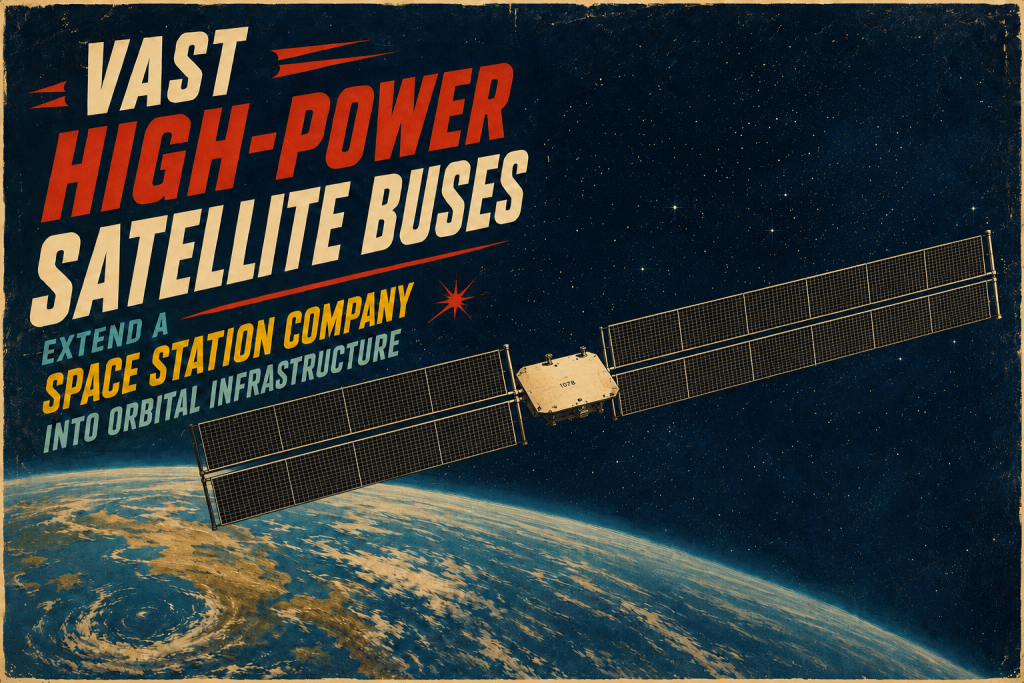
May 19, 2026 marked a sharp expansion in Vast’s business plan: the company announced Vast Satellite, a line of high-power satellite buses for operators in communications, Earth observation, national security, and orbital data center constellations. The first product is a 15 kilowatt (kW) class spacecraft bus, meaning a spacecraft platform designed to generate and manage far more electrical power than many smaller commercial satellites can provide. The announcement moved Vast beyond its public identity as a private space station developer and into the larger market for mission infrastructure in low Earth orbit (LEO).
A satellite bus is the service platform that carries the payload and keeps it alive. It supplies power, thermal control, propulsion, pointing, communications, command handling, and structural support. The payload does the customer’s mission, such as imaging Earth, relaying communications, processing data, or carrying sensors. Vast’s announcement matters because the company is selling the platform layer rather than only selling crewed station access.
Vast positioned the new satellite line as a reuse of technology from Haven-1, its planned commercial space station, and from Haven Demo, the uncrewed spacecraft that launched in 2025 and deorbited in 2026. That strategy gives the satellite product a different origin story from a startup that begins with a small CubeSat platform and scales upward. Vast is trying to adapt station-class subsystems, manufacturing capacity, avionics, propulsion work, batteries, flight software, and mission operations into a repeatable satellite product.
The announcement also disclosed early commercial demand. Vast said a confidential customer signed an agreement for four satellites, with an option for up to 200 additional satellites. The buyer’s identity, mission type, contract value, delivery schedule, and technical configuration were not disclosed. That leaves room for caution, but the option size gives the announcement a constellation-oriented character rather than a single demonstration mission.
Vast also said it plans to secure a satellite launch targeting late 2027 for 10 of its 15 kW-class satellites. That planned mission is separate from the company’s crewed station program, although both product lines draw from related internal systems. A late 2027 satellite launch target places Vast Satellite on a schedule that overlaps with Haven-1 readiness work, NASA private astronaut mission planning, and broader commercial LEO transition efforts.
What a 15 kW-Class Satellite Bus Offers Customers
Power changes what a satellite can do. A small spacecraft with limited power may capture data intermittently, process little information onboard, downlink only when ground stations are available, or operate payloads in short duty cycles. A 15 kW-class bus can support heavier payloads, stronger communications links, higher onboard computing loads, more demanding sensors, electric propulsion, and more thermal-control capacity. For mission planners, that can reduce the need to split work among many low-power satellites, although constellation design still depends on coverage, latency, cost, launch packaging, and replacement cycles.
Vast’s published specifications place the first bus in a middle ground between smallsat platforms and large traditional spacecraft. The company lists a 700 kg dry bus mass, more than 350 kg of payload capacity, dimensions of 2.2 m by 3.6 m, a five-year design life, and an operating LEO altitude range of 350 km to 1,200 km. It also lists future orbit options for medium Earth orbit (MEO), geostationary orbit (GEO), and lunar missions. Those future-orbit labels should be read as planned capability, not as flown service.
The power and thermal figures are central to the product. Vast lists 15 kW of solar power from two deployable rollout arrays, more than 20 kW of time-dependent payload peak power, 6 kW to 14.5 kW of orbit-average payload power depending on orbit and payload, and 6 kW to 10 kW of bus-managed thermal dissipation depending on mission conditions. Thermal dissipation matters because a payload that draws large amounts of electricity also creates heat. Spacecraft cannot use air cooling, so heat must move through structures and radiators before leaving the spacecraft as infrared radiation.
The table below summarizes the main claims Vast published for the first platform.
| Capability Area | Vast 15 kW-Class Bus Claim | Commercial Meaning |
|---|---|---|
| Mission Life | 5 years | Supports operating plans longer than short demonstrations. |
| Payload Capacity | 350+ kg | Allows larger sensors, radios, compute systems, or hosted payloads. |
| Solar Power | 15 kW | Supports power-hungry payloads and stronger onboard processing. |
| Orbit Range | 350-1,200 km LEO | Fits many Earth observation, communications, and defense missions. |
| Total Mission Delta-V | At least 500 m/s | Provides orbit adjustment, maintenance, and disposal capability. |
| Enhanced Pointing Option | <0.005 deg knowledge / <0.02 deg control | Serves payloads that need fine alignment, including optical systems. |
Guidance, navigation, and control (GNC) performance will influence customer fit. Vast lists pointing knowledge of less than 0.05 degrees and pointing control of less than 0.1 degrees, both at one standard-deviation confidence. It also offers an enhanced pointing option with tighter performance. Pointing matters for Earth observation sensors, laser communications terminals, high-gain antennas, and any payload that must hold an accurate line of sight.
Interfaces are another practical selling point. Vast lists Ethernet, RS-422 serial, discrete input and output lines, analog sensor inputs, platinum resistance temperature detectors, and heater interfaces. Optional enhanced interfaces include MIL-STD-1553 and SpaceWire, both familiar to spacecraft engineers. Interface breadth can shorten payload integration work because customers can adapt existing hardware without forcing a new electronics design.
Haven Demo Flight Heritage and Manufacturing Claims
Haven Demo is the credibility bridge in Vast’s satellite-bus announcement. The spacecraft launched on November 2, 2025 on SpaceX’s Bandwagon-4 rideshare mission from Cape Canaveral and completed a controlled deorbit on February 4, 2026. Vast said the three-month mission completed 49 test objectives, remained power positive throughout the flight, and tested systems tied to GNC, avionics, networking, power distribution, solar arrays, radio communications, cameras, thermal control, propulsion, and flight software.
The difference between ground qualification and flight heritage matters. A company can test vibration, thermal cycling, software, power systems, and propulsion on Earth, but space adds radiation, thermal extremes, operations delays, orbital dynamics, communications limits, and real anomaly behavior. Vast’s deorbit update reported that on-orbit radiation effects matched company predictions, that global positioning system data sometimes behaved unexpectedly over conflict regions, and that software updates helped filter unreliable position data. Those details strengthen the announcement because they move the story beyond generic claims about heritage.
Vast’s satellite line also depends on manufacturing depth. The May 2026 release described common in-house subsystems, including avionics, power, communications, propulsion, and flight software. The release also showed manufacturing elements such as a Vast Control Unit, satellite battery production, cathode testing, and a 10 kW electric thruster in preparation for vacuum testing. For satellite buyers, vertical integration can support schedule control and cost control, but it also increases internal execution burden because the company owns more of the technical stack.
The Haven Demo vehicle was much smaller and lower-power than the proposed 15 kW satellite bus. Vast’s Haven Demo page lists a mass of 552.19 kg and 1,100 W of power. Scaling from a 1.1 kW demonstration spacecraft to a 15 kW-class commercial bus is not an automatic conversion. Larger power systems, higher thermal loads, customer payload interfaces, batch production, quality control, supply availability, and launch integration create new work. Flight heritage reduces some uncertainty, but it does not remove the need for qualification of the new bus configuration.
A second table separates what Vast has flown from what it has announced for the satellite-bus product.
| Program Element | Status as of May 19, 2026 | Evidence of Maturity | Remaining Test |
|---|---|---|---|
| Haven Demo | Completed Flight and Deorbit | Three-month mission with 49 test objectives completed. | Lessons must transfer to larger station and satellite systems. |
| 15 kW-Class Bus | Announced Product | Specifications published and first sale disclosed. | Flight of first production satellites remains planned. |
| 10 kW Electric Thruster | In Development | Vacuum testing hardware shown by Vast. | Operational performance on the 15 kW bus must be demonstrated. |
| Orbital Compute Option | Planned Option | Vast named NVIDIA Space-1 Vera Rubin Module support. | Thermal, power, and mission integration remain customer-specific. |
Mission operations also separate Vast from a company that only sells hardware. Haven Demo used Vast’s Mission Control Center in Long Beach, and the controlled deorbit required coordination with NASA, aviation, and maritime safety authorities. If Vast sells buses to operators that want managed service, hosted payload support, or operational support, that experience may become part of the commercial offer. If customers buy only the bus, the value shifts back toward manufacturability, integration support, and cost.
Customer Demand From Communications, Earth Observation, Security, and Orbital Compute
Vast named four customer categories in its release: communications, Earth observation, national security, and orbital data center constellations. These categories have different buying patterns, but they share a demand for more payload power. Communications payloads can use power for higher-throughput links and stronger communications handling. Earth observation payloads can use it for advanced sensors and onboard processing. National security missions can demand higher responsiveness, more maneuverability, and resilient communications. Orbital data center concepts depend on the ability to power graphics processing units (GPUs), memory, storage, and data links.
The orbital compute angle may be the most attention-grabbing part of the announcement. Vast said it plans to offer the optional NVIDIA Space-1 Vera Rubin Module for orbital data center inferencing, artificial intelligence (AI) edge compute, signal processing, and autonomous spacecraft operations. NVIDIA presented the module in March 2026 as part of its space computing push, saying the Rubin GPU on the module delivers up to 25 times the AI compute of an H100 GPU for space-based inferencing. That is a chipmaker claim, not proof of an orbital data center market, but it helps explain why a 15 kW-class bus could attract interest.
Power alone does not make orbital compute practical. A compute satellite must handle heat, radiation, memory errors, data movement, software reliability, cyber resilience, and high-bandwidth communications with customers or ground networks. The business case depends on whether processing in orbit creates enough value compared with downlinking data to Earth-based data centers. Earth observation missions may make the earliest case because raw imagery can be filtered, compressed, prioritized, or analyzed before downlink. Remote-sensing operators already face data bottlenecks, and high-power onboard processing can reduce wasted transmission.
National security demand also fits the power story. Defense and security customers often value responsiveness, autonomy, maneuvering capacity, protected communications, and multi-sensor processing. Vast’s optional laser communications terminal, software-defined radio platform, enhanced pointing option, and high-performance GPU option align with those needs. The company has not disclosed whether the confidential customer is a defense, commercial, or civil operator. It also has not disclosed export-control details, customer geography, or payload type.
Communications operators may see the bus as a way to support higher-capacity nodes in LEO or mixed-orbit architectures. High-power buses can serve trunk links, optical inter-satellite links, direct-to-device architectures, or specialized enterprise links, depending on payload design. GEO communications satellites have long used high-power platforms, but LEO constellations need lower unit cost and repeatable manufacturing. Vast is trying to enter that middle zone: more power than many small platforms, but still designed for high-density launch and batch deployment.
Earth observation customers may be more sensitive to pointing, thermal stability, and downlink throughput than peak power alone. High-resolution optical systems, hyperspectral sensors, synthetic aperture radar payloads, and onboard AI pipelines all pull on the bus in different ways. Vast’s published payload capacity and pointing options are relevant, but final customer fit will depend on vibration, jitter, thermal gradients, contamination control, payload accommodation, and data handling.
Media Reactions Frame Vast as More Than a Station Startup
Credible media coverage before the Vast Satellite announcement had already shifted the company from a speculative station developer toward a visible contender in the commercial LEO transition. Space.com covered Vast’s March 2026 $500 million financing, reporting that the round included $300 million in Series A equity and $200 million in debt to support facilities, workforce growth, and Haven-2 development. That financing coverage gave outside readers a reason to treat Vast as more than a presentation-deck company.
Payload offered a more schedule-focused reaction in January 2026, reporting that Haven-1 had moved from an expected 2026 launch to no earlier than the first quarter of 2027. The same coverage emphasized that crewed flights would depend on SpaceX confidence in station safety and verification data. That outside framing is useful for the satellite-bus announcement because it shows how media reaction to Vast often mixes interest in speed with caution about human-spaceflight execution.
Space.com’s coverage of the Bandwagon-4 launch placed Haven Demo in a broader rideshare mission that also carried a Starcloud orbital data center test. That pairing now looks relevant. Vast’s May 2026 satellite-bus announcement directly names orbital data centers as one of the target markets, so the company’s demonstration heritage and the orbital compute market are converging in the same launch-era narrative.
The National Aeronautics and Space Administration selected Vast in February 2026 for the sixth private astronaut mission to the International Space Station (ISS), targeted no earlier than summer 2027. NASA described the selection as part of its commercial LEO strategy. That official action reinforced media coverage treating Vast as a company gaining operational exposure before Haven-1 and Haven-2.
The May 2026 bus announcement gives journalists and industry analysts a new angle: Vast is no longer only trying to sell destinations for people and microgravity payloads. It is also trying to sell high-power spacecraft platforms to unmanned markets. That broadens the company’s addressable customer base, but it also opens a second execution front at the same time the company is preparing Haven-1, courting Haven-2 stakeholders, and building international research partnerships.
Competitive Pressure in High-Power Satellite Platforms
Vast enters a market that already contains established satellite manufacturers and newer high-power platform specialists. The most direct startup comparison is K2 Space, which markets its Mega Class platform around 20 kW of power and describes it as a higher-power alternative to lower-power constellation-class satellites. K2’s public positioning rests on power, resilience, high delta-v propulsion, and scaled manufacturing. Vast’s 15 kW-class bus sits near that competitive lane, although exact customer fit will depend on price, production cadence, payload interfaces, orbit options, and demonstrated flight record.
Legacy satellite manufacturers bring a different kind of competition. Companies such as Thales Alenia Space, Airbus Defence and Space, Boeing Space, Lockheed Martin Space, Northrop Grumman Space, and Maxar Space Systems have decades of experience building communications, science, civil, and defense spacecraft. Their heritage can reassure conservative customers, especially for high-value government missions. Their cost structures and delivery cycles can also leave room for newer entrants that can offer faster builds or more standardized platforms.
The satellite-bus market has fragmented by size and mission model. CubeSat and microsatellite buses support low-cost missions, universities, technology demonstrations, and large low-power constellations. ESPA-class and mid-size buses support larger hosted payloads and dedicated missions. High-power buses support communications, defense, radar, large optics, and compute-heavy payloads. Vast is targeting customers that want the mass, power, and thermal capacity of larger systems without necessarily buying a traditional large GEO spacecraft.
Competition will also come from operators that build proprietary spacecraft in-house. SpaceX Starlink satellites, Planetimaging spacecraft, and many defense architectures use designs controlled by the operator. Those operators may buy parts, payloads, or subsystems, but they do not always buy a complete commercial bus. Vast’s best external customer targets may be companies that want high-power constellation capability without building the full spacecraft platform themselves.
A comparison of market positions shows where Vast is trying to fit.
| Provider Type | Typical Advantage | Typical Constraint | Vast’s Position |
|---|---|---|---|
| Legacy Prime Contractor | Long heritage and deep customer relationships. | Higher cost and longer schedules can limit some constellations. | Competes on vertical integration and speed claims. |
| Smallsat Bus Supplier | Lower cost and repeatable production. | Power, payload mass, and thermal capacity can constrain missions. | Offers a higher-power step above many small platforms. |
| High-Power Startup | Designed for newer compute and sensing demand. | Needs flight record, customer proof, and scaled production. | Uses Haven Demo heritage and station technology reuse. |
| In-House Operator Platform | Tightly matched to operator mission needs. | Requires internal spacecraft engineering depth. | Targets customers that want capability without building the bus. |
Vast’s station work may help or hinder its satellite-bus sales. The benefit is that station development forces attention to reliability, operations, power systems, software, safety, integration, and manufacturing. The constraint is management bandwidth. A company trying to finish Haven-1, prepare private astronaut work, win confidence for Haven-2, and build a satellite-bus product line must avoid spreading engineering and production resources too thin.
Risks, Constraints, and What Must Be Proven
The largest technical challenge is turning a company announcement into repeatable spacecraft delivery. Vast has flown Haven Demo and has published specifications for the 15 kW-class bus, but customers will still care about qualification status, launch environment margins, parts sourcing, radiation design, thermal modeling, propulsion performance, software assurance, cybersecurity, documentation quality, and integration support. A confidential first customer reduces public validation because outside observers cannot assess mission type, customer sophistication, or contract firmness.
Thermal management deserves special attention. A 15 kW bus with optional GPU compute, laser communications, software-defined radio, and high-power payload operation must reject heat in a vacuum. That is not a simple cooling problem. Radiators need view factors, surface area, coatings, thermal straps, heat pipes, structural paths, and careful payload placement. Customer payloads may produce heat in concentrated zones, and those patterns may change during an orbit. A bus that works for one payload may need design changes for another.
Electric propulsion also shapes risk. Vast lists a 10 kW krypton electric propulsion thruster and power processing unit. Electric propulsion can provide efficient orbit raising, stationkeeping, phasing, and disposal, but performance depends on thruster lifetime, power electronics, propellant handling, contamination, plume interactions, and mission profile. A bus carrying customer payloads must show that propulsion operations will not interfere with sensors, antennas, optical surfaces, or formation requirements.
Software and autonomy will matter more as onboard compute grows. A high-power satellite carrying GPUs and advanced sensors may process data, prioritize downlinks, manage faults, update models, and adjust operations with less immediate ground intervention. That requires careful software validation, cyber protection, command authority management, and fault containment. A satellite that processes sensitive Earth observation or defense data also raises governance issues over data handling, encryption, export controls, and customer access.
Regulation sits behind many commercial claims. Satellite operators need spectrum coordination, remote-sensing licenses where applicable, launch approvals, orbital debris mitigation plans, and deorbit plans. The Federal Communications Commission handles many U.S. satellite communications authorizations, and the National Oceanic and Atmospheric Administration regulates private U.S. remote-sensing systems. Vast’s bus customers may carry the license responsibility, but platform design affects compliance through communications links, imaging capability, disposal, propulsion, and tracking.
Program timing also carries business risk. Vast’s May 19, 2026 announcement names late 2027 for a planned 10-satellite launch, and Haven-1 is also targeted for 2027. These timelines create a dense execution window. Success would give Vast two public proof points: a crewed-station pathfinder and a high-power satellite batch. Slippage in either program may affect customer confidence in the other, even if the engineering teams and mission requirements differ.
Space Economy Meaning of Vast Satellite
Vast Satellite shows how the space economy is shifting from single-purpose companies toward infrastructure stacks. A company that starts with commercial stations may also sell satellite buses. A chip company may sell modules for orbit. A communications provider may supply station connectivity. A launch provider may shape station access and constellation deployment. The result is a market where power, compute, manufacturing, operations, and human spaceflight begin to share hardware paths.
For Vast, the satellite-bus line may become a revenue bridge. Private space stations require large capital commitments, government confidence, launch access, safety verification, crew training, and customer demand for microgravity activity. Satellite buses can address nearer-term unmanned markets with shorter sales cycles, especially if customers need power for data processing, sensing, communications, or defense and security missions. The confidential customer agreement suggests Vast is already trying to convert internal station investment into external product revenue.
The strategy may also support supply-chain resilience. A station program needs avionics, batteries, power electronics, propulsion, communications, thermal systems, structures, software, and test facilities. A satellite product line can increase production volume for related parts, helping suppliers and internal teams mature designs. Higher volume can expose flaws faster and reduce unit costs, but only if quality control scales with production.
NASA’s commercial LEO transition gives the broader setting. The agency’s commercial space stations strategy expects private operators to provide destinations after the ISS era. Vast’s Haven-1 and Haven-2 plans fit that transition. The satellite-bus line points to another path: commercial LEO infrastructure may include uncrewed satellites that support data, communications, sensing, and compute alongside crewed platforms.
Defense and security customers may watch this development closely. More powerful buses can support sensing and communication payloads that need stronger onboard processing and greater maneuvering flexibility. Such missions can serve government customers without being crewed spaceflight programs. That gives Vast a possible route into government procurement beyond NASA, although those customers usually require demanding security, reliability, and supply-chain controls.
The most interesting part of Vast’s announcement is the transfer of station technology into uncrewed infrastructure. Commercial stations are often described through astronauts, laboratories, and post-ISS continuity. The satellite-bus move reframes the same internal technology base as a platform for autonomous missions. If Vast can demonstrate a 10-satellite launch in late 2027 and convert the 200-satellite option into firm orders, the company will be judged less as a station startup and more as an orbital infrastructure manufacturer.
Summary
Vast’s May 19, 2026 announcement expands the company’s public strategy from commercial space stations into high-power satellite buses. The first 15 kW-class platform targets customers that need more power, payload capacity, compute, pointing, propulsion, and thermal management than many smaller spacecraft buses can provide. The product uses technology developed for Haven-1 and validated in part through Haven Demo, giving Vast a flight-history story that connects its crewed and uncrewed ambitions.
The announcement lands in a market shaped by orbital compute interest, Earth observation data demands, communications capacity needs, defense and security requirements, and NASA’s transition away from the ISS. Media coverage of Vast’s financing, Haven-1 delay, NASA private astronaut mission selection, and Haven Demo launch already framed the company as a visible commercial LEO contender with an aggressive schedule. The new satellite-bus line broadens that story but also adds execution pressure.
Vast now has to prove that station-derived subsystems can become a reliable, repeatable satellite platform. The confidential customer agreement and planned late 2027 launch of 10 satellites give the company near-term milestones beyond Haven-1. A successful product line could create revenue, improve manufacturing volume, and place Vast in high-power uncrewed markets. Missed schedules or limited customer disclosure would leave the announcement closer to a promising expansion than a confirmed business shift.
Appendix: Useful Books Available on Amazon
- The Space Barons
- Liftoff
- Reentry
- The Case for Space
- Space Is Open for Business
- The Future of Humanity
Appendix: Top Questions Answered in This Article
What Did Vast Announce on May 19, 2026?
Vast announced Vast Satellite, a product line of high-power satellite buses. The first platform is a 15 kW-class bus for communications, Earth observation, national security, and orbital data center constellation operators. Vast said the product uses technologies developed for Haven-1 and validated through Haven Demo.
What Is a Satellite Bus?
A satellite bus is the spacecraft platform that supports the payload. It usually provides power, structure, thermal control, propulsion, communications, attitude control, and onboard data handling. The payload performs the customer’s mission, such as imaging Earth, relaying communications, or processing data.
Why Does a 15 kW-Class Bus Matter?
A 15 kW-class bus can support payloads that need more electrical power than many smaller spacecraft platforms can provide. Higher power can serve advanced sensors, stronger communications links, onboard AI processing, electric propulsion, and thermal control. Mission value still depends on cost, reliability, launch access, and customer payload fit.
What Was Haven Demo?
Haven Demo was Vast’s uncrewed in-space testbed for Haven-1 and future station technologies. It launched on November 2, 2025 and completed a controlled deorbit on February 4, 2026. Vast said the mission completed 49 test objectives and tested systems later tied to its satellite-bus announcement.
How Does Vast Satellite Relate to Haven-1?
Vast says the satellite line uses common in-house subsystems developed for Haven-1, including avionics, power, communications, propulsion, and flight software. Haven-1 remains Vast’s planned commercial space station. Vast Satellite turns some of the same technology base toward uncrewed customer missions.
Who Is the First Vast Satellite Customer?
Vast said a confidential customer signed an agreement for four satellites, with an option to purchase up to 200 more. The company did not disclose the customer name, mission type, contract value, or delivery schedule. That secrecy limits outside assessment of commercial depth.
When Could the First Vast Satellite Mission Launch?
Vast said it plans to secure a launch targeting late 2027 for 10 of its 15 kW-class satellites. That target is a planned schedule, not a completed launch. The mission would give Vast a public demonstration of the satellite-bus line if it proceeds as described.
How Does Orbital Computing Connect to the Announcement?
Vast said the bus can support an optional NVIDIA Space-1 Vera Rubin Module for orbital data center inferencing, AI edge compute, signal processing, and autonomous operations. Orbital computing needs high power, thermal control, radiation-aware design, and strong data links. Vast’s bus announcement speaks directly to those needs.
What Are the Largest Execution Risks?
The largest risks include schedule performance, thermal management, electric propulsion maturity, scaled manufacturing, customer payload integration, software assurance, and regulatory compliance. Haven Demo lowers some uncertainty, but the 15 kW-class bus still needs its own flight record. Production quality will matter if Vast moves from four satellites toward a much larger order.
Why Is This Announcement Relevant to the Space Economy?
The announcement shows a commercial station company turning station investment into an uncrewed spacecraft product. That can broaden revenue sources and link human spaceflight, satellite manufacturing, orbital compute, Earth observation, communications, and defense and security markets. The result may be a more diversified orbital infrastructure business if Vast executes the plan.
Appendix: Glossary of Key Terms
Vast Satellite
Vast Satellite is the product line Vast announced on May 19, 2026 for high-power spacecraft buses. Its first platform is a 15 kW-class satellite bus designed for missions such as communications, Earth observation, national security, and orbital data center constellations.
Satellite Bus
A satellite bus is the main spacecraft platform that supports a payload. It supplies services such as electrical power, structure, thermal control, propulsion, communications, attitude control, and command handling so the payload can perform its mission.
Payload
A payload is the mission equipment carried by a spacecraft. Examples include cameras, radar sensors, communications equipment, scientific instruments, or onboard computers. The bus supports the payload, but the payload performs the customer-facing mission.
Kilowatt
A kilowatt is a unit of power equal to 1,000 watts. In satellite design, power level affects what payloads can operate, how much heat the spacecraft must reject, and how much onboard computing or communications capacity the platform can support.
Low Earth Orbit
Low Earth orbit is the region of space relatively close to Earth, often used by crewed spacecraft, Earth observation satellites, and many communications constellations. Vast lists the initial bus altitude range as 350 km to 1,200 km in this region.
Haven Demo
Haven Demo was Vast’s uncrewed spacecraft testbed for technologies tied to Haven-1 and future space station systems. It launched in November 2025, completed 49 test objectives, and executed a controlled deorbit in February 2026.
Haven-1
Haven-1 is Vast’s planned commercial space station. Vast describes it as a standalone station intended for private astronaut missions, government missions, research, and in-space manufacturing. Its development also supplies technologies Vast says support its satellite-bus product line.
Orbital Data Center
An orbital data center is a proposed space-based computing platform that processes data in orbit. Such systems may reduce downlink needs for some missions, but they require high power, thermal control, radiation-aware design, and reliable communications.
Guidance, Navigation, and Control
Guidance, navigation, and control refers to the systems that determine where a spacecraft is, where it should point, and how it should move. These functions affect imaging quality, communications alignment, propulsion use, and mission safety.
Electric Propulsion
Electric propulsion uses electrical energy to accelerate propellant and produce thrust. It is usually efficient but low thrust compared with chemical propulsion. It can support orbit raising, stationkeeping, phasing, and disposal maneuvers for satellites.