
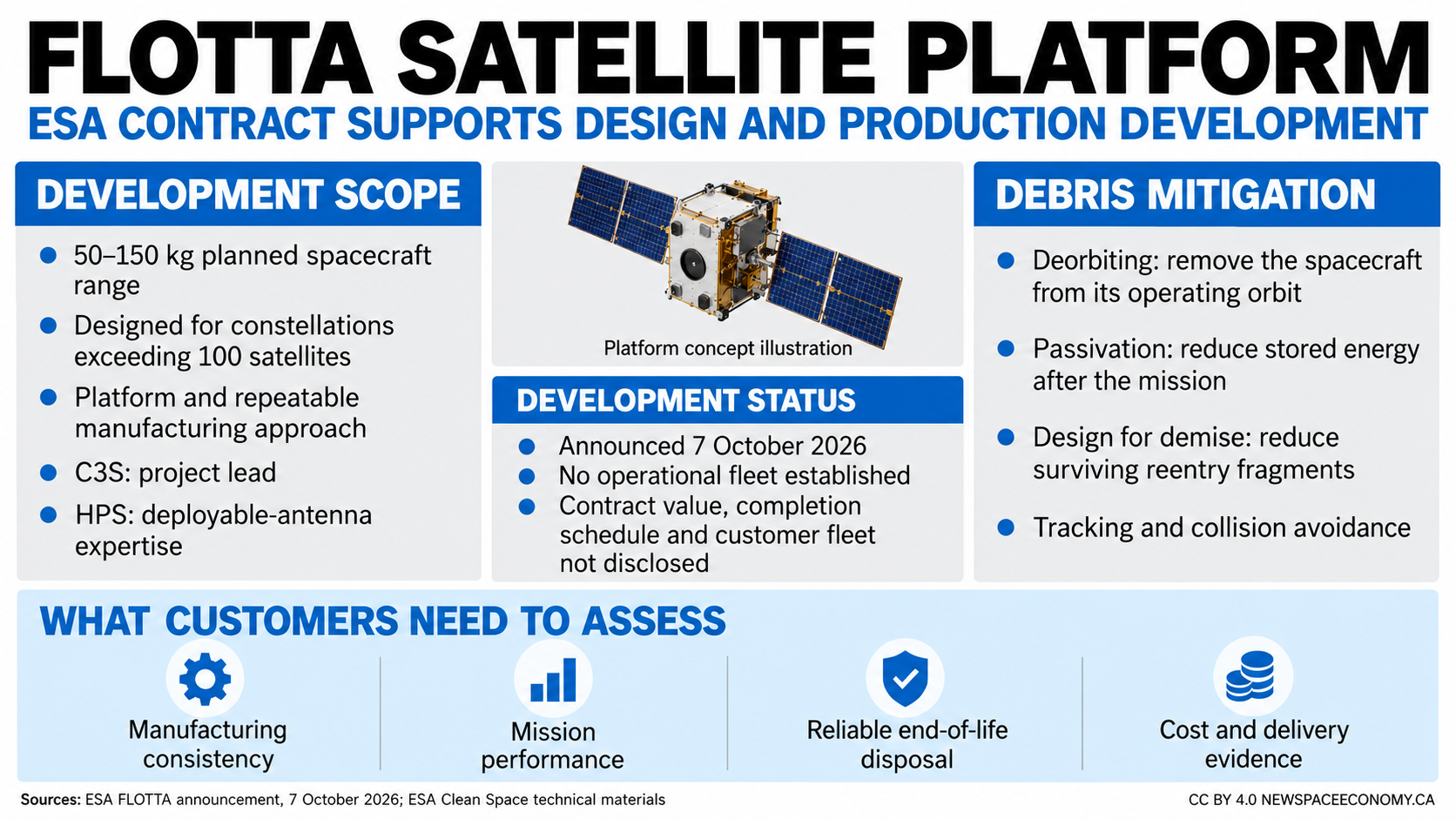
The European Space Agency announced on October 7, 2026, that Hungary’s C3S would develop FLOTTA, a microsatellite platform intended for communications constellations. The planned spacecraft range is 50–150 kilograms. The contract also covers an approach to manufacturing and deployment for fleets exceeding 100 satellites, combining the satellite design with provisions for repeatable production.
The project addresses two requirements that affect constellation suppliers: producing consistent spacecraft in quantity and managing what happens when those spacecraft stop operating. ESA identifies disposal, passivation, tracking, collision avoidance, and atmospheric breakup among the intended capabilities. Germany’s HPS will contribute deployable-antenna expertise. These are development objectives under a signed contract, not evidence that an operational fleet or a production line at the proposed scale already exists.
A satellite platform, often called a bus, provides the systems that support a mission’s payload. The payload performs the principal task, such as relaying communications. The platform supplies structure, electrical power, temperature control, computing, and the means to orient or maneuver the spacecraft. A reusable platform design can reduce the amount of engineering repeated for each mission, although a customer’s payload and operating requirements still need to be accommodated.
New Space Economy’s review of the satellite manufacturing supply chain explains how constellation production changes the industrial task. Manufacturers must control component sourcing, assembly procedures, software versions, testing, and the documentation connecting a delivered spacecraft to its design. Repeating an assembly process is insufficient if variations between units produce unpredictable behavior in orbit. Consistent production also requires a method for detecting whether a fault affects one spacecraft or an entire batch.
Debris mitigation adds requirements that extend beyond normal service. A satellite must be able to complete disposal activities after years of exposure to its operating environment. Decisions about batteries, propulsion, communications, and onboard control can affect whether that remains possible. This creates a connection between manufacturing quality and orbital behavior: an assembly or component defect that ends a mission can also prevent the spacecraft from executing its intended disposal sequence.
ESA has previously described this engineering problem through its CleanSat work. Its technical explanation separates deorbiting, design for demise, and passivation because they address different hazards. Deorbiting concerns removing a spacecraft from its operating region, including bringing a low-orbit satellite toward atmospheric reentry. Design for demise concerns how hardware breaks apart and burns up during reentry. Passivation concerns the stored energy that could cause an inactive spacecraft to fragment.
Passivation can include releasing residual pressure or propellant and preventing batteries from recharging after their final discharge. The objective is to reduce the possibility of an explosion or other breakup after the useful mission has ended. That requires components and control arrangements that remain functional at the relevant time. It also requires a defined sequence, because a spacecraft cannot keep performing commanded operations after the systems needed to receive and execute those commands have been shut down.
Design for demise presents a different engineering trade-off. Spacecraft hardware must withstand launch and remain functional in orbit, but selected components must also break down sufficiently during reentry to reduce the hazard from surviving fragments. ESA’s materials research identifies mass, shape, melting temperature, and thermal properties as factors affecting survival. Selecting materials for normal operation and selecting them for reentry behavior cannot be treated as unrelated decisions.
Testing is needed to support the corresponding predictions. Computer models estimate how a spacecraft heats, fragments, and loses material during descent, but their results depend on assumptions about component properties and breakup behavior. ESA’s materials-characterization work calls for standardized tests and a database that can improve those calculations. A claim that a platform is designed to break up during reentry does not establish that every component will disappear under every possible entry condition.
Earlier ESA procurement activity shows that this concern extends to communications hardware. In January 2024, the agency described separate work on the reentry behavior of optical communication terminals and on structural joints intended to promote breakup. The terminal work included testing materials and equipment to improve simulations, followed by prototype development. These examples illustrate the need to evaluate individual components as well as the overall spacecraft, without implying that FLOTTA will use those particular technologies.
ESA also published a microsatellite-platform tender in December 2025 that combined debris requirements with production planning. It called for a structure and core electronics design, an engineering model, a deployment system, and product and quality assurance plans. Its stated target was technology readiness level four, a laboratory-validation stage. That earlier procurement description supplies context for the agency’s development approach; the October FLOTTA announcement does not independently confirm a current readiness level for the contracted platform.
FLOTTA falls within ESA’s Advanced Research in Telecommunications Systems program and its Industrial Competitiveness activities. The program supports technology and product development intended to improve European suppliers’ ability to compete. Such support can reduce the development burden before a company has secured a large customer order. It does not remove the need to demonstrate that a resulting product meets a purchaser’s performance, price, schedule, and operational requirements.
For constellation buyers, the commercial value would depend on evidence that the design can be manufactured reliably and operated within mission constraints. A platform that simplifies disposal could still require compromises in payload capacity, power allocation, or the resources reserved for end-of-life operations. Those trade-offs need project-specific data. The public announcement does not provide a unit price, production rate, contract value, completion schedule, or committed customer fleet from which to calculate a commercial advantage.
The contract gives C3S a defined development task and establishes debris mitigation as part of the platform and manufacturing work. Its practical result will depend on the verified design, test evidence, and production capability that emerge. Buyers will need those results to judge whether FLOTTA can reduce their integration and disposal burden at an acceptable cost. Until that evidence is available, the supported conclusion is that ESA has funded development of a constellation-oriented platform, with its operational and commercial performance still to be established.
