
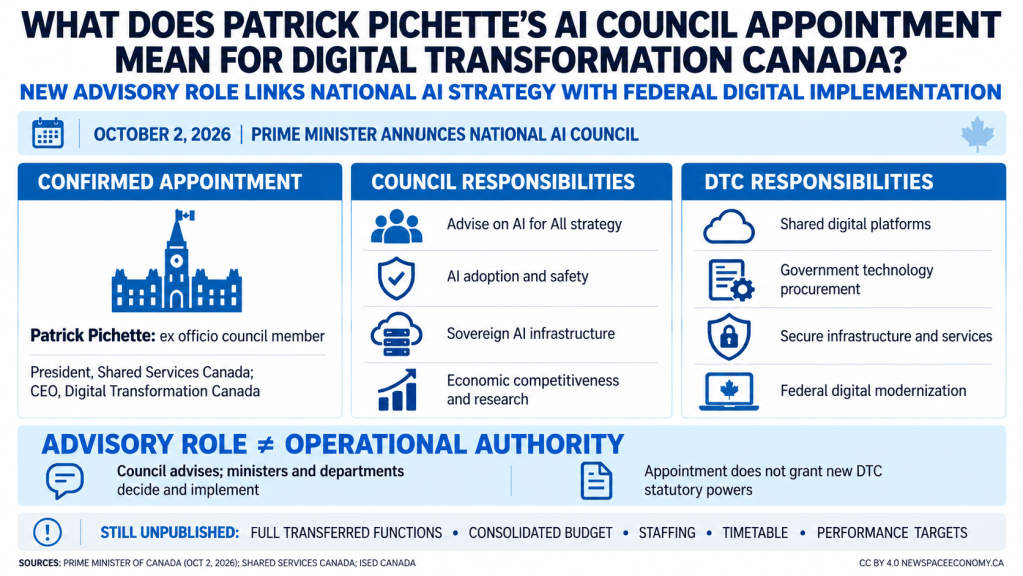
On October 2, 2026, Prime Minister Mark Carney announced the establishment of the Prime Minister’s National Council on Artificial Intelligence, naming Patrick Pichette, Chief Executive Officer of Digital Transformation Canada, as an ex officio member. The appointment establishes a formal connection between the federal government’s new national AI advisory body and the organization responsible for coordinating important elements of federal digital modernization. It does not grant Digital Transformation Canada additional legal authority over government AI policy or departmental operations.
According to the Prime Minister’s official announcement, the council provides independent advice on implementing and developing Canada’s national artificial intelligence strategy, AI for All. Its responsibilities include AI adoption, economic competitiveness, public-sector modernization, research, safety, governance, and sovereign infrastructure. The council will receive administrative support from the Privy Council Office. Ministers and departments will remain accountable for policy decisions and implementation.
The appointment follows the September 3 announcement establishing Digital Transformation Canada. The organization brings together Shared Services Canada, the Canadian Digital Service, and selected functions from the Treasury Board of Canada Secretariat and Public Services and Procurement Canada. Its mandate includes improving government services, expanding common digital platforms, supporting public servants with modern technology, and using federal procurement to help Canadian digital and AI companies develop commercial opportunities.
Pichette occupies two related federal leadership positions. A September 2 Governor-in-Council order appointed him President of Shared Services Canada, styled as Chief Executive Officer of Digital Transformation Canada, effective September 9. The appointment order establishes his formal administrative position under the Shared Services Canada Act. His council membership provides an additional advisory responsibility without changing that appointment or the existing accountability of responsible ministers.
The National Council on Artificial Intelligence includes researchers, entrepreneurs, investors, business leaders, and specialists in technology governance. Its announced membership includes Yoshua Bengio, Ajay Agrawal, Sanja Fidler, Gillian Hadfield, Jody Thomas, and other Canadian experts. Pichette participates ex officio, meaning his membership is associated with his government position. His participation connects the council with an organization responsible for delivering enterprise technology services and implementing government digital initiatives.
This connection is relevant because Canada’s AI for All strategy addresses several subjects within Digital Transformation Canada’s mandate. The strategy identifies six policy areas: protecting Canadians, developing AI skills, increasing adoption, establishing sovereign infrastructure, supporting Canadian technology companies, and building international partnerships. It also proposes using government procurement to help Canadian AI companies obtain customers and demonstrate their products.
Digital Transformation Canada could contribute to implementing these objectives through common technology platforms, infrastructure modernization, software procurement, and government-wide AI services. Federal departments currently operate under different program requirements, technology environments, and administrative responsibilities. Common platforms may reduce duplicate procurement and maintenance activities, although departments will continue to require specialized systems for particular programs. The government has not published a complete allocation of these responsibilities between DTC and departmental chief information officers.
The council’s advisory mandate could help identify priorities for shared AI infrastructure and government procurement. Recommendations concerning secure computing capacity, Canadian-controlled technology, common standards, and public-sector AI adoption could inform decisions made by responsible departments. However, the council does not have announced authority to direct DTC expenditures, approve procurement contracts, require departmental participation, or establish binding technology standards.
The distinction between advice and implementation is important for public accountability. The council can recommend policy changes and identify opportunities for coordinated action. Government organizations must still apply existing legislation, financial authorities, procurement requirements, security standards, and administrative procedures. Recommendations will require decisions by the responsible authorities before they become funded programs or operational requirements.
AI adoption also creates governance obligations. Federal automated decision systems covered by the Directive on Automated Decision-Making are subject to requirements involving risk assessment, transparency, and oversight. The Algorithmic Impact Assessment evaluates the potential effects of automated decisions and helps determine applicable safeguards. Broader AI deployments may also require privacy reviews, cybersecurity assessments, accessibility testing, and records-management controls.
Digital Transformation Canada’s role in technology procurement creates an additional connection with the government’s economic objectives. AI for All identifies the federal government as a potential early customer for Canadian technology companies. Government contracts can provide revenue and operational experience that companies may use when expanding into other markets. Procurement decisions must address technical suitability, security, interoperability, public-sector requirements, and value for money.
The strategy also includes national targets that provide context for the council’s work. The government aims to increase AI adoption among Canadian businesses from approximately 12% to 60% by 2034 and associates its strategy with substantial projected economic and employment benefits. These figures are policy objectives and projections, not completed outcomes. They do not constitute performance targets specifically assigned to Digital Transformation Canada.
Several operational questions remain unresolved. As of October 8, the government has not publicly identified the complete set of Treasury Board and procurement functions transferring to DTC, its separate consolidated budget, full staffing complement, or comprehensive implementation timetable. It has also not announced detailed performance measures for DTC’s AI activities or specified which common AI platforms federal departments will be required to adopt.
The council appointment does not resolve these organizational questions. It provides Pichette with a formal role in discussions about national AI policy, including subjects directly related to federal technology operations. The practical effect will depend on whether advisory recommendations result in authorized investments, procurement changes, shared infrastructure, and measurable improvements in government services.
Pichette’s participation establishes a connection between national AI advice and federal digital implementation without transferring decision-making authority to the council. The next meaningful evidence of its operational influence will be published decisions identifying specific projects, responsible organizations, funding commitments, implementation schedules, and performance measures. Those details will determine how the advisory relationship affects Digital Transformation Canada’s work.
Useful Books Available on Amazon
