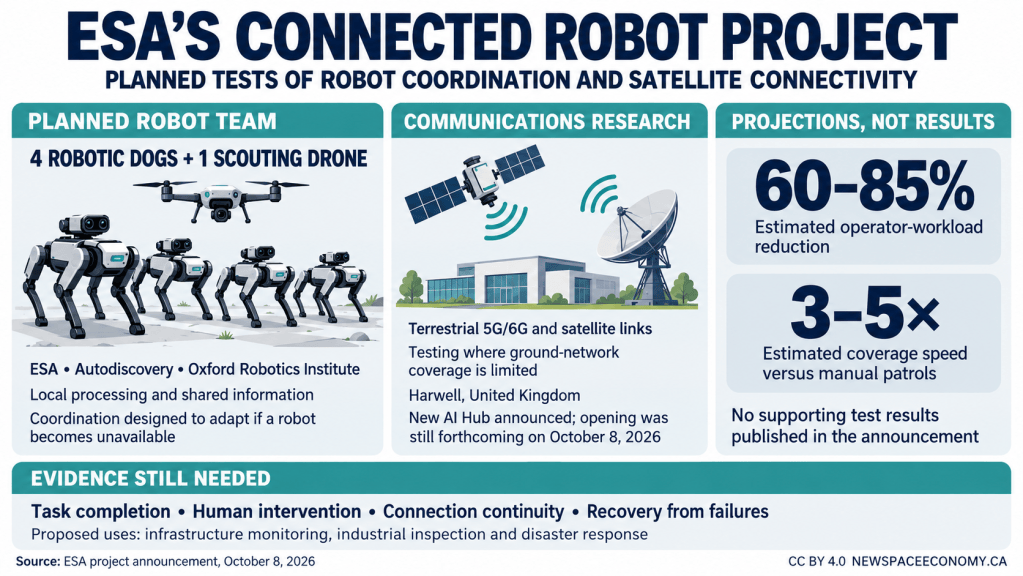
On October 8, 2026, the European Space Agency announced a project with British robotics company Autodiscovery and the University of Oxford’s Oxford Robotics Institute to develop satellite-connected robot teams. The planned system combines four robotic dogs and a scouting drone with local computing and terrestrial and satellite communications. Its immediate purpose is to investigate coordinated operations where communications coverage and working conditions can vary.
The project connects ESA’s telecommunications work with practical questions about industrial automation. A robot may navigate independently yet still need to exchange observations, receive revised instructions, or request human assistance. Testing those functions together could help establish where satellite connectivity adds operational value and where local processing remains necessary. The announcement establishes a development effort, rather than a completed commercial service.
ESA identifies its European Centre for Space Applications and Telecommunications at Harwell, England, as the project’s institutional setting. The agency said a new AI Hub would open shortly to support research, testing, and demonstrations. That wording matters: the October 8 announcement does not establish that the new facility was already operating. The project will complement an existing communications test environment.
ESA’s 5G/6G Hub already provides a private 5G network with satellite connectivity, engineering support, and facilities for demonstrations. Developed with information technology company CGI, it supports the integration and verification of communications equipment and applications. Bringing robots into this environment gives engineers a physical application against which to assess network behavior. A successful connection alone would not establish that a moving robot can complete an inspection reliably.
Autodiscovery describes itself as a mobile-robot systems integrator. Its published offerings include autonomous inspection, security patrols, and platforms for difficult terrain. That business position helps explain its role in the project: integration involves making the robot, sensors, software, and communications function as a usable system. The company’s existing product descriptions should not be read as evidence that the announced collaborative architecture has already passed field trials.
The planned division of computing is also relevant. Edge processing means analyzing information on or near the machines collecting it, rather than sending every measurement to a distant server. Local processing can support immediate decisions; communications can carry selected observations, shared maps, and instructions. The useful engineering question is which information must travel, how quickly it must arrive, and what the robot should do when it does not.
ESA proposes distributed coordination so the group can adapt when an individual robot becomes unavailable. In practical terms, assessing that proposal requires more than showing several machines moving simultaneously. A meaningful trial would examine whether unfinished work is reassigned, whether other robots recognize the missing unit, and whether the group avoids conflicting instructions. These are evaluation questions arising from the proposed architecture, not published project results.
Satellite connections introduce additional choices. A link can connect a remote site to an external control center without carrying every local exchange between machines. New Space Economy’s examination of satellite connectivity for remote mining describes this distinction between external communications and on-site control. The same distinction is useful here, although the Harwell announcement does not disclose a finalized network layout or identify a satellite-service provider.
Traffic also differs by purpose. A status message, a map update, and a live camera feed impose different demands on a network. Engineers need to decide what receives priority during restricted connectivity and what can wait. For prospective customers, the relevant outcome is continued, predictable operation under those conditions. An advertised network generation or headline data rate would not answer that operational question on its own.
The strongest near-term use cases described by ESA concern infrastructure monitoring, industrial inspection, and disaster response. Each creates different acceptance criteria. A patrol application would need evidence about missed events and unnecessary alerts; an inspection application would need repeatable observations; emergency work would require performance under conditions that may differ from a prepared test site. These examples explain why a single demonstration cannot establish suitability for every proposed market.
Human involvement remains part of that assessment. David Mindell’s research on robotics, described by MIT, examines how people remain involved in systems often characterized as autonomous. For the Harwell project, an informative workload comparison would include setup, supervision, intervention, maintenance, and recovery. Counting only minutes spent directly steering a machine could leave substantial operating work outside the comparison.
ESA reports project estimates of a 60–85% reduction in operator workload and coverage three to five times faster than traditional manual patrols. These figures are projections. The announcement provides no accompanying test protocol, dataset, or explanation of how the comparison was calculated. Any later evaluation would need to specify the patrol area, staffing baseline, detection requirements, environmental conditions, and tasks included in the workload calculation.
Safety and cybersecurity require similar specificity. Shared information is useful only if the robots and operators can judge whether it is valid and sufficiently recent. Testing should examine lost connections, inconsistent observations, unauthorized commands, and recovery after interruption. The announced emphasis on auditable software offers a basis for scrutiny, but access to software alone would not establish safe behavior in every operating environment.
The commercial assessment is broader than the number of robots supervised by one person. Potential buyers would need to compare equipment, communications, maintenance, training, and integration costs with the work completed. They would also need evidence that automated coverage preserves the required inspection or security quality. Expressed interest from prospective users can help define requirements, but it does not establish a purchase commitment or an economically viable deployment.
The project’s relevance to space exploration remains prospective. Testing communications and coordination on Earth can reveal problems worth investigating for remote missions, but it does not qualify these machines for another planetary environment. For ESA and its partners, the next useful evidence would be documented trials showing task completion, human intervention, communications continuity, and recovery from failures. Those results would allow customers to assess whether satellite connectivity improves the operation of a robot team under defined conditions.
Useful Books Available on Amazon