
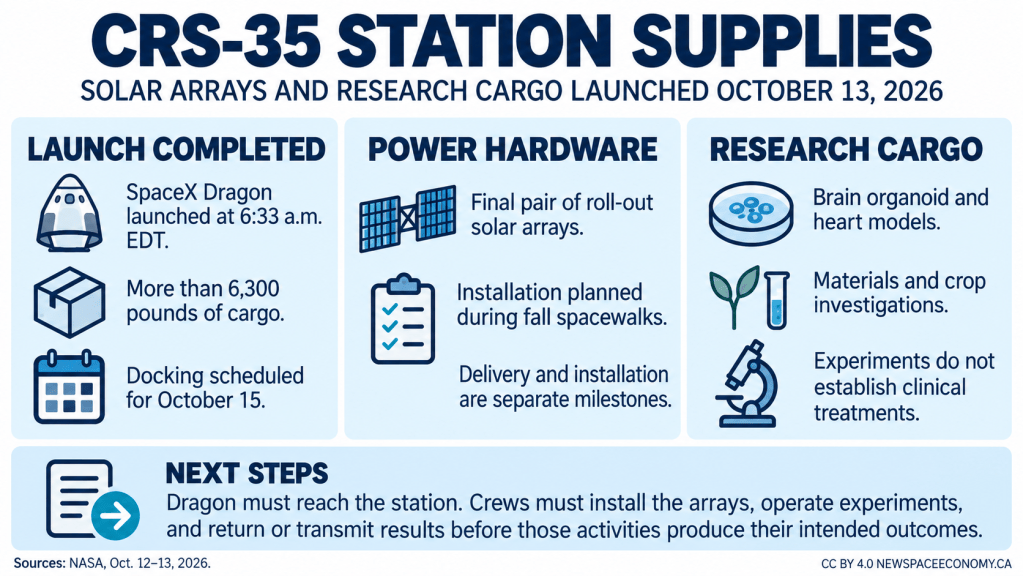
NASA confirmed that CRS-35 launched on October 13, 2026, carrying more than 6,300 pounds of supplies and hardware toward the International Space Station. SpaceX’s Falcon 9 lifted off at 6:33 a.m. EDT from Cape Canaveral Space Force Station. Dragon’s cargo includes the final pair of station roll-out solar arrays, connecting an infrastructure upgrade with the laboratory’s continuing research operations.
The launch confirmation establishes departure from Earth, not delivery to the station. NASA scheduled autonomous docking at Harmony’s space-facing port for October 15 at 11 a.m. EDT. Installation of the new arrays is planned during spacewalks later in the fall. Those later steps remain necessary before the hardware can contribute electricity to station operations.
Electrical power connects almost every part of a crewed orbital laboratory. Experiments require controlled conditions, instruments need electricity, and the station’s supporting systems must continue functioning during research. The arrays are infrastructure serving those activities. Their value is measured through usable power and continued operations, rather than through their presence aboard a launched cargo vehicle.
NASA’s solar-array background explains why augmentation became necessary. The station’s original arrays were installed in successive groups beginning in 2000. They continued operating beyond their original design life, but their output degraded with exposure to the space environment. Adding more efficient arrays provides additional generation without replacing the entire original power architecture.
The roll-out design also has a development history. A smaller version demonstrated deployment on the station in 2017 before the larger station arrays were introduced. NASA’s historical description identifies the use of existing sun tracking and power-distribution infrastructure. That approach makes the new equipment part of an established electrical system, with the associated requirement to install and connect it correctly.
The first installation campaigns provide practical context for the remaining work. In ESA’s account of the 2021 installations, the arrays traveled in a rolled configuration. Astronauts moved them to their worksites, secured them, made connections, and unfurled them. Compact transport and deployed operation are different configurations, which explains why successful launch alone cannot establish power-system performance.
Solar generation also has to support periods when the station is outside direct sunlight. NASA’s battery-system documentation describes the basic sequence: arrays charge batteries during illuminated portions of an orbit, and stored energy supplies electricity during eclipse. The relevant system includes generation, storage, and distribution. An increase in available sunlight-generated power is only one part of maintaining continuous service.
This provides a useful distinction between power and energy. Power describes the rate at which electricity is supplied or consumed. Stored energy determines how long a battery can support a load under specified conditions. The station’s operating plan has to account for both, rather than treating the rated output of an array as electricity available at the same level throughout every orbit.
CRS-35 also carries research hardware and materials. NASA lists artificial-retina manufacturing, three-dimensional heart-tissue models, glass-formation research, and brain organoids among the cargo. These are investigations with proposed applications. Their presence on the flight does not establish a medical treatment, a successful manufacturing process, or a commercial product.
A separate NASA research overview describes small laboratory-grown brain models that will spend five weeks in space and be compared with matching models on Earth. The comparison is intended to examine cellular responses to a short spaceflight. Such models allow a defined biological question to be studied, but they do not reproduce every feature of a complete human brain.
The research package also includes a crop-disease investigation comparing infected plants grown on Earth and aboard the station. Another experiment tests a compact microplate reader’s ability to measure biological markers. Onboard analysis could reduce the need to wait for samples to return to Earth. NASA describes these as research objectives and tests of capability, rather than established operational medical procedures.
Microgravity provides a physical reason for conducting experiments in orbit. NASA’s materials research guidance explains that it greatly reduces buoyancy-driven convection, sedimentation, and hydrostatic pressure. Removing or reducing those effects can help researchers isolate processes that are difficult to examine under ordinary laboratory conditions.
For materials work, convection is the movement of fluid associated with differences such as temperature and density. Sedimentation is the settling of material under gravity. Both can influence how a sample develops. Studying a process with those effects reduced can improve scientific understanding even when the eventual manufacturing process remains on Earth.
NASA’s physical sciences research description connects orbital experiments with fundamental investigations of fluids, materials, and related phenomena. Scientific value can come from better models or measurements, rather than immediate production of goods. A flight experiment must still produce interpretable data and survive comparison with its controls before an application can be assessed.
The value of an investigation can also extend beyond the team that first flew it. NASA’s Physical Sciences Informatics system makes research data available for further analysis. A well-documented experiment can support later comparisons, revised models, or questions that were not the original focus. That depends on retaining information about the sample, apparatus, and conditions of the measurement. The transportation mission enables collection of the evidence, but the scientific contribution continues through the interpretation and reuse of the resulting data. This separates the date of a cargo launch from the much longer process of establishing a research result.
New Space Economy’s history of the space station describes how construction, maintenance, logistics, and research developed together. That relationship continues in CRS-35. The mission carries equipment that supports the laboratory and experiments that use it, with both dependent on transportation and the crew’s available working time.
The next observable milestone is Dragon’s arrival, followed by cargo handling and the scheduled activities for each payload. Solar-array installation will establish whether the delivered hardware has become functioning infrastructure. Research results will require later analysis. CRS-35’s completed launch enables those next stages, but the mission’s practical outcomes will be established through delivery, installation, operation, and evidence from the investigations themselves.
