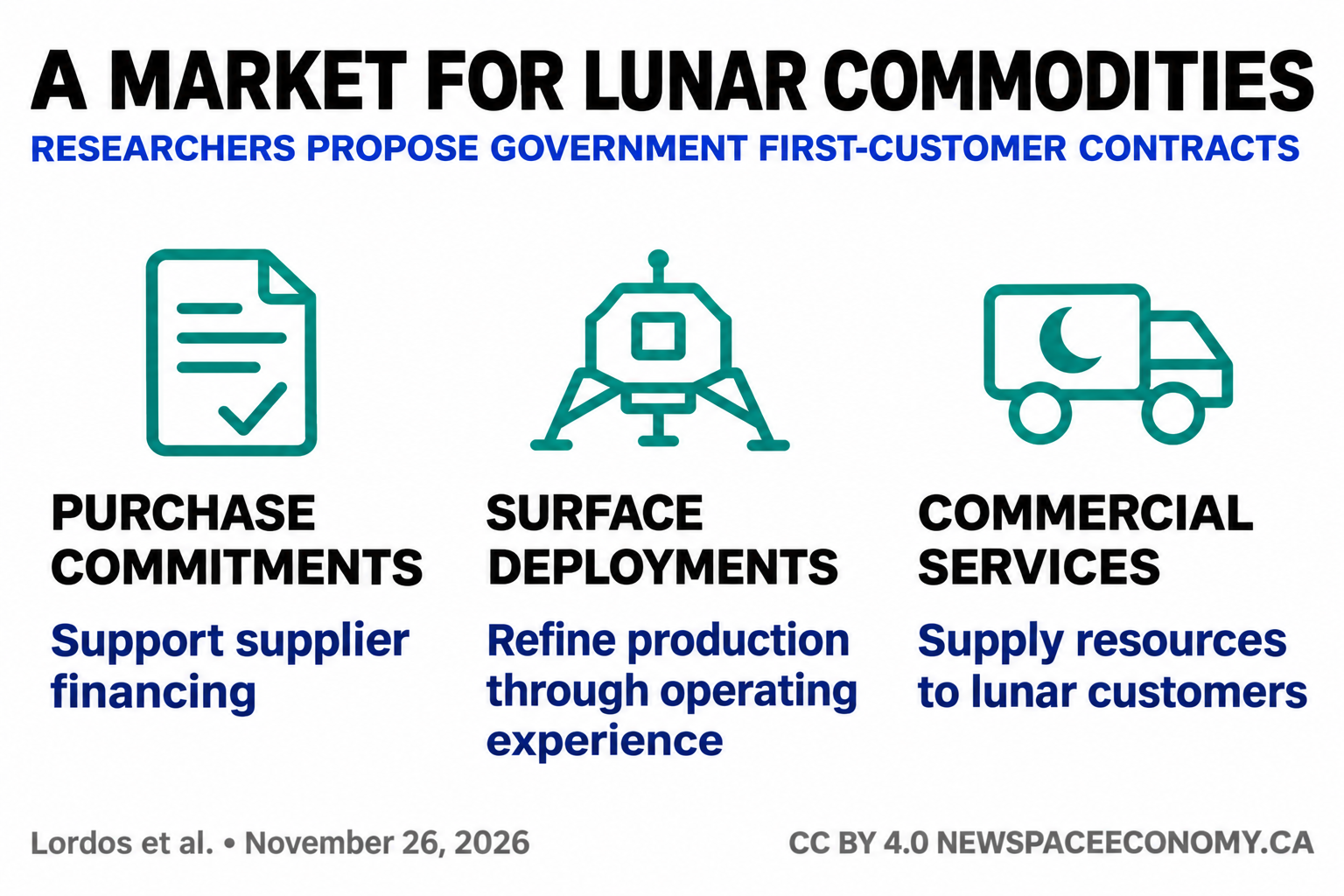
Researchers led by George Lordos proposed government first-customer contracts as a means of developing lunar commodities in a paper published November 26, 2026. The Space and Planetary Resources study describes a service model in which commercial operators produce resources for customers on the Moon.
The proposal connects advance purchasing with prospecting and repeated surface deployments. The authors argue that binding purchase commitments could help suppliers finance equipment before a larger customer base develops. They place responsibility for government demand within NASA’s Moon Base program and envisage commercial ownership and operation of production infrastructure.
Their analysis uses historical comparison and a review of resource-development literature. It examines the production chain from prospecting through processing and recycling, including useful heat. The proposed operating approach uses lessons from successive lunar deployments to refine equipment and services.
The Customer’s Location Changes the Product
A lunar customer purchases material at a different point in the transport chain from a customer on Earth. Oxygen produced near a lunar installation could substitute for oxygen shipped there. Returning a product to Earth adds a departure from the Moon, transportation, atmospheric entry, and recovery.
New Space Economy’s coverage of lunar mining return markets explains this distinction. Local consumption competes with deliveries from Earth; an exported product competes with terrestrial supplies at its destination. A resource’s geological abundance and its delivered commercial value describe different things.
A purchase agreement also specifies more than a substance’s name. Quantity, quality, delivery location, and timing define the product that a buyer accepts. Equipment production capacity describes an earlier stage in that transaction. Material can require separation, storage, or transport before it meets a customer’s specification.
NASA’s resource utilization program addresses these physical steps through technologies for excavation, drilling, processing, transportation, and storage. Its targeted products include oxygen and drinkable water, with applications in life support, propulsion, and fuel cells. In situ resource utilization means obtaining and using resources at the exploration destination.
A Ground Test Demonstrates an Extraction Step
NASA reported a molten regolith electrolysis test at Kennedy Space Center with Houston-based Lunar Resources Inc. Researchers placed about 25 kilograms of simulated lunar material in the company’s extraction reactor and heated it to approximately 1,700 degrees Celsius inside a vacuum chamber.
An electric current passed through the molten material separated oxygen from metals. The team measured and collected molecular oxygen. The chamber reproduced lunar vacuum pressure, allowing the experiment to investigate the process under a relevant environmental condition on Earth.
This method links electrical energy with production of a useful consumable. Heating melts the feedstock; electrolysis separates chemical constituents. The experiment’s input was simulated regolith, and its reported output was collected oxygen from the ground test.
NASA said analysis of the test data would help characterize the thermal and chemical behavior of larger reactors. The chamber and reactor can also be modified for additional environmental testing. Those measurements connect an individual extraction process with the equipment design needed to operate it at a larger scale.