
Key Takeaways
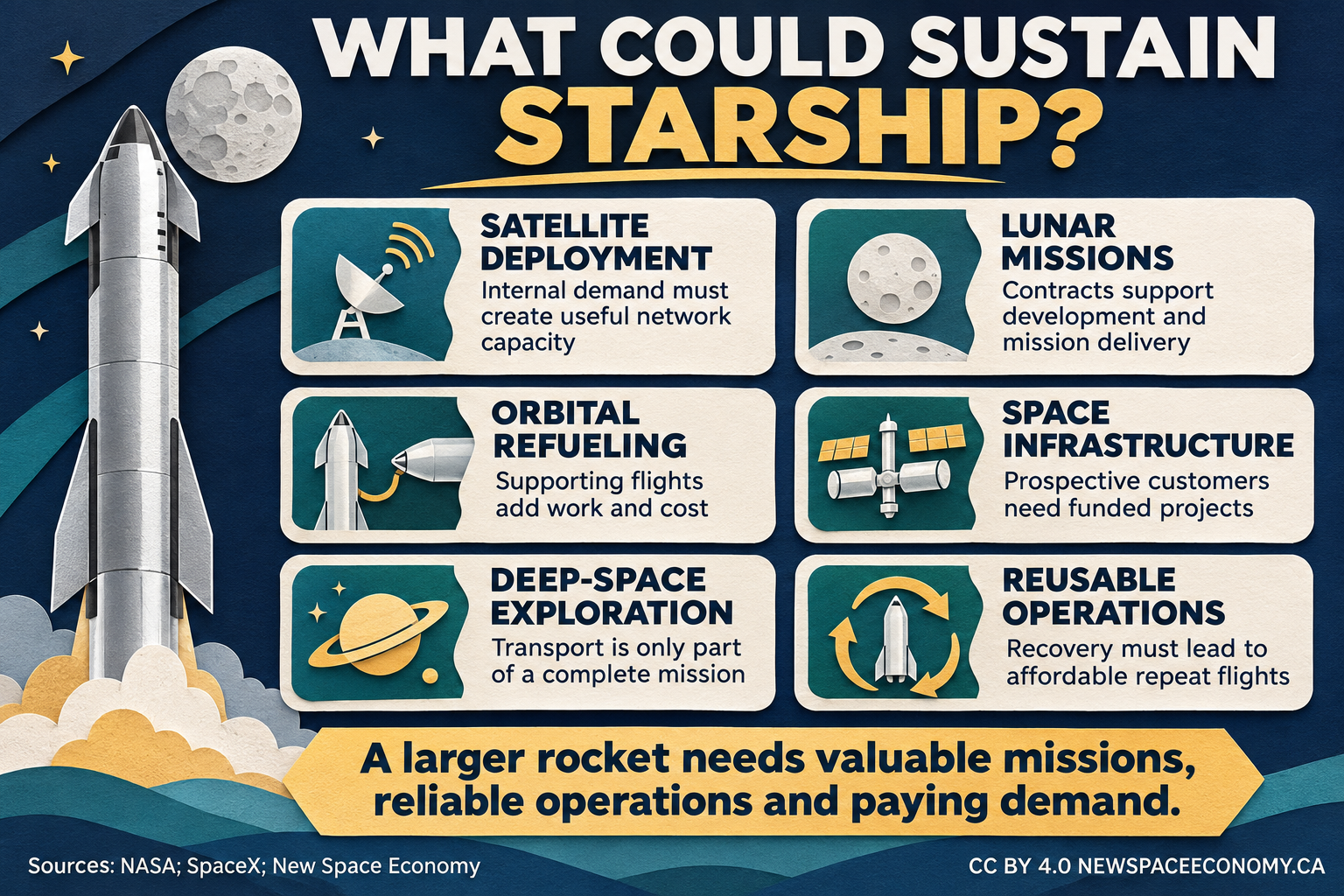
- Starlink can support repeated Starship use when deployment adds valuable communications capacity.
- Lunar contracts fund defined work; supporting tanker flights are costs within the mission campaign.
- Proposed infrastructure and exploration markets need funded projects before they become firm demand.
A Starship Business Case Built Around Delivered Missions
NASA’s October 23, 2026, lunar lander update describes real development work for two commercial lunar landers. It also states that neither provider has an assigned Artemis lunar landing mission under the realigned contracts. Selection will depend on readiness. The distinction captures a central issue in the Starship business case: a funded program can support development without guaranteeing a particular flight assignment or a lasting volume of commercial business.
A large rocket becomes economically useful when its capabilities match missions that someone can support financially. Payload capacity is one input. Delivery destination, reliability, launch timing, spacecraft compatibility, and the customer’s ability to pay determine whether that capacity has practical value. A vehicle can offer an impressive maximum load and still face a shortage of suitable payloads for a specific departure.
Starship’s prospective demand falls into several economically different categories. SpaceX can use transportation internally to expand Starlink. Government agencies can purchase development milestones or mission services. Independent satellite operators can buy deployment. Proposed orbital facilities and exploration programs could become customers if their technical and financial plans mature. Combining these categories into one total would obscure differences in certainty, timing, and the source of payment.
The relevant unit of analysis is usually the completed service. For a communications network, it may be useful capacity delivered to the right orbit. For a lunar program, it may be a lander delivered, fueled, tested, and ready for its mission. For a scientific expedition, it may be an instrument placed on an appropriate departure path. Counting launches alone treats supporting work and final customer outcomes as though they were interchangeable.
New Space Economy’s explanation of the launch services business model provides a useful framework for that distinction. The customer buys a transportation outcome with defined responsibilities. Payload mass matters, but a contract also has to address interfaces, acceptance, delivery conditions, and the consequences of delay.
This creates two separate tests for Starship. The first is whether particular missions can justify using the vehicle. The second is whether enough such missions can support the broader system, including factories, launch sites, engineering, maintenance, and replacement hardware. A successful mission can satisfy the first test without resolving the second. Conversely, valuable development work may occur before a stable commercial operating model emerges.
Assessing the business case requires evidence at several levels. Demonstrated capabilities establish what the system can do. Contract terms establish what an outside customer has purchased. Internal network economics establish whether SpaceX benefits from using its own transportation. Proposed applications establish possibilities, but they should not be treated as committed demand simply because a larger vehicle could carry them.
Starlink Connects Launch Capacity to Communications Revenue
SpaceX’s June 2026 prospectus identified Starship as an enabler for its next-generation Starlink satellites. It also distinguished low Earth orbit deployment from missions needing orbital refueling, stating that its planned satellite deployments did not require refueling or full upper-stage reuse. These are useful distinctions between the company’s stated development objectives and the different capabilities individual services require.
An internal satellite network changes the problem of finding a customer. SpaceX can coordinate spacecraft design, manufacturing, launch preparation, and network expansion within one organization. It does not need an independent operator to approve every commercial decision. New Space Economy’s Starlink market analysis places this internal demand within the broader business of providing communications services.
The ultimate source of value remains outside the launch operation. Customers pay for connectivity that meets their needs. Launching additional satellites is worthwhile when those satellites improve service, support paying users, replace aging equipment, or otherwise contribute enough value to justify their full cost. An internal transfer payment between business units does not itself create additional revenue for the consolidated company.
A larger deployment batch could reduce the transportation effort needed to add a given amount of network capacity. It could also permit spacecraft designs that would be inconvenient or impossible to accommodate on a smaller vehicle. Those benefits depend on successful integration and on the satellites delivering useful service. Capacity that cannot be sold or used effectively offers less economic benefit than its nominal technical rating suggests.
There is also a timing tradeoff. Waiting to accumulate a large satellite batch may improve utilization of a launch, but it can delay the availability of communications capacity. Sending a smaller batch earlier may be economically when the resulting service revenue or congestion relief outweighs the transportation saving from waiting. The best decision depends on network needs rather than on filling every available kilogram.
Internal demand can give a developing launch system work on a schedule that is more flexible than some external customer programs. It can support learning across repeated missions and expose integration problems before a broader customer base depends on the service. The associated risk remains real: a launch loss can destroy satellites and postpone network improvements even when both payload and rocket belong to the same company.
Starlink offers a plausible foundation for repeated Starship use, but it does not remove the need for financial discipline. The meaningful comparison is the total cost of expanding or maintaining the network through alternative approaches. That includes satellite production, deployment, operations, replacement, and the commercial value of the service delivered. A lower launch cost is beneficial when it improves that combined result.
Lunar Contracts Support Campaigns With Multiple Dependencies
NASA’s revised plan calls for tanker Starships to deliver cryogenic propellant to a depot that would fuel the lunar lander. The lander would meet Orion in Earth orbit before departure for the Moon. Both providers must complete uncrewed demonstrations before crewed lunar missions. These are planned mission arrangements, not evidence of an operating lunar transportation service.
New Space Economy’s coverage of the revised lunar mission architecture explains how changes in the rendezvous location alter the overall mission. From a business perspective, the important implication is that transportation has to be assessed as an integrated campaign. A lander flight cannot be evaluated independently of the supporting work that makes the mission possible.
A campaign involving several launches can generate substantial operational activity. That activity should not automatically be counted as a separate market for every launch. If a customer pays for a lunar service and the provider needs supporting tanker flights to deliver it, those flights are inputs to the contracted outcome. Their cost has to fit within the economics of that outcome unless another agreement provides additional payment.
Propellant transfer adds scheduling and coordination requirements. Hardware must arrive in compatible orbits, connect successfully, and preserve sufficient usable propellant for the next stage of the mission. A delay in one element can affect the value or availability of another. The economic concern is broader than the cost of the propellant itself: it includes the resources committed across the campaign.
Development contracts can help pay for capabilities that an ordinary launch customer would have little reason to finance. Demonstrations, testing, documentation, and verification can produce knowledge useful beyond one mission. They also consume engineering effort and facilities. Development revenue and revenue from a repeatable transportation service should be evaluated separately because the deliverables and cost patterns differ.
NASA’s Office of Inspector General reported in its March 2026 HLS review that the agency had controlled contract costs and collaborated effectively with providers, but development challenges would delay planned Artemis dates. That historical assessment illustrates why a contract award should not be read as proof that delivery risk has disappeared. Subsequent architecture changes must be considered when interpreting earlier schedules.
For Starship, lunar work can provide an institutional customer with a purpose that differs from satellite deployment. It can also create demand for specialized spacecraft capabilities. Whether it supports a sustained production and flight rate depends on future mission purchases, execution costs, and the availability of supporting systems. A national exploration objective gives the program significance, but it does not establish an unlimited budget or a guaranteed series of profitable flights.
Larger Payloads Need Customers Ready to Build Them
A larger rocket can change spacecraft design choices before it changes the number of customers. A satellite or orbital structure constrained by launch mass and volume may require folding mechanisms, lighter materials, or assembly after arrival. More available room can make alternative designs possible. The economic benefit comes from reducing total project cost or increasing useful capability, not from larger dimensions alone.
These tradeoffs help explain why a simple comparison of advertised cost per kilogram can mislead. A payload may occupy its permitted volume before reaching a vehicle’s mass limit. Its destination may require a different energy level than a standard low Earth orbit mission. Integration equipment, deployment hardware, and mission-specific analysis may affect the service price. Unused theoretical capacity cannot automatically be sold to another customer.
New Space Economy’s Falcon and Starship comparison provides context for the different roles of SpaceX’s launch systems. Moving a customer to a larger vehicle involves more than exchanging one quoted lift capacity for another. The payload must be compatible with its environment and deployment arrangements, and the customer must accept the schedule and risk attached to the chosen service.
Prospective space stations, manufacturing facilities, and other orbital infrastructure could benefit from larger deliveries. Their demand still depends on complete projects. A station requires systems and users after launch; a factory requires a product, a production process, and a buyer. Transporting the equipment is a necessary step for these concepts, but it cannot establish whether their operations will earn enough revenue.
This produces a coordination problem. A spacecraft developer may hesitate to commit to a design that requires a particular launch capability before that service is dependable. The launch provider may want committed spacecraft customers before expanding facilities. Contracts, demonstrations, shared technical work, and staged investment can reduce this uncertainty, but the existence of a conceptual payload does not resolve it.
Large payloads can also concentrate risk. Combining hardware in one flight may reduce repeated integration work and avoid some assembly operations. It also places more of a project’s equipment on a single launch. Splitting a project across flights can provide flexibility, although it may introduce docking, assembly, or commissioning costs. Neither approach is universally preferable.
The strongest evidence of infrastructure demand would include funded spacecraft development, defined interfaces, a realistic delivery schedule, and a business or public-service purpose that survives scrutiny after transportation is included. Announced concepts can be valuable indicators of interest. They belong in a different category from projects that have financed their hardware and committed to a launch service. Starship could expand the feasible design space, but customers must still convert that space into executable programs.
Deep-Space Exploration Requires More Than Transportation
Deep-space exploration offers compelling uses for greater delivery capacity. Scientific instruments, propulsion systems, shielding, communications equipment, and power supplies all compete for a mission’s mass allowance. More transportation capability can permit a different balance among those elements. It can also support sending additional equipment rather than relying on one compact and highly optimized spacecraft.
The financial benefit depends on the mission architecture. A heavier spacecraft is not necessarily cheaper, and a cheaper launch does not automatically reduce the cost of its instruments or operations. Engineering teams still have to solve problems associated with the destination, travel time, operating environment, and data return. Transportation can remove one constraint without removing the others.
Publicly funded science also follows a different demand process from consumer communications. A research mission has to compete for institutional support and resources. Its value may be measured in scientific knowledge rather than commercial revenue. Even a technically attractive launch option does not create an unlimited sequence of approved missions, because spacecraft development and mission operations require their own funding.
A similar distinction applies to Mars. Delivering cargo is part of any sustained presence, but power generation, habitats, life support, maintenance, and local operations would require additional systems. Crewed missions would add medical and human-performance requirements. A transportation proposal cannot be treated as a complete settlement business plan, and the possible need for many future cargo flights is not equivalent to signed orders.
The challenge extends to replacement and resupply. Equipment at a distant destination must remain useful for long enough to justify its delivery. Its operators need spare parts, trained personnel or autonomous capabilities, and ways to respond when something fails. A mission that can be launched but cannot be maintained has a different value from a dependable service with a credible support plan.
Large-scale exploration could eventually create repeated demand if governments, companies, or other institutions commit resources to sustained operations. Such demand should be described conditionally until the relevant commitments exist. A long-term ambition can guide technical investment without serving as evidence that near-term operating costs will be covered by external customers.
For business assessment, deep-space missions are best separated by their stage of maturity. Funded development work can support specific capabilities. Approved missions can support defined delivery requirements. Preliminary concepts can indicate future options. Treating all three as one market would overstate the certainty of demand and make it difficult to judge how much investment depends on outcomes that remain unresolved.
This does not make exploration commercially irrelevant. It means its contribution has to be traced through the institution that pays, the capability being purchased, and the schedule for delivery. The analysis becomes stronger when a named mission and an identifiable budget replace a general assumption that cheaper transportation will inevitably produce enough activity to support a much larger fleet.
Reuse Must Reduce the Cost of Repeated Service
Starship’s design ambition includes recovering both its booster and upper stage for reuse. The economic question extends beyond recovering hardware intact. A recovered vehicle has to be inspected, prepared, and returned to useful service at a cost and pace that justify retaining it. Recovery is a technical achievement; economical repetition is an operating result.
A reusable fleet exchanges some expenditure on new hardware for expenditure on recovery equipment, maintenance, inspection, and refurbishment. It can also require spare vehicles to keep the schedule moving when one is unavailable. The balance depends on service life, the amount of work between flights, and the consequences of unexpected repairs. A low assumed propellant cost is insufficient to describe that balance.
Fixed costs further complicate the comparison. Factories, launch sites, engineering organizations, and support facilities incur costs that cannot all be assigned to the next flight alone. A high flight rate can spread those costs across more services. It does so only when enough useful missions exist and the operating system can support them without a corresponding increase in costly disruption.
The relationship between flight rate and demand works in both directions. Lower costs can make additional missions attractive, but a provider may need substantial utilization to achieve those lower costs. Early operations can look different from a mature service. Business projections should distinguish an initial period of learning and investment from a later operating assumption that depends on a larger customer base.
Ground infrastructure can limit output even when vehicles are available. Payload processing, propellant handling, launch preparation, recovery, and maintenance must fit into a workable sequence. An improvement in one activity may have little effect if another activity remains the limiting step. This is why the economics of a rocket cannot be evaluated independently of the facilities and people that support it.
New Space Economy’s discussion of vertical integration and competition highlights the tradeoff between coordination and ownership. Bringing more work inside one organization can simplify engineering changes and align priorities. It also means that the organization must fund and manage more assets. Internal control can improve execution without making those assets free.
The practical evidence would be a pattern of repeated service with manageable turnaround work, dependable mission completion, and enough useful demand to sustain the operating system. No single demonstration establishes every element of that pattern. Different missions may also justify different configurations, so an economically useful satellite deployment service need not have the same requirements as a lunar campaign.
This makes the cost of a completed mission more informative than a headline estimate for an ideal flight. A credible assessment includes preparation, supporting launches where needed, vehicle losses or retirement, and the resources tied up in the fleet. It also distinguishes technical targets from measured operating performance rather than treating the target as an already achieved cost structure.
Funding and Customer Diversity Determine Durability
Starship’s potential applications form a portfolio rather than a single homogeneous market. Internal satellite deployment, institutional exploration, external commercial payloads, and proposed infrastructure each have different purchasing decisions. That diversity could be beneficial if their schedules and funding sources complement one another. It offers less protection when several applications depend on the same unproven capability or the same pool of capital.
The distinction between a contract and an option is particularly important. A firm commitment can still contain conditions, acceptance requirements, or cancellation provisions. An option creates a possible future purchase rather than the same certainty as exercised work. A memorandum describing cooperation may establish an intention without financing the complete mission. Public announcements need to be interpreted according to what they actually commit each party to deliver.
Internal demand requires a related discipline. SpaceX can decide to support a new service for strategic reasons even before that service generates sufficient revenue. Such investment may be rational, but it should be identified as investment. Counting the resulting launches as proof of independent customer demand would confuse the company’s spending decision with an external market’s willingness to pay.
Customer diversity can improve resilience when one program slows. Satellite deployment might have a different purchasing cycle from a government exploration campaign. An external operator may need a different orbit or launch date from an internal network. Those differences create opportunities for balancing work, but they also require interfaces, processes, and scheduling arrangements that can serve customers beyond the company’s own projects.
Capital has to arrive on a schedule that supports development and operations. Hardware and facilities may require spending before a mission produces revenue, and delays can lengthen the period before that expenditure earns a return. Customer milestone payments can help, depending on their terms. They do not remove the need to manage cash, delivery obligations, and the consequences of technical changes.
Competition should also be evaluated at the mission level. A customer may choose a smaller dedicated launch, shared transportation, a redesigned spacecraft, or a different deployment schedule. A larger vehicle wins work when its complete offer is attractive for that customer. Its advantage can come from capacity, destination, integration, availability, or price, but no single characteristic answers every procurement requirement.
A lasting business case would show progress across several connected measures: useful internal deployment, completed customer services, repeatable operations, and investments proportionate to credible demand. It would also identify which proposed markets remain dependent on future funding. That approach allows substantial opportunity to be recognized without turning ambition into booked business.
The central commercial test is whether the system can repeatedly deliver outcomes worth more than the resources required to provide them. Different customers can contribute to that result in different ways. Starship does not need every proposed market to succeed, but the markets that do develop must support the actual system SpaceX chooses to build.
Summary
Starship’s business case depends on connecting greater transportation capability to missions with a clear source of value and funding. Starlink offers internal demand tied to communications services. Lunar development contracts provide institutional work with specific deliverables. Independent satellites, orbital infrastructure, and deep-space programs offer additional possibilities whose maturity must be assessed individually.
The important distinctions are between capacity and useful delivery, supporting flights and final customer services, development funding and recurring operations, and proposed markets and committed projects. These distinctions prevent a busy flight schedule or a large theoretical payload from becoming a substitute for economic evidence.
A sustainable operating model would combine dependable missions, affordable repetition, and enough demand to support the associated facilities and workforce. Greater capability can help customers pursue different designs and destinations. Its lasting commercial value emerges when those possibilities become funded, executable missions and useful services.
Appendix: Top Questions Answered in This Article
What Is the Core Starship Business Case?
The business case is that greater transportation capability could deliver useful missions at a cost customers or SpaceX’s own services can justify. Payload capacity alone does not establish that result. Sustainable operations also require dependable delivery, adequate demand, and enough value to support vehicles, facilities, people, and future investment.
Why Does Starlink Matter to Starship?
Starlink provides an internal use for transportation capacity through satellite deployment. SpaceX can coordinate satellite and launch decisions within the same organization, which can simplify planning. The economic benefit still depends on the network delivering useful communications services, because an internal launch does not by itself create additional revenue from outside the company.
Does Every Starship Mission Require Orbital Refueling?
No. In its June 2026 prospectus, SpaceX distinguished planned low Earth orbit satellite deployments from missions requiring orbital refueling. The commercial assessment should match each service to its actual requirements rather than assume that every application depends on the same complete set of capabilities.
What Do Lunar Contracts Establish?
They establish defined work and obligations for the parties, subject to the terms of the agreements. They do not establish unlimited future demand or eliminate technical and schedule risk. NASA’s October 2026 update also made specific lunar landing assignments dependent on provider readiness under its realigned arrangements.
Are Tanker Flights Separate Sources of Revenue?
They are not automatically separate sources of external revenue. When tanker flights are required to deliver a contracted lunar service, they form part of the resources used to produce that service. A separate payment would depend on the relevant agreement, so launch counts alone cannot establish the revenue earned.
Could Larger Payload Capacity Reduce Spacecraft Costs?
It could allow different design choices, including fewer restrictions on mass or volume. Whether those changes reduce total project cost depends on the spacecraft, its destination, and its operating requirements. More available capacity can create options, but those options still require engineering work and a funded mission to produce value.
Why Are Proposed Orbital Facilities Uncertain Customers?
A proposed facility needs more than transportation to become an executable project. It requires financing, suitable equipment, an operating plan, and users or buyers for its services. Launch capability can help make a design feasible, but a concept should not be counted as firm demand before the relevant commitments exist.
Would Lower Launch Costs Guarantee Mars Demand?
Lower transportation costs could help make some mission designs more attractive, but they would not guarantee funding or sustained operations. Mars activities would also need power, habitats, maintenance, communications, and other systems appropriate to their purpose. A long-term transportation ambition should remain distinct from committed customer orders.
Why Is Recovery Different From Economical Reuse?
Recovery preserves hardware that may be used again, but it does not establish how much work is needed before the next useful flight. Inspection, refurbishment, fleet availability, and service life affect the result. Economical reuse depends on repeated operations that justify those costs compared with available alternatives.
What Evidence Would Strengthen the Business Case?
Evidence would include useful internal deployments, funded external missions, completed customer services, and repeatable operations with manageable costs. Investment plans should also be proportionate to credible demand. No single flight or announcement establishes the whole case, because technical capability, customer commitments, and sustainable economics answer different questions.
Appendix: Glossary of Key Terms
Payload
The spacecraft, equipment, cargo, or other useful load carried by a launch vehicle for a mission. Payload is distinct from the rocket hardware needed to transport it, although the precise boundary depends on the service and mission design.
Low Earth Orbit
An orbit around Earth at relatively low altitude, generally below about 2,000 kilometers. Missions in this region have different transportation requirements from journeys to the Moon or planets, so their economics should not be evaluated as though they require identical capabilities.
Cryogenic Propellant
Rocket propellant maintained at extremely low temperatures so that it remains in the required physical state. Storage and transfer require thermal management, making usable propellant delivery a matter of equipment performance and mission timing as well as the amount initially launched.
Depot
A facility or spacecraft used to collect and store supplies for later transfer. In the planned lunar campaign discussed here, a propellant depot would receive deliveries from tanker spacecraft and provide propellant to the lander before its journey.
Mission Architecture
The overall arrangement of vehicles, operations, locations, and supporting systems used to achieve a mission. Changing where spacecraft meet or how they receive propellant can alter schedules, technical requirements, and costs even when the ultimate destination remains the same.
Vertical Integration
An organizational approach in which a company performs several connected production or service activities internally. It can improve coordination and control over interfaces, but it also requires the company to finance, operate, and manage the assets associated with those activities.
[meta keywords=“Starship business case, SpaceX, Starlink deployment, lunar transportation, human landing system, orbital refueling, reusable rockets, launch economics, space infrastructure, deep-space exploration, satellite deployment, mission architecture, launch demand, vertical integration”]
